Showing posts with label greene. Show all posts

Saturday, December 7, 2024

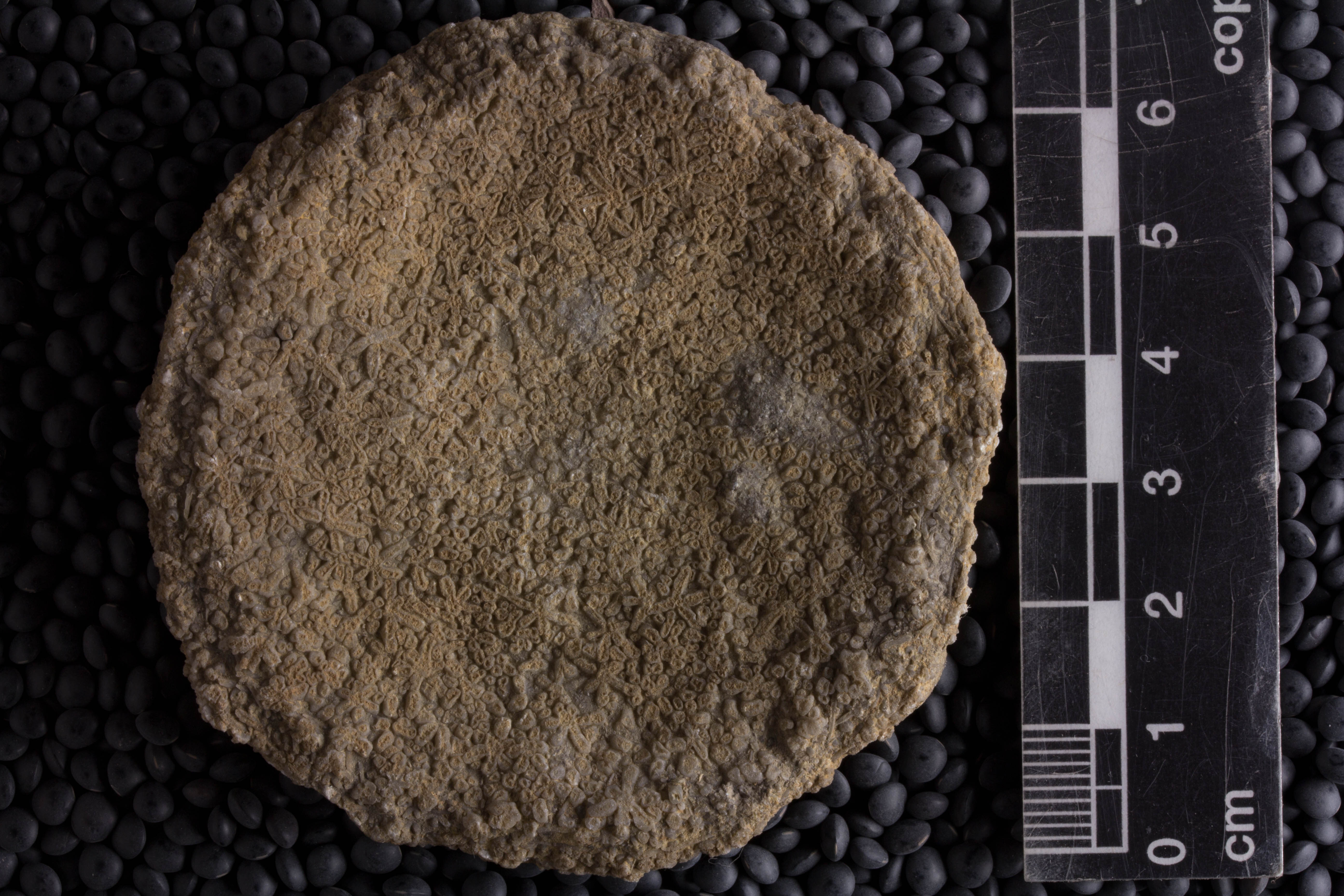
Astraeospongia meniscus Sponge Fossil

Photo by Laura Dykstra. (c) Field Museum of Natural History . CC BY-NC 4.0 https://fm-digital-assets.fieldmuseum.org/1163/578/P21403_fossil.jpg . (accessed on 2024-12-07)
 

While reading the Index Fossils of North America by Hervey W. Shimer & Robert R. Shrock from 1944, I found an interesting reference to Astraeospongia meniscus (Roemer, 1860) porifera fossil. It is listed as being found in Louisville, Kentucky and Brownsport, Tennessee. The creatures lived in the Silurian Period. This entry made me curious as I don't recalling find this fossil in the Louisville area but I have number of these fossils from Tennessee.

The picture above is from Chicago, Illinois, USA Field Museum of Natural History and was once part of the Borden Collection. It is great that the Field Museum is putting pictures of their fossils on-line. This fossil was from the defunct museum of William Borden (1823-1906) of Indiana. The fossil might have been collected by George Greene (1833-1917) who William Borden got a lot of local fossils from. 

This fossil was named by Dr. Carl Fredrick von Roemer (1818-1891) who is famous for his research of fossils found in Texas that he collected during his 1845-1847 visit there.

In his 1860 book, Die silurische Fauna des westlichen Tennessee / Eine palaeontologische Monographie, he talks about Dr. Gerard Troost (1776-1850) whom he visited in 1847 in Nashville, Tennessee. Below is the translation [German to English] of his Preface.

"When I returned from Texas in the summer of 1847 to Nashville, the capital of the state of Tennessee, and found a very friendly welcome and valuable instruction on the geological conditions of the country from Dr. G. Troost, who has made a great contribution to the natural history of the western states, my attention was particularly drawn to the beautifully preserved Silurian fossils in the excellent man's rich paleontological collection, the location of which was indicated as the Perry district (Perry County) in the western part of the state. In addition to the largely known forms of corals and brachiopods, there was a particularly large number of beautifully preserved crinoids, almost all of which were new in terms of species and mostly also in terms of gender, and many remarkable specimens from other animal classes. 

I immediately decided to visit the deposit of this remarkable fossil fauna myself and to gain a better knowledge of it by collecting it myself. Three weeks were spent on this trip, which was not without its difficulties and exertions, given the wild and sparsely cultivated nature of the area in question, but it also yielded a richer yield than I could have hoped for. The area over which the fossils in question are mainly found lies on both sides of the Tennessee River and includes the two districts (counties) Decatur on the left bank and Perry on the right bank'). Although I also visited some sites on the right bank, I collected mainly on the left bank. 

From a point about 5 English miles north of Brownsport, where I was hospitable in the house of Colonel Wallis Dixon, I roamed the entire area between Brownsport and Perryville at leisure and collected all the numerous "glades" hidden in the surrounding primeval forest, i.e. the small hills bare of tree growth and only covered at the top with low bushes of red cedar (Juniperus Virginiana L.), which form the actual sites of our fauna. This is how the collection was created which provided the material for the current work and which, although not necessarily complete, certainly contains the great majority of the species that make up the fauna in general and allows an almost correct picture of the latter to be given. If the publication of the paper dealing with this material has only now taken place, this is only partly due to the obstruction caused by other scientific works, but mainly due to the fact that it was necessary to wait to see whether the description of the organic inclusions in the corresponding layers of the state of New York by James Hall would not make a special description of the fauna of Tennessee unnecessary. 

However, since the publication of the second volume of the "Palaeontology of New York" containing the fossils of the "Niagara Group" has shown that the similarity between this fauna of the state of New York and that of Tennessee is sufficiently great to prove with certainty that the layers containing both faunas were deposited at the same time, but by no means so complete as to exclude the uniqueness of a significant number of species in each of the two faunas, this concern was removed and a description of the fauna appeared desirable.  

What was known about it from other sources was limited to a few incomplete and, given the state of paleontology at the time, unreliable lists of fossils given by Troost in his geological reports on the state of Tennessee, to the mention of a small number of the species that make up the fauna by E. de Verneuil in his valuable essay on the parallelism of the Polaeozoic layers in North America and Europe, and 1) Perry County also used to extend over the area on the left bank of the river, which has since become an independent district under the name Decatur County. In this older, broader sense, Perry County was designated by Troost and after him by other authors as the site where the Silurian fauna in question was found. In fact, the localities that Troost primarily exploited, and in particular the town of Perryville, are located on the left bank of the river in the Decatur district."

On page 2 he talks about the area that Dr. Troost discovered where he found Silurian fossils. Translated from German to English.

"The thickness of the entire sequence of layers cannot be determined in the region in which I have only become acquainted with it through my own observation, in the counties of Decatur and Perry on the Tennessee River, since the underlying layer is nowhere exposed here. Safford, who describes the sequence of layers as "the dyestone and gray limestone group," estimates it to be several hundred feet in the western part of the state, while it is said to be much smaller further east. The outcrop points where Troost first discovered the sequence of layers with its rich fauna and where I also collected the material on which the present work is based are small hills, 50 to 60 paces wide and usually only 10 to 25 feet high, without any trees or only covered with stunted and sparse tree growth on the top, the so-called "Glades," i.e. forest clearings, which are scattered in the primeval forest in the area between Brownsport and Perryville in significant numbers. On the bare slopes of these "glades," the layers, whose largely siliceous nature seems to be hostile to plant growth, come to light and which have been formed from the rock by weathering. dissolved, largely silicified fossils lie freely on the surface. If one is as lucky as I have been several times to find a virgin hill of this type in the dense forest, i.e. one that has not yet been trodden by a paleontological predecessor, then the yield is particularly rich, as the entire result of weathering over thousands of years then falls to the discoverer. "

On page 31, he talks about the unpublished crinoid fossils that Troost had found but laments now that Troost died in 1850 and the Troost names are meaningless. Roemer does realize that James Hall has the Troost manuscript describing them but has not published it. It would not be until 1909 when Columbia University graduate student Elvira Wood (1865-1928) publishes the Troost work after both men are long dead. Translated from German to English.

"Dr. G. Troost in Nashville, who had assembled a rich collection of organic inclusions from the Silurian layers and the carbonate limestone in the state of Tennessee and had devoted particular attention to the numerous crinoids in these older layers, sent the American Association for the Advancement of Science a list of all the crinoids he had known about from the older rocks of the state of Tennessee shortly before his death. This list was first printed in the Proceedings of the American Association. 1849 p. 60, Second Meeting held at Cambridge. Boston 1850. p. 62 and was subsequently included in Silliman's Journal of Sc. and Arts 1849, VIII, p. 419-420, and subsequently in Leonhard and Brown's Jahrbuch für Mineralogie etc. Jahrg. 1850 p. 376-377. It lists 88 species of crinoids and a few asterids and echinids, and gives a significant number of new generic names.  

Unfortunately, any description or diagnosis of the genera and species is missing, and even an indication of the localities and strata to which the individual species belong is missing. It is therefore impossible to determine from this list which species are meant by the various names. Even if, like me, one knows the Troost collection well from one's own examination and, on the other hand, owns specimens of most of the species contained in it, one is unable to determine the meaning of the names contained in that list. For example, I have no idea what generic forms are meant by the names Cabacocrinites, Balanocrinites, Agariocrinites, etc., although I very probably have the same forms in my collections made in the state of Tennessee. In the present text, therefore, the names of that list had to be completely disregarded when naming the species of crinoids to be described. Should it subsequently be possible to determine, for example with the help of Troost’s handwritten notes, that a greater or lesser number of the species to be described here are identical with species on that list, this would not affect the priority of the names I have chosen, because according to generally applicable nomenclatural principles, the publication of mere names of species without diagnosis or description does not justify a right of priority for such names. I am compelled to make this remark in order to avoid any confusion of names, especially because American authors have adopted individual names from Troost's list and given them preference over names of the same species by other authors who were the first to distinguish these species as new in a generally recognizable manner through description and illustration. 

Thus, my esteemed friend J. Hall, in the Report on the geological Survey of the State of Iowa by James Hall and I. D. Whitney Vol. I, Part II, Palaeontology. 1858, which contains a valuable extension of our knowledge of crinoids through the description and excellent illustration of a large number of crinoids from the Carboniferous Limestone and other older layers of the western states, has named a species of the genus Pentatrematites under the name Pentremites cherokeeus p. 691 and listed the literature references under this name as follows: “Pentremites cherokeeus: Troost, Ms. of Monograph; Catalogue, 1849, Proc. Am. Assoc. for the advancement of Science p. 60. Pentremites sulcatus: Roemer: Monogr. of Blastoideae 1852, p. 354, t. 6, f. 10a, b, c.” Based on a manuscript supposedly written earlier but never published and a list of names published in 1849, my name P. sulcatus, which I assigned in 1852 to a species that was in good faith believed to be new, is here removed. It is obvious that if such a failure to observe the recognized nomenclatural rules were to become more widespread, the security of the entire palaeontological nomenclature would be called into question."

On page 33, Roemer writes about the cystoid Caryocrinus ornatus (Say) and lists that the species Troost named of this genus are just varieties of this species. He also refers to as a crinoid when it is now known as a cystoid. Translated from German to English.

"This beautiful crinoid, whose structure was fully described by Leop. von Buch and James Hall based on specimens from Lockport in the state of New York, is the most common crinoid in our fauna. I have collected several hundred examples of the calyx in various glades. The dimensions of the largest of these are significantly larger than those observed by J. Hall at Lockport. The largest calyx I have is 65 millimeters. long and 50 millimeters wide, and individual loose tablets allow the conclusion that the cups were even larger. The usual size of the cups, as in Lockport, is about 30 millimeters long and 12 millimeters wide. Many examples therefore have a habitus somewhat different from that of the usual specimens from Lockport, in that the calyx narrows more towards the top towards the flat apex surface and the apex surface itself is smaller. The very large specimens in particular show this deviation. In some cases the apex surface also appears only smaller because the Lockport specimens usually preserved the pieces forming the arm bases have mostly fallen out in the specimens from Tennessee. Regarding the type of preservation, the calyxes are either silicified and then externally usually yellowish in color, or transformed into calcite and then white.
Say's Caryocrinites loricatus is a mere variety of the main form. Troost lists five other species of Caryocrinus (C. meconideus, C. hexagonus, C. granulatus, C. insculptus and C. globosus) in the already mentioned list of crinoids of the state of Tennessee, but not C. ornatus. After a personal, detailed examination of Troost's collection, I can confirm that all five alleged species are varieties of C. ornatus that are only distinguished by minor characteristics of the cup shape and the sculpture. The genus is currently only known in this single species and is an exclusively American genus. Apart from the western part of the state of New York, where the cups were found in bushels near Lockport during the digging of the Erie Canal, and in the county of Decatur in Tennessee, the species also occurs at the already mentioned locality of Beargrass Creek not far from Louisville in the state of Kentucky. In all three regions the species belongs to exactly the same level of Upper Silurian strata, as the accompanying fossils show. "

On page 34, he talks about a Troost specimen he studied called Apiocystites sp. Translated from German to English.

"APIOCYSTITES sp. Dr. Troost's collection in Nashville contained a small cystidea that probably belongs to the genus Apiocystites from the layers of our fauna in Decatur County. According to the rough sketch that I made of it and which I have in my possession, the species closely matches Hall's Apiocystites elegans and could possibly be identical with it. On the upper half of the elongated subcylindrical calyx, a round opening and two rhombus fields (“pectinated rhombs” by Forbes) were clearly visible. It would be desirable if a more precise identification of the species could be made based on the specimens from the Troost collection that remained in Nashville. I suspect that the name Echinocrinites fenestratus listed in Troost's crinoid list mentioned above refers to the species in question here."

On page 50, he remarks that Troost named 10 species of Eucalyptocrinus which are not valid. Translated from German to English.

" Incidentally, all Silurian Eucalyptocrinus species found so far belong to exactly the same geognostic level and also to the same Nordic facies of the Silurian group. In Europe, species of the genus are known from the island of Gotland, from Norway and from the English Wenlock limestone. In Norway, Kierulf found a beautiful, complete specimen of Eucalyptocrinus decorus in the uppermost limestone layers of the island of Malmö near Christiania. Troost lists 10 species of the genus Eucalyptocrinus in the above-mentioned list of Tennessee crinoids. Without being able to determine the meaning of these names in detail, I can assure you, based on Troost's collection, that most of these supposed species are to be regarded only as varieties."

 Plate II has images of the Astraeospongia meniscus which should be the holotype since he is credited with naming it. 


Lastly, I found what Dr. Roemer wrote on page 89 to be of interest, he mentions Louisville, Kentucky at least 4 times in his book and writes that he collected at Beargrass Creek near the city. He was led there by Dr. Lunsford Yandell (1805-1878) and Dr. Benjamin Franklin Shumard (1820-1869). Translated from German to English.

"It is especially the spongia, the crinoids and some brachiopods that establish the local independence of the fauna of Tennessee compared to that of New York. Among these, special emphasis should be placed on such species as Astraeospongia meniscus, Palaeomanon cratera, Astylospongia stellatim-sulcata, Plasmopora follis, Cyathophyllum Shumardi, Platycrinus Tennesseensis, Lampterocrinus Tennesseensis, Pentatrematites Reinwardtii and Calceola Tennesseensis, because, with their considerable size and striking form, they could not easily have been overlooked if they were present at all in the strata of western New York, while for such smaller species as Poteriocrinus pisiformis, Coccocrinus bacca, etc., it is quite possible that they have only accidentally escaped the attention of the New York paleontologists. On the other hand, the fauna of the Niagara group also has a number of distinguished forms which are lacking in the fauna of Tennessee. These include in particular some crinoids and trilobites such as Ichthyocrinus laevis, Lecanocrinus macropetalus, Stephanocrinus angulatus, Callocystites Jewettii and Lichas Boltoni. On the whole, the numerical ratio of the forms peculiar to each of the two faunas to those common to both is such as can be expected as a result of local influences given the considerable spatial distance between the deposits containing the two faunas and does not give any reason to question the previously assumed complete simultaneity of the deposits. The distribution area of ​​the fauna of Tennessee lies about 9 degrees of longitude further west than that of the corresponding layers of the state of New York and at the same time it is more than 7 degrees of latitude further south. In the entire wide space between Lockport and Perryville, layers of the same age have, to my knowledge, only been found at one point, namely at Bear Grass Creek, not far from Louisville in the state of Kentucky. On the slopes of a wooded gorge, gray limestone layers are exposed here in horizontal or slightly inclined layers, which contain the same fossil fauna as the layers of Perryville and Brownsport. I myself have collected specimens of Caryocrinus ornatus and Cytocrinus laevis at this locality, to which I was led by Mr. Yandell and Mr. Shumard. The exposure of the layers is, however, only imperfect and the preservation of the organic inclusions is less favorable than in the main distribution area of ​​the fauna in Tennessee. From the areas of North America further west, beyond the Mississippi, no layers with a fauna more closely comparable to ours have been known to date."

Monday, November 4, 2024

Aulacophyllum conigerum Coral Fossil


This picture is of an Aulacophyllum conigerum (Davis, 1877) coral fossil. It was found in the Beechwood Limestone of Charlestown, Indiana USA. It dates to the Middle Devonian Period.

This coral fossil was once part of the collection of southern Indiana paleontologist George K. Greene (1835-1917). It appeared that all of Greene's fossil collection was sold to American Museum of Natural History in New York City after his death but as it turns out there was one cabinet not sold and was past down to his descendants. 

This fossil is now on display at the Falls of the Ohio State Park Interpretive Center till at least September 2024 after that it should be transferred to the Indiana State Museum. George Greene's great-great-grandson William "Bill" Bishop passed away on November 29, 2023 and his wish that fossils be donated.

Sunday, November 3, 2024

Favosites globosus Coral Fossil


This picture is of a Favosites globosus (Greene, 1898) coral fossil. The name it is now known is Emmonsia eximia (Davis, 1887). It was found in the Beechwood Limestone of Charlestown, Indiana USA. It dates to the Middle Devonian Period.

This coral fossil was once part of the collection of southern Indiana paleontologist George K. Greene (1835-1917). It appeared that all of Greene's fossil collection was sold to American Museum of Natural History in New York City after his death but as it turns out there was one cabinet not sold and was past down to his descendants. 

This fossil is now on display at the Falls of the Ohio State Park Interpretive Center till at least September 2024 after that it should be transferred to the Indiana State Museum. George Greene's great-great-grandson William "Bill" Bishop passed away on November 29, 2023 and his wish that fossils be donated.

Saturday, November 2, 2024

Arachnophyllum striatum Coral Fossil


This picture is of an Arachnophyllum striatum (d'Orbigny, 1850) coral fossil. It was found in Beargrass Creek, Louisville, Jefferson County, Kentucky USA. It dates to the Silurian Period.

This coral fossil was once part of the collection of southern Indiana paleontologist George K. Greene (1835-1917). It appeared that all of Greene's fossil collection was sold to American Museum of Natural History in New York City after his death but as it turns out there was one cabinet not sold and was past down to his descendants. 

This fossil is now on display at the Falls of the Ohio State Park Interpretive Center till at least September 2024 after that it should be transferred to the Indiana State Museum. George Greene's great-great-grandson William "Bill" Bishop passed away on November 29, 2023 and his wish that fossils be donated.

Tuesday, July 9, 2024

Batocrinus icosidactylus Crinoid Fossil


These crinoid calyx fossils pictured above are known as Batocrinus icosidactylus (Casseday, 1854). They were found in the Salem Limestone of Lanesville, Harrison County, Indiana USA. The fossils date to the Middle Mississippian Period. 

The crinoid fossil genus and species was named by Samuel Addison Casseday (1831-1860), a Louisville area paleontologist.

These crinoid fossils were once part of the collection of southern Indiana paleontologist George K. Greene (1835-1917). It appeared that all of Greene's fossil collection was sold to American Museum of Natural History in New York City after his death but as it turns out there was one cabinet remained with the family and was past down to his descendants. 

The fossil collection is now on display at the Falls of the Ohio State Park Interpretive Center till September 2024 after that it will be transferred to the Indiana State Museum. George Greene's great-great-grandson William "Bill" Bishop passed away on November 29, 2023 and his wish that fossils be donated.

Monday, July 8, 2024

Batocrinus icosidactylus Crinoid Calyx


This crinoid calyx fossil pictured above is known as Batocrinus icosidactylus (Casseday, 1854). It was found in the Salem Limestone of Lanesville, Harrison County, Indiana USA. The fossil dates to the Middle Mississippian Period. 

The fossil was named by Samuel Addison Casseday (1831-1860), a Louisville area paleontologist.

This crinoid fossil was once part of the collection of southern Indiana paleontologist George K. Greene (1835-1917). It appeared that all of Greene's fossil collection was sold to American Museum of Natural History in New York City after his death but as it turns out there was one cabinet not sold and was past down to his descendants. 

This fossil is now on display at the Falls of the Ohio State Park Interpretive Center till September 2024 after that it will be transferred to the Indiana State Museum. George Greene's great-great-grandson William "Bill" Bishop passed away on November 29, 2023 and his wish that fossils be donated.

Sunday, June 30, 2024

Dolatocrinus stellifer Crinoid Fossil


This fragment of a crinoid calyx fossil pictured above is known as Dolatocrinus stellifer (Miller & Gurley, 1894). It was found in the Jeffersonville Limestone of the Falls of the Ohio, Clark County, Indiana USA. The fossil dates to the Devonian Period. 

See a fossil of this species in 3-D at the University of Michigan web site: https://umorf.ummp.lsa.umich.edu/wp/specimen-data/?Model_ID=1459

This crinoid fossil was once part of the collection of southern Indiana paleontologist George K. Greene (1835-1917). It appeared that all of Greene's fossil collection was sold to American Museum of Natural History in New York City after his death but as it turns out there was one cabinet not sold and was past down to his descendants. 

This fossil is now on display at the Falls of the Ohio State Park Interpretive Center till September 2024 after that it will be transferred to the Indiana State Museum. George Greene's great-great-grandson William "Bill" Bishop passed away on November 29, 2023 and his wish that fossils be donated.


Sunday, June 23, 2024

Breviphrentis nitida Horn Coral Fossil


These horn coral fossils pictured above were known as Breviphrentis nitida (Hall, 1876). They were found in the Jeffersonville Limestone of the Falls of the Ohio, Clark County, Indiana USA. The fossils date to the Devonian Period. Included in this picture is George Greene's original display label which refers to it as Zaphrentis nitida.

This coral fossil was once part of the collection of southern Indiana paleontologist George K. Greene (1835-1917). It appeared that all of Greene's fossil collection was sold to American Museum of Natural History in New York City after his death but as it turns out there was one cabinet not sold and was past down to his descendants. 

This fossil is now on display at the Falls of the Ohio State Park Interpretive Center till at least September 2024 after that it should be transferred to the Indiana State Museum. George Greene's great-great-grandson William "Bill" Bishop passed away on November 29, 2023 and his wish that fossils be donated.


Friday, June 21, 2024

Favosites emmonsi Coral Fossil

This "honeycomb" coral fossil pictured above is known as Favosites (Emmonsia) emmonsi (Hall, 1876). It was found in the Jeffersonville Limestone of the Falls of the Ohio, Clark County, Indiana USA. The fossil dates to the Devonian Period. Included in this picture is George Greene's original display label.

This coral fossil was once part of the collection of southern Indiana paleontologist George K. Greene (1835-1917). It appeared that all of Greene's fossil collection was sold to American Museum of Natural History in New York City after his death but as it turns out there was one cabinet not sold and was past down to his descendants. 

This fossil is now on display at the Falls of the Ohio State Park Interpretive Center till September 2024 after that it will be transferred to the Indiana State Museum. George Greene's great-great-grandson William "Bill" Bishop passed away on November 29, 2023 and his wish that fossils be donated.

Thursday, June 13, 2024

Turbinopsis shumardi Gastropod Fossil


Here are some pictures of a snail fossil known as Turbinopsis shumardi (de Verneuil). It was found in the Jeffersonville Limestone of Falls of the Ohio, Indiana USA. The fossils date to the Devonian Period. It was once part of the collection of southern Indiana paleontologist George K. Greene (1835-1917). It appeared that all of Greene's fossil collection was sold to American Museum of Natural History in New York City after his death but as it turns out there was one cabinet that was not sold and was past down to his descendants. 

The fossil species was named after Dr. Benjamin Franklin Shumard (1820-1869) a Louisville educated medical doctor who also collected and studied fossils.

This fossil is now on display at the Falls of the Ohio State Park Interpretive Center till September 2024 after that it will be transferred to the Indiana State Museum. George Greene's great-great-grandson William "Bill" Bishop passed away on November 29, 2023 and his wish that fossils be donated.


Wednesday, June 12, 2024

Arachnophyllum pentagonum Coral Fossil


The colonial rugose coral fossil pictured above is known as Arachnophyllum pentagonum (Goldfuss, 1826). It was found in the Louisville Limestone of Jefferson County, Kentucky USA. The fossils date to the Silurian Period. This coral fossil was once part of the collection of southern Indiana paleontologist George K. Greene (1835-1917). It appeared that all of Greene's fossil collection was sold to American Museum of Natural History in New York City after his death but as it turns out there was one cabinet not sold and was past down to his descendants. 

This fossil is now on display at the Falls of the Ohio State Park Interpretive Center till September 2024 after that it will be transferred to the Indiana State Museum. George Greene's great-great-grandson William "Bill" Bishop passed away on November 29, 2023 and his wish that fossils be donated.

Tuesday, June 11, 2024

Thecia minor Coral Fossils


Here are some pictures of a coral fossil known as Thecia minor (Rominger). They are found in the Louisville Limestone of Jefferson County, Kentucky USA. The fossils date to the Silurian Period. They were once part of the collection of southern Indiana paleontologist George K. Greene (1835-1917). It appeared that all of Greene's fossil collection was sold to American Museum of Natural History in New York City after his death but as it turns out there was one cabinet that was not sold and was past down to his descendants. 


These fossils are now on display at the Falls of the Ohio State Park Interpretive Center till September 2024 after that it will be transferred to the Indiana State Museum. George Greene's great-great-grandson William "Bill" Bishop passed away on November 29, 2023 and his wish that fossils be donated.

Sunday, June 9, 2024

Pleurodictym wardi Fossil Coral

Last year, I wrote about the life of a southern Indiana paleontologist George K. Greene (1835-1917). That research pointed to that Greene's fossil collection was sold to American Museum of Natural History in New York City but as it turns out there was one cabinet that was not sold and was past down to his descendants. 

This picture is of two coral specimens named Pleurodictym wardi (Greene, 1903) also called a "wasp nest coral". It was found in the Beechwood Limestone of Clark County, Indiana, USA and dates to middle Devonian Period. This coral species was named by Greene in his publications as Michelinia wardi. He wrote "name is honor of Prof. Henry A. Ward, the well known collector and Paleontologist of Rochester, New York". The publications named 166 new fossils but as turned out only 15 were valid.

This fossil is now on display at the Falls of the Ohio State Park Interpretive Center till September 2024 after that it will be transferred to the Indiana State Museum. George Greene's great-great-grandson William "Bill" Bishop passed away on November 29, 2023 and his wish that fossils be donated.


Wednesday, September 20, 2023

Dr. John H. Lemon - New Albany Indiana Paleontologist


The 1910 U.S. Census lists John Herschel Lemon was born in September 1844 and his obituary lists at a farm near Harrodsburg, Indiana. His family moved to Bloomington, Indiana in 1856 when he was 12, where at age 13 he and his brothers became students at Indiana University (IU). The American Civil War interrupted his studies and in May 1862 he became a private in the 54th Indiana Infantry, Company A and later 82nd Indiana Infantry, Company F. They guarded 4000+ Confederate prisoners of war (POWs) at Camp Morton (Indianapolis) and later deployed to western Kentucky.

The Owen Connection

His interest in paleontology may have been inspired by geologist Richard D. Owen (1810-1890) who was boarder at his mother's house in Bloomington, Indiana. Owen was professor on Natural Science at IU for 15 years and served as colonel in the Union Army in the 15th and later 60th Indiana Infantry Regiment and was in charge of the POWs at Camp Morton. His permanent residence was in New Harmony, Indiana and where he is buried when he died.

After the war, John Lemon continued his studies at IU and later studied at University of Michigan. Once he became a doctor, he moved to New Albany in 1867 and practiced medicine till the 1930s. He died on July 10, 1935 which at that time he was considered Indiana's longest serving physician.

The Smithsonian Connection

In 1887, Dr. Lemon sent the Smithsonian some charophyte fossils found at the Falls of the Ohio. F. H. Knowlton (1860-1926) named the fossil after him in 1889 calling it Calcisphaera lemoni in a paper called Description of a problematic organism from the Devonian at the Falls of the Ohio. The holotype specimens are in the Smithsonian Museum of Natural History USNM P 3664.

The George Greene Connection

New Albany fossil collector and author George K. Greene named a number of fossils after Dr. Lemon in publications from 1904. Greene named the fossil horn coral Heliophyllum lemoni in which wrote "The specific name is in honor of Dr. John Lemon, of New Albany, Ind., an ardent collector and a good palaeontologist. Found in the lower Devonian (Corniferous group), at the Falls of the Ohio. Now in the collection of the author." Later in his publication, he named another fossil after Lemon, the Crania? lemoni. "The specific name in in honor of the discoverer, Dr. John Lemon, of New Albany, Ind."


The Colonel Lucien P. Beckner Connection

Beckner had two fossils of Dr. Lemon in his collection. The first was a Paraconularia newberryi (Winchell) fossil still partially embedded in a nodule.Another was labeled Pentremites pyriformis? blastoid both fossils listed as found in Indiana.


Sources

In preparing this entry about Dr. Lemon, an informative blog post entitled Dr. John Herschel Lemon Reminisces about Early Life in Bloomington by Randi Richardson on November 26, 2018 at the Monroe County History Center Research Library blog was found helpful.

George K. Greene's Contribution to Indiana Palaeontology Volume I Part I to XX published from February 1898 till September 1904.

Smithsonian National Musuem of Natural History Department of Paleobiology Collections database

Frank Hall Knowlton's 1889 paper Description of a problematic organism from the Devonian at the Falls of the Ohio


Sunday, September 17, 2023

Earth Scientists Buried at Fairview Cemetery

Last Friday, I attended a fundraiser at Fairview Cemetery in New Albany, Indiana, USA presented by the Friends of Fairview called Stories Behind The Stones A Tour of Historic Fairview Cemetery. This year's topic was "Fairview's Honored Veterans" Part II. This tour covered 4 veterans for World War I & II, Korea Conflict, and Vietnam. Next year with be 14th Annual Event, September 20-21, 2024 and the tops is "Fairview's Magnificent Ladies".

Similar to my earlier post about the scientists at Cave Hill Cemetery, it seemed like a good time to highlight burials at this New Albany cemetery. My research so far as revealed 3 scientists buried at the Fairview Cemetery and another nearby.

Dr. Asahel Clapp (1792-1862)

Asahel Clapp was born in Vermont in October 5, 1792. He trained under Dr. Benjamin Chandler of St. Albans, Vermont and did not graduate from a medical school. In 1817, he traveled to New Albany, Indiana and stayed with one of the founding brothers of the town Joel Scribner (?-1823). A few years later on September 30, 1819, he married Joel's 17 year old daughter, Mary Lucinda Scribner (1802-1821) who died not long after. In 1822, he married the widow of Nathaniel Scribner (?-1818) an Elizabeth Edwards Scribner (1792-1872).

Dr. Clapp built one of the first brick houses in New Albany and located it on Main Street. The household was in the upper levels while is practice was on the first floor. The first lodge of the fraternity of Free Masons, known as Ziff lodge, No. 8 was organized by Dr. Clapp on September 14, 1818. He was chosen as the first worshipful master. 1820 he was elected president of the Medical Society of Indiana. Also this year he was the first fire chief of the 1st volunteer New Albany Fire Company.

 His diary was kept continuously from April 1819 till a few days before his death in December of 1862. Each entry is started with a weather report, thermometer & barometer reading. As result the U.S. National Weather Service in Louisville, Kentucky incorporated his weather data into their reference data for the years 1819-1862. He was known international for his fossil collecting and had direct contact with  Dr. David Dale Owen (1807-1860), Professor Benjamin Silliman (1779-1864), Albert Koch (1804-1862), and  Charles Lyell (1797-1875).

Asahel Clapp died at his home on Main Street in New Albany, Indiana on the morning of December 17, 1862 after a brief illness. He was buried a Fairview Cemetery in New Albany. Karl Rominger named a species of coral fossil after him called Michelinia clappi. It is not clear where his mineral or fossil collections ended up. Plat 4, Range 4 Lot 11 Grave 3

His son William who he helped train as a doctor, took over his practice and served during the American Civil War with Indiana 38th as a surgeon. He continued to be a doctor for the New Albany area until his death in 1900.

2024 UPDATE: Researcher Michael Homoya was kind enough to let me know that the picture I had posted as Dr. Asahel Clapp is really that of Asa Clapp (1762-1848) who was Portland, Maine's wealthiest landowner in the early 1800s. The circa 1825 painting is by Boston artist Thomas Badger (1792-1868). Learn more at Asa Clapp, Portland, ca. 1825 - Maine Memory Network. Michael Homoya wrote the 1991 article for Outdoor Indiana entitled "Indiana's First Resident Botanist: The Contributions of Dr. Asahel Clapp". June-2024 this image has been replaced.


William W. Borden (1823-1906) 

William Wallace Borden was born on August 23, 1823 in New Providence, Indiana, USA. Growing up in rural southern Indiana farming community, William became interested in fossils in 1862 after Dr. Reid of Salem showed him some crinoid stems and explained how they came about as fossils. This exchange sparked his lifelong study of fossils. His knowledge of geology allowed him to assist Official Geologist of the State, Professor Cox, in 1870s survey some southern Indiana counties. Using this knowledge, he became a member of a mining firm of Borden, Tabor, & Company and a made a large fortune mining in Colorado. One of his partners in this operation was Marshal Field of Chicago who the famous museum there is named after. He sold his mining interests in 1879 and returned to Indiana to use his wealth to help educate those in the local community.

He founded The Borden Institute in 1884 to educate the children of the farm community he grew up in called New Providence (later renamed in honor of him to Borden). Professor Borden also created The Borden Museum. It housed silver and minerals acquired from mines in Leadville, Colorado in 1878 & 1879 where he made his fortune. He bought the Dr. Knapp (of Louisville, Kentucky) Silurian & Devonian Period collection of fossils in 1886. It was a collection built up over 30 years by Dr. Knapp of corals & crinoids found in Beargrass Creek, Kentucky and Falls of the Ohio. He also bought quite a few fossils and artifacts from George K Greene (described below). The fossil above is a Bordenia knappi horn coral with the genus named after him.

After William Wallace Borden died in 1906, the Borden Institute was closed and in 1983 the building was razed after being declared a fire hazard. The museum [Mrs. George W. Robb] donated the fossil collection to the Field Museum in Chicago in 1923. It was estimated to be a 30,000 piece specimen collection.

George K. Greene (1833-1917)

George Kennard Greene was born November 18, 1833 in Columbus, Indiana to Captain George Greene (1802-1877) and Eunice R. Parker Greene (1808-1893).  His parents lived in Hancock County, Kentucky and George K. went to public schools there. He was also tutored in Latin and science privately. As a 13 year old boy, his family was visited by the German paleontologist and showman/entrepreneur Albrecht C. Koch (1804-1867) and his wife who were collecting fossil specimens for a French college. He was hired by Mr. Koch to assist Mrs. Koch on their geological journeys where he learned more about becoming a geologist and fossil dealer. When he was 19, the Kochs settled in Golconda, Illinois where they had lead mines.

After the American Civil War, George opened a  fossil shop in Jeffersonville, Indiana and later moved to Louisville and then Indianapolis. In 1879-1883 he was assistant Indiana state geologist under Professor John Collett where he labeled and classified fossils at State Museum and the Indiana University (IU) geological collection in Bloomington. He sold one-half of his personal collection to IU in 1878 and the other half to the Indiana State Museum in 1882. During the Chicago World's Fair (World's Columbian Exposition) in 1893 he ran his shop there. He ran a fossil shop in New Albany where he sold fossils to Yale, Harvard, and Cambridge, England universities. Greene sold quite a few fossils and artifacts to William Borden who is mentioned above.

Greene left his mark on Louisville's natural history knowledge by publishing Contribution to Indiana Palaeontology Volume I Part I to XX from February 1898 to September 1904 which described and imaged 164 species of local coral fossils. A number of fossil species are named after him including a charophyte fossil (shown above) Moellerina greenei (Ulrich).

He died on August 19, 1917 and is buried in an unmarked grave in Fairview Cemetery next to his second wife who died in 1910 (also in unmarked grave). His son, Newton Greene sold his estimated 400,000+ fossil collection to the American Museum of Natural History (AMNH) in New York City for $5,500. The collection today is at the Smithsonian's Museum of Natural History where it was sent in 1960. Note: I Photoshoped a tombstone for him in the above picture, in reality it is just a flat grass plot with no markers. Plat 12, Range 2 Lot 23 Grave 1

 Dr. John H. Lemon (1844-1935)

So technically, Dr. Lemon is buried in U.S. National Cemetery in New Albany but his wife and daughter are buried in Fairview. I will include him with this group. 

In 1887, Dr. Lemon sent the Smithsonian some charophyte fossils found at the Falls of the Ohio. F. H. Knowlton named the fossil after him in 1889 calling it Calcisphaera lemoni. George Greene named two fossils after Dr. Lemon, a horn coral called Heliophyllum lemoni (Greene, 1904) and a pelecypod Crania? lemoni (Rowley, 1904). Greene noted Dr. Lemon was "an ardent collector and good palaeontologist". Colonel Lucien Beckner had a Pentremites pyriformis blastoid fossil in his collection that was passed to Dr. James Conkin that came from Dr. Lemon. Another fossil from that collection is a Conularia fossil in a nodule that the label says was acquired after the 1937 flood from Dr. Lemon's collection.

It is thought John Herschel Lemon was born in September 1844 (1910 U.S. Census) on a farm near Harrodsburg, Indiana. His family moved to Bloomington, Indiana in 1856, where at age 13 he became a student at Indiana University (IU). The American Civil War interrupted his studies and in May 1862 he became a private in the 54th Indiana Infantry, Company A and later 82nd Indiana Infantry, Company F. They guarded 5000-6000 Confederate POWs at Camp Morton (Indianapolis) and later deployed to western Kentucky.

His interest in paleontology may have inspired by Richard D. Owen (1810-1890) who was boarder at his mother's house in Bloomington, Indiana. Owen was professor on Natural Science at IU for 15 years and served as colonel in the Union Army in the 15th and later 60th Indiana Infantry Regiment and was in charge of POW Camp Morton. His permanent residence was in New Harmony, Indiana.

After the war, John Lemon continued his studies at IU and later studied at University of Michigan. Once he became a doctor he moved to New Albany in 1867 and practiced medicine till the 1930s. He died on July 10, 1935 which at that time he was considered Indiana's longest serving physician.


Friday, August 25, 2023

Albert C Koch German-American Paleontologist


Earlier, this blog covered the life of George K. Greene (1833-1917) and in the posting it was revealed his association with Albert C. Koch. So here is a blog entry documenting Koch's life and his connection to paleontology and the Louisville area.

Time with George Greene

An article about George K. Greene in The Courier-Journal, Sunday September 17, 1911, entitled "Fossils Found Revert To Age When Louisville Was At the Equator" lists how Greene became associated with Koch.  "One day Dr. Koch, an eminent French geologist, stepped at the Greene home. He was collecting geological specimens for a French nobleman, who was to endow a college in his native land. Dr. Koch became interested in the young man at once. Soon the interest was mutual, and when George was 16 years old he left home 'to become a geologist'. For several years he traveled about studying under Dr. Koch, and aiding in his work."

An earlier The Courier-Journal article, on Sunday March 11, 1894 entitled "Curios and Fossils The Unique Life and Work of a Self-Made Scientist" tells another story of his relationship to Koch. "he was just thirteen years old when a peculiar encounter decided his bent in life. To the boy's native town, in an overland trip to collect fossils for a French nobleman, came a foreign scientist-Dr. Koch-traveling with his wife. The lad became fired with an ardor for the wonders opened to him by their pursuit, and journeyed on with them. Three years were spent in this prolonged and delightful geological picnic, rambling nearly all over the United States, gathering fossils and scientific lore. At the close of this jaunt the Kochs settled in Golconda, Ill., and young Greene began on his own account a fossil hunt, which probably only death will terminate."
Learning this, I wanted to find out more about Albert C. Koch so I bought an English translation of his trip taken to the United States in 1844-1846 to collect fossils. It was published in German in 1847 and was translated into English entitled Journey through a Part of the United States of North America in the Years 1844-1846 by Albert C. Koch translated/edited/introduction by Ernst A. Stadler.  I found a seller on Amazon that was selling new copies wrapped in plastic from the 1973 publish date for under $10 including shipping. I guess it was not the biggest seller back then and thus there is a large collection of uncirculated books still available as of this writing.

Early Life of Albert Koch

Albert Carl Koch was born on May 10, 1804 in Rielzch, Saxony (now Germany). His father was Johann Eusebius Sigismund Koch (1776-1851), a magistrate there and his mother was Johanna Maria Wilhelmina Sophia Martini (1782-). A natural history cabinet existed in his household containing stuffed birds and shells. No record exists of Albert's early childhood or how he was educated. His brother Louis Leobolt Koch was born October 10, 1806 in Saxony. He emigrated to the United States in 1834 but returned to Europe in 1836 and returned to the U.S. for good in 1854. After a relatively long life, Louis would die January 6, 1883 in Golconda, Illinois.

Albert migrated to the United States at the age of 22 (1826) and it appears he went to St. Louis. In 1830, he married Miss Elizabeth Reid (1810-1875) of Philadelphia [the 1860 census taken in St. Louis list her name as Elisabetha born 1808 in Massachusetts]. They moved to St. Clair, Michigan where his two daughters Rosalia (1831-1899) and Maria (1834-) were born. His son James Albert Koch (1836-1907) was born in St. Louis, Missouri. His oldest two daughters were baptized in St. Louis and the family later left there in 1840 to live in Europe. His youngest child, daughter Georgiana Koch (1843-1927) was born in London, England. She died Georgiana Hobeboom in Stapleton, Nebraska on November 29, 1927.

His Famous Mastodon Find & Charles Lyell


Koch had been hunting for large fossilized animals in the years 1838-1839 around the Missouri area and had found various remains. It was not until 1840 that he recovered an almost intact large vertebrate fossil animal. On March 24, 1840 he had received news of a farmer while building a mill had discovered some large fossil animal bones in Benton County, Missouri. It took him six days to find a way across the rain swollen Osage River and then a 24 mile horse back ride to the Pomme De Terre River. Once across it was another 30 miles to a valley where the fossil was discovered. He spent 4 months there extracting a fossilized mastodon. He then used 3 large wagons with a special constructed oak suspension to protect the fossils. Each wagon was pulled by 4 oxen which made its way to Boonville, Missouri  and then by steamboat to St. Louis. By August 1840 he had assembled the Missourium later known as the Missouri Leviathan or Mastodon giganteus.

In a October 29, 1841 letter to Dr. Mantell, Charles Lyell (1797-1875) writes about Albert Koch's Missourium fossil find. "I went with Dr. Harlan to see the great skeleton brought by a German, Koch, from the Missouri; a very large Mastodon which he calls the Missourium. He has turned the wonderfully huge tusks the wrong way-- horizontally-- has made the first pair of ribs into clavicles, and has intercalated several spurious dorsal and caudal vertebrae, and has placed the toe-bones wrong, to prove, what he really believes, that it was web-footed. I think he is a mixture of an enthusiast and an imposter, but more of the former, and amusingly ignorant. His mode of advertising is a thousand dollars reward for any one who will prove that the bones of his Missourium are made of wood. He is soon to take them to London, when you will have great treat, and see a larger femur than that of the Iguanodon. Harlan is lost in admiration at the bones of this and other individuals, all belonging to the old Ohio Mastodon of Cuvier, from very young to very old individuals. He has also other fossils"

A somewhat harsh assessment but as you can see in the above picture, the animal is not assembled correctly. In 1847, Albert publishes his observations in an 1844-1846 trip to the United States. In his discussion about collection fossils at Martha's Vineyard, Albert recounts visiting Lyell in London and being shown a walrus head skeleton found at Martha's Vineyard. Lyell told the whole was visible on the slope at the seashore there but no one had extracted it. Lyell had bought the skeleton head from a local man. Koch thought the skeleton to be too white to be fossil. As note on page 21, "But because it was pointed out as a fossil by such a famous geologist. I did not dare contradict him." Koch asked if Professor Richard Owen (1804-1892) had studied the specimen which he had but did not a straight answer as to whether it was a fossil. Koch then wrote, "The whole thing left me very unsatisfied, and I then resolved in secret to investigate more closely if I should ever come to Martha's Vineyard." He tracks down the man who found the skull and he found it sometime in 1840 "on an elevated seashore tow English miles from he local lighthouse." The man found no other parts of the animal. Koch goes to the site and it consists of "postdiluvian formation, namely a mixture of sand and clay with pebbles and large round stones washed ashore." Koch then concluded it was a modern walrus and thus publishing a back at you shot to what Lyell wrote about him and the Missourium fossil.

Fossil Hunting on the American East Coast

Koch visited the man who found the walrus skull again and purchased "two of the largest shark teeth which possibly have ever been found on Gay Head." Koch left the area on August 10, 1844. He notes he collected 585 specimens (58 various vertebrae, 19 bones, 62 shark/saurian teeth, a tooth & incisor of Iguanodon like creature, 3 big saurian incisors, 3 exterior covering of saurian, 8 green sand songlomerate with fish bones/scales, 326 crab or lobster pieces, 38 petrified shells representing 3 species, 40 pieces of cane like fossil plant, 12 crystallized petrified cane specimens, and 20 unknown petrifactions. He left Holmes Hole on August 14, 1844 and sailed to New Haven where he took a train to Boston. In Boston, he met with Dr. Jeffries Wyman (1814-1874) and visited the museum of society of natural history. Koch then delivered a letter from Privy Councillor Ludwig Reichenbach (1793-1879) of Dresden to Mr. Prattford in Cambridge with Mr. Melancour, Mr. Ludewig, and Dr. Richter. While there, they visited the botanical garden and the library at Harvard University.

On August 16, 1844 Koch traveled to New Haven, where he met Professor Benjamin Silliman (1779-1864) on August 17, 1844. They took his packed fossils to the geology lecture room at Yale University. Professor Charles Upham Shepard (1804-1886) of Charleston, South Carolina joined them. They identified the 3 saurian incisors to belong to ancient crocodile. Dr. Silliman commended Koch on his fossil finds. Koch departed for New York August 19, 1844 and arrived the next day. He visited the American Museum there and saw a number of bones excavated from Missouri but badly damaged which identified as "antediluvian elephant or mammoth, and only a few of the Mastodon giganteum."

Koch left the next day by steamship and eventually made his way to Erie, Pennsylvania where he took the canal. He then made it to Cleveland, Ohio by September 1, 1844 and got passage on the Ohio Canal to Portsmouth, Ohio which would get him to the Ohio River. Koch arrived at the Ohio River on September 7, 1844 where he got passage on a steamboat.

Koch's Fossil Collecting in the Louisville Area

Albert visited the Louisville, Kentucky area from September 9 to November 3, 1844. In his published diary of the American trip of 1844-1846, on Saturday, September 7, 1844 Koch writes, "we arrived at two o'clock in the afternoon in the town of Maysville, which lies close on the bank of the Ohio in the state of Kentucky... we used this time to climb the high rocky banks of the river... some scattered stones my attention was drawn to the fact that the local region must be rich in petrifications, and I found my expectations almost surpassed because the mountains were full of beautiful shells, among which I also discovered some coral species." He then collected as many as he could carry and took them back to the steamboat. The next day he visited President William Henry Harrison's tomb in North Bend, Ohio.

He arrived in Louisville, Kentucky on a Monday and started his quest for local fossils on the morning of September 9, 1844 by visiting Dr. Asahel Clapp (1792-1862) who told him the best collecting was at the falls located in Jeffersonville, Indiana. Koch wrote about the next day, "My expectations concerning the local fossils I found quite satisfied, if not surpassed. The shells and corals are frequently so beautiful and perfect, as if the animals whom they once served as houses and covering still lived in them." The next day he found more fossils noting they appear to be 45-60 species of corals and that they were loose on the rocks [silica fossils eroded out of limestone matrix]. By Thursday, Koch writes that the heat is almost unbearable and there is no shade on the fossil beds. He is concerned for his health as there is such large numbers of mosquitoes and his glad the beds have netting. "Many of the local inhabitants were laid low by fever, and others wandered around like spirits risen from the grave."

Friday, September 13, 1844 his collection of fossils was large and by his estimates he is lacking specimens from only a few species. On Monday, he met again with Dr. Clapp to review Koch's finds. Dr. Clapp tells him he had found species he had not seen even after collecting for 20 years in the area. The next day he hired a boat to take him to some rocky islands in the river for more collecting and then used the rest of his time to sort and pack specimens. Koch visited Dr. Clapp on Saturday to see his collection and determine which fossils to now look for. During his time in the Louisville area, Albert Koch writes about various political events that he attended related to the presidential election between James K. Polk (1795-1849) and Henry Clay (1777-1852).

By September 23, 1844, Koch begins to investigate the Charlestown, Indiana area for fossils on advice of his landlord [Mr. Greene]. He finds a Euomphalus shell of the Teredo family and another shell of a Pleurarynchus. Later in a dry creek bed, he writes he found several small species of sea urchin. On Wednesday, the 25th, he explored another dry creek bed about a mile from the city and found a Pentremites blastoid. By Thursday, he had collected now so many fossils he was only looking for rare specimens to keep. For the rest of the month, he continues to collect fossils and consults on occasion with Dr. Clapp about his finds.
 
On Sunday, November 3, 1844, he writes "Yesterday afternoon I made a farewell visit along the falls of the Ohio, where I had experienced much quiet pleasure by finding so many beautiful relics of the primeval ocean."

He refers to staying with a "Mr. Green" and his family while in the Louisville area. He also crates the fossils he finds and stores them with a merchant in Jeffersonville, Indiana. Months later in his diary, he writes on Thursday, June 12, 1845 that he arrived in Louisville by steamboat. "We were early enough event to go by steam ferry to Jeffersonville in Indiana, where I had left in storage the objects which I had collected last fall at the Ohio falls. I found them in good condition and had them brought to Louisville." The next day he took a mail packet to Cincinnati and from there boarded the steamboat Financier to Pittsburgh.

I believe his landlord while staying in Indiana was Captain George Greene (1802-1877) who was a merchant in Jeffersonville and the father of George K. Greene. Young George was definitely influenced by all the fossils being collected by Koch and it set him on a life long path of collecting the fossils of the Falls. The son would have been 11 at the time and Greene says when he was 16 he joined up with Koch to collect fossils and was with him for 3 years. If that recollection was correct he probably was with him from 1850-1853

Fossils from Keokuk, Iowa Territory

After leaving the Louisville area and traveling by steamboat to St. Louis, he learned about fossils being found in the "bituminous coal formations" in the Iowa Territory.  While traveling in the area he records, "I found here a rich yield of beautiful petrified shells which were new to me, and also two new species of coral."

Finding the Hydrarchos


Koch arrived on March 15, 1845 in Washington County, Alabama which he writes, "I set foot with almost indescribable feelings. The place which contained the Hydrarchos discovered by me lies near a not unimportant river, the Sintabouge River. Surrounded by woodlands, it is an elevation of volcanic origin on which where is no wood. The larger part of the surface consisted of a yellowish limestone mass, covered in part by black-brown earth which contained, particularly in the limestone, many beautiful fossils." 
 
He does not list how many workers helped him extract the fossil. The creature was in a "sort of half-circle". The head was turned around and the lower jaw with most of its teeth was about foot away from the rest of the skull. The spinal processes were mostly destroyed and the ribs were extracted and supported by custom made iron arcs. Koch talks of making a side trip to Clark County, Mississippi to investigate another large skeleton but only found a ruined laid out dorsal vertebrate. 
 
By April 20, 1845 he shipped off the "Hydrarchos" fossil by land and proceeded to John G. Creagh's plantation at Tattilaba Creek, Clark County, Alabama. On April 28, 1845 he started extracting the fossil head of the Zygodon. Koch later sent the fossils unearthed in Alabama to the port of Mobile on the sailing ship Newark bound for New York. The ship sunk off Key West, Florida in a violent storm. As luck would have it for Albert Koch, the salvagers sent "the giant sea serpent free of all charges... since this fossil sea monster was a scientific object and they were well aware that the discovery of it had entailed much difficulty and expense for its finder."

Hunting for Zeuglodons in Alabama

In January of 1848, Koch was looking for more vertebrate fossils in Alabama. On February 7, 1848 his crew unearthed a Zeuglodon fossil that took several months to extract and then ship to Dresden, Germany. It took craftspeople 8 months to expose the 96 foot fossil and it was put on display May 6, 1849 at the Royal Academy of Dresden. It then moved Breslau and then Vienna for a year (1850-1851). Next the fossil was displayed in Prague and then sent back to the United States. In 1853, it was exhibited in New Orleans at the Great Southern Museum. Koch then moved it to St. Louis where he sold it to Edward Wyman of the St. Louis Museum who in turn sold in 1863 to the Col. Wood's Museum of Chicago. 

Death

Albert died of "lingering torpor of the liver" on December 28, 1867 at his brother Louis Koch home in Golconda, Illinois. He was buried on the estate but his body later moved to the IOOF Cemetery (aka Odd Fellows Cemetery). The inscription on his tomb stone reads "Hydrae Arcana Aprumque Immania Condita Terra Titanum Exegit Duae Monumenta Manent" which translates to "immense things buried in the earth, which now survive as monuments."

Legacy

It appears that an image of Albert Koch is painted into a large vignette that 7.5 feet high and 348 feet long that is stored at the City Art Museum of Saint Louis. It was painted by John J. Egan in 1850 and it shows workers unearthing a vertebrate fossil while Albert Koch explains the area Dr. Montroville Wilson Dickeson (1810-1876).
 
Mammut americanum mastodon fossil recovered by Albert Koch in 1840 and sold to British Museum of Natural History in 1844 where it is still on display. Photo by Don Hitchcock in 2018 at donsmaps.com


The mastodon fossils that Koch uncovered, displayed in a traveling museum and then sold to the British Museum of Natural History, still exist. The main mastodon is on display in Hintze Hall at the British Museum of Natural History. The area in Kimmswick, St. Louis County, Illinois where the fossil was uncovered is now the Mastodon State Historic Site. Interestingly, Koch's work inspired another entrepreneur Charles William Beehler (1844-1914) to found Humboldt Exploration Company in 1898 to prospect for fossils at the Kimmswick Bone Bed site.
 

The whale fossil he sold to the Berlin museum was destroyed in 1945 as Germany bombed during World War II. Some things did survive the war, a few of the mastodon bone fossils and stone artifacts are still at the museum.  As historian Ilja Nieuwland discovered some pieces of Koch's original Hydrarchos at the Museum für Naturkunde in Berlin and documented on his appropriately named  Hydrarchos web site. He lists those parts as "several vertebrae, some teeth, fragments of both jaws, part of a humerus, one posterior skull section, and casts of various skull parts." Ilja also found Koch specimens at Teyler’s Museum in Haarlem, The Netherlands that sold to them in the early 1850s consisting of vertebrae and a skull missing its mandible.
 
The other Alabama whale fossil that was sold to Wood's Museum of Chicago was destroyed during Great Chicago Fire of 1871. Koch excavation of whale fossils were recognized by scientists of his day. Ludwig Reichenbach named a species after him in 1847 Basilosaurus kochii (Reichenbach, 1847) now known as Zygorhiza kochii (Reichenbach, 1847).
 
He is now used as an example in geology text books as a fossil hoaxer (e.g. The Changing Earth: Exploring Geology and Evolution by James S. Moore & Reed Wicander, 2014 page 175). If one does a search for "Albert Koch fossils", numerous posts can be found that reference him and his mis-interpretations of the mastodon & whale fossils he found.

This 2020 YouTube video by John Ruthven shows that even after all these years Albert Koch's fossil contributions are still being discussed.


My Observations


It is a mystery as to where all the Louisville area fossils Albert Koch collected in the fall of 1844 ended up. Maybe in some museums in Europe or possibly they were destroyed or misplaced during the wars that followed in the 20th century. More research is needed but I believe he returned to Louisville in the early 1850s and collected more coral fossils.
 
On George Greene's recollection of Albert Koch, it mystifies me on how in two different Courier Journal newspaper interviews he thinks that Albert Koch is French and not German. Also what his age is when he encounters Mr. Koch though it appears Koch visited Louisville numerous times during his lifetime. Another point is to how well each of them knew each other as neither named fossils after the other. What regard did Koch have on Greene in the type of paleontologist became, he definitely influenced him on economic value of fossils and in their trade.

From reading Albert Koch's account of American travel in 1844-1846, a better understanding of the health aspects of living in the area at this time: the large quantities of mosquitoes and the spread of disease that caused debilitating fever, food safety and the spread of gut ailments, steamboat boiler explosions, sailing ships lost at sea in storms, the reliance of water levels and ice accumulation in preventing river travel, and the being at the mercy of the wind and storms in ocean sail travel. 
 
Albert Koch has an interesting place in American paleontology. His fossil excavations of large vertebrate were impressive in the presence of primitive transportation and the rural areas in which they were found. After reading his travel account, it is obvious he lacks scientific training but his talent in personal communications, logistics and observation are how he finds and moves fossils from the field to the general and scientific communities.
 

UPDATE January 2024:

 
After writing this posting I found a newspaper article entitled "A Mighty Fossil Hunter: Sketch of a Hoosier Scientist, Prof. George K. Greene" by Emma Carleton of New Albany, Indiana in the The Indianapolis Journal, Sunday, November 28, 1897 page 10. It as yet another version of Greene's connection to Albert Koch. "When young Greene was thirteen years old, having had but about ten months' schooling in that time, there came to his native town a German geologist, Dr. Koch, traveling the country over, with his wife, a French woman, on an interesting geological pilgrimage, making an extensive collection of fossils for a wealthy French nobleman who was endowing a Parisian university. Mrs. Koch was an expert geologist, but she weighed two hundred pounds, and was in much need of a small boy to accompany her and carry her bag of fossil specimens and tools. For this office the little Kentucky boy was offered and accepted; and until he was nineteen year old he lived this unusual and interesting life, traveling with this scientific man and woman from fossil field to fossil field all over the country, by foot, carriage, rail or steamboat, as their route determined. Of these peregrinations in the cause of science Prof. Greene has many pleasant reminiscent stories to tell. New Harmony, at that time, being the intellectual Mecca of the West, thither he often accompanied the Kochs, there meeting the eminent Robert Dale Owen, David Dale Owen, Richard Owen and many other scientific men who were attracted to that remote Posey county stronghold of learning. From these advantages came naturally the knowledge and enthusiasm which gave to his life its scientific bent. The lead mines of Golconda, Ill., it may be mentioned, where discovered by Dr. Koch during one of his scientific forays, and, after a final trip to France, he settled in Golconda, expecting to become wealthy; this dream was not realized, however, and he lived and died there without having made a fortune."

UPDATE June 2024


The Courier-Journal article from Sunday morning September 17,1911 (Section 4, page 1) entitled "Fossils Found Revert To Age When Louisville Was At the Equator" by Dan Walsh Jr. The following is the section about George K. Greene and Albert Koch.

"This interesting old man was born at Columbus, Ind., seventy-six year ago. He is the son of George Graham Greene, a farmer and merchant of Hancock County, Kentucky. His mother was on a visit to the Indiana town when he first saw the light of day. His early education was received in the public schools, but he studied Latin and science under private teachers. One day Dr. Koch, an eminent French geologist, stopped at the Greene home. He was collecting geological specimens for a French nobleman, who was to endow a college in his native land. Dr. Koch became interested in the young man at once. Soon the interest was mutual, and when George was 16 years old he left home "to become a geologist."
For several years he traveled about studying under Dr. Koch, and aiding in his work. His whole interest was soon in geology, and in 1870 he moved to Jeffersonville so that he might be near the falls of the Ohio, which he declares to be the finest fossil bed in the world. As his studies progressed he moved about over Indiana, and finally, in 1878, he settled permanently in New Albany."

Some Publications by Albert Koch

"Remains of the Mastodon in Missouri," American Journal of Science 37, 1839, pp. 191-192.

A Short Description of Fossil Remains, found in the State of Missouri by the author.  8 pages, 1 plate. St. Louis: Albert C. Koch, publisher, Churchill & Stewart, printers, 1840.
 
Description of the Missourium, or Missouri Leviathan; together with its supposed habits, Indian traditions concerning the location from whence it was exhumed; also, comparisons of the Whale, Crocodile, and Missourium with the Leviathan, as described in the 41st chapter of the Book of Job, 2nd ed., enl. 20 pages. Louisville, Kentucky: Prentice & Weissinger, printers, 1841. 

"Description of the Missouri Leviathan, together with its supposed habits, and Indian Traditions concerning the location from whence it was exhumed." The Farmers' Cabinet, and American Herd-Book 6 August 1841-July 1842. Philadelphia: Kimber & Sharpless, 1842.

Sources

Journey through a Part of the United States of North America in the Years 1844-1846 by Albert C. Koch translated/edited/introduction by Ernst A. Stadler, Southern Illinois University Press, 1972, pp. 177.
 
“Albert Koch’s Hydrarchos Craze: Credibility, Identity, and Authenticity in 19th Century Natural History,” Science Museums in Transition: Cultures of Display in Nineteenth-Century Britain and America, by Carin Berkowitz and Bernard Lightman (eds.), University of Pittsburgh Press, 2017, pp. 139-161. LINK
 
Meeting Hydrarchos in Person(s) by Ilja Nieuwland, April 5, 2015 web site link
 

Side Note 

Ernst Anton Stadler was born November 10, 1928 in Passau, Bavaria, Germany and died at the age of 83 on March 26, 2012 in St. Louis, Missouri, USA. While living in Munich, he was employed by Radio Free Europe from 1950 to 1954. He met American Frances Cordell Hurd (1917-2000) in 1953 while she was working with the Red Cross in Germany. They married in 1954 and moved to St. Louis. Ernst worked for the brewery Anheuser-Busch. His in-laws were Carlos F. and Katherine Hurd who were aboard the S.S. Carpathia on April 14, 1912. They interviewed a number of survivors picked up from the S.S. Titantic sinking. He became famous as the first reporter to get a first hand accounts of the sinking which was published in Pulitzer papers Post-Dispatch and New York World.