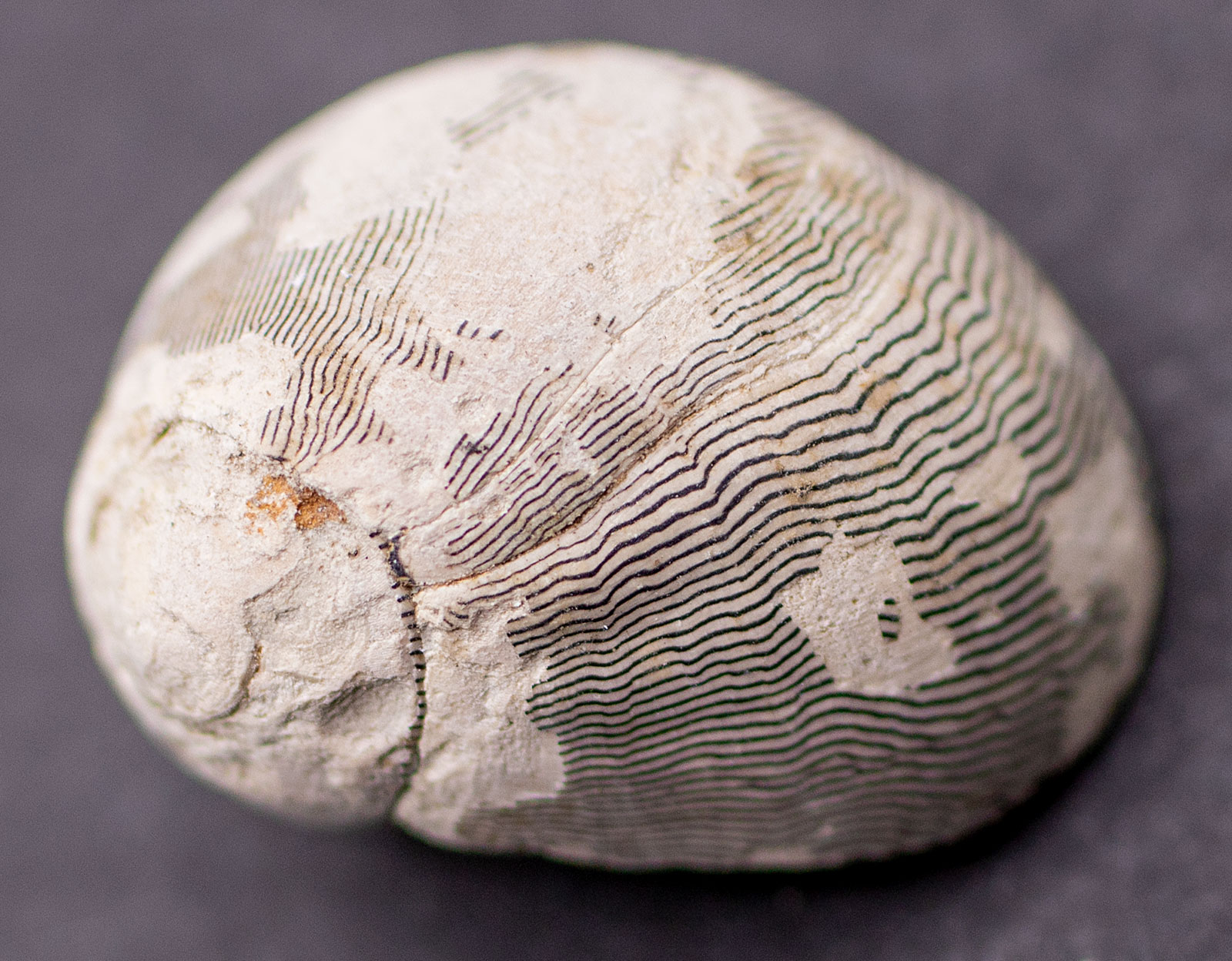
My interest in this geologist stems from some fossil specimens found in
Colonel Lucien Beckner's collection a Pennsylvanian Period gastropod found in the coal mines of eastern Kentucky and some gastropods from maybe the Eocene of Naples, Florida.
Early Years
Rogers "Rog" Clark Ballard was born on November 6, 1858 to Frances "Fanny" Ann Thruston (1826-1896) and Andrew Jackson Ballard (1815-1885) in Louisville, Kentucky, USA. He was born into a wealthy and prestigious family; his great-grandmother was George Rogers Clark (1752-1818) sister. Rogers began his early education at Hopkins Grammer of New Haven, Connecticut and then Williston Seminary of East Hampton, Massachusetts. After his freshman year of college, in the summer of 1877 he helped his father with mining interests in Colorado thus missing the start of his sophomore term.
He graduated in 1880 from the Sheffield Scientific School of Yale University with a degree of Bachelor of Philosophy. To round out his education, late in life the University of Louisville conferred a Master of Arts degree upon him in 1937 and the University of Kentucky awarded him a degree of Doctor of Laws in 1942.
Occupations
After graduating Yale, he started as a clerk for the Monon Railroad office in Louisville and worked his way up to Assistant Ticket Auditor. Later, he became a metallurgist for the Kentucky Geological Survey (KGS) on July 1, 1882. At the age of 25, on October 27, 1884, the Fayette County Court appended his mother's maiden name Thruston to his last name. His mother, the last of the Thrustons, wanted her family name to live on but as it turned out, he never married or had any children. He would sign paperwork with his initials RCBT or R.C. Ballard Thruston.
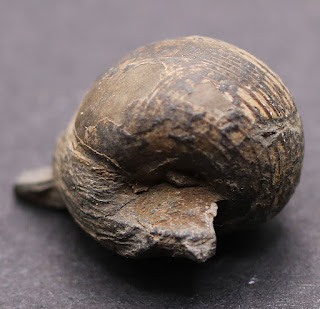 |
Appears to be a Bellerophon meekianus gastropod fossil found by George Rogers Ballard Thruston in 1883 in a coal seam at Elkhorn Creek, Pike County, Kentucky.
|
He helped survey and photograph ("kodak") Pike, Letcher, Harlan, and Bell counties till he left the KGS in 1887. RCBT took employment with the Kentucky Union Land Company where he was buying land in Harlan and Bell counties as well as Wise and Lee counties in Virginia for coal and iron mining. By 1890, he was promoted to Superintendent of the Land Department where he worked on acquiring land for timber and coal in Estill, Powell, Lee, Breathitt, Perry and Letcher counties. In the 1880s, he and his brothers acquired acreage through the Interstate Investment Company in the Big Stone Gap section of Virginia for coal production. RCBT managed the Big Stone Gap Iron Company from 1895 to 1899.
As a side note, The Trail of the Lonesome Pine by John Fox, Jr. (1862-1919) was published in 1908. It became one of the best selling books in the United States in 1908 and 1909. The story takes place in the Appalachian Mountains of Virginia and Kentucky. Its main character is geologist John Hale who the author in part based on Rogers Clark Ballard Thruston. The story was adapted into a 1912 Broadway production, a 1916 Cecil B. DeMille film, a 1923 film and a 1936 film starring Fred MacMurray (1908-1991), Sylvia Sidney (1910-1999), and Henry Fonda (1905-1982). The author John Fox, Jr. was a friend to RCBT in 1890 where his family lived at Big Stone Gap, Virginia.
 |
A colorized image from John Fox Jr. 1908 book The Trail of the Lonesome Pine showing the main characters mountain girl June Tolliver and geologist-engineer Jack Hale. It is thought heroine is based off a Keokee, Virginia girl Elizabeth Morris and the character Jack is partially based off of Rogers Clark Ballard Thruston who was a surveying geologist in the Big Stone Gap, Virginia area.
|
Retirement
In 1919, at the age of 61, Thruston retired with the intent to spending the rest of life studying history and traveling.
On November 18, 1921 he helped dedicate the Sunshine Ballard Cabin to Berea College. It was in honor of one of his relatives. The cabin allowed the school to expand its Fireside Industries department which taught weaving, basketry, homespun and hand work.
In 1922, he traveled to Naples, Florida, while there he found a number of gastropod shells (fossils?) known as Theodoxus reclivatus (Say, 1822) [modern name is Vitta usnea (Röding, 1798)].
In 1925, he participated in a history pageant in Lexington, Kentucky and dressed as his ancestor George Rogers Clark. He would spend the rest of his life promoting a monument be created to honor George Rogers Clark.
In 1930, he unveiled a monument to George Rogers Clark in Springfield, Illinois.
The Filson Historical Society
Today, the biggest impact Mr. Thruston left upon the Louisville area were his contributions to The Filson Historical Society (FHS). In 1919, he offered $50,000 to help the society obtain a fireproof room to store its collections. When the founder of the society, Reuben T. Durrett died in 1913, his family sold his historic collection the University of Chicago. RCBT went to Chicago to retrieve items that really belonged to the society and returned them to Louisville. He was president of the society from 1923 to 1946. In 1923, he helped the society purchase a new home and in 1929 covered half the cost of moving into it.
He purchased F. W. Leach's research work The Genealogies of the Signers of the Declaration of Independence and donated to the FHS. His photo collection of over 20,000 images from 1880-1942 was also donated to the FHS collection. He contributed the following to the FHS History Quarterly
1926 The Signing of the Declaration of Independence
1928 Letter by Edward Harris 1797
1935 Some Recent Findings Regarding the Ancestry of General George Rogers Clark
1937 Reprint of The Filson Club Program of June 25 1937 The Lincoln Pilgrimage
1940 Rachel Eastham Not Mary Byrd or Bird was the Wife of John Rogers The Grandfather of George Rogers Clark
1941 After the Death of George Rogers Clark
Legacy
He died at 2:15 a.m. at Jewish Hospital in Louisville, Kentucky on December 30, 1946. His funeral was held at Christ Church Cathedral followed by his burial at Cave Hill Cemetery. His remains are buried next to his parents in section G, lot 24, grave 12 at the cemetery.
RCBT left a very explicit 9 page will.
Here is part of it, "As to the disposition of my remains after death. I am the holder of lots 24 and 25 in Section G, in Cave Hill Cemetery, Louisville, Kentucky. There are buried the remains of my maternal grand-parents and their children, my parents, a brother, my sister and certain law kin. The space next to the grave of my father has been set aside for my remains. There I have erected a headstone with an inscription complete except as to the dates of my death; that date I direct my executor to
have suitably inscribed thereon.
My desire is that my body be cremated; that my ashes be placed in a simple glass, metal or pottery container and buried on the site above named. I also desire that all unnecessary forms and ceremonies be dispensed with and that the disposition of my remains after my death be accomplished simply, quickly and inexpensively."
As described above, his financial and research material contributions to the Filson Historical Society are probably his most lasting mark on the Louisville area. In 1947, the Society devoted an entire issue of the History Quarterly to his memory.
Besides the fossils I have documented earlier, he also left specimens to the old museum that was part of the Louisville Free Public Library which was later transferred to what is now the Kentucky Science Center. They are de-accessioning that collection so Thruston's items might now go to the Filson Historical Society or Frazier History Museum. The Speed Art Museum has some of his paintings including one called the View of Jerusalem from 1867.
He and his brothers donated a number of pieces of land to become parks: Ballard Square, Churchill Park and George Rogers Clark Park. In addition, they deeded the original home of George Rogers Clark on Poplar Level Road to the City of Louisville.