Showing posts with label conularia. Show all posts

Thursday, January 18, 2024

Paraconularia with Cypricardinia Pelecypod Fossils


Paraconularia (Sinclair, 1940) with Cypricardinia (Hall, 1860) pelecypod fossils shown in the pictures. Fossils were found in Floyd County Indiana USA. The fossils date to the Mississippian Period. Thanks to Kenny for images.


Sunday, December 24, 2023

Conularia formosa Fossil


This fossil appears to be a Conularia formosa (Miller & Dryer, 1878) from the Ordovician Period. It was found in the Logana Member of the Lexington Limestone for Franklin County, Kentucky, USA. Thanks to Kenny for the picture.

Wednesday, October 18, 2023

Conularia Fossil


This picture is of a recently found Conularia fossil that is about 1 cm long. It was found in the Carwood Formation of Floyd County, Indiana, USA. The fossil dates to the Mississippian Period. Thanks to Kenny for the image.

Wednesday, September 20, 2023

Dr. John H. Lemon - New Albany Indiana Paleontologist


The 1910 U.S. Census lists John Herschel Lemon was born in September 1844 and his obituary lists at a farm near Harrodsburg, Indiana. His family moved to Bloomington, Indiana in 1856 when he was 12, where at age 13 he and his brothers became students at Indiana University (IU). The American Civil War interrupted his studies and in May 1862 he became a private in the 54th Indiana Infantry, Company A and later 82nd Indiana Infantry, Company F. They guarded 4000+ Confederate prisoners of war (POWs) at Camp Morton (Indianapolis) and later deployed to western Kentucky.

The Owen Connection

His interest in paleontology may have been inspired by geologist Richard D. Owen (1810-1890) who was boarder at his mother's house in Bloomington, Indiana. Owen was professor on Natural Science at IU for 15 years and served as colonel in the Union Army in the 15th and later 60th Indiana Infantry Regiment and was in charge of the POWs at Camp Morton. His permanent residence was in New Harmony, Indiana and where he is buried when he died.

After the war, John Lemon continued his studies at IU and later studied at University of Michigan. Once he became a doctor, he moved to New Albany in 1867 and practiced medicine till the 1930s. He died on July 10, 1935 which at that time he was considered Indiana's longest serving physician.

The Smithsonian Connection

In 1887, Dr. Lemon sent the Smithsonian some charophyte fossils found at the Falls of the Ohio. F. H. Knowlton (1860-1926) named the fossil after him in 1889 calling it Calcisphaera lemoni in a paper called Description of a problematic organism from the Devonian at the Falls of the Ohio. The holotype specimens are in the Smithsonian Museum of Natural History USNM P 3664.

The George Greene Connection

New Albany fossil collector and author George K. Greene named a number of fossils after Dr. Lemon in publications from 1904. Greene named the fossil horn coral Heliophyllum lemoni in which wrote "The specific name is in honor of Dr. John Lemon, of New Albany, Ind., an ardent collector and a good palaeontologist. Found in the lower Devonian (Corniferous group), at the Falls of the Ohio. Now in the collection of the author." Later in his publication, he named another fossil after Lemon, the Crania? lemoni. "The specific name in in honor of the discoverer, Dr. John Lemon, of New Albany, Ind."


The Colonel Lucien P. Beckner Connection

Beckner had two fossils of Dr. Lemon in his collection. The first was a Paraconularia newberryi (Winchell) fossil still partially embedded in a nodule.Another was labeled Pentremites pyriformis? blastoid both fossils listed as found in Indiana.


Sources

In preparing this entry about Dr. Lemon, an informative blog post entitled Dr. John Herschel Lemon Reminisces about Early Life in Bloomington by Randi Richardson on November 26, 2018 at the Monroe County History Center Research Library blog was found helpful.

George K. Greene's Contribution to Indiana Palaeontology Volume I Part I to XX published from February 1898 till September 1904.

Smithsonian National Musuem of Natural History Department of Paleobiology Collections database

Frank Hall Knowlton's 1889 paper Description of a problematic organism from the Devonian at the Falls of the Ohio


Monday, May 8, 2023

Kentucky Conularia Fossil


This fossil was recently found in Allen County Kentucky USA. It appears to be a Conularia sp. The creature existed in the Mississippian Period. The fossil is from the Fort Payne Formation.

Thanks to Kenny for the image.

Monday, January 2, 2023

Paraconularia Fossil


Here is a fossil found near the end of 2022 in Carwood Formation of Floyd County, Indiana USA. The fossil dates to the Mississippian Period. It appears to be a Paraconularia missouriensis? (Swallow, 1860) and is about 2 cm in length.

 Thanks to Kenny for images.

Friday, October 16, 2020

Paraconularia Fossil From Indiana


This picture is of  what I think is a Paraconularia missouriensis? (Swallow, 1860) fossil. It existed in the Mississippian Period. The fossil was found in Carwood Formation of Washington County, Indiana USA. Thanks to Kenny for the picture. Conulariida are usually rare so I am not sure how common they are in this locality. Also it is a mystery as what exactly these extinct creatures looked like, are they a type of jellyfish?

UPDATE (2020-10-18): So I changed the name on this fossil, I think this is a Paraconularia missouriensis (Swallow, 1860) which is found in this Indiana county. The ridges are alternating when matching up at the midline thus a Paraconularia (Sinclair, 1940). I originally posted it as being Conularia (Miller, 1818). See this 2016 posting:

Learn more about this type of fossil at Dr. Mark Wilson's posting on the Wooster Geologist site:


A note about Conularia, it was originally shown (see above) on plate XX figure 7 in The History of Rutherglen and East-Kilbride by David Ure (1749-1798), Glasgow:Printed by David Niven 1793. The specimen was not named but the author writes this on pages 330-331. "The clafs to which the curious foffil, fig. 7. pl. XX. originally beloned, is not fo far as I know, determined. The fpecimens are in cafts of iron-ftone, fometimes found incolfed in iron-ftone like a nucleus ; at other times found among till along with marin fhells, &c. Specimens are very rare." Note their typesetting back this strange to me. It looks like the the substitute lowercase f for lowercase s on some words. Find a scan of the book at: https://www.google.com/books/edition/The_History_of_Rutherglen_and_East_Kilbr/0jgtAAAAYAAJ?hl=en&gbpv=0

References:
Miller, Hugh 1818. The Mineral Conchology of Great Britain by James Sowerby, Volume III, p. 108 

Sinclair, G.W. 1940. A discussion of the genus Metaconularia with descriptions of new species. Transactions of the Royal Society of Canada, 34:101-121

Sinclair, G. W. 1952. A classification of the Conulariida. Fieldiana Geology, 10:135–145. 

Swallow, G. C. 1860. Descriptions of new fossils from the Carboniferous and Devonian rocks of Missouri. Academy of Sciences of Saint Louis, Transactions, 1:635–660. 

Sunday, June 5, 2016

Paraconularia missouriensis Fossil


This fossil is part of the Indiana University Department of Geology collection. It appears to be a Paraconularia missouriensis (Swallow). The approximately 13.5 cm long fossil was found in Washington County, Indiana, USA. The specimen dates to the Mississippian Period.

Thanks to Kenny for the image.

Saturday, February 23, 2013

Paraconularia magna


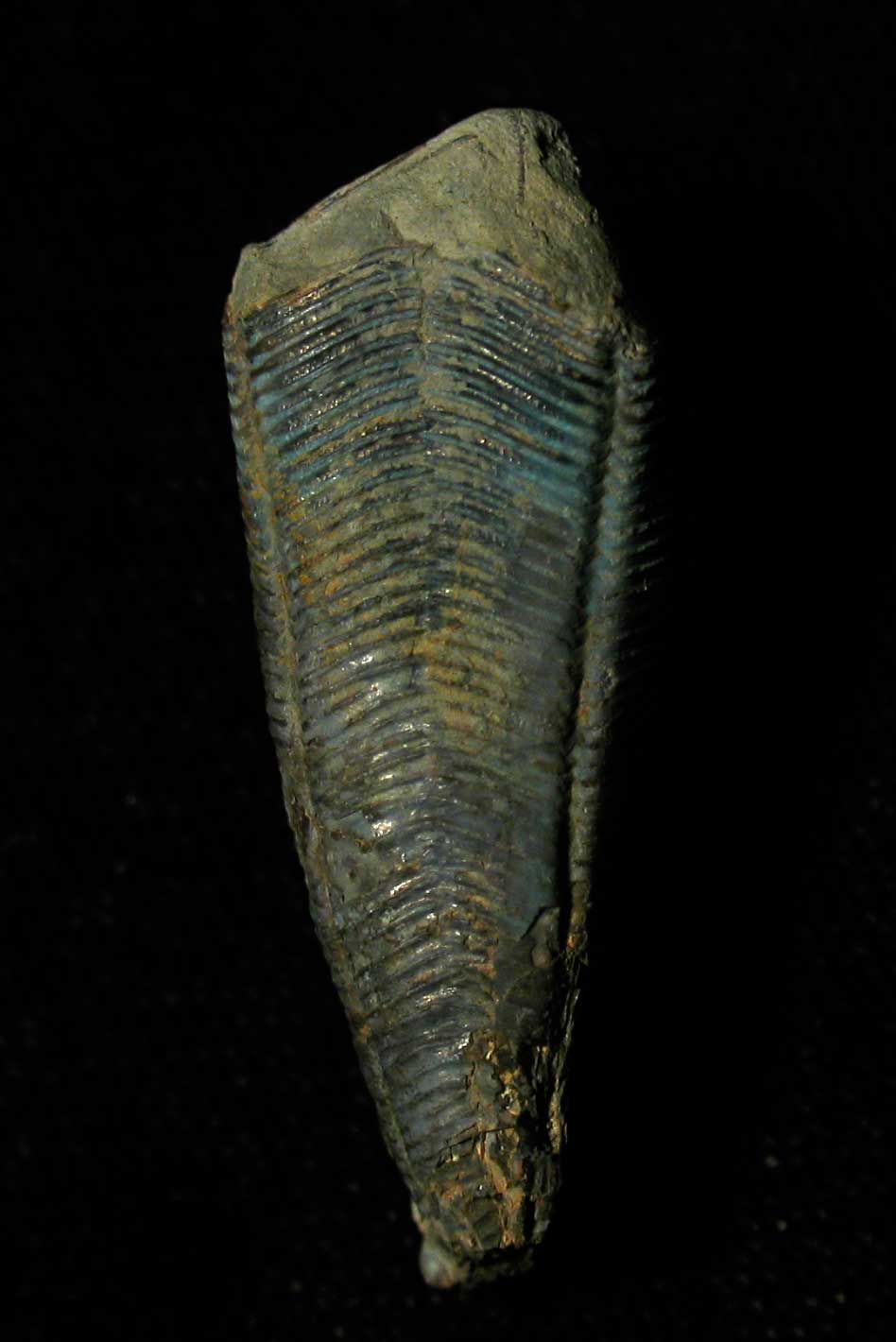
This appears to be a Paraconularia magna fossil. It was found in the Cisco group Finis Shale of Jack County Texas. It is from the Pennsylvanian Period (Virgilian). It was named by Ries in 1949.

These specimens are interesting in that they are blue. Under magnification one can see a blue like fossilized shell and more grove like detail.


Sunday, September 6, 2009

French Conularia pyramidata

The following are pictures taken at the Muséum National D'Historie Naturelle Jardin Des Plantes Paléontologie et Anatomie Comparée in Paris, France. They are Conularia from the Silurian and Ordovician Periods. This is interesting for me since the common Conularia fossil finds in the Louisville area are from the Carboniferous Period.

The first two are Conularia pyramidata found in France, I think from somewhere in Normandy. They are from the Silurian Period.


This next Conularia of unknown species comes from New Holland according to the label.


This last image of four fossils are of Ordovician Period Conularia anomala from Czechoslovakia.

Here is a poster that was in the museum describing Conulaires (Conulariida?). I have yet to translate it. The image of the little stalks with beads at the end protruding from the top of the Conularia is interesting.

Friday, September 4, 2009

Conularia From Louisville, Kentucky

Here is a Conularia fossil my cousin found in southern Jefferson County, Kentucky near the city of Louisville. It is from the Mississippian or Carboniferous Period. Found in the Borden Formation.

Friday, February 13, 2009

Conularia

Here is an odd creature that no one quite knows what it really looked like. It left a skeleton that is in the shape of a four sided pyramid with a lot of grooved lines on it. Some think it might be some sort of jellyfish but they have been found with stems.

Maybe some type of crinoid. It is called a Conularia and existed in the Mississippian time period. I believe this one was found in southern Louisville.