Showing posts with label Pennsylvanian. Show all posts

Tuesday, July 4, 2023

Latzelia primordialis Centipede Fossil


This picture is of a Latzelia primordialis (Scudder, 1890) centipede fossil cast. It was found in Carbondale Formation of Grundy County, Illinois USA. It dates to the Pennsylvanian Period. Its U.S. National Museum catalog number is 38003. The specimen on display is the holotype.

The picture was taken in June 2023 on the first floor of the Smithsonian Museum of Natural History in Washington D.C. USA.

Fossil was named by Samuel Hubbard Scudder (1837-1911) in the Mazon Creek fossil beds of Illinois.

Monday, July 3, 2023

Euproops danae Horseshoe Crab Fossil


This picture is of an Euproops danae (Meek & Worthen, 1868) horseshoe crab fossil. It was found in Carbondale Formation of Grundy County, Illinois USA. It dates to the Pennsylvanian Period. Its U.S. National Museum catalog number is 38854.

The picture was taken in June 2023 on the first floor of the Smithsonian Museum of Natural History in Washington D.C. USA.

Image courtesy of the Smithsonian Institution Specimen Catalog Number:  USNM PAL 38854 Specimen GUID:  http://n2t.net/ark:/65665/m3f4bd1c88-6763-4b98-8641-93abc743175d Photographer Bruce Martin. Specimens housed in the collections of the Department of Paleobiology, National Museum of Natural History, Smithsonian Institution.


Sunday, July 2, 2023

Eoscorpius carbonarius Scorpion Fossil


This picture is of an Eoscorpius carbonarius (Meek & Worthen, 1868) scorpion fossil cast. It was found in Carbondale Formation of Illinois USA. It dates to the Pennsylvanian Period. Its U.S. National Museum catalog number is 618348.

The picture was taken in June 2023 on the first floor of the Smithsonian Museum of Natural History in Washington D.C. USA.

Friday, November 6, 2020

Neuropteris inflata Fossil of Mazon Creek


Above is an image of part of a seed fern frond plant fossil called Neuropteris inflata (Lesquereux). This plant fossil dates to the age Moscovian/Desmoinesian of the Carboniferous (Pennsylvanian) Period between 354 and 290 million years ago. It was found Mazon Creek, Illinois, USA. Like most fossils found at this locality, it was inside a nodule. The layer to fossil was found is the Francis Creek Shale.

The fossil was on display in the Evolving Planet section of The Field Museum of Natural History in Chicago Illinois, USA as of August 2020. Accession number is P30763. They have quite an extensive collection of Mazon Creek fossils at the exhibit.

The Field Museum produced a visual PDF of some of the fossils found at Mazon Creek. It can be found at this link:

https://fieldguides.fieldmuseum.org/sites/default/files/rapid-color-guides-pdfs/534_usa-age_fossils.pdf

Tuesday, October 20, 2020

Crenulopteris acadica Tree Fern Fossil


Above is an image of a tree fern frond plant fossil called Crenulopteris acadica (Bell, 1962). This plant fossil dates to the Carboniferous (Pennsylvanian) Period between 354 and 290 million years ago. It was found Mazon Creek, Illinois, USA. Like most fossils found at this locality, it was inside a nodule. The layer to fossil was found is the Francis Creek Shale.

The fossil was on display in the Evolving Planet section of The Field Museum of Natural History in Chicago Illinois, USA as of August 2020. Accession number is PP46053. They have quite an extensive collection of Mazon Creek fossils at the exhibit.

The Field Museum produced a visual PDF of some of the fossils found at Mazon Creek. It can be found at this link:

https://fieldguides.fieldmuseum.org/sites/default/files/rapid-color-guides-pdfs/534_usa-age_fossils.pdf

Monday, October 19, 2020

Diplazites unita Fern Fossil


Above is an image of a tree fern frond plant fossil called Diplazites unita (Brongniart, 1822) Cleal, 2015This plant fossil dates to the Carboniferous (Pennsylvanian) Period between 354 and 290 million years ago. It was found Mazon Creek, Illinois, USA. Like most fossils found at this locality, it was inside a nodule. The layer to fossil was found is the Francis Creek Shale.

The fossil was on display in the Evolving Planet section of The Field Museum of Natural History in Chicago Illinois, USA as of August 2020. Accession number is PP1015. They have quite an extensive collection of Mazon Creek fossils at the exhibit.

The Field Museum produced a visual PDF of some of the fossils found at Mazon Creek. It can be found at this link:

https://fieldguides.fieldmuseum.org/sites/default/files/rapid-color-guides-pdfs/534_usa-age_fossils.pdf


References:

Brongniart, A. (1822): Sur la classification et la distribution des végétaux fossiles  ‒ Mémoires du Muséum d’Histoire Naturelle, 8

Cleal, C. J. (2015): The generic taxonomy of Pennsylvanian age marattialean fern frond adpressions. ‒ Palaeontographica, Abteilung B, 292: 1–21. 

Sunday, October 18, 2020

Mazon Creek Calamites Plant Fossil


Above is an image of a horsetail trunk plant fossil called Calamites sp. This plant fossil dates to the Carboniferous (Pennsylvanian) Period (354-290 mya). It was found Mazon Creek,  Illinois, USA. The layer fossils are found is in Francis Creek Shale.

The fossil was on display in the Evolving Planet section of The Field Museum of Natural History in Chicago Illinois, USA as of August 2020. Accession number is UP2561. They have quite an extensive collection of Mazon Creek fossils at the exhibit.

The Field Museum produced a visual PDF of some of the fossils found at Mazon Creek. It can be found at this link:

https://fieldguides.fieldmuseum.org/sites/default/files/rapid-color-guides-pdfs/534_usa-age_fossils.pdf

Mazon Creek Collections Database at Illinois State Museum

http://www.museum.state.il.us/databases/geology/mazoncreek/graphical/index.php

Monday, October 12, 2020

Odontopteris aequalis Mazon Creek Fern Fossil


Above is an image of a seed fern plant fossil called Odontopteris aequalis. This plant fossil dates to the Carboniferous (Pennsylvanian) Period. It was found Mazon Creek, Illinois, USA. Like most fossils found at this locality, it was inside a nodule.

The fossil was on display in the Evolving Planet section of The Field Museum of Natural History in Chicago Illinois, USA as of August 2020. Accession number is PP31097. They have quite an extensive collection of Mazon Creek fossils at the exhibit.

The Field Museum produced a visual PDF of some of the fossils found at Mazon Creek. It can be found at this link:

https://fieldguides.fieldmuseum.org/sites/default/files/rapid-color-guides-pdfs/534_usa-age_fossils.pdf

Sunday, October 11, 2020

Mariopteris nervosa Fern Fossil From Mazon Creek


Above is an image of a seed fern plant fossil called Mariopteris nervosa (Brongniart) Zeiller. This plant fossil dates to the Carboniferous (Pennsylvanian) Period. It was found Mazon Creek, Illinois, USA and appears to be made of chocolate (only kidding). 

The fossil was on display in the Evolving Planet section of the Field Museum of Natural History in Chicago Illinois, USA as of August 2020. Accession number is PP46034. They have quite an extensive collection of Mazon Creek fossils at the exhibit.


Reference:

https://www.academia.edu/5989500/Mariopteris_Dicksonites_and_Fortopteris_from_the_Dobrudzha_Coalfield_Bulgaria

Sunday, June 28, 2020

Pecopteris Fern Fossil


As of June 2020, on display at the  New Harmony Indiana USA Working Men's Institute Museum & Library was this Pecopteris fern fossil. The fossil dates to Pennsylvanian Period. Specimen accession number WMI 300.7 and is part of the James Sampson collection. Fossil found in the Bond Formation at the Rush Creek locality of Posey County, Indiana, USA.

New Harmony was named by Robert Owen in 1825 after purchasing it from the Harmony Society who founded Harmony there in 1814. A number of earlier American geologists lived in this town including William McClure, Gerard Troost, David Dale Owen, F. B. Meek, E. T. Cox, B.F. Shumard, and Richard Owen. Naturalists Thomas Say and Charles-Alexandre Lesueur also lived in New Harmony. Thomas Say is buried near the center of the town.

Monday, June 1, 2020

Sphenophyllum Plant Fossil


This plant fossil appears to be a Sphenophyllum. It was found in Hazard (Perry County) Kentucky in the Breathitt Group.  The fossil dates to Pennsylvanian (Carboniferous) Period. 

Recently, I have been posting a lot of fossil I received from friends years ago. My effort has been to try and document a lot of fossils I have that are unlabeled. So slow progress as I name the fossils and add them blog if they were not posted before. This fossil is one of them, my cousin Kenny gave it to me almost 10 years ago.


Sunday, May 31, 2020

Alethopteris and Neuropteris Plant Fossils


These pictures are of plant fossils from St. Clair, Pennsylvania. These plants grew in the Late Carboniferous or Pennsylvanian Period and can be found in the Llewellyn Formation.

St. Clair is famous for the white appearance of their plant fossils which caused by aluminum silicate or pyrophyllite. This first image is of fossils are what appears to be Alethopteris (top) and Neuropteris (bottom).

The next image is a close up of the Neuropteris fossil.

Thanks to Dave H for this fossil specimen so many years ago.


The last image is with a ruler to show the size of these fossils.


Thursday, January 23, 2020

Neuropteris Plant Fossil from Kentucky


This fossil appears to be a Neuropteris plant fossil. It was found in Perry County Kentucky, USA. The fossil dates to the Pennsylvanian Period. Scale is in centimeters.

Thanks to Kenny for the image.

Wednesday, January 22, 2020

Unidentified Carboniferous Period Plant Fossil


Picture shown is of an unidentified plant fossil. It was found in Perry County Kentucky, USA. The fossil dates to the Pennsylvanian Period. Scale shown is cm increments.

Thanks to Kenny for the image.

Tuesday, January 21, 2020

Bowmanites-a-sphenopsid Fossil


This fossil appears to be a Bowmanites-a-sphenopsid plant fossil. It was found in Perry County Kentucky, USA. The fossil dates to the Pennsylvanian Period.

Thanks to Kenny for the image.

Monday, January 20, 2020

Asterophyllites Plant Fossil


This fossil appears to be an Asterophyllites sp. plant fossil. It was found in Hazard County Kentucky, USA. The fossil dates to the Pennsylvanian Period.

Thanks to Kenny for the image.

Sunday, January 13, 2019

Fossil Plant Presentation at Falls of the Ohio State Park


Here is a picture of plant fossil called Sigillaria elegans. It is from the Pennsylvanian Period and was found in Hazard, Kentucky, USA.

Herb Miracle showed this fossil at a presentation he gave today at the Falls of the Ohio State Park at Clarksville, Indiana, USA. Thanks to Kenny for image.

Wednesday, October 12, 2016

Asterosoma Trace Fossils


Today's post is a very interesting set of fossils which I initially did not know what they were. I received an e-mail from the granddaughter of a person who found these specimens in the Estill County, Kentucky  USA.

Luckily, Dave at Views of the Mahantango blog was able to identify them as Asterosoma sp., a worm/shrimp? burrow trace fossil.


They appear to be from the Breathitt Formation of Pennsylvanian Period.

Thanks to Tamara for letting me post these pictures.

Learn more:
Post about them on Fossil Forum: http://www.thefossilforum.com/index.php?/topic/28148-star-shaped-trace-fossils/

Info on the Arkansas Geological Survey blog: https://arkansasgeological.wordpress.com/tag/asterosoma/

Geology of Estill County, Kentucky: http://www.uky.edu/KGS/water/library/gwatlas/Estill/Geology.htm

Saturday, March 19, 2016

Edestus Shark in Video Game


The game developers of Jurassic World cell phone game have modeled an Edestus shark for the game. It showed up as one of the creatures to get past in the tournaments set for this weekend. It is interesting to see how the graphic designer modeled it's teeth in a single row.

The real shark is much older than the Jurassic Period. It dates to the upper Middle Pennsylvanian or Carboniferous Period (approximately 307 million years ago).

See this entry from 2015 about an actual Edestus fossil found in a Kentucky coal mine. http://louisvillefossils.blogspot.com/2015/01/newly-found-edestus-shark-fossil.html


Sunday, November 8, 2015

Marginifera lasallensis Brachiopod Fossil


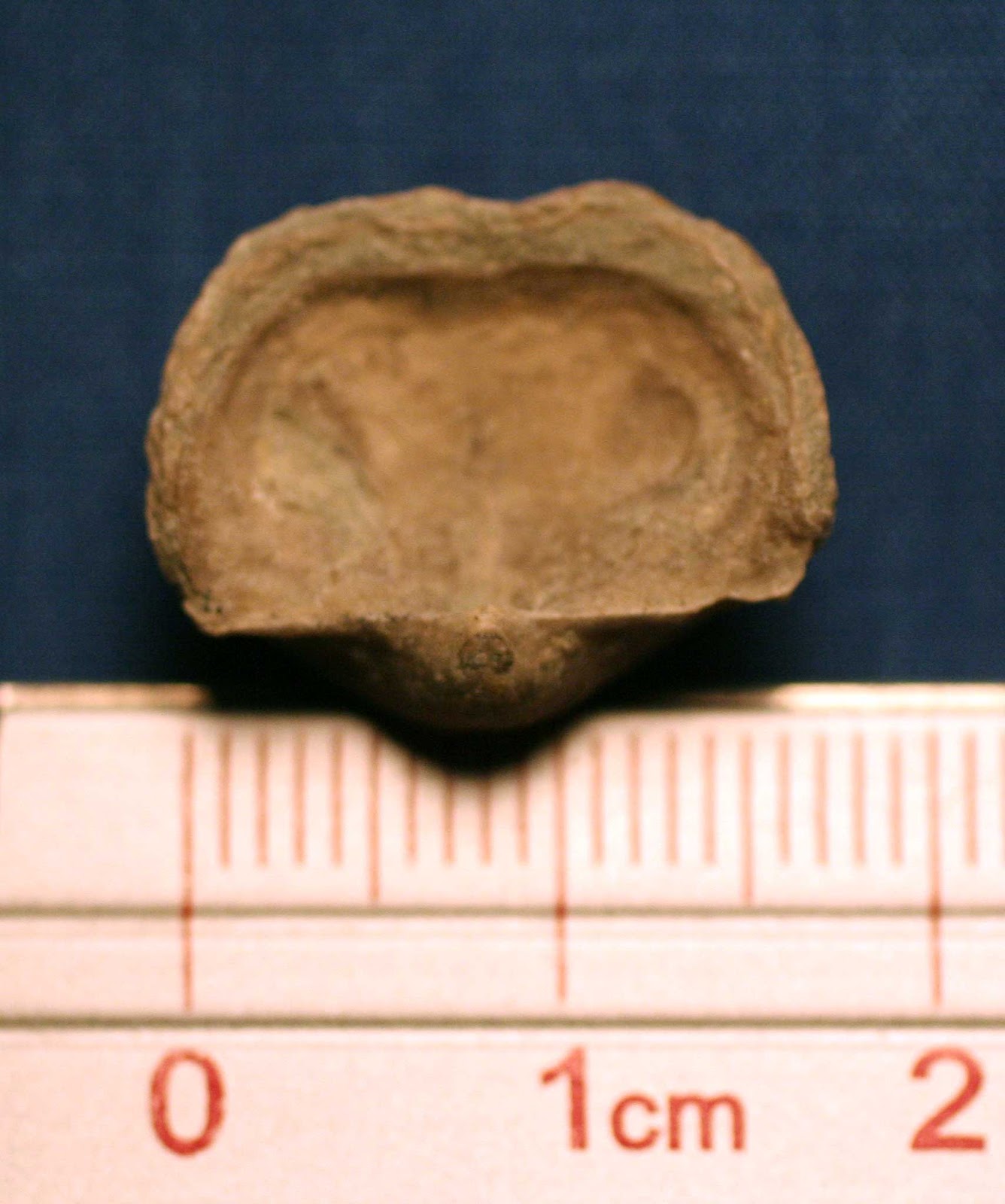
These pictures appear to be a Marginifera lasallensis brachiopod fossil. It was found in the Lenepah Formation of Nowata County, Oklahoma USA. It dates to the Pennsylvanian Period.