Showing posts with label worm tube. Show all posts

Sunday, March 30, 2025

Worm Tube Fossil


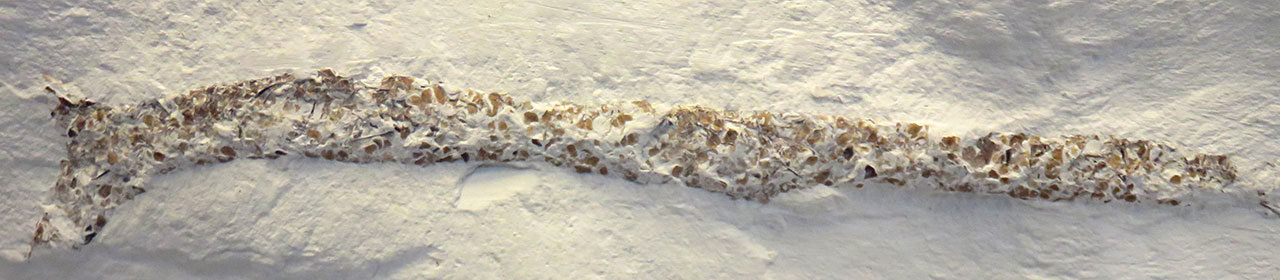
These pictures are of a worm tube fossil. Fossil found in the New Providence Formation of Clark County, Indiana USA. It dates to the Mississippian Period. Thanks to Kenny for the images.


Friday, February 10, 2023

Platyceras niagarense with Cornulites proprius


This post is of two fossils: the gastropod Platyceras (Platystoma) niagarense (Hall, 1852) with several worm tubes known as Cornulites proprius. Fossil found in the Waldron Shale of Clark County Indiana USA. It dates to the Silurian Period.

Fossil on display at Falls of the Ohio Interpretative Center Clarksville Indiana USA as of December 2022.

Sunday, November 27, 2022

Serpula quadristriata Worm Fossil


This image shows a number of Serpula quadristriata worm fossils. It dates to the Late Jurassic Period (Oxfordian Stage) and was found at Neuvisy (Ardennes) France. It was displayed at Muséum National D'Historie Naturelle Jardin Des Plantes Paléontologie et Anatomie Comparée, Paris, France.  Image taken August 2009.

Tuesday, March 17, 2020

Pyrite Snail with Worm Tubes Fossils


This snail fossil is quite a find but so much more with encrusted worm tubes, bryozoans and pyrite cubic shapes. The snail appears to be a Platystoma niagarense with four visible Cornulites propius worm tubes and maybe a encrusting trepostome bryozoan. The end of the largest worm tube is a golden colored pyrite. The snail shell appears to be composed pyrite as well. It was found in the Waldron Shale of Shelby County Indiana USA. The fossils date to the Middle Silurian Period.


Sunday, January 7, 2018

Vinlandostrophia Brachiopod Fossil with Friends


Here is an image of three fossils in one place. First is the Vinlandostrophia (Platystrophia) sp. brachiopod with an unidentified inarticulate brachiopod attached. On the inarticulate brachiopod is a Cornulites corrugatus worm tube fossil. These fossils date to the Ordovician Period. They might be from the McMillan/Grant Lake Formation and were found in eastern Jefferson County, Kentucky, USA.

Thanks to Kenny for image.

Monday, December 26, 2016

Terebella Worm Tube Trace Fossil


This picture is a trace fossil of the Terebella worm tube . Over time the tube filled with remnants fish teeth and scales along with chalk. It was found in Sussex, England. The fossil dates to the Cretaceous Period.

It was on display at the British Natural History Museum in London on August 2016.

Wednesday, October 12, 2016

Asterosoma Trace Fossils


Today's post is a very interesting set of fossils which I initially did not know what they were. I received an e-mail from the granddaughter of a person who found these specimens in the Estill County, Kentucky  USA.

Luckily, Dave at Views of the Mahantango blog was able to identify them as Asterosoma sp., a worm/shrimp? burrow trace fossil.


They appear to be from the Breathitt Formation of Pennsylvanian Period.

Thanks to Tamara for letting me post these pictures.

Learn more:
Post about them on Fossil Forum: http://www.thefossilforum.com/index.php?/topic/28148-star-shaped-trace-fossils/

Info on the Arkansas Geological Survey blog: https://arkansasgeological.wordpress.com/tag/asterosoma/

Geology of Estill County, Kentucky: http://www.uky.edu/KGS/water/library/gwatlas/Estill/Geology.htm

Monday, December 21, 2015

Cornulites proprius on an Eospirifer radiatus


These images show an Eospirifer radiatus brachiopod fossil with a fossilized Cornulites proprius worm tube. It was found in the Waldron Shale of Clark County Indiana USA. These creatures existed in the Silurian Period.


Wednesday, September 17, 2014

Mississippian Age Cornulites Fossil


The white fossil appears to be a Cornulites worm tube fossil next to an unidentified brown trilobite genial spine. It was found in the Glen Dean formation.of Grayson County, Kentucky USA. The fossil dates to the Mississippian Period. Image was taken with a microscope with an approximate 4 mm field of view (FOV).

Thanks to Kenny for the image.