

Showing posts with label new providence. Show all posts
Showing posts with label new providence. Show all posts
Wednesday, November 19, 2025
Amplexus Pyrite Horn Coral


Saturday, April 5, 2025
Cladochonus beecheri Coral Fossil on Crinoid


Sunday, March 30, 2025
Worm Tube Fossil

These pictures are of a worm tube fossil. Fossil found in the New Providence Formation of Clark County, Indiana USA. It dates to the Mississippian Period. Thanks to Kenny for the images.


Sunday, January 8, 2023
Cladochonus Coral Fossil on Crinoid Column

These pictures are of a Cladochonus crassus? (McCoy, 1847) coral fossil on crinoid column. Specimen is about 2 cm in length. Fossil found in the New Providence Formation of Clark County, Indiana USA. It dates to the Mississippian Period. Thanks to Kenny for the images.

Saturday, January 2, 2021
Crinoid Fossil Stem Cross Section
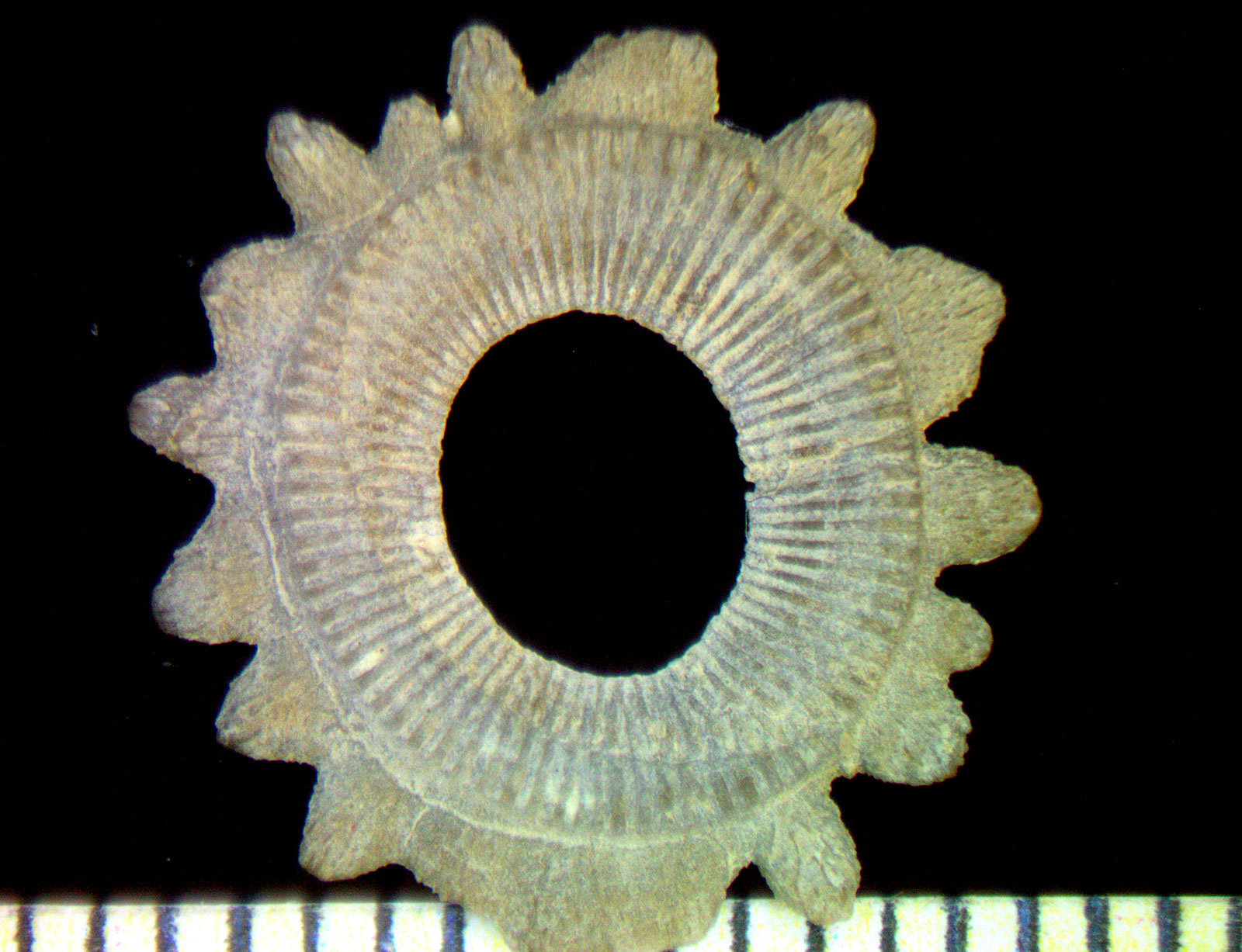
Thanks to Kenny for the image.
Wednesday, November 21, 2018
Spiny Unidentified Brachiopod Fossil

Note, I originally posted this as a snail fossil but now it is thought to be some sort of brachiopod. Spiny
Thanks to Kenny for the image.
Tuesday, November 20, 2018
Cladochonus Coral Fossil on Crinoid Stems

Cladochonus coral fossil on crinoid stems found in Scott County, Indiana USA. Fossils found in New Providence Formation and it dates to Mississippian Period.

Friday, December 29, 2017
Crinoid Holdfast on Dead Crinoid Stem


Sunday, March 5, 2017
Cladochonus Coral Overgrown by Crinoid

UPDATE (Jan 2023): This coral growth on the crinoid stem appears to be Cladochonus crassus (McCoy, 1847).
The image is of a tabulate coral Cladochonus beecheri? (Grabau, 1899 aka Monilopora) that grew on a crinoid column. The crinoid responded by growing over the coral leaving just the corallite openings. Some of the images show a root like structure that might be a crinoid holdfast or some sort of bryozoan.
Fossil found in the New Providence formation in Clark County, Indiana, USA. These creatures existed in the Mississippian Period.


Thursday, December 31, 2015
Parasites on Crinoid Fossil?

These images are quite interesting in that they show possible parasites or byrozoans on a crinoid stem fossil. These fossil was found in Scott County Indiana in the New Providence Formation. It dates to the Mississippian Period.

These might be something like the Wooster College paleontologists found on Jurassic crinoid stems: http://woostergeologists.scotblogs.wooster.edu/2014/11/14/woosters-fossils-of-the-week-a-new-crinoid-species-from-the-middle-jurassic-of-southern-israel-with-a-bonus-parasitic-infection/

Thanks to Kenny for images.
Wednesday, December 30, 2015
Unidentified Crinoid Holdfast Fossil

This image is of an unidentified crinoid holdfast attached to larger crinoid stem fossil. It was found in the New Providence Formation (Keokuk) of Scott County Indiana USA. This creature existed in the Mississippian Period. Thanks to Kenny for this image.

Monday, December 28, 2015
Unidentified Gastropod Fossil

Sunday, December 27, 2015
Cladoconchus Coral Fossil

This image is of a Cladoconchus sp. coral on an unidentified crinoid fossil. It was found in the New Providence Formation (Keokuk) of Scott County Indiana USA. These creatures existed in the Mississippian Period. Thanks to Kenny for this image.
Saturday, November 7, 2015
Scytalocrinus disparilis Crinoid Calyx Fossil
UPDATE: This fossil was originally identified as an Aphelecrinus bayensis.
The fossil pictured appears to be a Scytalocrinus disparilis (MIller and Gurley) crinoid calyx. It was found in the New Providence Formation of Clark County Indiana USA. This crinoid is known from Crawfordsville and Muldraugh Member of the Borden Formation in Kentucky. The creature existed in the Mississippian Period. The matrix had to be coated with a sealer since it was so soft.

Thanks to Kenny for the image.

The fossil pictured appears to be a Scytalocrinus disparilis (MIller and Gurley) crinoid calyx. It was found in the New Providence Formation of Clark County Indiana USA. This crinoid is known from Crawfordsville and Muldraugh Member of the Borden Formation in Kentucky. The creature existed in the Mississippian Period. The matrix had to be coated with a sealer since it was so soft.

Thanks to Kenny for the image.

Friday, November 6, 2015
Punctospirifer? Brachiopod Fossil

These pictures are what appear to be Punctospirifer sp. brachiopod fossil. It was found in the New Providence Formation of Clark County Indiana USA. It dates to the Mississiippian Period.

Sunday, February 22, 2015
Microfossil Crinoid Pieces from Clark County Indiana

My cousin recently sent me some images of crinoid fossils he has been finding in the New Providence Formation of Clark County, Indiana, USA. The fossils date to the Mississippian Period (Carboniferous). All pictures were taken using a microscope and have an approximate field of view of 2 mm.


Subscribe to:
Posts (Atom)