Showing posts with label borden. Show all posts

Saturday, December 7, 2024

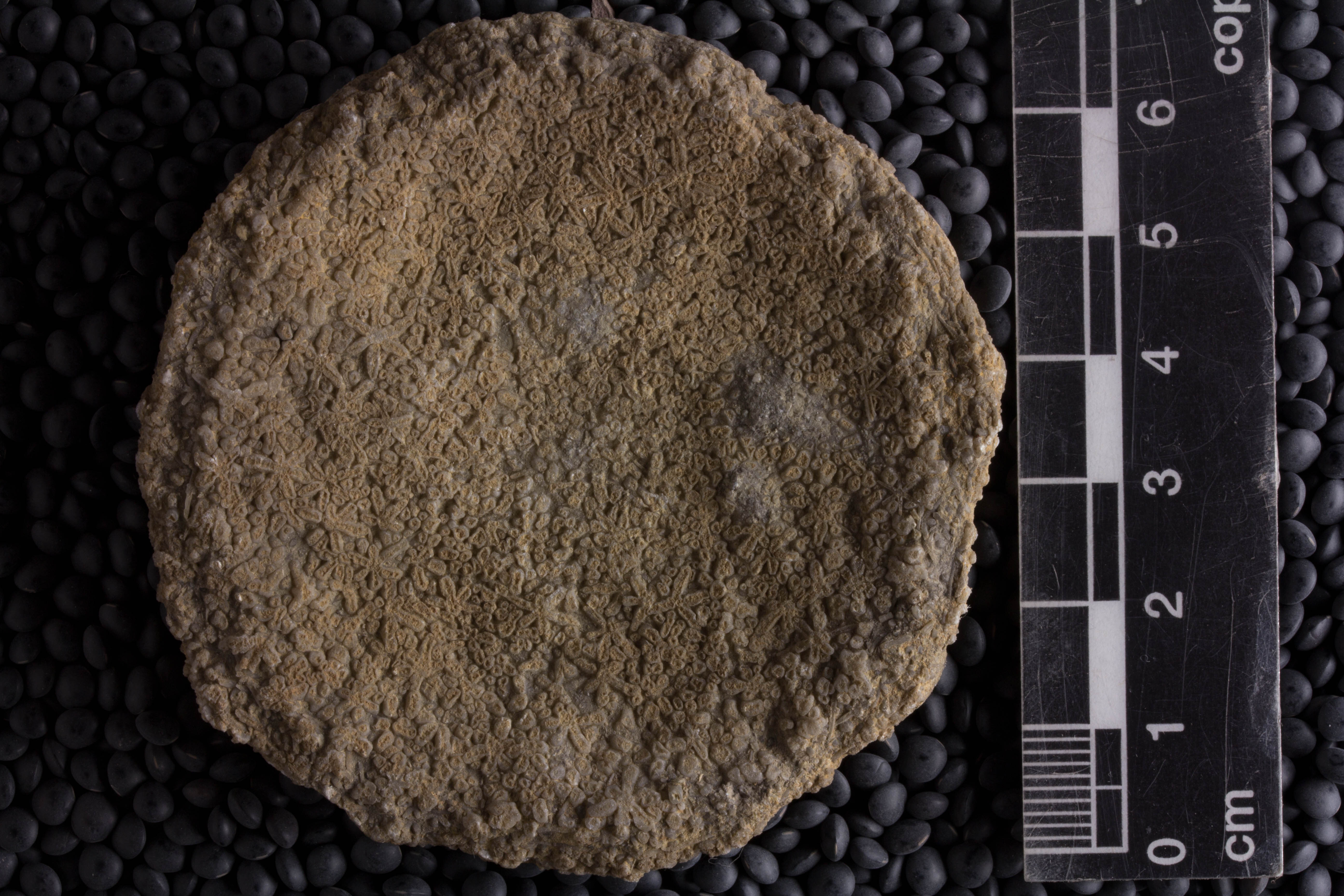
Astraeospongia meniscus Sponge Fossil

Photo by Laura Dykstra. (c) Field Museum of Natural History . CC BY-NC 4.0 https://fm-digital-assets.fieldmuseum.org/1163/578/P21403_fossil.jpg . (accessed on 2024-12-07)
 

While reading the Index Fossils of North America by Hervey W. Shimer & Robert R. Shrock from 1944, I found an interesting reference to Astraeospongia meniscus (Roemer, 1860) porifera fossil. It is listed as being found in Louisville, Kentucky and Brownsport, Tennessee. The creatures lived in the Silurian Period. This entry made me curious as I don't recalling find this fossil in the Louisville area but I have number of these fossils from Tennessee.

The picture above is from Chicago, Illinois, USA Field Museum of Natural History and was once part of the Borden Collection. It is great that the Field Museum is putting pictures of their fossils on-line. This fossil was from the defunct museum of William Borden (1823-1906) of Indiana. The fossil might have been collected by George Greene (1833-1917) who William Borden got a lot of local fossils from. 

This fossil was named by Dr. Carl Fredrick von Roemer (1818-1891) who is famous for his research of fossils found in Texas that he collected during his 1845-1847 visit there.

In his 1860 book, Die silurische Fauna des westlichen Tennessee / Eine palaeontologische Monographie, he talks about Dr. Gerard Troost (1776-1850) whom he visited in 1847 in Nashville, Tennessee. Below is the translation [German to English] of his Preface.

"When I returned from Texas in the summer of 1847 to Nashville, the capital of the state of Tennessee, and found a very friendly welcome and valuable instruction on the geological conditions of the country from Dr. G. Troost, who has made a great contribution to the natural history of the western states, my attention was particularly drawn to the beautifully preserved Silurian fossils in the excellent man's rich paleontological collection, the location of which was indicated as the Perry district (Perry County) in the western part of the state. In addition to the largely known forms of corals and brachiopods, there was a particularly large number of beautifully preserved crinoids, almost all of which were new in terms of species and mostly also in terms of gender, and many remarkable specimens from other animal classes. 

I immediately decided to visit the deposit of this remarkable fossil fauna myself and to gain a better knowledge of it by collecting it myself. Three weeks were spent on this trip, which was not without its difficulties and exertions, given the wild and sparsely cultivated nature of the area in question, but it also yielded a richer yield than I could have hoped for. The area over which the fossils in question are mainly found lies on both sides of the Tennessee River and includes the two districts (counties) Decatur on the left bank and Perry on the right bank'). Although I also visited some sites on the right bank, I collected mainly on the left bank. 

From a point about 5 English miles north of Brownsport, where I was hospitable in the house of Colonel Wallis Dixon, I roamed the entire area between Brownsport and Perryville at leisure and collected all the numerous "glades" hidden in the surrounding primeval forest, i.e. the small hills bare of tree growth and only covered at the top with low bushes of red cedar (Juniperus Virginiana L.), which form the actual sites of our fauna. This is how the collection was created which provided the material for the current work and which, although not necessarily complete, certainly contains the great majority of the species that make up the fauna in general and allows an almost correct picture of the latter to be given. If the publication of the paper dealing with this material has only now taken place, this is only partly due to the obstruction caused by other scientific works, but mainly due to the fact that it was necessary to wait to see whether the description of the organic inclusions in the corresponding layers of the state of New York by James Hall would not make a special description of the fauna of Tennessee unnecessary. 

However, since the publication of the second volume of the "Palaeontology of New York" containing the fossils of the "Niagara Group" has shown that the similarity between this fauna of the state of New York and that of Tennessee is sufficiently great to prove with certainty that the layers containing both faunas were deposited at the same time, but by no means so complete as to exclude the uniqueness of a significant number of species in each of the two faunas, this concern was removed and a description of the fauna appeared desirable.  

What was known about it from other sources was limited to a few incomplete and, given the state of paleontology at the time, unreliable lists of fossils given by Troost in his geological reports on the state of Tennessee, to the mention of a small number of the species that make up the fauna by E. de Verneuil in his valuable essay on the parallelism of the Polaeozoic layers in North America and Europe, and 1) Perry County also used to extend over the area on the left bank of the river, which has since become an independent district under the name Decatur County. In this older, broader sense, Perry County was designated by Troost and after him by other authors as the site where the Silurian fauna in question was found. In fact, the localities that Troost primarily exploited, and in particular the town of Perryville, are located on the left bank of the river in the Decatur district."

On page 2 he talks about the area that Dr. Troost discovered where he found Silurian fossils. Translated from German to English.

"The thickness of the entire sequence of layers cannot be determined in the region in which I have only become acquainted with it through my own observation, in the counties of Decatur and Perry on the Tennessee River, since the underlying layer is nowhere exposed here. Safford, who describes the sequence of layers as "the dyestone and gray limestone group," estimates it to be several hundred feet in the western part of the state, while it is said to be much smaller further east. The outcrop points where Troost first discovered the sequence of layers with its rich fauna and where I also collected the material on which the present work is based are small hills, 50 to 60 paces wide and usually only 10 to 25 feet high, without any trees or only covered with stunted and sparse tree growth on the top, the so-called "Glades," i.e. forest clearings, which are scattered in the primeval forest in the area between Brownsport and Perryville in significant numbers. On the bare slopes of these "glades," the layers, whose largely siliceous nature seems to be hostile to plant growth, come to light and which have been formed from the rock by weathering. dissolved, largely silicified fossils lie freely on the surface. If one is as lucky as I have been several times to find a virgin hill of this type in the dense forest, i.e. one that has not yet been trodden by a paleontological predecessor, then the yield is particularly rich, as the entire result of weathering over thousands of years then falls to the discoverer. "

On page 31, he talks about the unpublished crinoid fossils that Troost had found but laments now that Troost died in 1850 and the Troost names are meaningless. Roemer does realize that James Hall has the Troost manuscript describing them but has not published it. It would not be until 1909 when Columbia University graduate student Elvira Wood (1865-1928) publishes the Troost work after both men are long dead. Translated from German to English.

"Dr. G. Troost in Nashville, who had assembled a rich collection of organic inclusions from the Silurian layers and the carbonate limestone in the state of Tennessee and had devoted particular attention to the numerous crinoids in these older layers, sent the American Association for the Advancement of Science a list of all the crinoids he had known about from the older rocks of the state of Tennessee shortly before his death. This list was first printed in the Proceedings of the American Association. 1849 p. 60, Second Meeting held at Cambridge. Boston 1850. p. 62 and was subsequently included in Silliman's Journal of Sc. and Arts 1849, VIII, p. 419-420, and subsequently in Leonhard and Brown's Jahrbuch für Mineralogie etc. Jahrg. 1850 p. 376-377. It lists 88 species of crinoids and a few asterids and echinids, and gives a significant number of new generic names.  

Unfortunately, any description or diagnosis of the genera and species is missing, and even an indication of the localities and strata to which the individual species belong is missing. It is therefore impossible to determine from this list which species are meant by the various names. Even if, like me, one knows the Troost collection well from one's own examination and, on the other hand, owns specimens of most of the species contained in it, one is unable to determine the meaning of the names contained in that list. For example, I have no idea what generic forms are meant by the names Cabacocrinites, Balanocrinites, Agariocrinites, etc., although I very probably have the same forms in my collections made in the state of Tennessee. In the present text, therefore, the names of that list had to be completely disregarded when naming the species of crinoids to be described. Should it subsequently be possible to determine, for example with the help of Troost’s handwritten notes, that a greater or lesser number of the species to be described here are identical with species on that list, this would not affect the priority of the names I have chosen, because according to generally applicable nomenclatural principles, the publication of mere names of species without diagnosis or description does not justify a right of priority for such names. I am compelled to make this remark in order to avoid any confusion of names, especially because American authors have adopted individual names from Troost's list and given them preference over names of the same species by other authors who were the first to distinguish these species as new in a generally recognizable manner through description and illustration. 

Thus, my esteemed friend J. Hall, in the Report on the geological Survey of the State of Iowa by James Hall and I. D. Whitney Vol. I, Part II, Palaeontology. 1858, which contains a valuable extension of our knowledge of crinoids through the description and excellent illustration of a large number of crinoids from the Carboniferous Limestone and other older layers of the western states, has named a species of the genus Pentatrematites under the name Pentremites cherokeeus p. 691 and listed the literature references under this name as follows: “Pentremites cherokeeus: Troost, Ms. of Monograph; Catalogue, 1849, Proc. Am. Assoc. for the advancement of Science p. 60. Pentremites sulcatus: Roemer: Monogr. of Blastoideae 1852, p. 354, t. 6, f. 10a, b, c.” Based on a manuscript supposedly written earlier but never published and a list of names published in 1849, my name P. sulcatus, which I assigned in 1852 to a species that was in good faith believed to be new, is here removed. It is obvious that if such a failure to observe the recognized nomenclatural rules were to become more widespread, the security of the entire palaeontological nomenclature would be called into question."

On page 33, Roemer writes about the cystoid Caryocrinus ornatus (Say) and lists that the species Troost named of this genus are just varieties of this species. He also refers to as a crinoid when it is now known as a cystoid. Translated from German to English.

"This beautiful crinoid, whose structure was fully described by Leop. von Buch and James Hall based on specimens from Lockport in the state of New York, is the most common crinoid in our fauna. I have collected several hundred examples of the calyx in various glades. The dimensions of the largest of these are significantly larger than those observed by J. Hall at Lockport. The largest calyx I have is 65 millimeters. long and 50 millimeters wide, and individual loose tablets allow the conclusion that the cups were even larger. The usual size of the cups, as in Lockport, is about 30 millimeters long and 12 millimeters wide. Many examples therefore have a habitus somewhat different from that of the usual specimens from Lockport, in that the calyx narrows more towards the top towards the flat apex surface and the apex surface itself is smaller. The very large specimens in particular show this deviation. In some cases the apex surface also appears only smaller because the Lockport specimens usually preserved the pieces forming the arm bases have mostly fallen out in the specimens from Tennessee. Regarding the type of preservation, the calyxes are either silicified and then externally usually yellowish in color, or transformed into calcite and then white.
Say's Caryocrinites loricatus is a mere variety of the main form. Troost lists five other species of Caryocrinus (C. meconideus, C. hexagonus, C. granulatus, C. insculptus and C. globosus) in the already mentioned list of crinoids of the state of Tennessee, but not C. ornatus. After a personal, detailed examination of Troost's collection, I can confirm that all five alleged species are varieties of C. ornatus that are only distinguished by minor characteristics of the cup shape and the sculpture. The genus is currently only known in this single species and is an exclusively American genus. Apart from the western part of the state of New York, where the cups were found in bushels near Lockport during the digging of the Erie Canal, and in the county of Decatur in Tennessee, the species also occurs at the already mentioned locality of Beargrass Creek not far from Louisville in the state of Kentucky. In all three regions the species belongs to exactly the same level of Upper Silurian strata, as the accompanying fossils show. "

On page 34, he talks about a Troost specimen he studied called Apiocystites sp. Translated from German to English.

"APIOCYSTITES sp. Dr. Troost's collection in Nashville contained a small cystidea that probably belongs to the genus Apiocystites from the layers of our fauna in Decatur County. According to the rough sketch that I made of it and which I have in my possession, the species closely matches Hall's Apiocystites elegans and could possibly be identical with it. On the upper half of the elongated subcylindrical calyx, a round opening and two rhombus fields (“pectinated rhombs” by Forbes) were clearly visible. It would be desirable if a more precise identification of the species could be made based on the specimens from the Troost collection that remained in Nashville. I suspect that the name Echinocrinites fenestratus listed in Troost's crinoid list mentioned above refers to the species in question here."

On page 50, he remarks that Troost named 10 species of Eucalyptocrinus which are not valid. Translated from German to English.

" Incidentally, all Silurian Eucalyptocrinus species found so far belong to exactly the same geognostic level and also to the same Nordic facies of the Silurian group. In Europe, species of the genus are known from the island of Gotland, from Norway and from the English Wenlock limestone. In Norway, Kierulf found a beautiful, complete specimen of Eucalyptocrinus decorus in the uppermost limestone layers of the island of Malmö near Christiania. Troost lists 10 species of the genus Eucalyptocrinus in the above-mentioned list of Tennessee crinoids. Without being able to determine the meaning of these names in detail, I can assure you, based on Troost's collection, that most of these supposed species are to be regarded only as varieties."

 Plate II has images of the Astraeospongia meniscus which should be the holotype since he is credited with naming it. 


Lastly, I found what Dr. Roemer wrote on page 89 to be of interest, he mentions Louisville, Kentucky at least 4 times in his book and writes that he collected at Beargrass Creek near the city. He was led there by Dr. Lunsford Yandell (1805-1878) and Dr. Benjamin Franklin Shumard (1820-1869). Translated from German to English.

"It is especially the spongia, the crinoids and some brachiopods that establish the local independence of the fauna of Tennessee compared to that of New York. Among these, special emphasis should be placed on such species as Astraeospongia meniscus, Palaeomanon cratera, Astylospongia stellatim-sulcata, Plasmopora follis, Cyathophyllum Shumardi, Platycrinus Tennesseensis, Lampterocrinus Tennesseensis, Pentatrematites Reinwardtii and Calceola Tennesseensis, because, with their considerable size and striking form, they could not easily have been overlooked if they were present at all in the strata of western New York, while for such smaller species as Poteriocrinus pisiformis, Coccocrinus bacca, etc., it is quite possible that they have only accidentally escaped the attention of the New York paleontologists. On the other hand, the fauna of the Niagara group also has a number of distinguished forms which are lacking in the fauna of Tennessee. These include in particular some crinoids and trilobites such as Ichthyocrinus laevis, Lecanocrinus macropetalus, Stephanocrinus angulatus, Callocystites Jewettii and Lichas Boltoni. On the whole, the numerical ratio of the forms peculiar to each of the two faunas to those common to both is such as can be expected as a result of local influences given the considerable spatial distance between the deposits containing the two faunas and does not give any reason to question the previously assumed complete simultaneity of the deposits. The distribution area of ​​the fauna of Tennessee lies about 9 degrees of longitude further west than that of the corresponding layers of the state of New York and at the same time it is more than 7 degrees of latitude further south. In the entire wide space between Lockport and Perryville, layers of the same age have, to my knowledge, only been found at one point, namely at Bear Grass Creek, not far from Louisville in the state of Kentucky. On the slopes of a wooded gorge, gray limestone layers are exposed here in horizontal or slightly inclined layers, which contain the same fossil fauna as the layers of Perryville and Brownsport. I myself have collected specimens of Caryocrinus ornatus and Cytocrinus laevis at this locality, to which I was led by Mr. Yandell and Mr. Shumard. The exposure of the layers is, however, only imperfect and the preservation of the organic inclusions is less favorable than in the main distribution area of ​​the fauna in Tennessee. From the areas of North America further west, beyond the Mississippi, no layers with a fauna more closely comparable to ours have been known to date."

Sunday, September 17, 2023

Earth Scientists Buried at Fairview Cemetery

Last Friday, I attended a fundraiser at Fairview Cemetery in New Albany, Indiana, USA presented by the Friends of Fairview called Stories Behind The Stones A Tour of Historic Fairview Cemetery. This year's topic was "Fairview's Honored Veterans" Part II. This tour covered 4 veterans for World War I & II, Korea Conflict, and Vietnam. Next year with be 14th Annual Event, September 20-21, 2024 and the tops is "Fairview's Magnificent Ladies".

Similar to my earlier post about the scientists at Cave Hill Cemetery, it seemed like a good time to highlight burials at this New Albany cemetery. My research so far as revealed 3 scientists buried at the Fairview Cemetery and another nearby.

Dr. Asahel Clapp (1792-1862)

Asahel Clapp was born in Vermont in October 5, 1792. He trained under Dr. Benjamin Chandler of St. Albans, Vermont and did not graduate from a medical school. In 1817, he traveled to New Albany, Indiana and stayed with one of the founding brothers of the town Joel Scribner (?-1823). A few years later on September 30, 1819, he married Joel's 17 year old daughter, Mary Lucinda Scribner (1802-1821) who died not long after. In 1822, he married the widow of Nathaniel Scribner (?-1818) an Elizabeth Edwards Scribner (1792-1872).

Dr. Clapp built one of the first brick houses in New Albany and located it on Main Street. The household was in the upper levels while is practice was on the first floor. The first lodge of the fraternity of Free Masons, known as Ziff lodge, No. 8 was organized by Dr. Clapp on September 14, 1818. He was chosen as the first worshipful master. 1820 he was elected president of the Medical Society of Indiana. Also this year he was the first fire chief of the 1st volunteer New Albany Fire Company.

 His diary was kept continuously from April 1819 till a few days before his death in December of 1862. Each entry is started with a weather report, thermometer & barometer reading. As result the U.S. National Weather Service in Louisville, Kentucky incorporated his weather data into their reference data for the years 1819-1862. He was known international for his fossil collecting and had direct contact with  Dr. David Dale Owen (1807-1860), Professor Benjamin Silliman (1779-1864), Albert Koch (1804-1862), and  Charles Lyell (1797-1875).

Asahel Clapp died at his home on Main Street in New Albany, Indiana on the morning of December 17, 1862 after a brief illness. He was buried a Fairview Cemetery in New Albany. Karl Rominger named a species of coral fossil after him called Michelinia clappi. It is not clear where his mineral or fossil collections ended up. Plat 4, Range 4 Lot 11 Grave 3

His son William who he helped train as a doctor, took over his practice and served during the American Civil War with Indiana 38th as a surgeon. He continued to be a doctor for the New Albany area until his death in 1900.

2024 UPDATE: Researcher Michael Homoya was kind enough to let me know that the picture I had posted as Dr. Asahel Clapp is really that of Asa Clapp (1762-1848) who was Portland, Maine's wealthiest landowner in the early 1800s. The circa 1825 painting is by Boston artist Thomas Badger (1792-1868). Learn more at Asa Clapp, Portland, ca. 1825 - Maine Memory Network. Michael Homoya wrote the 1991 article for Outdoor Indiana entitled "Indiana's First Resident Botanist: The Contributions of Dr. Asahel Clapp". June-2024 this image has been replaced.


William W. Borden (1823-1906) 

William Wallace Borden was born on August 23, 1823 in New Providence, Indiana, USA. Growing up in rural southern Indiana farming community, William became interested in fossils in 1862 after Dr. Reid of Salem showed him some crinoid stems and explained how they came about as fossils. This exchange sparked his lifelong study of fossils. His knowledge of geology allowed him to assist Official Geologist of the State, Professor Cox, in 1870s survey some southern Indiana counties. Using this knowledge, he became a member of a mining firm of Borden, Tabor, & Company and a made a large fortune mining in Colorado. One of his partners in this operation was Marshal Field of Chicago who the famous museum there is named after. He sold his mining interests in 1879 and returned to Indiana to use his wealth to help educate those in the local community.

He founded The Borden Institute in 1884 to educate the children of the farm community he grew up in called New Providence (later renamed in honor of him to Borden). Professor Borden also created The Borden Museum. It housed silver and minerals acquired from mines in Leadville, Colorado in 1878 & 1879 where he made his fortune. He bought the Dr. Knapp (of Louisville, Kentucky) Silurian & Devonian Period collection of fossils in 1886. It was a collection built up over 30 years by Dr. Knapp of corals & crinoids found in Beargrass Creek, Kentucky and Falls of the Ohio. He also bought quite a few fossils and artifacts from George K Greene (described below). The fossil above is a Bordenia knappi horn coral with the genus named after him.

After William Wallace Borden died in 1906, the Borden Institute was closed and in 1983 the building was razed after being declared a fire hazard. The museum [Mrs. George W. Robb] donated the fossil collection to the Field Museum in Chicago in 1923. It was estimated to be a 30,000 piece specimen collection.

George K. Greene (1833-1917)

George Kennard Greene was born November 18, 1833 in Columbus, Indiana to Captain George Greene (1802-1877) and Eunice R. Parker Greene (1808-1893).  His parents lived in Hancock County, Kentucky and George K. went to public schools there. He was also tutored in Latin and science privately. As a 13 year old boy, his family was visited by the German paleontologist and showman/entrepreneur Albrecht C. Koch (1804-1867) and his wife who were collecting fossil specimens for a French college. He was hired by Mr. Koch to assist Mrs. Koch on their geological journeys where he learned more about becoming a geologist and fossil dealer. When he was 19, the Kochs settled in Golconda, Illinois where they had lead mines.

After the American Civil War, George opened a  fossil shop in Jeffersonville, Indiana and later moved to Louisville and then Indianapolis. In 1879-1883 he was assistant Indiana state geologist under Professor John Collett where he labeled and classified fossils at State Museum and the Indiana University (IU) geological collection in Bloomington. He sold one-half of his personal collection to IU in 1878 and the other half to the Indiana State Museum in 1882. During the Chicago World's Fair (World's Columbian Exposition) in 1893 he ran his shop there. He ran a fossil shop in New Albany where he sold fossils to Yale, Harvard, and Cambridge, England universities. Greene sold quite a few fossils and artifacts to William Borden who is mentioned above.

Greene left his mark on Louisville's natural history knowledge by publishing Contribution to Indiana Palaeontology Volume I Part I to XX from February 1898 to September 1904 which described and imaged 164 species of local coral fossils. A number of fossil species are named after him including a charophyte fossil (shown above) Moellerina greenei (Ulrich).

He died on August 19, 1917 and is buried in an unmarked grave in Fairview Cemetery next to his second wife who died in 1910 (also in unmarked grave). His son, Newton Greene sold his estimated 400,000+ fossil collection to the American Museum of Natural History (AMNH) in New York City for $5,500. The collection today is at the Smithsonian's Museum of Natural History where it was sent in 1960. Note: I Photoshoped a tombstone for him in the above picture, in reality it is just a flat grass plot with no markers. Plat 12, Range 2 Lot 23 Grave 1

 Dr. John H. Lemon (1844-1935)

So technically, Dr. Lemon is buried in U.S. National Cemetery in New Albany but his wife and daughter are buried in Fairview. I will include him with this group. 

In 1887, Dr. Lemon sent the Smithsonian some charophyte fossils found at the Falls of the Ohio. F. H. Knowlton named the fossil after him in 1889 calling it Calcisphaera lemoni. George Greene named two fossils after Dr. Lemon, a horn coral called Heliophyllum lemoni (Greene, 1904) and a pelecypod Crania? lemoni (Rowley, 1904). Greene noted Dr. Lemon was "an ardent collector and good palaeontologist". Colonel Lucien Beckner had a Pentremites pyriformis blastoid fossil in his collection that was passed to Dr. James Conkin that came from Dr. Lemon. Another fossil from that collection is a Conularia fossil in a nodule that the label says was acquired after the 1937 flood from Dr. Lemon's collection.

It is thought John Herschel Lemon was born in September 1844 (1910 U.S. Census) on a farm near Harrodsburg, Indiana. His family moved to Bloomington, Indiana in 1856, where at age 13 he became a student at Indiana University (IU). The American Civil War interrupted his studies and in May 1862 he became a private in the 54th Indiana Infantry, Company A and later 82nd Indiana Infantry, Company F. They guarded 5000-6000 Confederate POWs at Camp Morton (Indianapolis) and later deployed to western Kentucky.

His interest in paleontology may have inspired by Richard D. Owen (1810-1890) who was boarder at his mother's house in Bloomington, Indiana. Owen was professor on Natural Science at IU for 15 years and served as colonel in the Union Army in the 15th and later 60th Indiana Infantry Regiment and was in charge of POW Camp Morton. His permanent residence was in New Harmony, Indiana.

After the war, John Lemon continued his studies at IU and later studied at University of Michigan. Once he became a doctor he moved to New Albany in 1867 and practiced medicine till the 1930s. He died on July 10, 1935 which at that time he was considered Indiana's longest serving physician.


Sunday, March 7, 2021

Digital Necromancy?


Gerard Troost
Picture of daguerreotype circa 1848
On Display at Tennessee State Museum - Nashville (2010)
Miss Margaret Lindsley Warden Collection
 Tennessee Division of Geology - Bulletin 84


Recently the website MyHertiage Deep Nostalgia™ became available that allows you to animate still pictures using artificial intelligence algorithms.  In a sense, it can allow one to digitally animate those that are dead.

As a test, I submitted two images of long dead paleontologists: Gerard Troost (1776-1850) and William Borden (1823-1906). I have documented their lives in earlier posts [Troost 12-13-2009 LINK & Borden 11-12-2009 LINK] and included still frame pictures used for this trial.

William Borden Picture from Baird's History of Clark County, Indiana (1909)


Saturday, October 29, 2011

Silurian Reef Database Project

Silurian Reef Database from Field Museum on Vimeo.


Here is an interesting video from the Fossil Invertebrate Department of the Field Museum of Natural History in Chicago, Illinois. A summer 2011 intern named Alex Lang(?) is the narrator and describes his task of cataloging Silurian fossils into a computer database. He states in the video that only 278 invertebrate fossil specimens are on display of over the 2 million in the collection. The collection is cataloged on books that began with the 1893 Columbian World Exposition in Chicago. Hopefully, they have transcribed the handwritten volumes and keep a copy in a fireproof safe. Better would be to photograph the volumes and store them digitally in various places around the world.

Louisville, Kentucky and Chicago, Illinois both sit on top of the remains of ancient Silurian reefs. The Field Museum also has links to this area in its relationship between local mining tycoon and geologist/paleontologist William Borden. His approximately 30,000 piece fossil collection was transferred from New Providence (Borden), Indiana to the Field Museum in 1923. William Borden and Marshall Field were partners in mining interests in Leadville, Colorado as well. See my post about Mr. Borden for more info: http://louisvillefossils.blogspot.com/2009/11/borden-institute.html.

Learn more about the Field Museum at their web site: http://fieldmuseum.org/

Check out the Fossil Invertebrates Diversity picture gallery (147 images): http://fieldmuseum.org/explore/multimedia/fossil-invertebrates-diversity

Specimens they show of local interest:

Image 16 (UC 14016): Polypora (Fenestella) cultellata bryozoan Falls of the Ohio, Indiana
Image 17 (UC 17494): Constellaria florida bryozoa Covington, Kentucky
Image 21 (UC 28227): Archimedes symmetricus bryozoa Princeton, Kentucky
Image 23 (PE 16568): Hiscobeccus capax brachiopod Abington, Indiana
Image 27 (UC 12329): Kirkidium (Conchidium) laqueatum brachiopod Delphi, Indiana
Image 28 (UC 13212): Pentameus oblongus brachiopod Indiana
Image 29 (UC 13520): Anthracospirifer (Spirifer) bifurcatus brachiopod New Providence, Indiana (Borden collection?)
Image 41 (UC 16542): Onniella meeki brachiopods Brookfield, Indiana
Image 63 (PE 40269): Triangulotarbus terrehautensis  spider? Terre Haute, Indiana
Image 72-74 (UC 12900-1): Carcinosoma (Eusarcus) newlini eurypterid Kokomo, Indiana
Image 90 (UC 2465): Petraster americanus starfish Cincinnati, Ohio
Image 91 (UC 6020): Triamara tumida (Holocystites adipatusas) cystoid Jefferson County, Indiana
Image 92 (UC 6028): Caryocrinites indianensis cystoid Jefferson County, Indiana
Image 94 (UC 6419): Agelacrinites pulaskensis endrioasteroid Pulaski County, Kentucky
Image 95 (UC 6623): Oligoporus sulcatus echinoid? Harding County, Kentucky
Image 96 (UC 8825): Carneyella pilea endrioasteroid Cincinnati, Ohio
Image 97 (UC 9956): Elaeacrinus verneuili blastoid Falls of the Ohio, Indiana
Image 98 (UC 18061): Holocystites alternatus cystoid Jefferson County, Indiana
Image 103 (UC 54070): Carneyella pilea endrioasteroid Cincinnati, Ohio
Image 104 (P 20623): Platystoma Shumardi gastropod Falls of the Ohio, Indiana

Tuesday, April 27, 2010

Bordenia knappi


A horn coral named after William Borden whom Borden, Indiana was also named.  Mr. Borden made a fortune mining silver in Colorado in the late 1800s and returned to Indiana.  His geology collection became very large and after his death transferred to the Field Museum in Chicago.  He might be best known for creating the Borden Institute and Museum to help educate youth in the southern Indiana area.

This horn coral is actually two clustered together but 90 degrees out of phase.  It is called Bordenia knappi (Hall, 1882) and found in the Speed Member of North Vernon Limestone.  It was found in Clark County, Indiana, USA and the coral existed in the Middle Devonian Period (Eifelian).

The species was named by Dr. James Hall in the 35th Annual Report of the State of New York, page 438 in 1884. It was named in honor of Professor Hall's friend long time fossil hunter Dr. James Knapp of Louisville, Kentucky, USA.

The genus Bordenia was named by long time fossil collector from New Albany, Indiana, USA George K. Greene in 1903 in Contributions to Indiana Palaeontology Volume I, page 99, plates 31 figures 4-11. He named it for William Borden who he later sold his collection to.

Thursday, January 14, 2010

Quest for a Horn Coral


I continue to search for the elusive Bordenia knappi (Hall, 1882) horn coral.  It is challenging to understand some of the paleontology literature though.


From the library, I checked out Treatise on Invertebrate Paleontology Editor Curt Teichert, Part F Coelenterata Supplement 1 Rugosa and Tabulata by Dorothy Hill Volume 1, The Geological Society of America, Inc. and The University of Kansas 1981.  Page F147 it says, "Bordenia Greene, 1901, p. 57 [*B.zaphrentiformis] Solitary, irregular ceratoid or trochoid with talon, or weak colonial, with peripheral offsets; major septa long but amplexoid; minor septa short; tabulae complete, horizontal, with downturned edges; no dissepiments."  It then lists it as Mississippian Period found in Indiana and Kentucky.  Whoa!  I think this is a Devonian Period coral.


George K. Greene published Contributions to Indiana Paleontology on page 99 describes Bordenia knappi and with plates 31 figures 4-11.  "Zaphrentis deformis, Hall Twelfth Annual Report of the Indiana Geological Survey, 1882, page 290, plate 20, figure 9-10.
Zaphrentis Knappi, Hall, Thirty-fifth Annual Report of the State of New York, page 438, 1884.
As the descriptions for both species are the same, I prefer the specific name Knappi, as this was intended as a compliment by Prof. Hall, to his old friend, Dr. James Knapp, of Louisville, Ky.
Corallum simple, or composite, and sometime growing socially, two or more together, with a broad scar at the point of attachment.  Gradually, or sometimes more rapidly, expanding in diameter to the calix.  Height varying in different individuals, from fifteen to forty millimeters.  Diameter of calix, from ten to twenty-five millimeters.  Depth, five to ten millimeters, with a smooth space in the center of the calix, occupied by the tabulae, from ten to twelve millimeters in diameter.  Number of lamellae, from thirty to thirty-two, in the circumference of a calix, twenty-five millimeters in diameter.  When well preserved they are unequal in size, and sharp at the margin, gradually descends to to the smooth space in the center of the calix, but does not extend on the side of the coral.  Exterior with numerous strong rounded annulations and wrinkles, caused by periodical growth.
Found in the Upper Devonian (Hamilton group) at Charlestown, and in the strippings above the different cement quarries, throughout Clark County, Indiana, now in my collection."

E.C. Stumm's book Corals of the Silurian and Devonian Corals of the Falls of the Ohio describes it on page 46 as "Corallum simple, small, highly distorted, with thick epitheca and one or several talons of attachment.  Average length about 3 cm, average calyx diameter 1.5 cm.  Calyx very shallow.  Septa about 25-30, of equal size, extending more than half distance to axis.  No distinct fosula. Tabulae complete, about 2 mm apart.  No dissepiments."


Thursday, November 12, 2009

The Borden Institute


Louisville, Kentucky is located across the Ohio River from Clark County, Indiana. Clark County is partial home to the Falls of the Ohio State Park and its world famous fossils. The county also produced a very generous intellectual who amassed a large fossil collection in the 1800s. His name was William W. Borden (1823-1906).

Growing up in rural southern Indiana farming community, William became interested in fossils in 1862 after Dr. Reid of Salem showed him some crinoid stems and explained how they came about as fossils. This exchange sparked his lifelong study of fossils. His knowledge of geology allowed him to assist Official Geologist of the State, Professor Cox, in 1870s survey some southern Indiana counties. Using this knowledge, he became a member of a mining firm of Borden, Tabor, & Company and a made a large fortune mining in Colorado. One of his partners in this operation was Marshall Field of Chicago who the famous museum there is named after. He sold his mining interests in 1879 and returned to Indiana to use his wealth to help educate those in the local community.

He founded The Borden Institute in 1884 to educate the children of the farm community he grew up in called New Providence (later renamed in honor of him to Borden). Professor Borden also created The Borden Museum. It housed silver and minerals acquired from mines in Leadville, Colorado in 1878 & 1879 where he made his fortune. He bought the Knapp Silurian & Devonian collection of fossils in 1886. It was a collection built up over 30 years by Dr. Knapp of corals & crinoids found in Beargrass Creek, Kentucky and Falls of the Ohio.
Professor Borden bought the Dr. S. H. Harrod (Canton, Indiana) fossil collection in 1887. It contained crinoids of the St. Louis Formation found near Spurgeon's and Paynter's Hills. Two years later he acquired fossils from Big Bone Lick Kentucky contained in Dr. C. C. Graham collection.

The crinoid collection increased in size to over 3000 specimens in 1901 with the purchase of the G.K. Greene collection. It appears Greene named a number of specimens after Borden as documented in his 1904 book.

The picture and some of the material used for this posting was taken from Baird's History of Clark County, Indiana (1909) published by B.F. Bowen, Indianapolis, Indiana.

William Wallace Borden Monument
Fairview Cemetery
New Albany, Indiana

After William Wallace Borden died in 1906, the Borden Institute was closed and in 1983 the building was razed after being declared a fire hazard. The museum [Mrs. George W. Robb] donated the fossil collection to the Field Museum in Chicago in 1923. It was estimated to be a 30,000 piece specimen collection [refer to Field Museum of Natural History Publication 217 Annual Report of the Directors to the Board of Trustees for the Year 1923]. Here is a passage from that report, "Although a substantial Museum building had been erected in Borden to house the collection, Mrs. Robb felt that its importance justified placing it in a larger institution where its intrinsic value could be appreciated by greater numbers. The collection is especially noteworthy for the beauty and perfection of its crinoids and for the extreme care with which the specimens have been assembled."

Amazingly, Borden, Indiana with its current population of around 800 inhabitants once housed one of the most impressive fossil collections in the midwestern United States.


It appears that a local horn coral, named after Professor Borden, is of the family Cyathopsidae, Bordenia knappi (Hall, 1882). It is from the Middle Devonian Period and found in Speed Limestone (Clark County, Indiana) and northern Kentucky. According to Stumm's book Silurian and Devonian Corals of the Falls of the Ohio, pp. 46-47, "Mr. Guy Campbell who has studied the Falls of the Ohio region for many years has informed the author that B. knappi, Hadrophyllum orbignyi (Edwards & Haime, 1851), and a not described species of Aulopora are the only corals in the Speeds Limestone." Fossil image derived from Plate 31, images 4, 9, & 11 in Contribution to Indiana Palaeontology. Vol. 1. Part I to XX. by George K. Greene, February 1898 to September 1904, published Ewing & Zeller, New Albany, Indiana is displayed above.

See one of the horn coral pictured at the Indiana Memory Collection website from the Falls of the Ohio State Park collection.