Showing posts with label clam. Show all posts

Monday, September 16, 2024

Shell Fossils at Florence Italy Mineral Museum


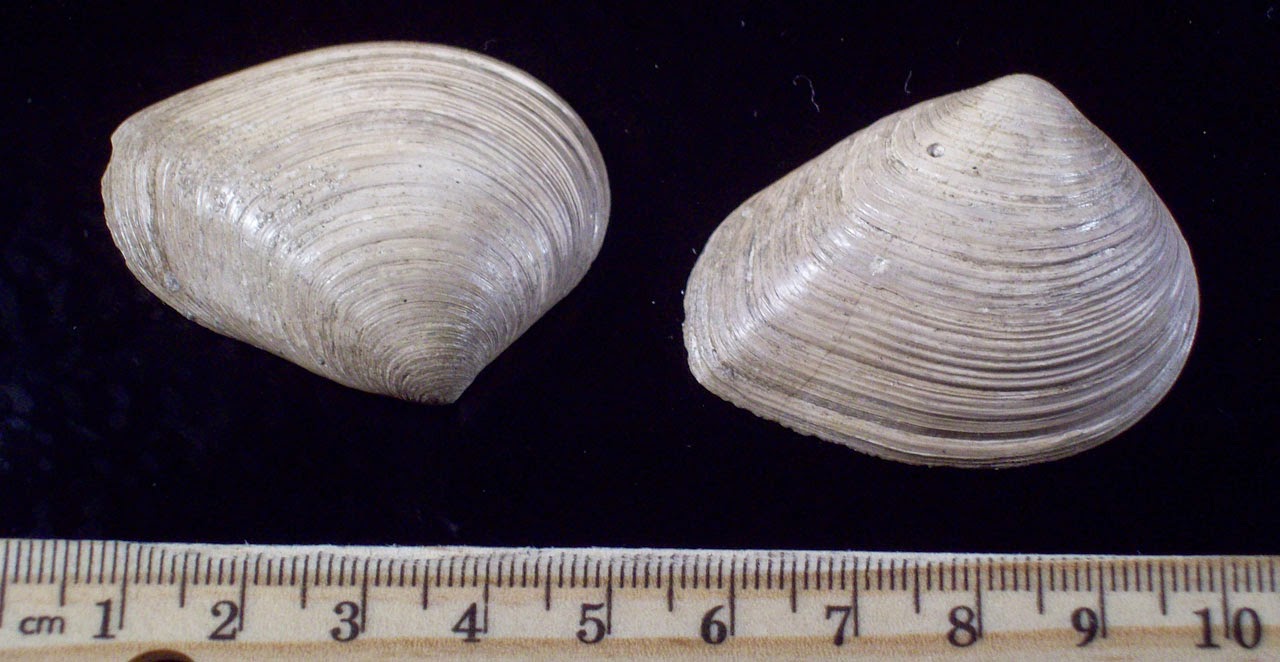
Here are some pictures from a mineral museum of calcite specimen found in the state of Florida of the United States. Fossils are probably the Giant Venus Clam fossil (aka Mercenaria permagna) of the Fort Drum Member, Nashua Formation of Ruck's Pit in Okeechobee County, Florida, USA. This animal lived in the Calabrian Stage (780,000 years ago to 1.8 million years ago) of the Pleistocene Epoch of the Quaternary Period.

Specimen was on display at the la Specola Museo Di Zoologia Ceropastica e Mineralogia (Florence, Italy) (August 2024).


Sunday, December 13, 2020

A Clam Fossil and Its Friends


Pictured above is a hash plate from the Calloway Creek Formation of Spencer County Kentucky USA. The main fossil is a mostly intact Caritodens demissa (Conrad, 1842) clam fossil with some interesting fossils on or around it. Below is unidentified 4mm diameter bryozoan fossil on the clam fossil.

Near the bryozoan on the shell is the 1.5 mm cephalon of unidentified trilobite fossil seen below.


Near by is the spine of an unidentified trilobite fossil measuring about 4 mm.

Off to the side of the shell is the pygidium of probably a Flexicalymene trilobite fossil about 5mm in size.

Thanks to Kenny for the pictures of his recent fossil find.

Pelecypod fossil originally described by Timothy Abbott Conrad in 1842 as Avicula demissa in "Observations of the Silurian and Devonian systems of the U.S., with descriptions of new organic remains" Journal of the Academy of Natural Sciences of Philadelphia, v. 8, no. 2, p. 228-235.

Plate XIII figure 3


Find on Internet here:

https://www.biodiversitylibrary.org/item/79280#page/260/mode/1up

Monday, August 24, 2020

Opal Plesiosaur Vertebra Fossil


In August 2020, I visited The Field Museum of Natural History. It is an amazing place for any one interested in natural history. My main interests were the fossil and mineral collections on display. One specimen that really impressed me was in the Grainger Hall of Gems. It was an opal plesiosaur vertebra fossil from Australia. The Grainger Hall of Gems started off as a Tiffany & Company gem collection exhibited at Chicago's 1893 World's Columbian Exposition. After the exposition was over, it was purchased and made part of the new museum when it opened in 1921.

Over hundreds and thousands of years silica-rich groundwater dissolve fossil remains and leave silica gel. Once the gel hardens it forms opal. Also included in the display are opal fossilized clam and snail fossils.


I have documented other Australian opal fossils at the Natural History Museum in London, England:
https://louisvillefossils.blogspot.com/2020/02/opal-gastropod-fossils.html

and Muséum National D'Histoire Naturelle Minéralogie et Géologie in Paris France
https://louisvillefossils.blogspot.com/2016/08/opal-belemnite-fossils.html

Wednesday, June 3, 2020

Venericardia planicosta Pelecypod Fossil


This bivalve fossil was found in Monroeville, Monroe County, Alabama in the Gosport Sand Formation.  It existed in the Eocene Epoch of the Paleogene Period. The fossil appears to be a Venericardia planicosta (Lamarck 1801).  It is extra nice in that both halves are present. I still need to clean this fossil. Thanks to Herb & Pam for the fossil.


Identification based on plate 167 figure 22 of Index Fossils of North America (Shimer & Shrock, 1944).


Monday, May 25, 2020

UV Fluorescent Mercenaria Clam Fossil


This post shows some images of a Giant Venus Clam fossil (aka Mercenaria permagna) of the Fort Drum Member, Nashua Formation of Ruck's Pit in Okeechobee County, Florida, USA. This animal lived in the Calabrian Stage (780,000 years ago to 1.8 million years ago) of the Pleistocene Epoch of the Quaternary Period.

What is special about this fossil is that the calcite crystals that form inside the shell are yellow fluorescent to ultraviolet (UV) light. The above image was using an LED array to illuminate it.


Thanks to Rusty for this fossil.

Friday, April 3, 2020

Cypricardinia arata Pelecypod Fossil


This image is of several very nice Cypricardinia arata clam fossils. They were found in the Waldron Shale of Clark County, Indiana USA. The fossils date to the Silurian Period (Wenlock Epoch, Sheinwoodian to Homerian Stage).
Thanks to Kenny for the image.

Friday, March 13, 2020

Syrian Propeamussium eocenicum Fossil


This image is of a Propeamussium eocenicum (Sacco) pelecypod fossil. It was found near Damascus Syria. The fossil dates to the Eocene Epoch. It was displayed at Muséum National D'Historie Naturelle Jardin Des Plantes Paléontologie et Anatomie Comparée, Paris, France.  Image taken August 2016.

Thursday, February 6, 2020

Cast of Large Ambonychia Clam Fossil with Bryozoan


This fossil mold appears to be an Ambonychia clam with both valves and is big enough to almost cover the palm of a hand. The clam fossil may have several colonies of cyclostome bryozoan (though only their holdfasts remain). I don't see where the zooids would bud out of their protective structures.The branching pattern seen in the pictures can be found on quite a few clam molds at the site this fossil was collected.
On both sides there are remnants of another bryzoan in what seems to be Prasapora simulatrix.

It looks like the shell eroded away and the bryozoan set up shop on the mold but on both sides. Not sure how this was accomplished at the same time which leads me to believe they grew on one side till the fossil was turned over and then new colonies grew on this water exposed side. Just a theory...


This fossil was found in Bullitt County, Kentucky, USA. It might be from the Grant Lake Formation. The fossil dates to the Ordovician Period.


Tuesday, December 11, 2018

Mercenaria Clam Fossil


This image is of a Mercenaria sp. clam fossil.  The fossil dates to the Jurassic Period (210-145 million years ago). The specimen was found in Mahajunga, Madagascar. It was on display at the Indiana University Southeast (IUS)
campus, first floor of Sciences Building as part of Glenn M. Mason collection. Image taken November 2018.

Monday, January 8, 2018

Ambonychia Clam Fossil with Bryozoan


These images are of Ambonychia sp. clam fossils encrusted with bryozoan. Fossils are from the Ordovician Period. They were found in Jefferson County, Indiana, USA.


Thanks to Kenny for images.

Sunday, December 3, 2017

Cone Shaped Rudistid Clam Fossil


This image is of Eoradiolites davidsoni clam fossil on display at Mace Brown Museum of Natural History (August 2017). They date to about 120 million years ago, Early Cretaceous Period. The fossil was found in the Denton County Texas USA.

The Mace Brown Museum of Natural History is located at the College of Charleston, 202 Calhoun Street, 2nd Floor, Charleston, South Carolina 29424.

Learn more at their blog: http://blogs.cofc.edu/macebrownmuseum/

Sunday, August 20, 2017

Amusium mortoni Bivalve Fossil


Recently I visited The Charleston Museum in South Carolina USA. It is one of the oldest museums in the United States. Founded in 1773 and opened to the public in 1824. I was hoping to see the natural history exhibit with special interest in fossils and minerals on display. Unfortunately, these areas were undergoing remodeling during my visit. In the main entrance area, they did have some minerals and this fossil was on display.

The picture above is an Amusium mortoni Ravenei 1844 saltwater clam fossil. Fossil dates to the Pliocene epoch (Neogene Period) and was found in Charleston County South Carolina.

Outside the closed Natural History Gallery was a model showing what the renovated area will look like when it re-opens September 23, 2017.


Wednesday, February 22, 2017

Astarte Clam Fossil


The Astarte (Coelastarte) excavata (J. Sowerby) pelecypod fossil from the Middle Jurassic Period (174-164 million years ago). Found in Inferior Oolite, Dundry Somerset England. On display at the British Natural History Museum London as of August 2016.

Sunday, February 19, 2017

Inoceramus concentricus Clam Fossils


This image is of the fossilized remains Inoceramus (Actinoceramus) concentricus clams. They were found in the Gault clay of Kent England. This layer dates to the Cretaceous Period.

Specimen on display in the mineral area of the British Natural History Museum in London on August 2016.

Sunday, March 1, 2015

Endocostea simpsoni Clam Fossil from Colorado


This Endocostea simpsoni inoceramid clam fossil is on display at the Mesa Verde National Park as of August 2014. The clam existed in the Late Cretaceous Period (Campanian).

The area is rich in geological history going back 2 billion years. The national park was founded in 1906 to protect the Anasazi Native American sites found on the mesa tops, cliffs, and canyons. The exposed areas found in the park are from the Mesozoic Era, Cretaceous Period (about 100-78 million years ago). They make up four formations: Cliff House, Menefee, Point Lookout, and Mancos.

Reference:
Guide to the Geology of Mesa Verde National Park by Mary O. Griffitts, 1990, ISBN 0-937062-11-1
Available at amazon.com at this web link.

Monday, December 22, 2014

Cretaceous Clam Fossil


While touring the Natural History section of the Arizona Historical Society Museum at Papago Park (1300 N. College Ave, Tempe Arizona 85281) I saw this clam fossil specimen (AHS-NH#21712)

This fossil was probably found in the Pierre Shale Formation of Glendive, Dawson County, Montana, USA. It dates to the Cretaceous Period.

Image was taken in October 2014.

Sources:
Neat image of Cretaceous Inoceramus clam fossil with pearls
http://www.paleocurrents.com/baculite_mesa/img/2003-05-17mesa_fossils/HTML/img_2480.htm

Monday, September 22, 2014

Crassatella Pelecypod Fossil Evidence of Predation


The shell fossil in the first picture shows signs of predation probably from some sort of gastropod. These fossils appear to be Crassatella vadosus pelecypods (named by Morton 1834). They existed during the Cretaceous Period (about 70 million years ago). This fossil was found in McNairy County, Tennessee (Ripley Formation).

See their identification PDF at this LINK.

Learn more about these fossils at the Coon Creek Science Center web site: http://www.memphismuseums.org/coon_creek-overview

Fossils from the Herb Miracle collection.


Sunday, September 21, 2014

Cyprimeria Pelecypod Fossil


The fossil appears to be Cyprimeria alta pelecypod fossil. It existed during the Cretaceous Period (about 70 million years ago). This fossil was found in McNairy County, Tennessee (Ripley Formation).

Fossils from this locality have an identification PDF at this LINK.

Learn more about these fossils at the Coon Creek Science Center web site: http://www.memphismuseums.org/coon_creek-overview

Fossil from the Herb Miracle collection.

Monday, November 25, 2013

Ambonychia Pelecypod Fossil with Bryozoan


This fossil appears to be an Ambonychia clam fossil with both valves. It is has quite a bit of matrix covering detailed parts. The clam fossil has a colony of cyclostome bryozoan (see this web site image or called ctenostome type on this web site).

The fossil still needs to be cleaned to see if more shell and bryozoan detail can be revealed. It is rare for me to find clams with both valves intact so this was a happy discovery.

The fossil was found in the Kope Formation of Carroll County, Kentucky, USA. These creatures existed in the Ordovician Period.


Wednesday, November 6, 2013

Homilodonta filistriata Clam Fossil


This picture shows what appears to be a Homilodonta filistriata clam or pelecypod fossil. It was found in the Kope Formation (Eden Group) of Carroll County, Kentucky, USA. It dates to the Ordovician Period. According to the fossilworks web site, it is also known as Ctenodonta filistriata and Deceptrix filistriata.

It is still in matrix and appears to have both valves.