Here is a cool picture of an Atrypa (Hall, 1862) brachiopod fossil (note the circle in the top left corner probably made by a gastropod). The fossil was found in the Genshaw Formation at Carmeuse Quarry, Rogers City, Michigan USA. The creature lived Middle Devonian Period (Erian Stage).
Showing posts with label predation. Show all posts
Wednesday, September 22, 2021
Predation on Atrypa Brachiopod Fossil
Labels:
alpena,
brachiopod,
devonian,
michigan,
predation
Saturday, January 30, 2021
Eocene Leaf Fossil with Insect Holes
Unidentified leaf fossil found in the Florisant formation of Teller County Colorado USA. This fossil is special in that it has three places on the leaf where there is predation. The darker areas show signs of the leaf repairing itself. The fossil dates to the Eocene Epoch. The leaf is about 3.5 cm in length.
Thanks to Kenny for the image.
Monday, September 22, 2014
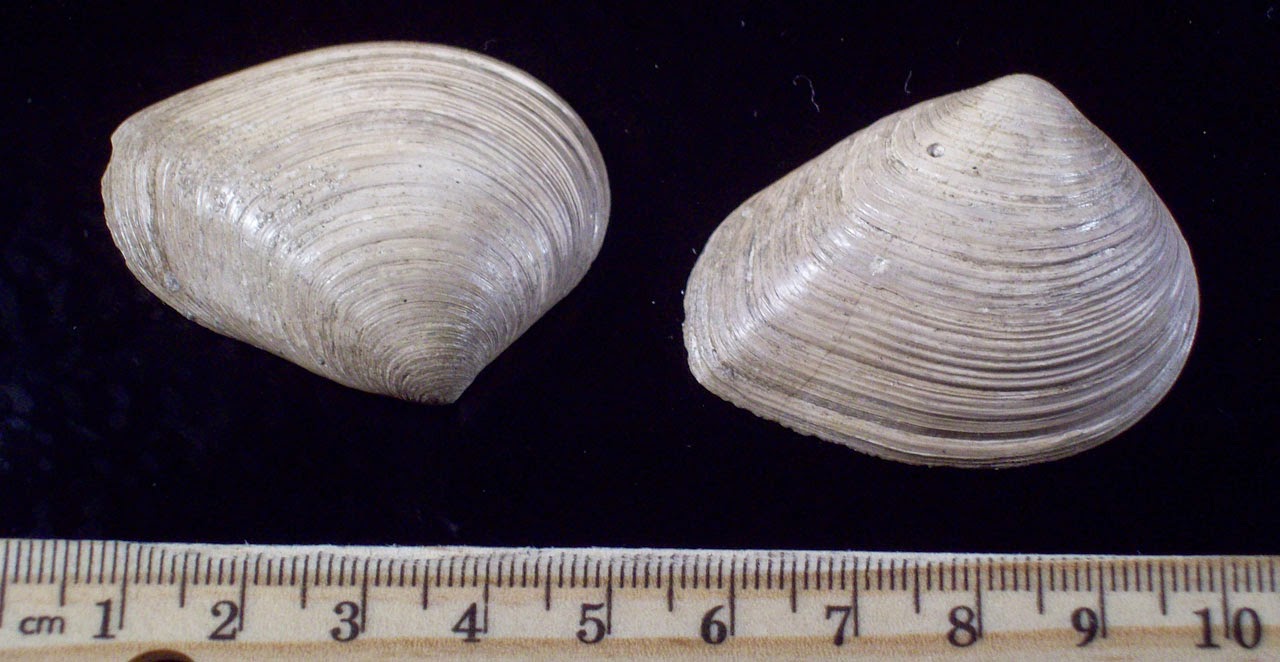
Crassatella Pelecypod Fossil Evidence of Predation
The shell fossil in the first picture shows signs of predation probably from some sort of gastropod. These fossils appear to be Crassatella vadosus pelecypods (named by Morton 1834). They existed during the Cretaceous Period (about 70 million years ago). This fossil was found in McNairy County, Tennessee (Ripley Formation).
See their identification PDF at this LINK.
Learn more about these fossils at the Coon Creek Science Center web site: http://www.memphismuseums.org/coon_creek-overview
Fossils from the Herb Miracle collection.
Labels:
clam,
coon creek,
Cretaceous,
pelecypod,
predation,
tennessee
Thursday, July 19, 2012
Escharopora falciformis Bryozoan
This partial fossil bryozoan attached to a piece of Lexington Limestone matrix appears to be an Escharopora falciformis. It was found in Franklin County, Kentucky and is Ordovician in age.
Similar fossils like are shown in Plate III Figures 17-19 (page 45) in Cincinnati Fossils An Elementary Guide to the Ordovician Rocks and Fossils of the Cincinnati, Ohio, Region edited by R.A. Davis 1998. The guide describes the fossils as "characteristic flat, blade shape, and the pattern of diamond-shape apertures." The text goes on to say they are found in the Mt. Hope and Fairmount subdivisions (Cincinnatian Series, Maysvillian Stage).
Thanks to Herb for the fossil and identification help.
Next image is of the fossil wet which highlights predation on its surface.
Similar fossils like are shown in Plate III Figures 17-19 (page 45) in Cincinnati Fossils An Elementary Guide to the Ordovician Rocks and Fossils of the Cincinnati, Ohio, Region edited by R.A. Davis 1998. The guide describes the fossils as "characteristic flat, blade shape, and the pattern of diamond-shape apertures." The text goes on to say they are found in the Mt. Hope and Fairmount subdivisions (Cincinnatian Series, Maysvillian Stage).
Thanks to Herb for the fossil and identification help.
Next image is of the fossil wet which highlights predation on its surface.
Labels:
bryozoan,
cincinnatian,
Kentucky,
ordovician,
predation
Subscribe to:
Posts (Atom)