Friday, May 14, 2010

Fossils of Bullitt County

Pictures contained in this posting are of Ordovician Period fossils found in Bullitt County, Kentucky. I believe they are from the Grant Lake Formation.

This first fossil is a Platystrophia sp. brachiopod.  I like to think of it as the Kentucky's state fossil even though all brachiopods found in the state are.

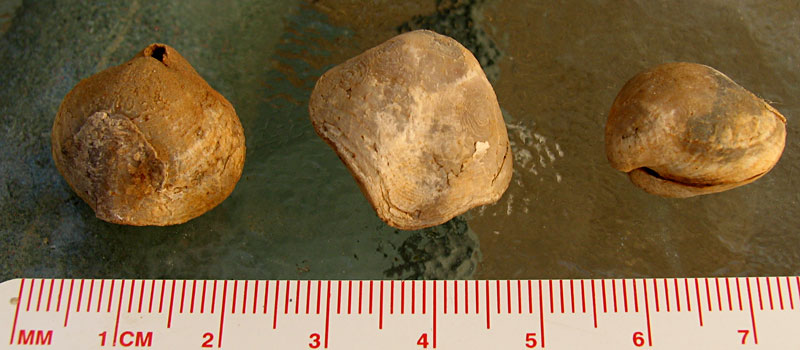
This pelecypod or clam is called Caritodens demissa? (Conrad, 1842).  They are somewhat rare where I look and this is probably the 6th one I have found in 2 years of looking.


This fragment is of an Ambonychia robusta? Hall clam fossil.  Another rare find and I used the engraver to reveal more of the shell pattern.  It reminds me of the modern day fan shell (family Pinnidae).

Mold of another clam that might be an Ischyrodonta elongata? (Ulrich).  Finding molds like is probably the most common clam fossil to find.

Pygidium (rear section) of a Flexicalymene trilobite.  I found two the say this was collected.  How did it come to be?  Part of a molt, broken remains of the trilobite, or maybe a piece left after a cephalopod made a meal of the rest of its body?  The answer is lost from a previous time.


Feeding scoop or hypostoma of an Isotelus trilobite.


Playstrophia brachiopod with some matrix still attached to the fossil.


A cluster of Rafinesquina brachiopods which is rare for me to find.  The clump probably contains over 20 shell fossils.  This brachiopod is named after the famous yet eccentric French naturalist Constantine Rafinesque.  Rafinesque is buried at Transylvania University located in Lexington, Kentucky.


Platystrophia brachiopod embedded in matrix but with great growth lines exposed.


Another Platystrophia brachiopod that needs to have residue matrix cleaned off.


Hebertella brachiopod not as common as the Platystrophia at this site.


I think this in an internal mold of a Hebertella brachiopod.


These next two images are of maybe a Liospira gastropod fossil.


Last two images are of the unknown straight shelled cephalopod.  Appear to be molds.


Thursday, May 13, 2010

Athyris Brachiopod


This post is about the Athyris brachiopod fossil.  The brachiopod existed in the Devonian Period (416-359 million years ago).  The picture of three brachiopods above are from Clark County, Indiana found in the Speed Member of the North Vernon Limestone.  The two brachiopods shown below are from the Glenshaw Formation of Alpena County, Michigan.


Next picture is of the Athyris vittata brachiopod from Michigan.


These last three pictures are of the Michigan and Indiana Athyris side by side.  It appears to me that the ones from Indiana might be molds or worn because they do not show the growth lines of the specimens from Michigan.  The difference in color is also of interest.  Why are the Michigan fossils black?  Were they in some sort of shale?


This last picture of the Indiana Athyris brachiopod (one on right) really shows the beekite patterns.

UPDATE: Jeepers! I forgot to thank Dave over at Views of the Mahantango for sending me the brachiopods from Michigan shown in this post.

Wednesday, May 12, 2010

Indiana University Press Spring SALE!

Thanks to the blog Love in the Time of Chasmosaurs for the notice about Indiana University Press spring/summer book sale with some books marked down 80% with free U.S. ground shipping for orders of $25 or more.  Enter code WWEZXX at checkout to receive discounts, quantities limited and sale ends 06/30/2010.

I like Echinoderm Paleobiology for $36 and Oceans of Kansas for $24.  If you like dinosaurs, they have quite a few books on sale.

Books of interest Limestone Lives - Voices from the Indiana Stone Belt by Katherine Ferrucci at $21 and This Place We Call Home - A History of Clark County, Indiana by Carl E. Kramer at $21.