Showing posts with label unidentified. Show all posts

Wednesday, February 16, 2022

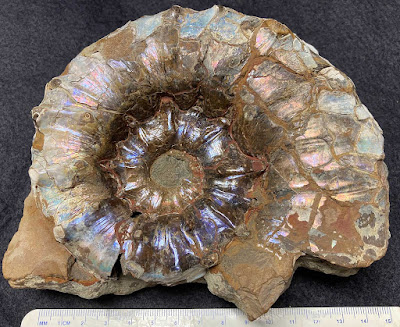
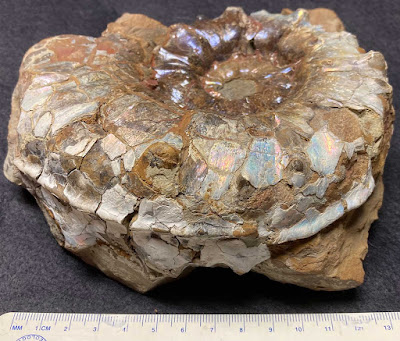
What Genus is this Ammonite Fossil?


My cousin Kenny acquired a partially exposed ammonite fossil from a long time mineral collector years ago. Recently, he has prepped more of it showing more of the inner whorl.  No collecting information is known about it and image searches have not shown any fossil quite like it.

The current guess as to what it might be is Euaspidoceras

UPDATE (August 2022): I now wonder if this a Prionocyclus hyatti  (Stanton, 1894) found in Kansas in the Cretaceous Period Carlile Formation. See this specimen at the Sternberg Museum of Natural History at Fort Hays State University.

Monday, February 22, 2021

Unidentified Insect Fossils From Florrisant Colorado


These images show unidentified insect fossils found in the Florissant Formation of Teller County, Colorado, USA. They date to the Eocene Epoch of the Paleogene Period.

The field of view (FOV) for the pictures in order of view: 1mm,5mm, 2mm, and 4mm.

Thanks to Kenny for the images.

Sunday, February 21, 2021

Unidentified Florissant Insect Fossil

These images show unidentified fossils found in the Florissant Formation of Teller County, Colorado, USA. The field of view (FOV) for the top one is 6 mm and the bottom image is a close up of the insect's head. They date to the Eocene Epoch of the Paleogene Period.

Thanks to Kenny for the images.


Friday, February 19, 2021

Unidentified Insect Fossils


These images show unidentified insect fossils found in the Florissant Formation of Teller County, Colorado, USA. They date to the Eocene Epoch of the Paleogene Period.

The field of view (FOV) for the pictures in order of view: 2mm,6mm, 8mm, 5mm, and 4mm.

Thanks to Kenny for the images.

Monday, September 21, 2020

Something New From The Waldron Shale


UPDATE (11-13-2020): I now think this fossil is a cluster of holdfasts for cystoids. See my post about this here.

Last Saturday (09-19-2020) I visited a Waldron Shale site and found a fossil I have not seen before. At first I thought it might be some sort of colonial coral. I showed it to my cousin Kenny and he thought it might be a parasite on a crinoid column. Similar to a fossil he found in 2015, on a Mississippian Period fossil. See this posting for more info. See image below of a Mississippian crinoid stem with what appear to be galls from parasitic marine worms.

One can see the similarities with the current Waldron Shale find.

He will need to prep this new find to see there is a crinoid column this fossils are attached to or part of. These shapes do look similar to galls of putative myzostomids (small marine worm) on crinoids as seen on a researchgate.net page showing an image from the book Fossil Crinoids by Hans Hess, William I. Ausich, Carlton E. Brett, and Michael J. Simms (Cambridge University Press, 1999).

Upon further Internet searching I came across the Time Scavengers blog with a 2017 post about The College of Wooster's paleontologist Mark A. Wilson. He posted an image Upper Ordovician cobble with encrusting crinoids (three volcano-like fossils). These shapes have some similarity to this fossil find has well. Could they be a cluster of small crinoid holdfasts?


Link to scan of the paper on Tremichnus by Carlton E. Brett from 1985:
http://webcentral.uc.edu/eprof/media/attachment/eprofmediafile_1303.pdf

Link to paper Phosphannulus on Paleozoic Crinoid Stems by James R. Welch 1976:
https://www.jstor.org/stable/1303489

Link to chapter entitled Biotic Interactions among Recent and among Fossil Crinoids by David L. Meyer and William I. Ausich. See section on Parasitism and Table V for information about parasites that infest crinoid.
https://www.researchgate.net/profile/David_Meyer16/publication/283756496_Biotic_Interactions_among_Recent_and_among_Fossil_Crinoids/links/568ad15008ae1975839db6d3/Biotic-Interactions-among-Recent-and-among-Fossil-Crinoids.pdf

Link to paper entitled Host-specific pit-forming epizoans on Silurian crinoids by Carlton E. Brett. The images show mostly boring holes and not the structures with holes seen in this fossil.
https://deepblue.lib.umich.edu/bitstream/handle/2027.42/75404/j.1502-3931.1978.tb01229.x.pdf?sequence=1

Link to article Phylogeny of Myzostomida (Annelida) and their relationships with echinoderm hosts by Mindi M. Summers and Greg W. Rouse.
https://bmcevolbiol.biomedcentral.com/articles/10.1186/s12862-014-0170-7

Monday, August 31, 2020

Unidentified Florissant Insect Fossil


This image shows an unidentified insect fossil found in the Florissant Formation of Teller County, Colorado, USA. The field of view (FOV) is 4 mm. It dates to the Eocene Epoch of the Paleogene Period.

Thanks to Kenny for the image.

Sunday, February 23, 2020

Pecten Scallop + Coral Fossil


I am not sure where or what time period this fossil is from. It appears to be a Pecten pelecypod fossil with small coral colony attached.  Looking at the indentation in the shell it may have had more colonies attached at one time.


It was part of the James Conkin collection.


Monday, January 29, 2018

Unidentified Devonian Scolecodont Fossil


This microfossil is an unidentified scolecodont. The field of view (FOV) is about 3 mm. It dates to the Devonian Period. The fossil was found in the Beechwood Limestone of Clark County, Indiana USA.

Thanks to Kenny for the image.

Thursday, December 21, 2017

Unidentified fossil?


This image was sent to me recently and the sender asked if I knew what it was. It looks to me to be impressions left by plant stems or leaves. It was found in Breckinridge County, Kentucky USA. The county appears to be mostly in Mississippian Period surface rock but west of the county is Pennsylvanian Period rock.

If anyone has an idea of what this might be, please leave a comment or e-mail me at louisvillefossils@gmail.com. Thanks!

Monday, January 26, 2015

Unidentified Fish Fossils

When I go on trips I sometimes try to find fossils or minerals from that area as a memento. My last trip to Arizona I found this plate in a museum gift shop. Unfortunately, it had no identification label so I do not know its name, location where found, geological formation, or time period. Since it was in a gift shop it must be from an area where fish fossils are commonly found and sold to collectors. Areas I find on the Internet as sources of fish fossils are Green River, Wyoming, Liaoning/Hubai, China, and Ceara, Brazil.


The fish does sort of look like a Dastilbe crandalli found in the Santana Formation of Ceara, Brazil. Fish from that area date to the Lower Cretaceous Period.

The matrix had 2 other fish remains on it. One is of the tail and rear vertebra and the other fossil on the other side of the plate is a jumbo of parts which includes some of the rib bones.


Source:
http://en.wikipedia.org/wiki/Dastilbe


Friday, May 6, 2011

Brown Puff Ball Fossil


Not sure what this is, thought it might be some sort of crinoid calyx but cannot find where the stem attached.  Reminds me of a brownish dinner roll or slightly deflated doughnut hole.  It is about 2 cm wide and 1 cm tall embedded in matrix with a lot of Cryptolithus trilobite pieces.  The brown material might be argonite.  Matrix is the Kope Formation of the Ordovician period found in Carroll County, Kentucky.

Also included is a picture of a fragment of an Ambonychia clam fossil located on the same matrix block as this mystery fossil.