Showing posts with label paleocene. Show all posts

Thursday, December 21, 2023

Paleohyptodus rutoti Fossil Shark Teeth


This image is of some fossil teeth of the Sand Tiger shark aka Paleohyptodus rutoti (Winkler, 1874) on display at Mace Brown Museum of Natural History (August 2017). It dates to the Paleocene Epoch of the Paleogene Period. The fossils were maybe found in the rivers of South Carolina USA.

The Mace Brown Museum of Natural History is located at the College of Charleston, 202 Calhoun Street, 2nd Floor, Charleston, South Carolina 29424.

Learn more at their blog: http://blogs.cofc.edu/macebrownmuseum/

Monday, February 28, 2022

Physalis infinemundi Plant Fossil

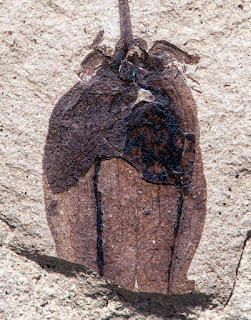
Wilf P, MR Carvalho, MA Gandolfo, NR Cúneo. 2017. Eocene lantern fruits from Gondwanan Patagonia and the early origins of Solanaceae. Science, v. 355, p. 71-75, 6 January 2017. DOI: 10.1126/science.aag2737. Image from figshare.com CC by 4.0

Today's posting shows a fossil from the Solanaceae or nightshade family. It is called Physalis infinemundi (Wilf, 2017). When alive, it grew in Patagonia (location now known as Chubut Province, Argentia; about 52 million years ago Paleocene Epoch, Paleogene Period). Fossil was named by Peter Wilf of Penn State University in 2017. This fossil is curated at Museo Paleontológico Egidio Feruglio in Trelew, Chubut, Argentina. It appears to be Physalis fruit also known as a fossil tomatillo. Moving ahead in time to the present, shown below is a picture of a tomato today grown with some of the latest agricultural technology.
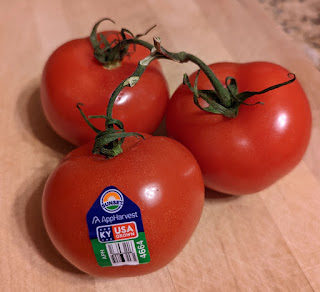
Recently, I was interested in tomatoes after buying some in the produce section of the local Walmart. The tomatoes were quite good being that Kentucky is in the winter time. As it turns out the tomatoes were grown in Kentucky at an in door farm located in the Appalachia region of the state by AppHarvest. Doing some research into this company I was impressed that they were: bringing jobs to Appalachia, using recycled rainwater, growing enclosed thus no harsh chemical pesticides/LED lighting, climate controlled buildings where bees used for pollination, and robotic harvesting.

I used the tomatoes on garden salads and as one of the vegetables on burritos. They were very tasty! Picture below of tomatoes at the Walmart produce section.

Sources:

Article about this fossil
 Wilf P, MR Carvalho, MA Gandolfo, NR Cúneo. 2017. Eocene lantern fruits from Gondwanan Patagonia and the early origins of Solanaceae. Science, v. 355, p. 71-75, 6 January 2017. DOI: 10.1126/science.aag2737

Informative blog post about Tomatillos
 
Blog post by Martha Stewart about her visit to AppHarvest

Thursday, November 1, 2018

Notidanodon loozi Fossil Shark Teeth


This image is of Notidanodon loozi fossil shark teeth on display at Mace Brown Museum of Natural History (August 2017). This extinct animal was also known as a cow shark. It dates to the Paleocene Epoch (Thanetian, about 58 million years ago), Paleogene Period. The fossils were found in Descenderie D Basin (Ouled Abdoun) Morocco, North Africa.

The Mace Brown Museum of Natural History is located at the College of Charleston, 202 Calhoun Street, 2nd Floor, Charleston, South Carolina 29424.

Learn more at their blog: http://blogs.cofc.edu/macebrownmuseum/

Tuesday, April 11, 2017

Coryphodon oweni Fossil


This fossil is part of a skull of an extinct pantodont known as Coryphodon oweni. Fossil was named by Herbert in 1856. It was found in the Meudon of Sparnacian of France. This creature existed in the Paleocene and Lower Eocene Epochs of the Paleogene Period.. It was on display in August of 2016 at the  Muséum National D'Historie Paris.

Wednesday, September 8, 2010

Ginkgo biloba Fossil


A short time ago, I read an informative post on about Ginkgo biloba fossils on my friend's blog: Views of the Mahantango.  Reviewing pictures from a recent trip to the Smithsonian Museum of Natural History, they have a display on living fossils which they cover the Ginkgo or Maidenhair Tree (aka Ginkgo biloba).  The text of the display says this tree is what Charles Darwin referred to as the "living fossil".  The plant has is origins over 290 million years ago or the Late Carboniferous Period.

The plant is known for its fan-shaped leaves which can be seen in the fossil pictures.  The above picture is of a Ginkgo digitata of the Jurassic Period found in Spitsbergen.  The last two pictures of a ginkgo leaf fossil found in Montana of the Paleocene.


Wednesday, May 19, 2010

Turritella Gastropod of Alabama


About 60 million years ago (or so) during the Paleocene epoch, a towering coiled shell sea gastropod roamed a shallow sea that is now where southern Alabama is in the United States.  Fast forward to the early 1800s, Timothy Abbott Conrad from the Academy of Natural Sciences of Philadelphia spends years studying the shell fossils of Monroe County, Alabama.  His studies result in a book Fossil Shells of the Tertiary Formations of North America which a reproduction of can be found at Google Books website.


The fossil pictures in this post were found in the Gosport Sand or Lisbon Formation of the Paleocene Epoch/Eocene Period. The location was Monroe County, Alabama, USA. This gastropod fossils might be the Turritella mortoni?.  Thanks to Pam and Herb for these fossils. 


Close up of spiral point.