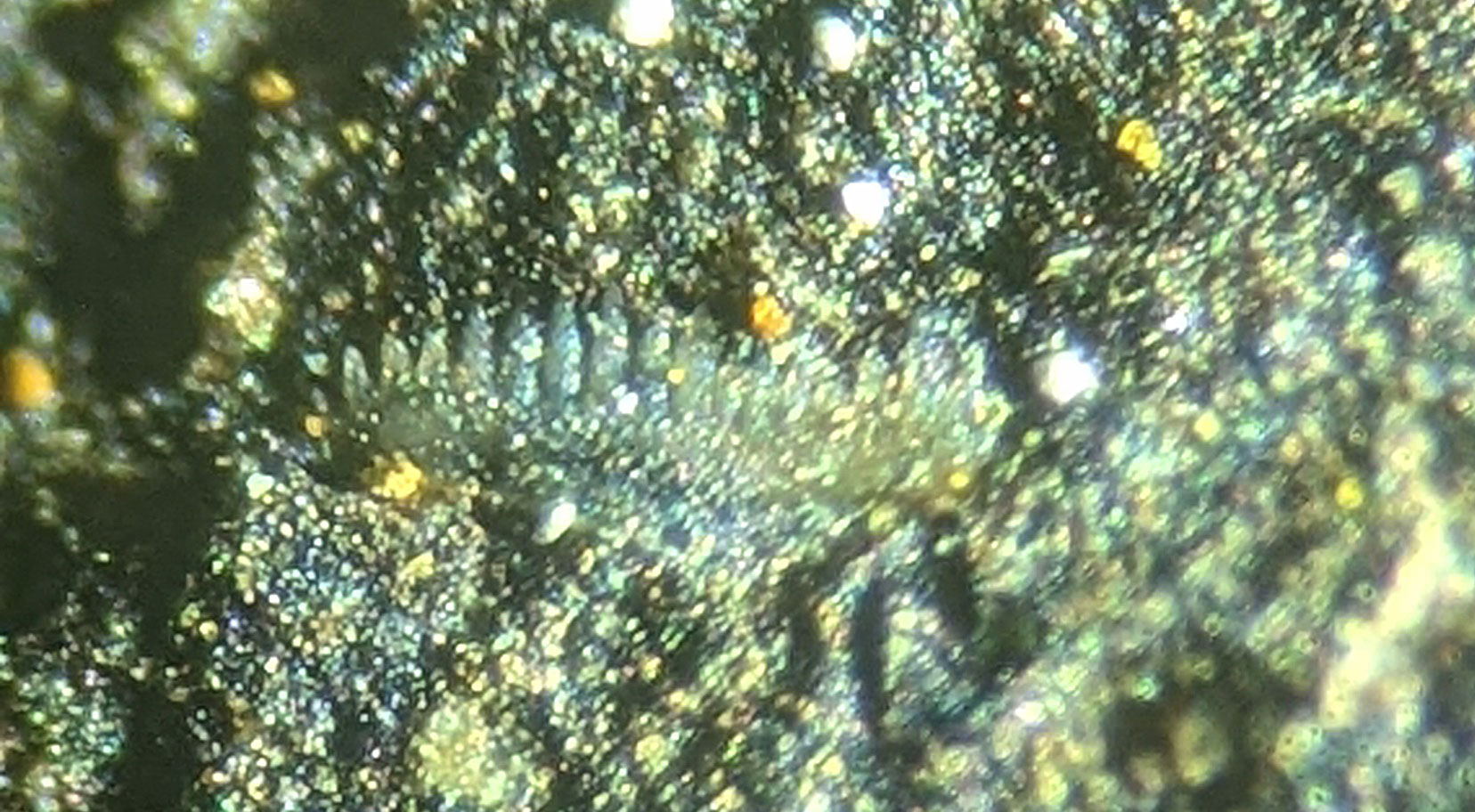
Conodont (on right side) with sponge holdfast fossils found in the New Albany
Shale. It dates to the Upper Devonian Period. Specimen from the Barbara
Conkin collection and was probably found in Clark or Floyd County,
Indiana USA. Thanks to Kenny for the image. Field of view about 6 mm.
Thursday, August 13, 2026
Sponge Holdfast Fossil in New Albany Shale
Wednesday, August 12, 2026
New Albany Shale Conodont Fossil
Conodont fossil found in the New Albany
Shale. It dates to the Upper Devonian Period. Specimen from the Barbara
Conkin collection and was probably found in Clark or Floyd County,
Indiana USA. Thanks to Kenny for the image. Field of view about 3mm.
Wednesday, November 16, 2022
Unidentified Conodont Fossils
Conodont fossils found near
Brookville Lake, Franklin County, Indiana USA and Waynesville Formation dates to the
Ordovician Period.
Images have a field of view is 1 mm.
Wednesday, September 28, 2022
New Albany Shale Conodonts
Here are two freshly found conodont fossils in the New Albany Shale (Late Devonian Period). The first appears to be some sort of Spathognathodus sp. (Branson and Mehl, 1941). The second appears to be of the genus Elictognathus (Cooper, 1939). Both were found on a shale plate about 4 cm by 4 cm. Field of view for images was about 1 mm. Specimens were collected in Floyd County, Indiana, USA. Indiana Geological Survey Bulletin 41, Conodonts from the Jacob Chapel Bed (Mississippian) of the New Albany Shale in Southern Indiana by Carl B. Rexford (1969) was used for the identification of these fossils.
Sunday, January 28, 2018
Icriodus Conodont Fossil
This microfossil appears to be an Icriodus sp. conodont. The field of view (FOV) is about 1 mm. It dates to the Devonian Period. The fossil was found in the Beechwood Limestone of Clark County, Indiana USA.
Thanks to Kenny for the image.
Monday, December 8, 2014
Conodont Microfossil Polygnathus longiposticus
This image shows what appears to be a Polygnathus longiposticus conodont fossil. This creature existed in the Mississippian Period. Fossil was found in the Jacob Chapel Shale of Clark County Indiana USA.
Source for ID is Conodonts of the Jacobs Chapel Shale by Carl B. Rexroad, Indiana Department of Natural Resources Geological Survey Bulletin 41 (published Bloomington Indiana 1969).
Thanks to Kenny for the image.
Sunday, December 7, 2014
Spathognathodus sp. Conodont Microfossil
This image shows what appears to be a Spathognathodus sp. conodont fossil. This creature existed in the Mississippian Period. Fossil was found in the Jacob Chapel Shale of Clark County Indiana USA.
Source for ID is Conodonts of the Jacobs Chapel Shale by Carl B. Rexroad, Indiana Department of Natural Resources Geological Survey Bulletin 41 (published Bloomington Indiana 1969).
Thanks to Kenny for the image.
Saturday, December 6, 2014
Spathognathodus crassidentatus Conodont Fossil
This image shows what appears to be a Spathognathodus crassidentatus conodont fossil. This creature existed in the Mississippian Period. Fossil was found in the Jacob Chapel Shale of Clark County Indiana USA.
Source for ID is Conodonts of the Jacobs Chapel Shale by Carl B. Rexroad, Indiana Department of Natural Resources Geological Survey Bulletin 41 (published Bloomington Indiana 1969).
Thanks to Kenny for the image.
Friday, December 5, 2014
Conodont Spathognathodus macer Fossil
This image shows what appears to be a Spathognathodus macer conodont fossil. This creature existed in the Mississippian Period. Fossil was found in the Jacob Chapel Shale of Clark County Indiana USA.
Source for ID is Conodonts of the Jacobs Chapel Shale by Carl B. Rexroad, Indiana Department of Natural Resources Geological Survey Bulletin 41 (published Bloomington Indiana 1969).
Thanks to Kenny for the image.
Thursday, December 4, 2014
Ozarkodina Conodont Fossil
This image shows what appears to be an Ozarkodina conodont fossil. This creature existed in the Mississippian Period. Fossil was found in the Jacob Chapel Shale of Clark County Indiana USA.
Source for ID is Conodonts of the Jacobs Chapel Shale by Carl B. Rexroad, Indiana Department of Natural Resources Geological Survey Bulletin 41 (published Bloomington Indiana 1969).
Thanks to Kenny for the image.
Wednesday, December 3, 2014
Spathognathodus macer Conodont Fossil
Source for ID is Conodonts of the Jacobs Chapel Shale by Carl B. Rexroad, Indiana Department of Natural Resources Geological Survey Bulletin 41 (published Bloomington Indiana 1969).
Thanks to Kenny for the image.
Tuesday, December 2, 2014
Ozarkodina Conodont Fossil
This image shows what appears to be an Ozarkodina conodont fossil. This creature existed in the Mississippian Period. Fossil was found in the Jacob Chapel Shale of Clark County Indiana USA.
Source for ID is Conodonts of the Jacobs Chapel Shale by Carl B. Rexroad, Indiana Department of Natural Resources Geological Survey Bulletin 41 (published Bloomington Indiana 1969).
Thanks to Kenny for the image.
Monday, December 1, 2014
Lonchodina Conodont Fossil
This image shows what appears to be a Lonchodina conodont fossil. This creature existed in the Mississippian Period. Fossil was found in the Jacob Chapel Shale of Clark County Indiana USA.
Source for ID is Conodonts of the Jacobs Chapel Shale by Carl B. Rexroad, Indiana Department of Natural Resources Geological Survey Bulletin 41 (published Bloomington Indiana 1969).
Thanks to Kenny for the image.
Sunday, November 30, 2014
Polygnathus lobatus Conodont Fossil
This image shows what appears to be a Polygnathus lobatus conodont fossil. This creature existed in the Mississippian Period. Fossil was found in the Jacob Chapel Shale of Clark County Indiana USA.
Source for ID is Conodonts of the Jacobs Chapel Shale by Carl B. Rexroad, Indiana Department of Natural Resources Geological Survey Bulletin 41 (published Bloomington Indiana 1969).
Thanks to Kenny for the image.
Monday, September 15, 2014
Polygnathus Conodont Fossil
Here is a picture of a recently found conodont fossil fragment. It appears to be a Polygnathus sp. The fossil was found in the Jacobs Chapel Shale of Clark County, Indiana, USA which dates to the Mississippian Period.
Thanks to Kenny for the picture.
Thursday, September 11, 2014
Bryantodus mundus Conodont Fossil
Here is a picture of a recently found conodont fossil fragment. It appears to be a Bryantodus mundus. The fossil was found in the Jacobs Chapel Shale of Clark County, Indiana, USA which dates to the Mississippian Period.
Thanks to Kenny for the picture.
Wednesday, September 10, 2014
Siphonodella duplicata Conodont Fossil
Here is a picture of a recently found conodont fossil. It appears to be a Siphonodella duplicata. The fossil was found in the Jacobs Chapel Shale of Clark County, Indiana, USA which dates to the Mississippian Period.
Thanks to Kenny for the picture.
Monday, March 4, 2013
Icriodus expansus? Conodont Fossil
Thanks to Kenny for the picture.
Monday, June 4, 2012
Calcium Acetate or the Lemon Meringue Pie Effect
Several weeks passed when I noticed something interesting in the container, formations of white crystals were forming. As it turns out a chemical reaction was taking place, one in which the limestone samples (calcium carbonate) were interacting with the vinegar (acetic acid) to form water, carbon dioxide, and calcium acetate (calcium salt). The carbon dioxide floated off into the atmosphere, the water eventually evaporated, which just left the limestone and crystallized calcium acetate.
The calcium acetate formed a texture and color that reminded me of the layer of meringue that one finds on lemon pies.
![]() |
| Lemon Meringue Pie - photo by Renee Comet (1994) - wikipedia.org |
Sunday, February 5, 2012
Icriodus Conodont Fossil
This fossil appears to be an Icriodus angustus? conodont found in either the upper Devonian New Albany Shale or Middle Devonian Beechwood Limestone of Clark County, Indiana.
Conodonts have been found in the southern Indiana for a while. In 1938, a new species found at the Falls of the Ohio was named Icriodus latericrescens by E.G. Branson and M.G. Mehl
While doing some conodont research, I came across an article about a researcher at the University of Houston named Glen Merrill. Dr. Merrill is a professor of Natural Sciences and has been publishing papers for over 50 years. His laboratory has collection approximately 750,000 conodonts. The article states that "Each conodont animal had seven kinds of elements that were surrounded by soft tissues and grew layer on layer."
Another item gleaned from the article is that the fossils change color when exposed to heat. From amber they go to brown, grey or black and eventually opaque and then vaporize. Oil companies became interested in this property as they found gas/oil in layers that had been heated and these fossils could be studied as thermal markers.
Read this informative article entitled UHD's Award Winning Faculty Series: Meet Glen Merrill from June 23, 2011 at the University of Houston Downtown web site: http://uhdnews.uhd.edu/news/stories.aspx?articleid=245&zoneid=1