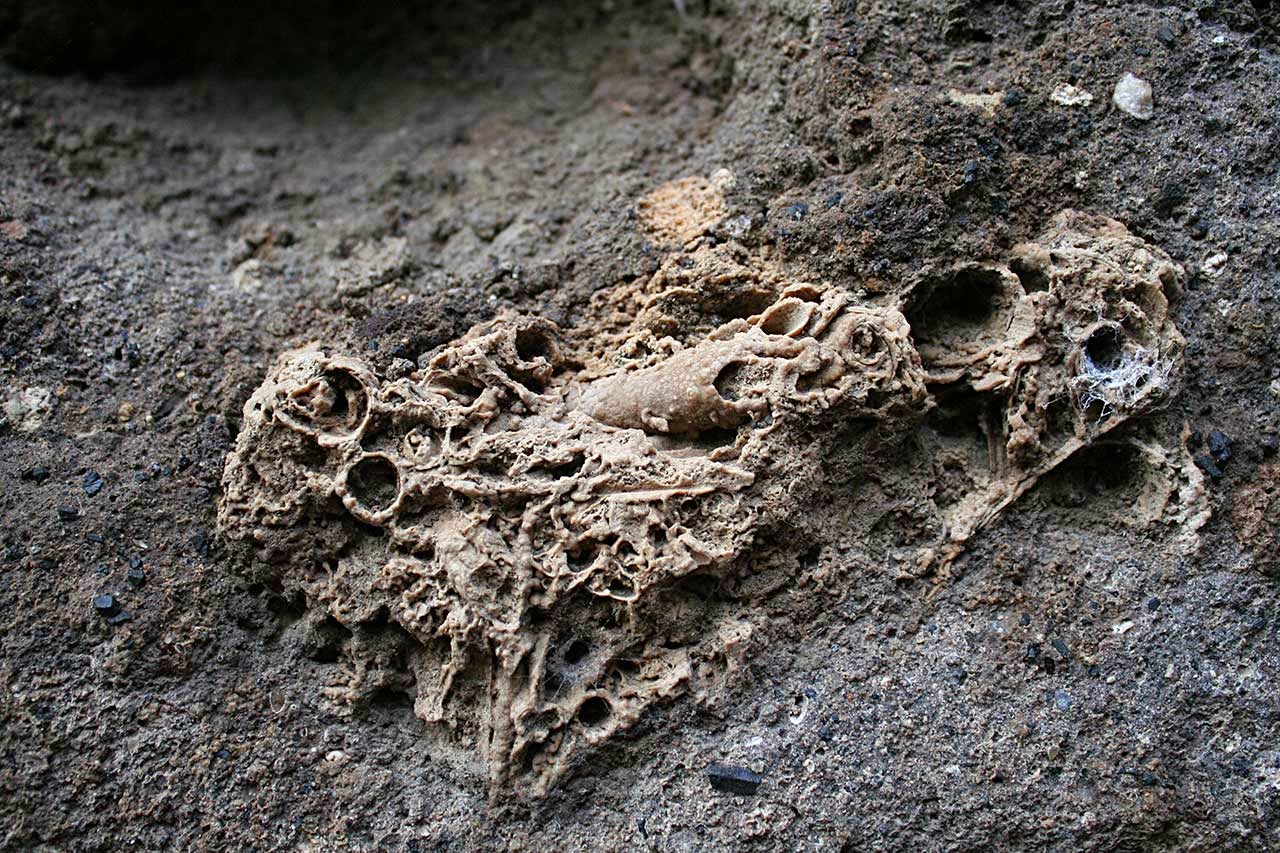
My visit to Italy was mostly a vacation just to relax so I did not do much research to find museums or fossil/mineral sites to visit. I read that it is illegal to collect fossils in Italy and their museums have some odd schedules about being open. That said, I did keep my eyes open to geological features at places we stopped to visit. One town we spent a few hours at was San Gimignano, Italy.
One of the walls had a stone block that had some fossils in it. The fossil I could see was a small gastropod calcite fossil about 2 cm in diameter. The rest of the brown block had broken shell fragment fossils.
A nearby stone in the same wall had an interesting pattern on it. Could it be volcanic in origin?
Near the wall were olive trees, here is picture of some baby olives.
Here is a panoramic view from San Gimignano of the surrounding countryside:
I found a small shop that sold jeweler and some mineral and fossil specimens. It is called Mirone Alabastri (53037 San Gimignano, Firenze). The fossils they sold were ammonites found in Madagascar. I did find some mineral specimens from Italy there that seemed unique.
Here is a dark quartz crystal in matrix from the quarries at Monterigginoi near Siena. Learn more about the locality here:
http://www.mindat.org/loc-125546.html
This green mineral might be malachite. The specimen was found at Serrabottini Massa Marittima in Grosseto Province of Tuscany Italy. Learn more about this locality here:
http://www.mindat.org/loc-64651.html
These next set of images are of the specimen magnified under the microscope x23. Learn more about this locality's malachite here:
http://www.mindat.org/gallery.php?cform_is_valid=1&loc=64651&min=2550&cf_pager_page=2
The last mineral picture is a piece of galena from unknown locality.