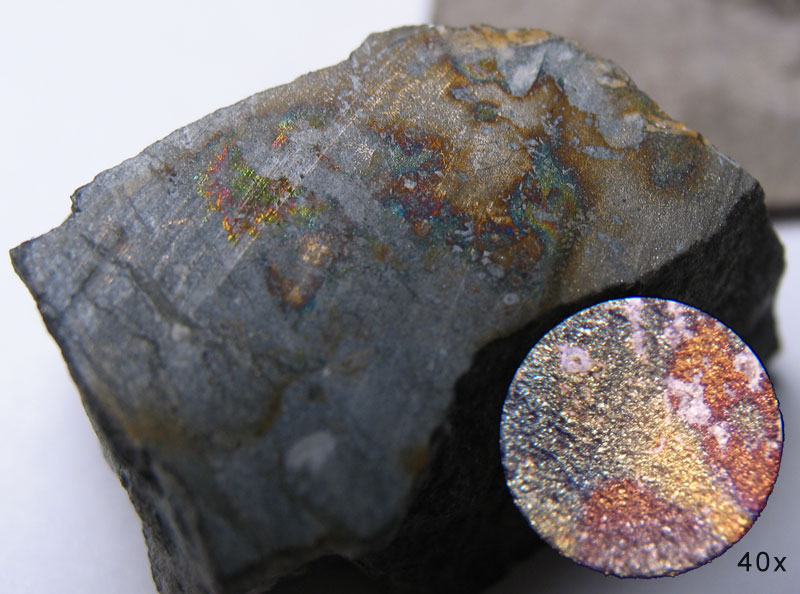
New Albany Shale Pyrite Polished
Iridescent pyrite magnified 40x
Clark County, Indiana
An
article in the Evansville Courier & Press from March 6, 2010, talks about a Louisiana exploration company looking to lease land in Illinois. They are attempting to drill 5,000 feet (1500 m) into the New Albany Shale to find natural gas. The article states they need at least 640 acres (2.5 km ^ 2) and will pay $6 an acre a year. Test drilling to hopefully begin by 2011. Another item I learned is that it is sometimes referred to as the Devonian Shale.
UPDATE (07/04/2010): A while back HBO was shown on Dish Network for FREE and one movie that the DVR saved was Gasland. If you plan on selling mineral rights to your land and have to use well water, it would be a good idea to view this movie. The website is
here. In addition, one should read a rebuttal at the Energy In Depth
web site that refutes some items in the film. After seeing the film and reading the web site you then need to decide what to believe by two groups promoting their own agendas. The country needs the energy sources but it appears we need cleaner methods of extraction that are economically viable.
New Albany Shale Pyrite Polished
Pyrite magnified 40x
Clark County, Indiana
I guess that would explain why I saw a gas slick in the water container I was using to polish the New Albany Shale pyrite the other day. Of course, the shale we find here is not 5,000 feet (1500 m) down. but very close to the surface. Looking at one of the guides produced by the University of Louisville, the shale is dated to the Late Devonian Period. It is Blocher and Selmier Members. When cutting the specimen in the 2nd image the water in the saw tray turned black-dark gray and smelled like a sewer! Some of these pyrite samples can really stink when they are sawed (sulfur?). The first pyrite specimen was more of light gray water color. Definitely different chemical compositions/concentrations in the layers of New Albany Shale.
New Albany Shale
Clark County, Indiana
One other surprise is the level of thoughtful comments on the newspaper web site. I did not realize all that went into lease agreements for mineral rights.
Magnified Coalified Fossil Wood
Devonian Period
New Albany Shale - Clark County, Indiana