Thursday, March 4, 2010
Paleoclimate Interpretation Lecture
On Tuesday, March 30, 2010, a lecture entitled "The Influence of High Frequency Climate Variability on Paleoclimate Interpretation" will be given. It is described as "Understanding past long-term climate states can play an important role in helping to forecast future climate changes. This talk is a discussion of how these issues affect our understanding and interpretation of paleoclimate." This presentation is part of the American Association of Petroleum Geologists Distinguished Lecture series.
The lecture will be given by Martin Perlmutter of Chevron (Houston, Texas) who has 25 years experience at Chevron and Texaco as research scientist and team leader.
Lecture will be at the University of Kentucky campus, Mining & Minerals Resource Building (Rose Street), Room 102. Reception starts at 6 PM EST and lecture given at 6:30 PM.
Sponsored by University of Kentucky, Kentucky Geological Survey, American Association of Petroleum Geologists, Kentucky Society of Professional Geologists, Morehead State Department of Earth and Space Sciences, and Eastern Kentucky University Department Geography and Geology. There is one more sponsor but I cannot read their name on the logo maybe (American Institute of Professional Geologists).
Learn more at this website: http://www.uky.edu/KGS/announce/PerlmutterPoster.pdf
Foerstephyllum Coral Fossil
Foerstephyllum sp. (Bassler, 1941) coral fossil from the Upper Ordovician Period limestone of Spencer County, Kentucky. This coral is in the phylum Cnidaria.
Thanks to Mary Ann for letting me photograph this fossil.
Labels:
colonial coral,
Kentucky,
ordovician
Wednesday, March 3, 2010
Ancyrocrinus Crinoid
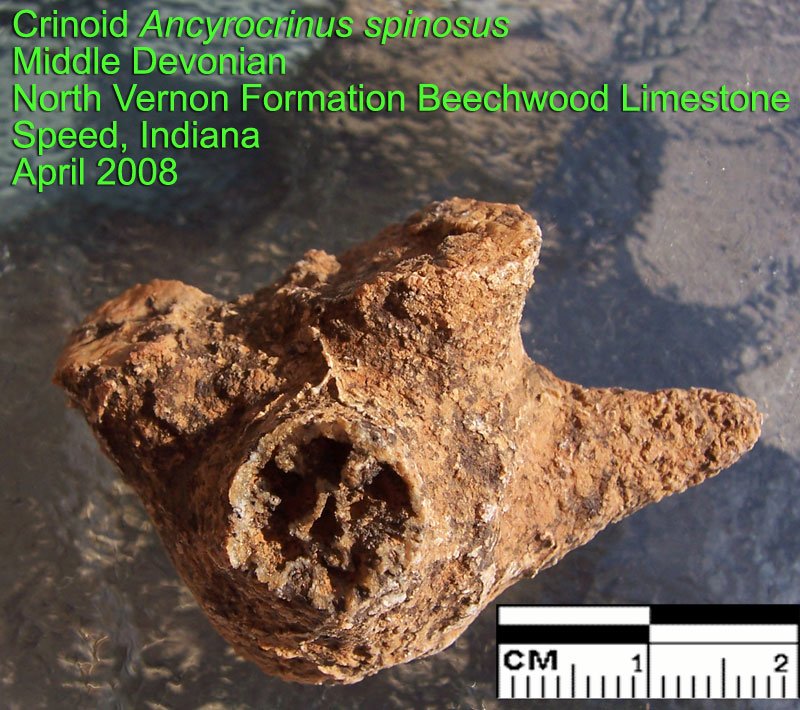
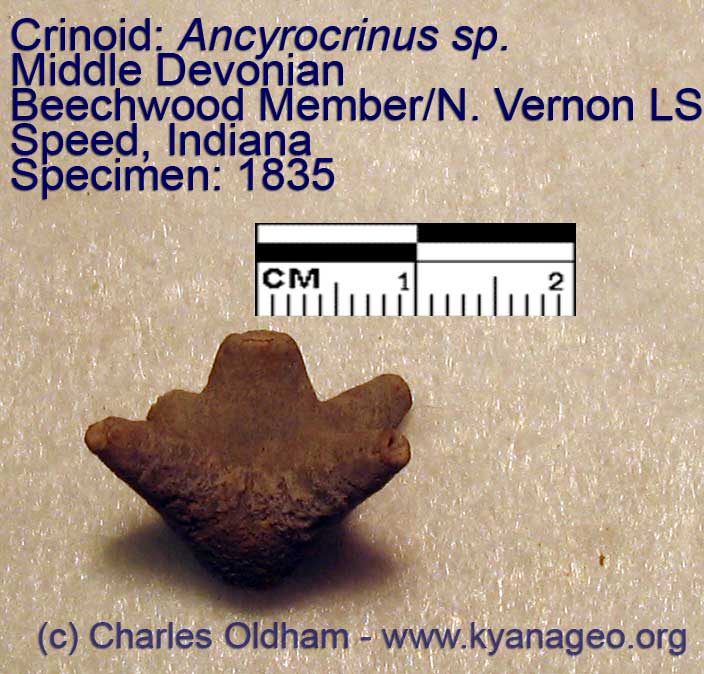
The Ancyrocrinus spinosus? crinoid from the Middle Devonian Period (406-385 million years ago). These crinoids were found in North Vernon Limestone, Beechwood Member. The location is Speed, Indiana (Clark County).
This crinoid was unique in that it had this holdfast anchor or grapple shape that snagged on rocks or other seabed objects. The benefits could be the crinoid is more mobile and less likely to get buried in sea storms.
Classification of this crinoid would be Class: Crinoidea, Order: Cladida, Family: Botryocrinidae (Thanks to the Cochise College Geology page for that info).
The first picture shows a more unique configuration with a double prong on one side of the holdfast. Usually I find them with four prongs and they about 90 degrees apart. All of the specimens here were found by my friend Mary Ann.
This crinoid was unique in that it had this holdfast anchor or grapple shape that snagged on rocks or other seabed objects. The benefits could be the crinoid is more mobile and less likely to get buried in sea storms.
Classification of this crinoid would be Class: Crinoidea, Order: Cladida, Family: Botryocrinidae (Thanks to the Cochise College Geology page for that info).
The first picture shows a more unique configuration with a double prong on one side of the holdfast. Usually I find them with four prongs and they about 90 degrees apart. All of the specimens here were found by my friend Mary Ann.
Here is one I found in 2008 at Speed, Indiana.
Here is another posted in the KYANA Geological Society website with its prongs mostly intact.
Subscribe to:
Posts (Atom)