Monday, March 6, 2023

Granatocrinites globosus Blastoid Fossil


Granatocrinites globosus (Troost, 1835) blastoid fossil Plate 4 figures 12-14 drawn by Major Adolphus Heiman (1809-1862) from A Critical Summary of Troost's Unpublished Manuscript on the Crinoids of Tennessee by Elvira Wood 1909. This very distinct blastoid was found in the Devonian Period aged at Bedford County Tennessee USA. It was assigned U.S. National Museum number 33077 and identified as a holotype. Elvira Wood refers to as Orbitremites granulatus (Roemer).

Picture of the real fossil is below:

Image courtesy of the Smithsonian Institution Specimen Catalog Number:  USNM PAL 33077 Specimen GUID:     http://n2t.net/ark:/65665/m3fa639a8e-6c3a-459b-acd8-8d23c8e76bed Photographer Suzanne McIntire. Specimen housed in the collections of the Department of Paleobiology, National Museum of Natural History, Smithsonian Institution


Sunday, March 5, 2023

Troosticrinus reinwardtii Blastoid Fossil


Troostocrinus reinwardtii (Troost, 1835) blastoid fossil Plate 3 figures 2-4 drawn by Major Adolphus Heiman (1809-1862) from A Critical Summary of Troost's Unpublished Manuscript on the Crinoids of Tennessee by Elvira Wood 1909. This very distinct blastoid was found in the Silurian Period aged Brownsport limestone of Tennessee. It was assigned U.S. National Museum number 33071.

Troost's Original drawings of Pentremites reinwardtii from 1835 work

Gerard Troost (1776-1850) originally called this fossil Pentremites reinwardtii (Troost, 1835) in On The Pentremites reinwardtii, A New Fossil; With Remarks on the Genus Pentremites (Say), and Its Geognostic Position in the States of Tennessee, Alabama, and Kentucky in Geological Society of Pennsylvania (1835). It appears he named the species after a Dutch botanist Caspar Georg Carl Reinwardt (1773-1854). The genus Troost used was named by his friend from Philadelphia and New Harmony, Indiana Thomas Say (1787-1834).

 The holotype fossil Troost found back in the 1830s now resides at the National Museum of Natural History, Smithsonian Institution. See photographs of it below that were taken sometime in 2010.


Image courtesy of the Smithsonian Institution Specimen Catalog Number:  USNM PAL 33071 Specimen GUID:     http://n2t.net/ark:/65665/3fda37982-30dd-4c41-aa35-c48973890252 Photographer Suzanne McIntire. Specimen housed in the collections of the Department of Paleobiology, National Museum of Natural History, Smithsonian Institution

Image courtesy of the Smithsonian Institution Specimen Catalog Number:  USNM PAL 33071 Specimen GUID:     http://n2t.net/ark:/65665/3fda37982-30dd-4c41-aa35-c48973890252 Photographer Suzanne McIntire. Specimen housed in the collections of the Department of Paleobiology, National Museum of Natural History, Smithsonian Institution


Saturday, March 4, 2023

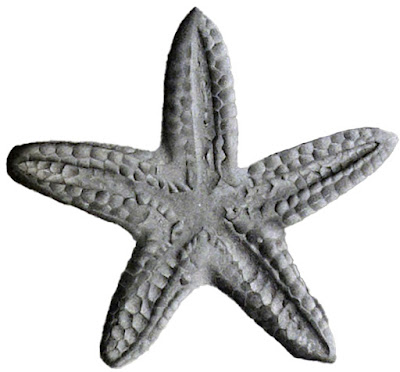
Macroporaster nylanderi Starfish Fossil

Macroporaster nylanderi drawing by Dr. Elvira Wood 1921

A Silurian Period fossil called Macroporaster nylanderi (Raymond, 1921). It was found in sandstone at New Sweden, Aroostook County, Maine, USA by Olof O. Nylander who the species is named after. Outer radius is 19 mm and inner radius is 7 mm, depth 2-2.5 mm. It was described in No.4 - A New Fossil Starfish From New England by Percy E. Raymond published Proceedings Boston Society of Natural History Volume 36 (August 1921). When fossil was published it was shown to be specimen number 14,966 in collection of Boston Society of Natural History.

Above is figure 7 in article drawn by Dr. Elvira Wood. This image was one of many illustrations she did for Dr. Raymond's publications between 1920-1924. Dr. Wood published one of the first American drawings of a starfish in 1909 of Troost's Palaeaster antiqua (Troost, 1835). Charles Schuchert renamed that fossil Mesopalaeaster antiquus (Troost, 1835) in 1915.

The current fossil is stored at the National Museum of Natural History at the Smithsonian Institution in Washington, D.C. and is listed as a holotype USNM PAL 166743. Another picture of this specimen shows its label (maybe from Boston) showing it was purchased from Nylander. Olof O. Nylander (1864-1943) was born in Oremella, Sweden where he became interested in natural history. He migrated to the United States in 1883 and worked in various states as a painter. He later was contracted out as a geologist for the U.S. Geological Survey, the Canadian government, and various universities/colleges. In 1939, the WPA built the Nylander Museum of Natural History in which he was the first curator-director. It housed his collections which were transferred to them in 1943 at his death. As of this writing, the museum in closed to the public.

Judging from the Smithsonian picture compared to the drawing, someone tried to prep this fossil and destroyed part of it. The paper described it as not having any other fossils on the matrix but it looks like the area around the fossil was removed and a small brachiopod fossil (reminds me of a Rhynchotreta) was revealed.

Image courtesy of the Smithsonian Institution Specimen Catalog Number:  USNM PAL 166743 Specimen GUID: https://collections.nmnh.si.edu/search/paleo/?ark=ark:/65665/3b69b1962935c41b69ed004c723c45745 Photographer Suzanne McIntire. Specimen housed in the collections of the Department of Paleobiology, National Museum of Natural History, Smithsonian Institution