Monday, March 7, 2011

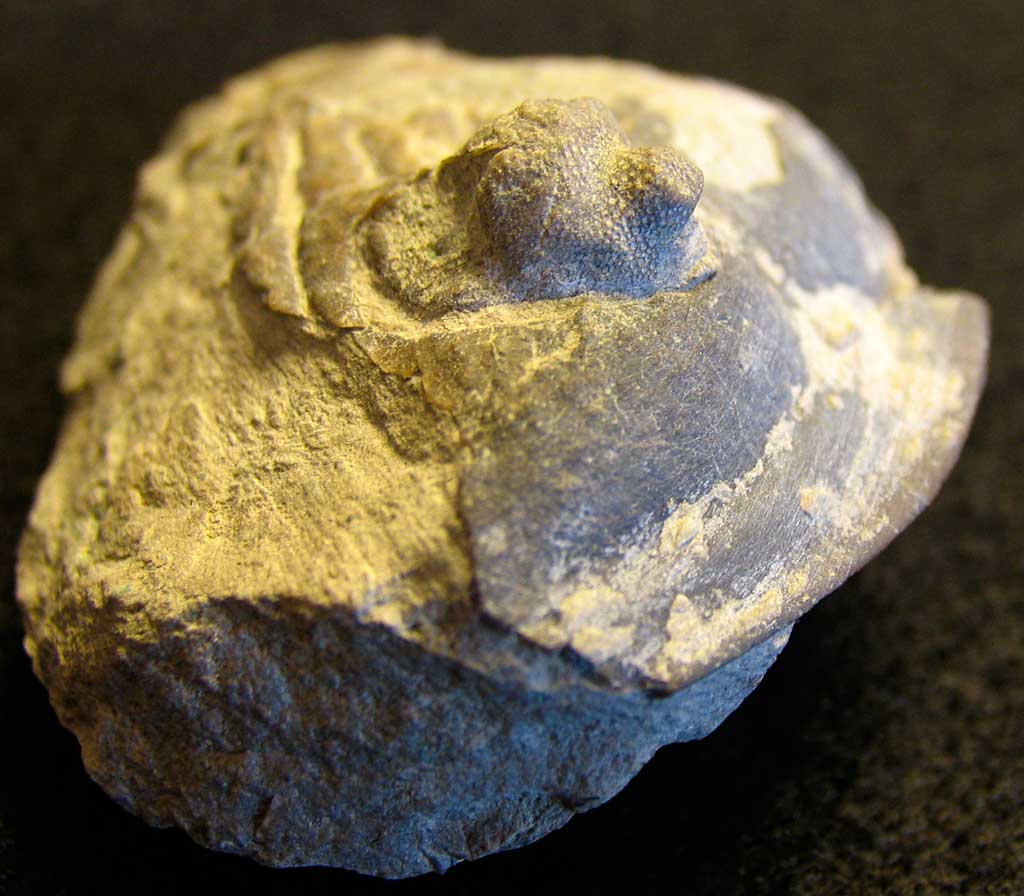
Huntonia lindenensis? Trilobite Cephalon


A cephalon of a Huntonia lindenensis? trilobite found in western Tennessee.  The fossil was found in the Birdsong Formation of the Lower Devonian Period.  It appear to be a molt as the eye lens on one side are covered with a bryozoan.  The molt must have been exposed on the seafloor for a while for this colony to establish.

Thanks to Herb for letting me photograph it.


Sunday, March 6, 2011

Franken-Trimerus Trilobite


When you search for trilobite fossils around the Louisville, Kentucky area there is a high probability that none will be found.  On a good day and at the right location one can walk away with some nice fragments.  Every so often lightning might strike near by or an entire trilobite fossil will be found.  This post is not about that.

The image presented is of fragments of a Trimerus trilobite that could be cobbled together to create a Franken-Trimerus.  It would be a monster.  The main pieces are present: head (cephalon), body (thorax), and tail (pygidium).  It needs more thorax.

Even if the beast was assembled, it take more than a mad scientist and lightning to awaken it. Could make for an interesting movie though on the SyFy channel.  [Que the Weird Science music]

Fossils were found in the Waldron Shale (Silurian) of Clark County, Indiana.  Thanks to Kenny for the photos.


Saturday, March 5, 2011

Mystery Mining Tools


Mystery mining tools found in or around the fluorite mines of Crittenden County, Kentucky. Does anyone know what these are?  When recently at the Ben E. Clement Mineral Museum during the tour, the museum manager showed these tools and asked if anyone knew what they were.  Three different sized tools, one is in a circle and two others were pill shaped.  Inside the tray tools are rows of spike like protrusions. Circular tool is about 4 inches in diameter (10 cm), longest pill shape tool is about 12 inches long (30 cm) and the shorter pill shaped tray is about 10 inches long (25 cm).


Here are some other tools that were on display.


Last picture shows model of fluorite mine with its vertical shaft 200 feet (61 m) deep.