Wednesday, April 1, 2009
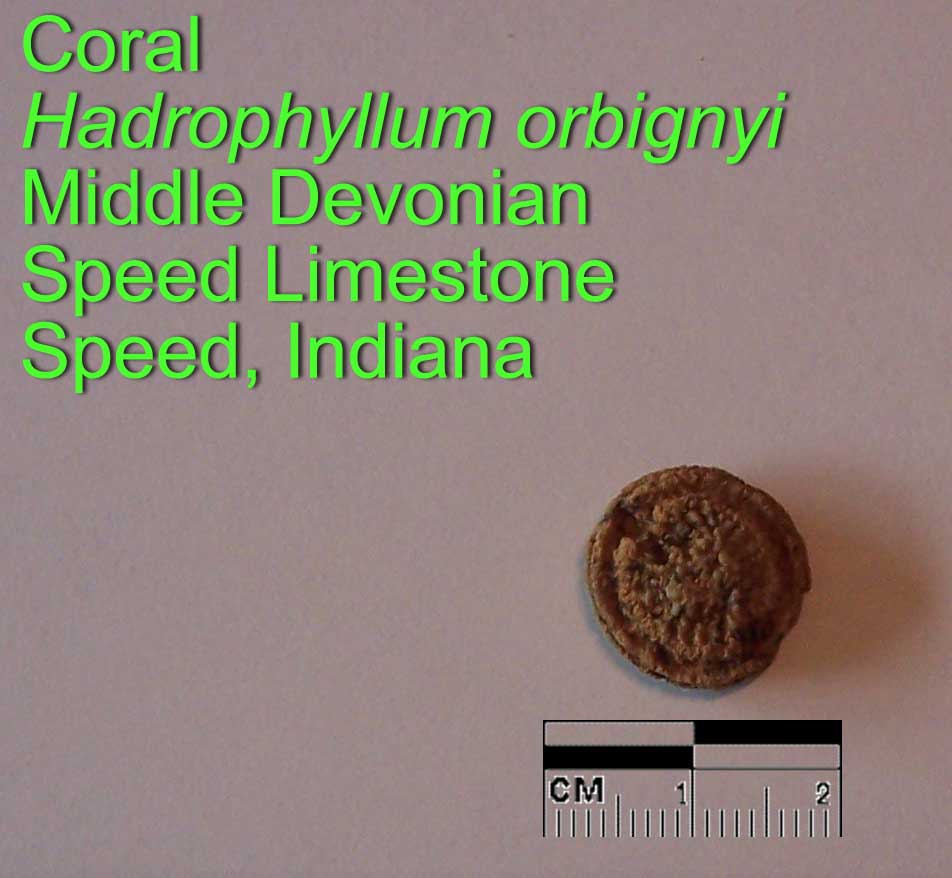
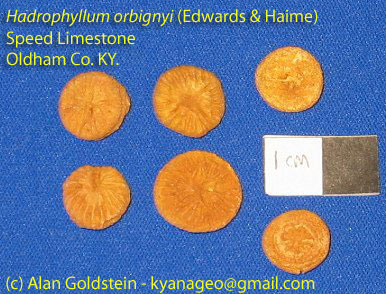
Devonian Button Coral Hadrophyllum orbignyi
Yesterday's entry showed some recovered pictures from April 2008 KYANA Geological Society quarry visit. Here are two pictures I found on that camera of Devonian button coral that are from that quarry. They are called Hadrophyllum orbignyi (Edwards & Haime, 1851). These were found in the Speed Limestone in Clark County, Indiana. I have also seen them referred to as Hadrophyllum d'orbignyi in older literature.
More images of these can be seen here:
http://www.kyanageo.org/Fossils/devonian/coral/hadrophyllum-orbignyi.jpg
http://www.kyanageo.org/Fossils/devonian/coral/RCL161_Hadrophyllum_orbignyi.jpg
http://www.yale.edu/ypmip/taxon/anthozoa/rugosa/37141.html
Labels:
button coral,
devonian,
hadrophyllum,
indiana
Tuesday, March 31, 2009
A Good Reason to Join KYANA Geological Society
We did a little house cleaning and the USB Kodak transfer cable was found in a drawer. I have been looking for this cable for about a year because the some pictures from a geology field trip was stored in the Kodak digital camera's internal memory. So these pictures were taken in April 2008 as KYANA Geological Society had their quarry field trip into a local quarry located in Clark County, Indiana. The area of the quarry we went to that day was full of Devonian fossils (horn corals, colonial corals, byrozoans, Phacops trilobites, button corals, gastropods, and other fossils). We also found geodes and pyrite in the New Albany Shale layer.
Our society gets to collect there because we have group insurance and are conscious about safety. Hopefully, our quarry trips will begin soon now that the weather is warming up.

Our society gets to collect there because we have group insurance and are conscious about safety. Hopefully, our quarry trips will begin soon now that the weather is warming up.

Monday, March 30, 2009
Silurian Chain Coral Called Halysites
Here is a Silurian index fossil called Halysites or chain coral. It is part of the hands on exhibit in the Discovery Gallery at the Louisville Science Center where I volunteer. The specimen does not have a label as to where it is from but it looks like ones I find in the area so it could be from Jefferson or Clark counties in this area.
I found a description of this coral in a a book stored at books.google.com entitled "An Introduction to the Study of Fossils (Plants and Animals) by Hervey Woodburn Shimer published in 1914. From pages 137-138, "Coral compound, composed of long, laterally compressed corallites, and covered by peritheca. Septa absent or represented by spines; tabulae numerous. Between each pair of corallites is a small tube. Budding occurs only from one side and the young corallites remain in contact with the parent by a constricted edge, thus forming chains, in which each corallite is a link (whence the common name, "chain-coral," from the Greek halysis, chain)."

Labels:
chain coral,
halysites,
silurian
Subscribe to:
Posts (Atom)