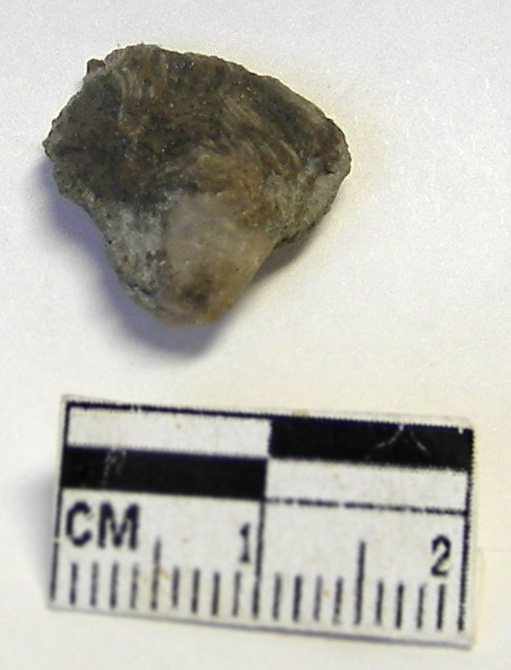
This brachiopod fossil appears to be a Parmorthis waldronensis (Foerste) of the Waldron Shale. Found in Clark County, Indiana from the Middle Silurian Period.
While the Louisville Limestone and Laurel Member layers represented a warm, shallow, opaque sea the material found in the Waldron Shale shows evidences of a muddy environment. These fossils are a dark grey and preserved quite well in the shale. They also have some pyrite crystals.
The Waldron Shale was named in 1882 by Dr. M. N. Elrod in the Geology of Decatur County, 12th Annual Report Indiana Department of Geological and Natural History 1882 (pp. 109-111). Dr. James Hall described the Waldron Shale fauna in the 28th Report New York State Museum in 1879 (pp.100-199; plates 3-34). Information gleaned from The Stratigraphic and Faunal Relations of the Waldron Fauna in Southern Indiana by E.M. Kindle and V.H. Barnett (1909).
It is referred to as Orthis elegantula (Dalman, 1828) [pages 285-286; plate 21] in the Indiana Department of Geology and Natural History Eleventh Annual Report by John Collett (1881), The paleontology starts on page 215 and was written by Professor James Hall, State Geologist of New York. A similar brachiopod fossil found in New York's Rochester Shale is referred to as Resserella elegantula (Dalman, 1828) in The Silurian Experience Field ID Guide by Paul Chinnici and Kent Smith (2009).

Microscope image of the ridges of the brachiopod magnified 40 times.


View of bottom of one of the specimens.


Thanks to the Indiana State Museum collections database web site for help with identification of these specimens. This posts contains pictures of three different brachiopod fossils. I am only about 50% sure of this identification for all three. Some of the fossils could also be a Rhipidomella hybrida (Sowerby).