On June 12, 2010 the Louisville Science Center IMAX theater will begin showing the movie Sea Rex: Journey to a Prehistoric World. Looks like Saturday's show times are 1, 3, 6, 7, and 9 PM and Sunday 1 and 3 PM. Be sure to check with the science center to verify the exact movie times.
Official movie website can be found here.

Saturday, June 5, 2010


Friday, June 4, 2010
Leptaena waldronensis Brachiopod

These Leptaena waldronensis brachiopod fossils have been cleaned with sand abrasion. They were found in the Waldron Shale of Clark County, Indiana. The creatures existed in the Silurian Period. See this link for information on the specimen at the Indiana State Museum Center for Science and Culture.
See earlier blog posting showing the Leptaena acuticuspidata of Lower Devonian Period found in Tennessee.
This link to a May 4, 2010 blog posting on the Leptaena rhomboidalis of Devonian Period found in Clark County, Indiana.


Thursday, June 3, 2010
Silurian Myelodactylus Crinoid Prepped

Silurian Period Myelodactylus convolutus crinoid arm/stem fossil found in the Waldron Shale of Clark County, Indiana, USA. This fossil has been prepped with air abrasion cleaning. The rock this fossil is in is pretty hard and is difficult to remove.
Update (08/03/2010): This might be part of a Myelodactylus crinoid. See something like it on the KYANA Geological Society web site and the Indiana Memory Collection site. (11/20/2013) The calyx is in the center of the coiled section -- must be small. Thanks to Alan for the explanation.)
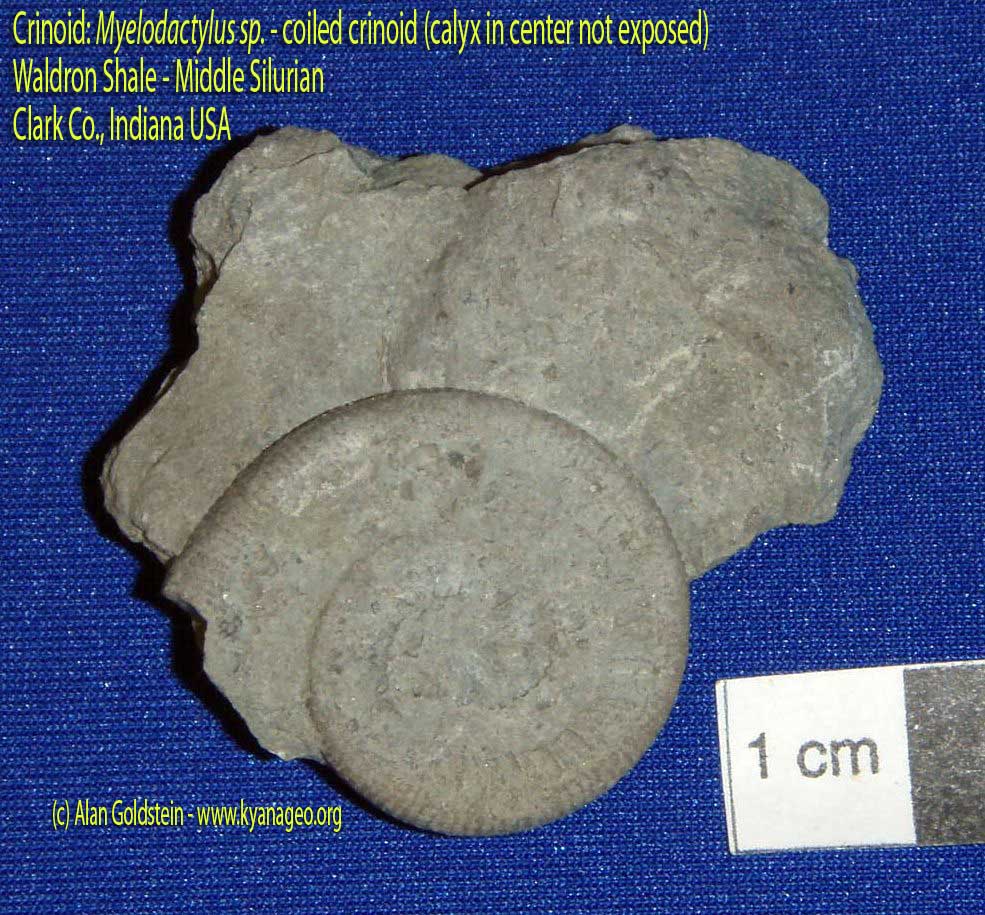
Update (02/16/2020): Kenny was able to provide a species name. Learn more about this unique crinoid from this article Myelodactylid crinoids from the Silurian of the British Isles by Stephen K Donovan and George D Sevastopulo from 1989 Palaeontology Volume 32 pages 689-710 at https://www.biodiversitylibrary.org/part/173971#/summary Plate 81 shows clear examples of what the calyx looked like though it might be somewhat different in the species of this fossil.


The picture below where the fossil still has water on it shows some sort of detail of a series of plates the inner spiral is resting on.


See some of the best Waldron Shale fossils on display on the Internet at Bob Schacht's web site at this webpage. The pictures of the Lyriocrinus crinoid calyx are amazing, described as "probably the finest crinoid ever to be found in the Waldron Shale Formation." :)
As always if you want to see some remarkable fossils from Indiana in person, visit the Indiana State Museum at 650 West Washington Street, Indianapolis. They have a truly amazing display of Crawfordsville, Indiana crinoids. Their database contains a number of Waldron Shale crinoids as well viewed at this web page.
Subscribe to:
Posts (Atom)