|
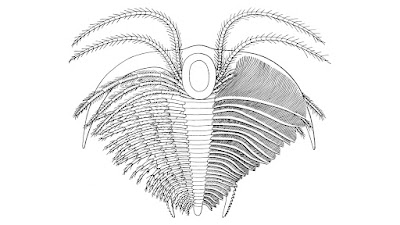
1920 drawing by Dr. Elvira Wood of the Ceraurus pleurexanthemus trilobite. Published in The Appendages, Anatomy, and Relationships of Trilobites by Percy E. Raymond
|
In today's post I would like to highlight a research paleontologist named Dr. Elvira Wood (1865-1928). From what I can find in public records on the Internet, Dr. Wood was a paleontologist who was active in the late 1800s till the 1920s. Her contributions to paleontology were in organizing, interpreting, illustrating, teaching about, and publishing fossils from university and museum collections.
How I became associated with her work was reading her master's thesis at Columbia University published in 1909 on Dr. Gerard Troost's lost fossils. Without it, Dr. Troost's major manuscript on Tennessee fossils completed weeks before his death might never have been published. More than likely it either would have been lost or still sitting in an museum archive. Thankfully, Miss Wood was able to get it updated and published 60 years after it had been completed.
My interest in Gerard Troost (1776-1850) was as a volunteer at the Louisville Science Center (LSC) which housed his mineral collection. The collection was purchased by the Louisville Public Library in the 1870s and was later transferred to the science center. I believed the collection is now at the Indiana State Museum. He also had a large fossil collection of which a few fossils (unlabeled) might still be at the Kentucky Science Center (aka LSC). The fossils that Dr. Wood published descriptions about in her thesis should be stored at the Smithsonian. The rest could be lost to time or somewhere in Nashville, Tennessee.
I could not find a picture of her to lead off this posting so I have placed an illustrations of a fossil she created an image of. There is a picture in the MIT Museum collection of female students in 1893 at Margaret Cheney Room in which she may in [See NOTE 0 below].
Early Life
Her father served in the 26th Regiment of Maine Volunteers during the American Civil War from 1861-1863. She was born in the town of Gouldsboro, Maine on February 11, 1865. In 1872, when she was 7 years old, her parents moved to Boston, Massachusetts. Years after the war, he operated a carpenter and builder shop at 465 Blue Hill Avenue in Boston till his death in 1883 [See NOTE 1 below].
 |
| As of yet not been able to find a picture of Elvira Wood but this drawing is from the MIT 1896 Technique yearbook which depicts the fashion of the time. |
|
Education
At age 17, she graduated from the Girls' High School of Boston on June 1882 [See NOTE 2 below]. She then entered the State Normal School at Framingham, a teacher training school now known as Framingham State University. After graduation, Elvira then enrolled in the Massachusetts Institute of Technology (MIT) as a special student in 1893, taking courses in geology, biology, and chemistry. In 1896, her class graduated but she is not listed as getting a degree, instead she became instructor in paleontology at MIT. During her MIT years, the yearbooks show she was active in Eta Sigma Mu (a secret female student group) that later became The Cleofan and the Geological Society.
MIT Research
 |
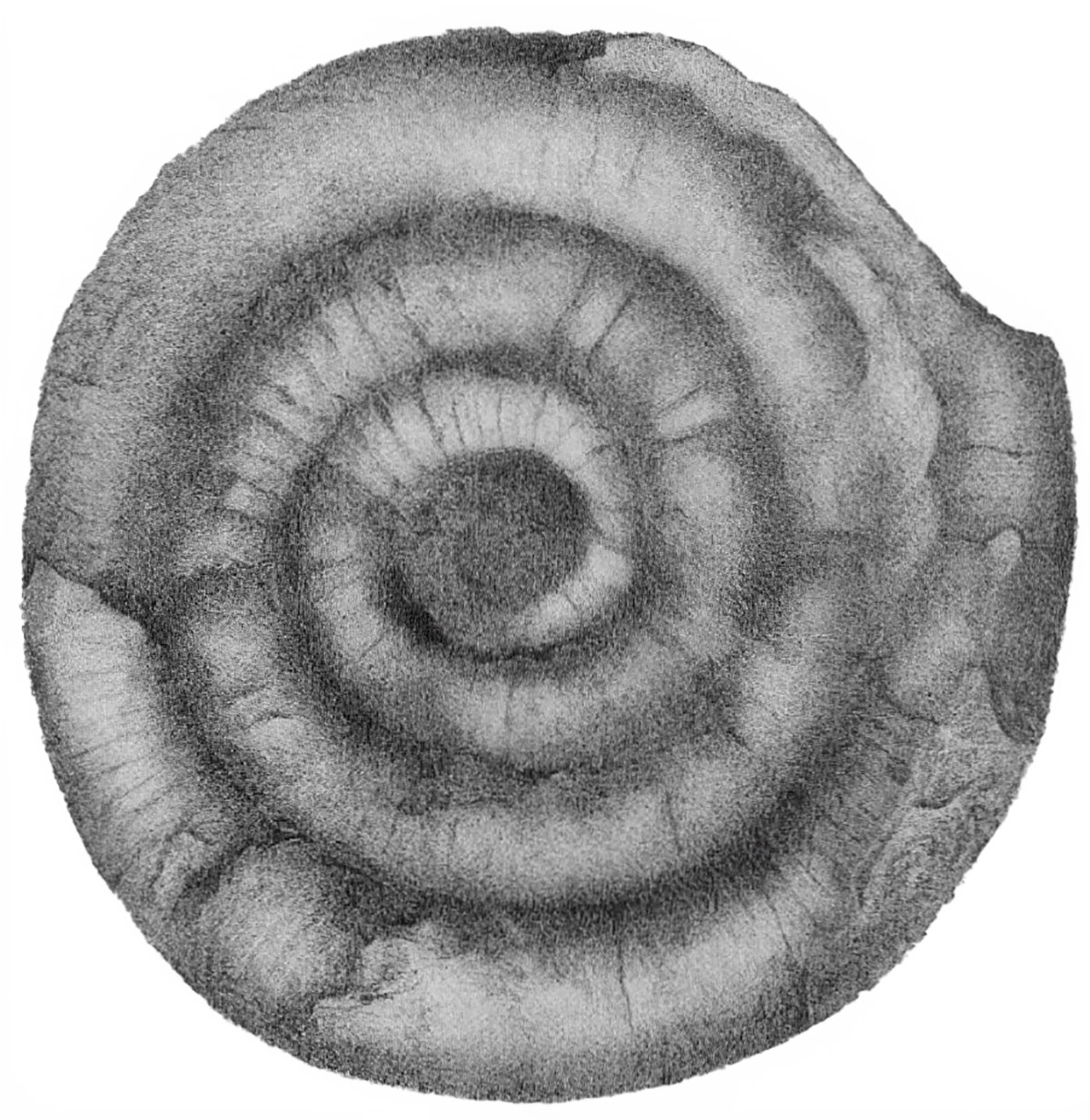
Elvira Wood named this new crinoid fossil species Gennaeocrinus carinatus from the Hamilton formation of Charlestown, Indiana in an October 1901 publication. This image is an illustration she created.
|
In October 1901 she published a paper naming a new crinoid species Gennaeocrinus carinatus. The paper was prepared at the laboratory of the Geological Department of MIT and she thanks Professor William H. Niles for the opportunity to do this. As it turns out, this holotype fossil now resides at the Museum of Comparative Zoology at Harvard University (IP 108317 BSNH catalog number 13327, MUSE locality number 949, previous number 3342). MIT must have transferred their fossil collection to Harvard at sometime in the near past.
She sent a signed copy of this paper to Professor Alpheus Hyatt (1838-1902) which is now in the Harvard library of the Museum of Comparative Zoology. When Google scanned their old books collection the system recorded Ms. Wood's note and signature (see below). The Harvard library shows receiving it in October 15, 1902. Hyatt estate must have given his library to Harvard several months after his death on January 15, 1902. She taught at MIT until February 1903.
Working At USGS
Ms. Wood accepted the post of paleontological assistant to Director of the United States Geological Survey (USGS) who at the time was Dr. Charles D. Walcott (1850-1927). In the following year, she received a regular appointment as Geologic Aid of the USGS. On June 29, 1905, the El Paso Herald newspaper under the headline Geological Survey Work printed "The preparation of monograph on Cambrian brachiopods by C.D. Walcott, assisted by Miss Elvira Wood."
In 1904 she published On New and Old Middle Devonic Crinoids which was the culmination of research on fossil specimens submitted to her for study by Assistant Curator Mr. Charles Schuchert. She named two new crinoid genus (Tripleurocrinus and Tylocrius) and seven new species (Megistocrinus tuberatus holotype USNM PAL 26395, Megistocrinus regularis syntype USNM PAL 36013, Megistocrinus sphaeralis holotype USNM PAL 26397, Tylocrinus novus holotype USNM PAL 35150, Dolatocrinus costatus holotype USNM PAL 26396, and Dolatocrinus asterias USNM PAL 36023). In July 1911, Frank Springer published a document Some New American Fossil Crinoids in which he changed the identification of Tripleurocrinus levis to Myrtillocrinus levis. Its holotype fossil is still stored at the Smithsonian National Museum of Natural History USNM PAL 35146 along with the others mentioned above.
 |
| Ostracod fossil Aluta woodi named by Dr. Charles D. Walcott after Elvira Wood in 1913 |
While working for Dr. Walcott, he named an ostracod fossil after her in 1905 called Bradoria woodi. In 1913, he would rename the same Chinese ostracod for her called Aluta woodi plus another fossil documented below. Miss Wood started revising Dr. Troost unpublished manuscript at Professor Charles Schuchert (1858-1942) of Yale University's suggestion while working at the USGS. Dr. Schuchert was apprentice to Dr. James Hall, later worked at the USGS (1893-1894) and curator U.S. National Museum (1894-1904). One can wonder how Schuchert knew about the Troost manuscript, from Hall or the Smithsonian? When it was published in 1909 she thanked Walcott for 39 photographs used in the publication. She also thanked Dr. Ray S. Bassler (1878-1961) of George Washington University for photographic illustrations. This appointment was changed to that of Assistant Geologist in June 1907.
Graduate Studies At Columbia University
In the same year she resigned from the USGS and started working at Columbia University. Once there she taught paleontology and assisted at the summer session. In September 1907, she began studies as a graduate student and she received a Master of Arts degree in May 1908 [see NOTE 3 below] with her thesis "A Critical Summary of Troost's Unpublished Manuscript on the Crinoids of Tennessee." When the thesis was published she thanked Dr. Amadeus W. Grabau (1870-1946) for valuable advice (maybe he was her thesis advisor?).
 |
| Adolphus Heiman drawing of a reconstructed Crinoid Calyx fossil of an Actinocrinus magnificus meant to be the title image for Gerard Troost's Crinoids of Tennessee monograph probably completed in 1849. The original fossil is at the Smithsonian PAL 39900. Elvira Wood wrote about this specimen in her Master's thesis. |
In 1909, Dr. Grabau (Professor of Palaeontology in Columbia University) along with Dr. Hervey W. Shimer (Assistant Professor of Palaeontology in MIT) published the North American Index Fossil book Volume 1. He thanks Elvira as one of his students for helping with its publication. Her copies of volumes 1 and 2 are at the Harvard University Library of the Museum of Comparative Zoology (donated on May 10, 1932 years after her death) [LINK]. See image below of the donation label and on the next page her signature from Volume 2.
She received her PhD in August 1909 with the thesis entitled The Phylogeny of Certain Cerithidae [see NOTE 4 below]. When it was published she thanked another female paleontologist Dr. Carlotta J. Maury (1874-1938) "for the loan of Oligocenic shells from the Paris Basin" and Dr. Grabau of Columbia University "for many helpful suggestions" in the acknowledgements. It also lists she presented the abstract to the New York Academy of Science on February 7, 1910.
 |
| Cerithium tuberosum gastropod fossil plate II figure 4 from Elvira Wood's The Phylogeny of Certain Cerithidae 1910 PhD thesis |
Paleontology Career
She accepted the position as Curator, Geological Department, Columbia University, where she remained two years, resigning this position to accept the position of Assistant Curator in Paleontology, Museum of Comparative Zoology at Cambridge, Massachusetts in October 1911. In 1912, she worked on labeling the crinoids fossils in the collection as well updating the card catalogue of crinoid fossils.
In 1913, the Carnegie Institution of Washington published Research in China in Three Volumes and Atlas Volume Three The Cambrian Faunas of China by Charles D. Walcott. On pages 60-61, anthozoa Coscinocyathus elvira is shown from the Ki-chóu formation, south of Wu-t'ai-hién, Shan-si China. It dates from the Middle Cambrian Period. Walcott writes, "The specific name is given in recognition of the work of Miss Elvira Wood in connection with the preliminary study of the Cambrian fauna of China." Later in the publication, he names a fossil ostracod Aluta woodi and Walcott explains on page 228 "The specific name is given in recognition of the excellent and thorough preparatory work that was done by Miss Elvira Wood in the preliminary study of the Cambrian fossils from China and her work upon the Devonian crinoids."
 |
| Cactocrinus proboscidalis crinoid calyx fossil from The Use of Crinoid Arms in Studies of Phylogeny by Elvira Wood plate I figure 1 photo by W. E. Rowe Heliotype Co. Boston 1914 |
In 1914 she published "The Use of Crinoid Arms in Studies of Phylogeny" in the Annals of the New York Academy of Sciences Volume XXIV. In this article, she named new crinoid fossils Cactocrinus baccatus and C. platybrachiatus. The New York Academy of Sciences also elected Dr. Elvira Wood of the Museum of Comparative Zoology as a Fellow on December 21, 1914.
She continued to curate the paleontology collection at Harvard until 1914 when it is reported "Owing to ill health, Miss Elvira Wood's work was limited to the assortment of considerable series of fossils received from the Boston Society of Natural History." Next year's report said "Miss Elvira Wood resumed her work on 1 December 1915, and during the remainder of the year, she was engaged in revising the identification and arrangement of the study series of Tertiary Gastropoda."
Dr. Wood is mentioned one last time in the Annual Report of the Director of the Museum of Comparative Zoology at Harvard 1916-1917 with the entry "Miss Elvira Wood was employed for eight months and continued the revision and arrangement of the study series of Tertiary Gastropoda."
 |
| 1920 drawing by Dr. Elvira Wood of the Calymene senaria trilobite. Published in The Appendages, Anatomy, and Relationships of Trilobites |
The Appendages, Anatomy, and Relationships of Trilobites by Percy E. Raymond, Ph.D. Harvard published this work in December 1920 to the memory of Charles Emerson Beecher (1856-1904). Dr. Elvira Wood has a large number of trilobite illustrations on this publication. Dr. Raymond writes, "I am greatly indebted to Doctor Elvira Wood for the care and skill with which she has worked up these restorations from my rather sketchy suggestions. She has put into them not only a great amount of patient work, but also the results of considerable study of the specimens." The trilobite images are displayed throughout this blog post and were published 100 years ago last month.
 |
| 1920 drawing by Dr. Elvira Wood of the Isotelus maximus trilobite. Published in The Appendages, Anatomy, and Relationships of Trilobites by Percy E. Raymond |
It appears she left Harvard after 1917 and went to work at the American Museum of Natural History on trilobite models. In their annual report for 1920 she is still working with trilobites. In her last published book is this quote: "Her last position was Assistant Curator in Paleontology, American Museum of Natural History, New York City, which she was obliged to resign on account of an accident, which made her an invalid for the remainder of her life." [See NOTE 5 below] In her obituary published in an MIT journal states, "In 1917 she became assistant to the curator of the American Museum of Natural History in New York City, but was the victim of an accident during that year which made her a permanent invalid, and since 1917 she has been living in Waltham." [See NOTE 6 below]
Forced Retirement Due to Accident
The last entry in the newspaper database about her is from August 4, 1921 Bangor Daily News (Maine) which wrote "Dr. Elvira Wood and sister of Waltham, Mass. are occupying Finch Lane cottage. Dr. Wood will address the Girl Scouts on Nature Study at East Sullivan, date to be announced."
Winifred Goldring (1888-1971) in The Devonian Crinoids of the State of New York Memoir 16 published 1923 thanked Dr. Wood for help getting specimens and allowing her to use plate images from earlier publications. Note: Dr. Goldring became the first woman in the United States to be appointed a state paleontologist (New York).
Dr. Wood's trilobite images appeared in two more papers: in 1924 by Dr. Raymond entitled New Upper Cambrian and Lower Devonian Trilobites from Vermont and in 1925 Some Trilobites of the Lower Middle Ordovician of Eastern North America. The last paper contains some impressive illustrations of trilobite fossils.
 |
| 1925 drawing by Dr. Elvira Wood of the Ectenaspis beckeri trilobite fossil. Published in Some Trilobites of the Lower Middle Ordovician of Eastern North America by Percy E. Raymond |
Up until she died, it appears Elvira continued to work documenting the Wood family tree. In her final book, she mentions travel to interview relatives as early as 1916 and lists dates of events happening to family members till 1928.
Death
She died at the age of 63 on December 29, 1928 and was buried at the family plot in Mount Feake Cemetery Waltham, Middlesex County Massachusetts USA. Her father George W. Wood (1833-1883), mother Elvira K. Whitaker Wood (1837-1916), sister Amanda (1859-1932), brother Gleason (1867-1941) and his wife Lena (1868-1946) are buried there as well. In 1930, two years after Dr. Wood's death, her book documenting the Wood family history was published The Ancestry and Descendants of Ebenezer Wood of West Gouldsborough, Maine. From reading the book, she notes it originally just started as a small endeavor documenting her family history but turned into a larger project over time.
In 1931, the librarian at Harvard's Museum of Comparative Zoology writes, "A small collection of books and pamphlets from the library of Miss Elvira Wood, who worked on the collection of fossils here some twenty years ago, were received through the kindness of her brother." [see NOTE 7 below] Years later, Google digitized one of the books donated, below is an image of the library label from North American Index Fossil book Volume 1.
 |
| 1920 drawing by Dr. Elvira Wood of the Ceraurus pleurexanthemus trilobite. Published in The Appendages, Anatomy, and Relationships of Trilobites by Percy E. Raymond |
Fossils Named by Dr. Wood
She named her first fossil in 1901's A new Crinoid from the Hamilton of Charlestown, Indiana. The crinoid fossil was called Gennaeocrinus carinatus.
As of February 2021, the holotype showed up in the specimen database of
the Museum of Comparative Zoology at Harvard University.
Miss Wood named two brachiopod species in her 1901 publication Marcellus Limestones of Lancaster, Erie Co., N.Y. called Camarotoechia pauciplicata and Crania recta. She donated these type fossils to the New York State Museum in 1902.
In 1904's On New and Old Middle Devonic Crinoids, Elvira Wood named two crinoid genus: Tripleurocrinus and Tylocrius and seven crinoid fossil species: Megistocrinus tuberatus, Megistocrinus regularis, Megistocrinus sphaeralis regularis, Tylocrinus novus, Dolatocrinus costatus, Dolatocrinus asterias and Myrtillocrinus levis. As of March 2021, the holotypes are stored at Smithsonian National Museum of Natural History.
In 1909, she published A Critical Summary of Troost's Unpublished Manuscript on the Crinoids of Tennessee.On page 93, she names a new crinoid species Hydreionocrinus spinosus after the fossil by Wetherby who described it in 1881 as Hydreionocrinus depressus found by Troost. She writes that Wetherby had actually found a new species and thus she named it. It's genus was later changed to Tholocrinus (Kirk, 1939).
Conclusion
While public records have provided a rough time line to Dr. Wood's life, they do not really give any insight as to what motivated her to spend her life in the study of fossils. The 1930 book about her family tree includes an introduction that gives a glimpse of some of her personal perspective on the world. Ms. Wood writes: "The man who said he did not want to look up his family tree for fear of finding a gallows tree had an entirely wrong idea of the true purpose of genealogical research. It should not be undertaken with the sole idea of finding food for vanity in the number of distinguished people we can claim as belonging to us but rather in a spirit of open-minded investigation. If we find evil in our ancestry it is a warning that here is something it is our business to eliminate from the family strain. If we find good it is a challenge to us to equal that plane of experience. More than that, if we are to contribute to the progress of the world we must not only equal the moral attainments of our ancestors, we must excel them. Another fact that is strongly brought out by studies of genealogy is that moral achievement is the only kind contributing to sound social advancement."
At the introduction of her family history book she writes, "When the work was still in its early stages an accident deprived the writer of the power to move about freely, and visiting of libraries and other sources of information became impossible." [NOTE 5 below]. Even with this set back she had an amazing career working with some of the best American fossil collections at the American Museum of Natural History, U.S. Geological Survey, the Smithsonian, Harvard University, Columbia University and MIT. In addition, she corresponded and collaborated with some of the top invertebrate paleontologists of the day.
She concludes her family's genealogy book with this text:
"This ends the story of an American family from the early days of the settlement of the country to the present time. It contains no celebrated names, no records of shining achievement. Its members were mainly farmers, merchants or mechanics, but they were, with but a few exceptions, men and women of industry, integrity, devotion to duty, and many of them people of sincere religious faith. They possessed the one indispensable attribute of the nation in the past and its hope for the future whether it be held by rich or poor, learned or unlearned; and may the United States of America never lack an abundance of middle class families of this type."
During my research, things I learned
1) Finding all the trilobite images she illustrated. I knew about her work on the Troost fossils from years ago when I worked on his collection. It appears early in her studies, she worked with Paleozoic crinoid fossils, then helped Charles Walcott with Cambrian fossils and finished her career creating a lot of trilobite fossil illustrations and models.
2) Another interesting fact is that she obtained her advanced degrees when she was in her 40s. I am speculating that after high school she trained to become a teacher (maybe specializing in science). She got accepted at MIT to study more advance sciences and while there started working at the Harvard museum.
3) Learning that she had named a number of fossils and had a few named in honor of her work.
4) Her collaborations with Charles Walcott, Amadeus Grabau and Percy Raymond. I learned more about their careers and scientific contributions.
5) The stories of other female paleontologists working at the time, specifically Winifred Goldring, Carlotta Maury, and Marjorie O'Connell. Women of that time had a lot of challenges especially pursuing careers in
geological sciences. Learn more about this period and read about other women paleontologists in the Museum of the Earth's Daring to Dig: Women in American Paleontology on-line exhibit. An upcoming book and web site is being created by author Katherine Dettwyler about Marjorie O'Connell Shearon. Dr. O'Connell wrote a paper in 1914 that renamed one of the largest horn coral fossils (Siphonophrentis) known to have existed that can be found in the Louisville, Kentucky area. She and Dr. Wood have a number of things in common: they both worked at the American Museum of Natual History at the same time, got degrees from Columbia University, and collaborated with Dr. Grabau while there.
Recent Mentions of Elvira Wood's Work
After all these decades, there has been some recent activity involving Dr. Wood, a few papers in 2002 and 2009 referring to Aluta woodi Chinese ostracod fossil Charles Walcott named it after her as well as papers on Troost's fossils. Two papers were written about the lost Troost crinoids which referenced Dr. Wood's 1909 work in 2005 by Kennesaw State University's Julie Newell in Earth Sciences History and Ohio State's William Ausich 2009 paper in Journal of Paleontology. I was glad to see that months ago a Harvard podcast referred to Dr. Elvira Wood and her time working in their museum.
In an August 2020 podcast, Harvard Museums of Science & Culture (HMSC) Connects! entitled 19th-Century Women at Harvard's MCZ with guest Reed Gochberg and hosted by Jennifer Berglund. Dr. Gochberg is the Assistant Director of Studies, History, and Literature at Harvard. Around the 07:19 mark in the podcast Dr. Gochberg says "One woman who worked at the museum in the 1890s named Elvira Wood actually for a while taught as an instructor at MIT. She got her PhD at Columbia, and then she came back to work at the museum in the 1910s for a few years, but she specialized in invertebrate paleontology, and so the work that she was doing at the museum in the 1890s was actually preparing some of the museum's early paleontology displays for public exhibits, and she also donated a number of her own collections, she helped to catalog collections for the museum, and also prepared illustrations and actually published some of her own work."
Link is here: https://www.podbean.com/ew/pb-wcp7y-e5c317 or read the transcript: https://hmsc.harvard.edu/19th-century-women
Publications of and ones Dr. Elvira Wood contributed to
Crosby, William O. and Ballard, Hetty O.,
Distribution and Probable Age of the Fossil Shells in the Drumlins of the Boston Basin. The American Journal of Science, Vol. XLVIII, December 1894. pp. 486-496. [
LINK] They write on page 495, "In the collection of the shells we have received important assistance from Mr. T. A. Watson, and from Mr. H. D. Card, Mr. G. W. Stose, Miss Elvira Wood and Miss E. F. Fisher, students in the Geological Department of the Massachusetts Institute of Technology."
Grabau, Amadeus W.
Geology and Palaeontology of Eighteen Mile Creek and the Lake Shore Sections of Erie County, New York, The Buffalo Society of Natural Sciences, Vol. 6 No. 1, June 1898, Buffalo, New York pp. 1-403. [
LINK] Elvira Wood did a lot of figures for this work. Dr. Grabau named a horn coral fossil for her
Hadrophyllum woodi on pages 128-129. He wrote, "Named in honor of Miss Elvira Wood, Instructor in Palaeontology, Mass. Inst. Technology".
 |
Figure 10C on page 129 Hadrophyllum woodi. Type Specimen Morse Creek. Figures drawn by Miss Elvira Wood in 1898.
|
Grabau, Amadeus W.
Moniloporidae, a new family of Palaeozoic Corals, Proceedings of the Boston Society Natural History, Vol. 28, No. 16, Issued April 1899 Boston pp. 409-424 Pl. 1-4 [
LINK] Her initials on drawings plate 2 and name listed "Elvira Wood del." plate 3, 13 figures of
Ceratopora distorta and 17 figures on plate 4 of
Ceratopora dichotoma.
Crosby, William O. Geology of the Boston Basin Vol. I. Part III. The Blue Hills Complex, Boston Society of Natural History 1900 [LINK] p. 293 "Miss Elvira Wood has also rendered valuable assistance in drawing."
Grabau, Amadeus W.
Siluro-Devonic Contact in Erie County, New York, Bulletin of the Geological Society of America, Vol. 11, pp. 347-376, pls. 21-22, May 26, 1900 [
LINK] Listed at beginning of plates "The fossils were drawn by Miss Elvira Wood, instructor of paleontology in the Massachusetts Institute of Technology." Figures on plates 21-22
Grabau, Amadeus W.
Palaeontology of the Cambrian Terranes of the Boston Basin, Author's Edition Issued August 1900 Boston [
LINK] on page 694 "To Miss Elvira Wood and Miss L.R. Martin thanks are due for the care and labor bestowed on the illustrations of the fossils." "Plate 31 Figures 3,4,6a-c,9a-f,10c,11b, and 12a were drawn by Miss Elvira Wood, Instructor in Paleontology in the Massachusetts Institute of Technology;", "Plate 32 Figures 1 a, b, 7 c, 8 e, f and 9 c were drawn by Miss L. R. Martin. The remainder were drawn by Miss Elvira Wood.", "Plate 33 All the figures were drawn by Miss Elvira Wood, Instructor in Palaeontology in the Massachusetts Institute of Technology.)", "Plate 34 Figs. 8-10 were drawn by Miss L. R. Martin, the others by Miss Elvira Wood, Instructor in Palaeontology in the Massachusetts Institute of Technology.)"
Grabau, Amadeus W.
Guide to the Geology and Paleontology of Niagara Falls and Vicinity, Bulletin of the New York State Museum, April 1901 [
LINK] on page 138 Figure 31
Cyathophyllum hydraulicum drawings, p. 184
Orthothetes hydraulicus figure 92, p. 199
Spirifer eriensis figure 119, p. 204
Whitfieldella sulcata figure 128
Whitfieldella retundata figure 129
Whitfieldella laevis figure 130, p. 217
Trochoceras gebhardi figure 149, p. 219
Leperditia scalaris figure 150 reused from 1900
Siluro-Devonic Contact in Erie County, New York work but she is not credited
in this book.
Wood, Elvira.
A new Crinoid from the Hamilton of Charlestown, Indiana, American Journal of Science, Vol. XII, October 1901, pp. 1-14. Pl. V. The link leads a document Google scanned at Harvard library. The original was signed by Elvira Wood to her MIT instructor Alpheus Hyatt probably in late 1901. His library was donated to the Harvard Library after he died in January 1902. [
LINK]
Wood, Elvira.
Marcellus Limestones of Lancaster, Erie Co., N.Y. Paleontologic Papers 2, New York State Museum, December 1901 [
LINK]
Grabau, Amadeus W.
Phylogeny of Fusus and its Allies gastropod Smithsonian Miscellaneous Collections Part of Volume XLIV no. 1417 Washington 1904. [
LINK] on page 7 he writes "To Miss Elvira Wood, of Washington, formerly Instructor in Palaeontology in the Massachusetts Institute of Technology, the writer is greatly indebted for the care and skillful labor she has bestowed on the difficult figures of the protoconchs and early conch stages shown in plates XVII and XVIII, as well as the original figures in the text."
Wood, Elvira.
On New and Old Middle Devonic Crinoids, Smithsonian Miscellaneous Collections, Washington D.C., August 6, 1904, pp. 56-84, Pl. XV-XVI. [
LINK]
Walcott, Charles D.
Cambrian Brachiopoda with Descriptions of New Genera and Species, Proceedings of the United States National Museum, Vol. XXVIII, 1905 pages 227-337.[
LINK] Miss Wood is not mentioned in manuscript but is listed as working on it in a newspaper article [cited in the above text earlier in this blog].
Walcott, Charles D.
Cambrian Faunas of China, No. 1415 Proceedings of the United States National Museum Vol. XXIX, pages 1-106, 1905. [
LINK] on page 102 he names a new species of fossil ostracod after her called
Bradoria woodi. Walcott writes this "The specific name is given in recognition of the excellent and thorough preparatory work that was done by Miss Elvira Wood in the preliminary study of the Cambrian fossils from China and her work upon the Devonian crinoids." On page 3, he writes, "In the autumn of 1903 the Carnegie Institution of Washington sent an expedition to China....A considerable quantity of material was collected and received in Washington in the fall of 1904...The material when thus prepared was labeled with locality and formation numbers and taken in hand by Miss Elvira Wood, who separated the species and selected and indicated specimens for illustration."
Wood, Elvira.
A Critical Summary of Troost's Unpublished Manuscript on the Crinoids of Tennessee, Smithsonian Institution United States National Museum Bulletin 64, Washington D.C., 1909, pp. 1-150, Pl. 1-15. [
LINK]
Grabau, Amadeus W. and Shimer, Hervey W.
North American Index Fossil Invertebrates Volume 1, A.G. Seiler & Company, 1909. [
LINK] on page vi "Special acknowledgements are further gladly made to Florence Henry Shimer, A.M., and to former and present students of the senior author, especially Elvira Wood, A.M., and Fred K. Morris, A.B."

Grabau, Amadeus W. and Shimer, Hervey W.
North American Index Fossil Invertebrates Volume II, A.G. Seiler & Company, 1910. [
LINK] on page 760 Troost paper referenced, page 736 New York fossil paper referenced, and pages 739;742 her crinoid papers are referenced. Her personal copy is now in the Harvard library which she signed (see signature above). In volume 2 her crinoid papers are referenced. In the revised and more
famous 1944 edition her crinoid fossils are again referenced. Link is to
a scan her personal copy that was donated to Harvard in 1931. I would
have thought she would have gotten it signed by the authors since she
helped them. Also I would have thought it would have been marked up with
notes about various fossils she would study or reference for research
through her career.
Wood, Elvira.
The Phylogeny of Certain Cerithidae, Annals of the New York Academy of Sciences, Volume XXIV, New York, May 1910, pp. 1-92, Pl. I-IX. [
LINK]
Walcott, Charles D. Cambrian Brachiopoda, Monographs of the United States Geological Survey, Washington, Volume LI, Part I-Text, 1912, page 13 [LINK] He writes, "Miss Elvira Wood separated and classified the brachiopods collected in 1905-06, directed the preparation of drawings, and, in 1906, revised the proof of the plates, which were printed at that time."
Walcott, Charles D.
Research in China in Three Volumes and Atlas Volume Three The Cambrian Faunas of China, Carnegie Institution of Washington, Publication No. 54, Washington, D.C. January 1913 [
LINK] on page 60
Coscinocyanthus elvira named and pages 227-228
Aluta woodi named.
Wood, Elvira.
The Use of Crinoid Arms in Studies of Phylogeny, Annals of the New York Academy of Sciences, Volume XXIV, New York, May 1, 1914, pp. 1-17, Pl. I-V. [
LINK]
Raymond, Percy E.,
The Appendages, Anatomy, and Relationships of Trilobites, The Connecticut Academy of Arts and Sciences, Volume VII, December 1920 [
LINK] While Dr. Wood did not write this paper, she did a lot of the diagrams which the author acknowledged her for.
Raymond, Percy E.,
A New Fossil Starfish from New England, Proceedings of the Boston Society of Natural History, 1921, Volume 36, Number 4, pp. 165-172 Pl. 3. [
LINK] "Fig. 7.
Macroporaster nylanderi sp. nov. The holotype, 2.75 times the natural size. Drawn by Dr. Elvira Wood."
Grabau, Amadeus W.
A Textbook of Geology Part II Historical Geology, D.C. Heath & Co. Publishers, 1921 [
LINK] Wood's illustrations used from previous publications figures 1326 and 1328 but are uncredited.
Goldring, Winifred.
The Devonian Crinoids of the State of New York Memoir 16, The University of the State of New York, 1923 [
LINK] page 8 thanks Dr. Elvira Wood of Waltham, Mass. Throughout her book Dr. Goldring references Dr. Wood earlier work from 1904 and 1901 on
Gennaeocrinus carinatus and
Myrtillocrinus levis as well as her 1914 crinoid paper.
Raymond, Percy E.,
New Upper Cambrian and Lower Devonian Trilobites from Vermont, Report of the State Geologist on the Mineral Industries and Geology of Vermont 1923-1924 [
LINK] on page 138 "The figures for the plates were drawn by Dr. Elvira Wood, with the exception of figures 1,2,3,4,10,16,20 and 23, Plate 12; figures 10 and 12, Plate 13; and 4 and 20, Plate 14, which were done by Miss Krause of New Haven"
Raymond, Percy E.
Some Trilobites of the Lower Middle Ordovician of Eastern North America. Bulletin of the Museum of Comparative Zoology at Harvard College Vol. LXVII. No. 1, Cambridge, Mass. U.S.A. April 1925. [
LINK] Dr. Raymond does not thank Dr. Wood for creating 9 of the 10 plates of trilobite images for this paper. Plate 6 was photographs by George Nelson. Reading his introduction the fossils were collected on trips taken in 1917, 1918, 1919, and 1921. It is possible she drew the considerable number of images for this paper while at home after returning from New York. All the plates she worked on have "Elvira Wood, del" in the bottom left corner. [According to Webster's dictionary, del is short for the Latin
delineavit it means 'Elvira Wood drew these'.]
Wood, Elvira.
The Ancestry and Descendants of Ebenezer Wood of West Gouldsborough, Maine, Springfield Printing and Binding Company, Springfield, Mass. 1930. [
LINK]
Notes for this blog post
NOTE 0: Coeducation at MIT: 1950s-1970s by Robert M. Gray page 11.
NOTE 1: The 1930 book The Ancestry and Descendants of Ebenezer Wood of West Gouldsborough, Maine page 69 was the source.
NOTE 2: Reported June 28, 1882 in The Boston Daily Globe Wednesday Evening edition
NOTE 3: Notice published in The New York Times, "Columbia Joyful at Commencement", Thursday May 28, 1908, page 16. She is listed in 3rd column under MASTER OF ARTS. "Columbia University's 154th annual commencement was celebrated on Morningside Heights yesterday with a series of events that lasted continuously from 9:30 in the morning until uncertain hours of the night. Eleven hundred and forty degrees were conferred."
NOTE 4: Notice published in The New York Times, Thursday June 2, 1910 (page 7). SCIENCE N.S. Vol. XXII, No. 816 published the following notice on page 237 August 19, 1910 DOCTORATES CONFERRED BY AMERICAN UNIVERSITIES Columbia University Elvira Wood: "The Phylogeny of Certain Cerithiidae"
NOTE 5: The Ancestry and Descendants of Ebenezer Wood of West Gouldsborough, Maine (1930) was the source of these quotes. They are from the introduction of the book but there are no page numbers on first 20 pages of the book.
NOTE 6: News from the Classes '96,
The Technology Review, Volume 31, March, 1929, Number 5, page 290. [
LINK]
NOTE 7: Annual report of the director of the Museum of Comparative Zoölogy at Harvard College to the president of Harvard College for 1931-1932, Report on the Library by Eleanor S. Peters on page 47. [
LINK]
 | | 1920 drawing by Dr. Elvira Wood of the Cryptolithus tessellates trilobite. Published in The Appendages, Anatomy, and Relationships of Trilobites by Percy E. Raymond |
|