Tuesday, November 8, 2022
Orohippus Horse Fossil Cast
These casts of a fossil skull and foot were displayed on August 2022, at the Harvard Museum of Natural History in Cambridge, Massachusetts, USA. An extinct horse fossil called Orohippus (Marsh, 1872). The fossil dates to the Eocene Epoch (45-50 million years ago).
Sunday, November 6, 2022
Greererpeton burkemorani Fossil
This cast of a fossil was displayed on August 2022, at the Harvard Museum of Natural History in Cambridge, Massachusetts, USA. An extinct tetrapod fossil is called Greererpeton burkemorani (Romer, 1969). The cast made of the specimen that was found at Greer Quarry, Decker's Creek Monongalia County West Virginia USA. It dates to the Mississippian Period. Genus first described by Alfred S. Romer in 1969. The species appears to be named after a Cleveland Museum of Natural History paleontologists John J. Burke and William E. Moran who uncovered fossils like this at Greer Quarry (the type locality).
https://mczbase.mcz.harvard.edu/guid/MCZ:VP:VPRA-4348 its record shows collector as CMNH which I suppose means Cleveland Museum of Natural History. So this might be a cast of one of their fossils. Visiting their web site, I found a 3D model of a different specimen CMNH 11093 from the same West Virginia locality.
Saturday, October 29, 2022
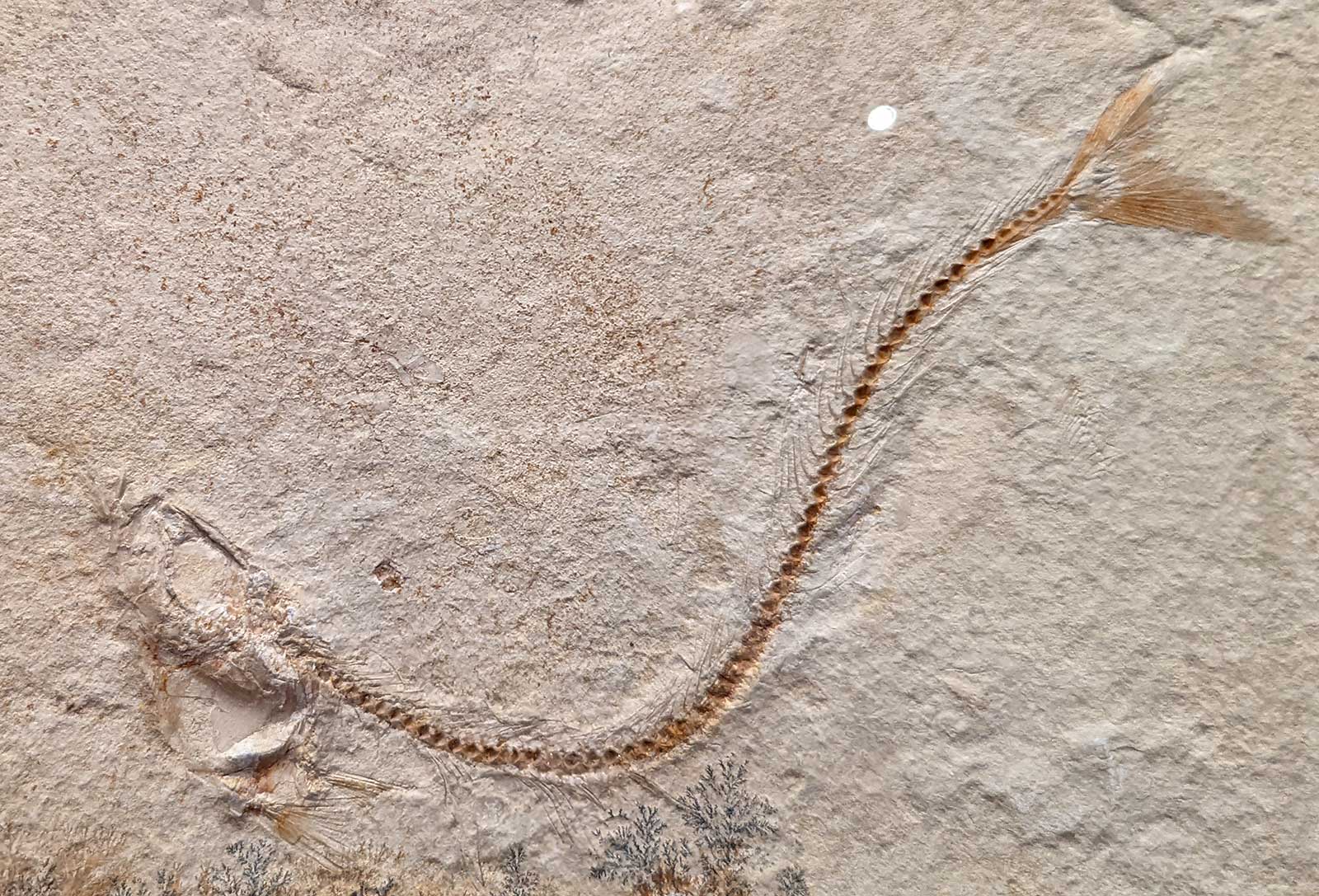
Naseus rectifrons Fish Fossil
https://mczbase.mcz.harvard.edu/guid/MCZ:VP:VPF-5378
Thursday, October 20, 2022
Dapedoglosus testis Fish Fossil
This fossil was displayed on August 2022, at the Harvard Museum of Natural History in Cambridge, Massachusetts, USA. This fish fossil is called Dapedoglosus testis (Cope, 1887) along with a small Priscacara. This specimen was found in the Green River Formation at Kemmerer Wyoming USA. It dates to the Eocene Epoch (48 million years ago), Paleogene Period.
Wednesday, October 19, 2022
Mioplosus labricoides Fish Fossil
This fossil was displayed on August 2022, at the Harvard Museum of Natural History in Cambridge, Massachusetts, USA. This fish fossil is called Mioplosus labricoides (Cope, 1887). This specimen was found in the Green River Formation at Kemmerer Wyoming USA. It dates to the Eocene Epoch (48 million years ago), Paleogene Period.
Tuesday, October 18, 2022
Priscacara serrata Fish Fossil at Harvard
This fossil was displayed on August 2022, at the Harvard Museum of Natural History in Cambridge, Massachusetts, USA. This fish fossil is called Priscacara serrata (Cope, 1887). This specimen was found in the Green River Formation at Kemmerer Wyoming USA. It dates to the Eocene Epoch (48 million years ago), Paleogene Period
Sunday, October 2, 2022
Triarthrus becki Trilobite Fossil
Yesterday's posting was of the trilobite Triarthrus eatoni (Hall, 1838) specimens on display at the Harvard Museum of Natural History. Today's post will cover another species of this trilobite highlighted in The Appendages, Anatomy, and Relationships of Trilobites by Percy E Raymond. It was published in December of 1920 by Connecticut Academy of Arts and Sciences. Dr. Raymond was associate professor of palaeontology and curator of invertebrate palaeontology in the Museum of Comparative Zoology at Harvard University. It covers Charles Emerson Beecher (1856-1904) unpublished work on trilobites including the Triarthrus becki (Green, 1839?) found in the Utica Shale. Paleo-illustrator and MIT/Columbia University educated paleontologist Elvira Wood (1865-1928) did a lot of illustrating on this book.
On page 40 a historical description was provided, "Specimens of Triarthrus retaining appendages were first obtained by Mr. W. S. Valiant from the dark carbonaceous Utica shale near Rome, New York, in 1884, but no considerable amount of material was found until 1892. The first specimens were sent to Columbia University, and were described by Doctor W. D. Matthew (1893). This article was
accompanied by a plate of sketches, showing for the first time the presence of antennules in trilobites and indicating something of the endopodites and exopodites of the appendages of the cephalon, thorax,
and pygidium. Specimens had not yet been cleaned from the lower side, so that no great amount could then be learned of the detailed structure. Matthew concluded that 'The homology with Limulus seems
not to be as close in Triarthrus as in the forms studied by Mr. Walcott; but the characters seem to be of a more comprehensive type, approaching the general structure of the other Crustacea rather than any special form.'"
The following are from plate I in the book. Described as "Photographs of Triarthrus becki, made by C. E. Beecher."
Fig. 1. Specimen 213. The dorsal test has been removed from the glabella, revealing the outline of the posterior end of the hypostoma, the proximal ends of the antennules, the gnathites, and incomplete
endopodites of some appendages, × 5.43
right side, × 7.33.
Fig. 3. Specimen 217. This specimen shows better than any other the form of the gnathites of the cephalon. Note also the setæ of the exopodites under the cheek at the right. The appearance of a hook on the posterior gnathite on the right may be accidental, but it does not show broken edges, × 6.85.
Fig. 4. Specimen 215. The ventral side of the cephalon of a small entire specimen. Shows well the form of some of the gnathites and a few of the endopodites. Note the unusual position of the antennules. × 7.63.
Fig. 5. Specimen 226. This specimen did not photograph well, but is important as showing the exopodites and endopodites emerging from under the cephalon. × about 6.
Saturday, October 1, 2022
Triarthrus eatoni Trilobite Fossils
When I visited the Harvard Museum of Natural History in August 2022, one of the most historical invertebrate fossils I found were these two. These trilobite fossils are Triarthrus eatoni (Hall, 1838). They were found in the Utica Shale of Trenton, New York USA. During the Taconic Orogeny, the geological process of moutain-building ash, clay and organic carbon compacted into what became the Utica Shale. The fossils date to the Late Ordovician Period.
The historical part of the specimens is that they were collected by Charles Doolittle Walcott (1850-1927). He is famous for discovering the Cambrian Burgess Shale of Canada and was the 4th secretary of Smithsonian Institution. Walcott published a number of papers on trilobites including the 1894 Note of Some Appendages of the Trilobites and 1918 Appendages of Trilobites.
https://mczbase.mcz.harvard.edu/guid/MCZ:IP:IPAR-5630
Recently, I bought a book that relates to this called The Appendages, Anatomy, and Relationships of Trilobites by Percy E Raymond. It was published in December of 1920 by Connecticut Academy of Arts and Sciences. Dr. Raymond was associate professor of palaeontology and curator of invertebrate palaeontologyin the Museum of Comparative Zoology at Harvard University. It covers Charles Emerson Beecher (1856-1904) unpublished work on trilobites including the Triarthrus becki (Green, 1839?) found in the Utica Shale. Paleo-illustrator Elvira Wood (1865-1928) did quite a bit of work on this book.
Friday, September 30, 2022
Tenontosaurus tilletti Dinosaur Fossil
This fossil was displayed on August 2022, at the Harvard Museum of Natural History in Cambridge, Massachusetts, USA. This dinosaur limb bone belonged to a herbivore ornithopod Tenontosaurus tilletti (Ostrom, 1970). This specimen was found in the Cloverly Formation at Montana USA. It dates to the Middle Cretaceous Period.
Thursday, September 29, 2022
Priscacara pealei Fish Fossil
This fossil was displayed on August 2022, at the Harvard Museum of Natural History in Cambridge, Massachusetts, USA. This fish fossil is called Priscacara pealei (Cope, 1887). This specimen was found in the Green River Formation at Kemmerer Wyoming USA. It dates to the Eocene Epoch (48 million years ago), Paleogene Period
Monday, September 26, 2022
Harvard Notogoneus osculus Fish Fossil
This fossil was displayed on August 2022, at the Harvard Museum of Natural History in Cambridge, Massachusetts, USA. This fish fossil is called Notogoneus osculus (Cope, 1885). This specimen was found in the Green River Formation at Kemmerer Wyoming USA. It dates to the Eocene Epoch, Paleogene Period. Catalog number is MCZ5350 or VPF-5350.
https://mczbase.mcz.harvard.edu/guid/MCZ:VP:VPF-5350
Posted another specimen at the American Museum of Natural History in 2020.
https://louisvillefossils.blogspot.com/2020/03/notogoneus-osculus-fish-fossil.html
Friday, September 16, 2022
Probelesodon minor Fossil
This fossil reptile skull and jaw were displayed on August 2022, at the Harvard Museum of Natural History in Cambridge, Massachusetts, USA. It is called Probelesodon minor (Romer, 1973). The creature lived during the middle Triassic Period. Fossil was found in 1965 in the Chañares Formation of La Rioja Province of Argentina.
Thursday, September 15, 2022
Placenticeras Ammolite Fossil
This fossil was displayed on August 2022, at the Harvard Museum of Natural History
in Cambridge,Massachusetts, USA. It is an ammonite fossil is called Placenticeras (Meek, 1870). The creature lived during the Upper Cretaceous Period
(80 million years ago). Fossil was found in Bearpaw Formation on the Blackfeet Reservation of southern Alberta, Canada. Specimen on loan to museum from the Mineral Trust.
The amazing iridescent colors are the mineral ammolite (aragonite).
Wednesday, September 14, 2022
Aeger tipularis Prawn Fossil
This fossil was displayed on August 2022, at the Harvard Museum of Natural History in Cambridge,Massachusetts, USA. This prawn fossil is called Aeger tipularis (Schlotheim, 1822). The crustacean lived during the Jurassic Period (Kimmeridgian Stage). Fossil was found Solnhofen Limestone of Bavaria, Germany. Catalog number is MCZ106308.
Tuesday, September 13, 2022
Eurypterus remipes Eurypterid Fossil
This fossil was displayed on August 2022, at the Harvard Museum of Natural History in Cambridge,Massachusetts, USA. This eurypterid fossil is called Eurypterus remipes (Dekay, 1825). This sea scorpion lived during the Silurian Period. This specimen was found in Litchfield, New York which is famous for this type of fossil.
Tuesday, September 6, 2022
Anaethalion knorri Fish Fossil
This fossil was displayed on August 2022, at the Harvard Museum of Natural History in Cambridge,Massachusetts, USA. This fish fossil is called Anaethalion knorri (Blainville, 1818). Fish lived during the Jurassic Period (Kimmeridgian Stage). Fossil was found Solnhofen Limestone Formation of Bavaria, Germany. Catalog number is MCZ5333.
This display was odd in the MCZBASE database lists its name as Aethalion knorri but the name on the wall in the museum lists it as Analthanion knorr.
Monday, September 5, 2022
Urocles lepidotus Fish Fossil
This fossil was displayed on August 2022, at the Harvard Museum of Natural History in Cambridge,Massachusetts, USA. This fish fossil is called Urocles lepidotus (Agassiz). Fish lived during the Jurassic Period (Kimmeridgian Stage). Fossil was found Solnhofen Limestone Formation of Bavaria, Germany. Catalog number is MCZ5336.
Sunday, September 4, 2022
Macrosemius rostratus Fish Fossil
This fossil was displayed on August 2022, at the Harvard Museum of Natural History in Cambridge, Massachusetts, USA. This fish fossil is called Macrosemius rostratus (Agassiz, 1844). Fish lived during the Jurassic Period (Kimmeridgian Stage). Fossil was found Solnhofen Limestone Formation of Bavaria, Germany. Catalog number is MCZ5300.
Saturday, September 3, 2022
Leptolepis dubius Fish Fossil
This fossil was displayed on August 2022, at the Harvard Museum of Natural History in Cambridge, Massachusetts, USA. This fish fossil is called Leptolepis dubius (Blainville, 1818). Fish lived during the Jurassic Period (Kimmeridgian Stage). Fossil was found Solnhofen Limestone Formation of Bavaria, Germany. Catalog number is MCZ7090.
Wednesday, August 31, 2022
Pycnodus platessus Fish Fossil
https://mczbase.mcz.harvard.edu/guid/MCZ:VP:VPF-6248