Showing posts with label ammolite. Show all posts

Monday, December 9, 2024

Ammolite - The Organic Gemstone


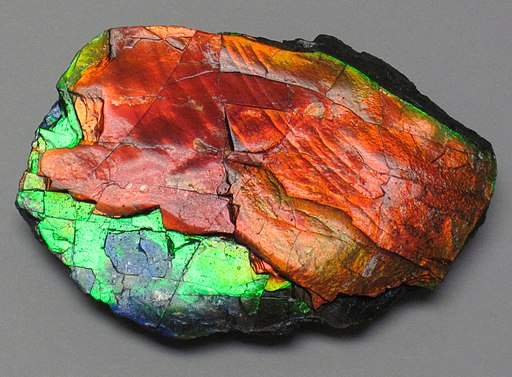
The picture above is a organic gemstone formed from the remains of ancient ammonite creatures. Below is a picture of a Placenticeras meeki (Böhm, 1898) ammonite fossil found in the Bearpaw Shale Formation of the Lethbridge District, Alberta, Canada. The fossil dates to the Cretaceous Period. Specimens were on display at the Natural History Museum Vienna (Naturhistorisches Museum Wien) on August 2024.


Thursday, September 15, 2022

Placenticeras Ammolite Fossil


This fossil was displayed on August 2022, at the Harvard Museum of Natural History in Cambridge,Massachusetts, USA. It is an ammonite fossil is called Placenticeras (Meek, 1870). The creature lived during the Upper Cretaceous Period (80 million years ago). Fossil was found in Bearpaw Formation on the Blackfeet Reservation of southern Alberta, Canada. Specimen on loan to museum from the Mineral Trust.


The amazing iridescent colors are the mineral ammolite (aragonite).


Tuesday, October 29, 2019

Ancyloceras Heteromorph Ammonite Fossils


Fossils in picture are Ancyloceras heteromorph ammonite fossils. They date to the Cretaceous Period (115 million years ago) and were found in Morocco. The fossils were on display at a northern Indiana USA museum.


The museum is called Joshua Tree Earth and Space Museum and is located at 106. S. Michigan Street, Lakeville, Indiana. Admission is free but they could use the donations. They are open 10 AM to 6 PM daily and can be reached at 574-784-2291.

Thanks to Kenny for the image.

Sunday, September 29, 2019

Stolen Canadian Ammolite Fossil

Picture of ammolite fragment from Lethbridge Canada, shown here for reference. This piece was not stolen but available to see on Wikipedia. Attribution: James St. John [CC BY 2.0 (https://creativecommons.org/licenses/by/2.0)]

CTV News Calgary Canada reported on July 18, 2019 that thieves stole serving plate sized ammonite fossil from their quarry. The fossil once prepped and polished is estimated to be worth around $30,000-40,000 U.S. The quarry is near Lethbridge, Alberta, Canada and is operated by Enchanted Designs Limited.

What makes the fossil so valuable is that it is composed of a organic gem like material ammolite. Ammolite is a biogenic gemstone like pearl and amber. The material comes from the ancient shells of cephalopods. More than likely the fossil was a Placenticeras sp. from the Cretaceous Period (70-75 million years ago). The creatures swam in what was known as the Western Interior Seaway which stretched from today's Arctic Ocean, through western Canada and United States and down to the Gulf of Mexico.

Below is an embedded video of the story when some nice images of the quarry and what raw and finished ammonite fossils look like from the quarry. If the video is not showing up, go to this link to view: https://calgary.ctvnews.ca/lethbridge/video?clipId=1733413&binId=1.1484062&playlistPageNum=1


Read about the story at this link:
https://calgary.ctvnews.ca/50k-fossil-stolen-in-noon-hour-heist-from-ammonite-mine-near-lethbridge-1.4514504

Tuesday, August 27, 2019

Iridescent Placenticeras meeki Ammonite Fossil


Iridescent Placenticeras meeki ammonite fossil on display at The Museo Civico di Storia Naturale di Milano (Milan Natural History Museum), Italy as of August 2019. It is quite a beautiful fossil and probably one of the most valuable (price-wise) with exception to the dinosaurs on display there.
It dates to the upper Cretaceous Period and was found in Canada. I would estimate the fossil was at least 30 cm in diameter.


What makes the fossil so valuable is that it is composed of a organic gem-like material ammolite. Ammolite is a biogenic gemstone like pearl and amber. The material comes from the ancient shells of cephalopods. The creatures swam in what was known as the Western Interior Seaway which stretched from today's Arctic Ocean, through western Canada and United States and down to the Gulf of Mexico.

Friday, December 7, 2018

Placenticeras intercalare Ammonite Fossil


This ammonite fossil was on display at the American Museum of Natural History (AMNH) in New York city in July 2018. The ammonite fossil is named Placenticeras intercalare. It was found in the Bearpaw Formation, Lethbridge, Alberta, Canada and dates to the Cretaceous Period (75 million years ago). Accession number is Fl-56701. Donated by Korite International and Canada Fossils Ltd.


The ammonite fossil shell is now iridescent caused by being exposed to high pressures and temperatures. The marine creature existed in the Western Interior Seaway that covered the middle of what is now the North American continent. The seaway existed from about 75-65 million years ago.

What makes the fossil so valuable is that it is composed of a organic gem-like material ammolite. Ammolite is a biogenic gemstone like pearl and amber. The material comes from the ancient shells of cephalopods.


Learn more about the museum at https://www.amnh.org/


Tuesday, April 19, 2011

$150000 Canadian Ammonite

From time to time I visit the web site of an Internet fossil dealer at indiana9fossils.com to look at the expensive and exotic fossils for sale.  Listed on April 8, 2011 were a group of ammonite fossils from the Bearpaw Formation of southern Alberta, Canada.  An approximate 28 inch diameter fossil is the Placenticeras meeki from the Cretaceous Period is one fossil in this group on display.  The specimen labeled "Canada Ammonite M3" sold for $150000!  As of this writing two other smaller specimens are for sale for $6000 and $25000.


See pictures of the fossils at this web page: http://www.indiana9fossils.com/Ammonites/Ammolite-Ammonites.htm

Wow, that is one expensive invertebrate fossil!

What makes the fossil so valuable is that it is composed of a organic gem like material ammolite. Ammolite is a biogenic gemstone like pearl and amber. The material comes from the ancient shells of cephalopods.  The creature swam in what was known as the Western Interior Seaway which stretched from today's Arctic Ocean, through western Canada and United States and down to the Gulf of Mexico.