This picture is of an Aulopora (Goldfuss, 1829) horn coral fossil. It existed during the Devonian period. The fossil was found in Caledonia, New York, USA. Fossil was on display at the Natural History Museum Vienna (Naturhistorisches Museum Wien) on August 2024.
Friday, November 29, 2024
Aulopora Coral Fossil
Thursday, November 14, 2024
Dalmanites limurus Trilobite Fossil
This picture is of a Dalmanites limurus trilobite fossil. It existed during the Silurian period. The fossil was found in Monroe County, New York USA. Fossil was on display at the Natural History Museum Vienna (Naturhistorisches Museum Wien) on August 2024. The trilobite was probably found in the Rochester Shale.
Tuesday, November 5, 2024
Productella spinulicosta Brachiopod Fossil
Here are some illustrations of the brachiopod fossil Productella spinulicosta (Hall, 1867). The fossil was found in the Marcellus and Hamilton beds at Erie County, New York, USA. The fossil dates to the Devonian Period. They were published in Amadeus Grabau's (1870-1946) book Geology and Palaeontology of Eighteen Mile Creek and the Lake Shore Sections of Erie County, New York from 1899. The images are from pages 205, figures 112 & 112A.
Tuesday, October 15, 2024
Ichthyocrinus laevis Crinoid Fossil Illustration
Here are some illustrations of the crinoid fossil Ichthyocrinus laevis (Conrad). The fossil was found in the Rochester shale at Erie County, New York, USA. The fossil dates to the Silurian Period. This fossil is also found in the Lockport Shale. They were published in Amadeus Grabau's (1870-1946) book Geology and Palaeontology of Eighteen Mile Creek and the Lake Shore Sections of Erie County, New York from 1899. The images are from pages 157-158, figure 53.
Monday, October 14, 2024
Eucalyptocrinus decorus Crinoid Fossil Illustration
Here are some illustrations of the crinoid fossil Eucalyptocrinus decorus (Phillips). The fossil was found in the Clinton beds at Erie County, New York, USA. The fossil dates to the Silurian Period. This fossil is also found in the Rochester Shale. They were published in Amadeus Grabau's (1870-1946) book Geology and Palaeontology of Eighteen Mile Creek and the Lake Shore Sections of Erie County, New York from 1899. The images are from pages 157-158, figure 53.
Sunday, October 13, 2024
Orthothetes subplanus Brachiopod Illustration
Here are some illustrations of the brachiopod fossil Orthothetes subplanus (Conrad). The fossil was found in the Clinton beds at Niagara Falls, New York, USA. The fossil dates to the Silurian Period. This fossil is also found in the Rochester Shale. They were published in Amadeus Grabau's (1870-1946) book Geology and Palaeontology of Eighteen Mile Creek and the Lake Shore Sections of Erie County, New York from 1899. The images are from page 184, figure 91.
Saturday, May 11, 2024
Amadeus Grabau's Paleontology of Niagara Falls Book
On September 12, 2022 I posted about acquiring Amadeus Grabau's (1870-1946) book Geology and Palaeontology of Eighteen Mile Creek and the Lake Shore Sections of Erie County, New York from 1899. While looking at my bookshelf for a book to read, I came across another book I had acquired in 2023. It is the 1901 Amadeus Grabau's Guide to the Geology and Paleontology of Niagara Falls and Vicinity. Normally I would not get a book about fossils from New York or a place I have not collected from before but I have a special interest in this author.
I bought the book for a number of reasons: it is signed by Dr. Grabau, it includes a chapter from Elizabeth J. Letson (1874-1919) [who I profiled in a blog posting June 1, 2021], it contains a number images by paleontologist Elvira Wood (1865-1928), and it has fossil images I can scan and post (particularly Silurian Period fossils). The book is an ex-Cap May City Public Library (New Jersey) copy and was bought from Princeton Antiques Bookfinders (Atlantic City).
It is inscribed: "To my good Friend Rev. August Steinle with the warm regards of the author Amadeus W Grabau May 8, 1906". Below is a scan of what he wrote, note the insect holes where they have eaten part of the page. I am not sure I have the spelling of the reverend's last name correct.
Chapter 5 in the book is written by Ms. Letson (title listed as Director of museum, Buffalo society of natural sciences) and it is entitled "Post-Pliocene Fossils of Niagara". On page 241, she included the figure and description for Amnicola letsoni (Walker, 1901) which is a gastropod species named after her. At the beginning of the chapter she lists a footnote "I wish to acknowledge here my obligations to Prof. Henry A. Pilsbry, Mr Bryant Walker and Dr. V. Sterki, for valuable assistance and advice given in the preparation of this chapter."
Thursday, August 24, 2023
Carl Brett Fossil Videos
Today's entry is to highlight a number of fossil YouTube videos featuring the University of Cincinnati geology professor Dr. Carlton Brett. These videos were created by Paleontological Research Institution (PRI) of Ithaca, New York, USA. This first video focuses on Devonian Period bivalves from central New York and in particular Actinopteria and Plethomytilus.
The 2nd video covers Devonian Period brachiopod fossils with a focus on Spinocyrtia and Tullypothyridina.
Dr. Brett continues his fossil exploration of a central New York site highlighting Devonian Period bryozoan fossils like the Leptotrypella.
The fourth video covers Devonian Period trilobite fossils like the Phacops (Eldredgeops) rana.
The fifth video covers the rugose (horn) corals like the Heliophyllum halli.
This last video shows tabulate coral finds like Favosites.
Wednesday, July 12, 2023
Maclurea magna Gastopod Fossils
This picture is of a Maclurea magna (Lesueur, 1818) gastropod fossils. It was found in Chazy, New York, USA. It dates to the Silurian Period.
The picture was taken in June 2023 on the first floor of the Smithsonian Museum of Natural History in Washington D.C. USA.
Sunday, January 29, 2023
Lichas boltoni Fossil
Here is an image of a Silurian Period of a Lichas boltoni (Bigsby, 1825) [it is now known by genus Arctinurus (Castelnau, 1843)]. This illustration was originally in an 1852 James Hall publication of a fossil found in the Rochester Shale of New York.
This image was scanned from plate 17 of Guide to the Geology and Paleontology of Niagara Falls and Vicinity by Amadeus W. Grabau April 1901.
Sunday, October 2, 2022
Triarthrus becki Trilobite Fossil
Yesterday's posting was of the trilobite Triarthrus eatoni (Hall, 1838) specimens on display at the Harvard Museum of Natural History. Today's post will cover another species of this trilobite highlighted in The Appendages, Anatomy, and Relationships of Trilobites by Percy E Raymond. It was published in December of 1920 by Connecticut Academy of Arts and Sciences. Dr. Raymond was associate professor of palaeontology and curator of invertebrate palaeontology in the Museum of Comparative Zoology at Harvard University. It covers Charles Emerson Beecher (1856-1904) unpublished work on trilobites including the Triarthrus becki (Green, 1839?) found in the Utica Shale. Paleo-illustrator and MIT/Columbia University educated paleontologist Elvira Wood (1865-1928) did a lot of illustrating on this book.
On page 40 a historical description was provided, "Specimens of Triarthrus retaining appendages were first obtained by Mr. W. S. Valiant from the dark carbonaceous Utica shale near Rome, New York, in 1884, but no considerable amount of material was found until 1892. The first specimens were sent to Columbia University, and were described by Doctor W. D. Matthew (1893). This article was
accompanied by a plate of sketches, showing for the first time the presence of antennules in trilobites and indicating something of the endopodites and exopodites of the appendages of the cephalon, thorax,
and pygidium. Specimens had not yet been cleaned from the lower side, so that no great amount could then be learned of the detailed structure. Matthew concluded that 'The homology with Limulus seems
not to be as close in Triarthrus as in the forms studied by Mr. Walcott; but the characters seem to be of a more comprehensive type, approaching the general structure of the other Crustacea rather than any special form.'"
The following are from plate I in the book. Described as "Photographs of Triarthrus becki, made by C. E. Beecher."
Fig. 1. Specimen 213. The dorsal test has been removed from the glabella, revealing the outline of the posterior end of the hypostoma, the proximal ends of the antennules, the gnathites, and incomplete
endopodites of some appendages, × 5.43
right side, × 7.33.
Fig. 3. Specimen 217. This specimen shows better than any other the form of the gnathites of the cephalon. Note also the setæ of the exopodites under the cheek at the right. The appearance of a hook on the posterior gnathite on the right may be accidental, but it does not show broken edges, × 6.85.
Fig. 4. Specimen 215. The ventral side of the cephalon of a small entire specimen. Shows well the form of some of the gnathites and a few of the endopodites. Note the unusual position of the antennules. × 7.63.
Fig. 5. Specimen 226. This specimen did not photograph well, but is important as showing the exopodites and endopodites emerging from under the cephalon. × about 6.
Saturday, October 1, 2022
Triarthrus eatoni Trilobite Fossils
When I visited the Harvard Museum of Natural History in August 2022, one of the most historical invertebrate fossils I found were these two. These trilobite fossils are Triarthrus eatoni (Hall, 1838). They were found in the Utica Shale of Trenton, New York USA. During the Taconic Orogeny, the geological process of moutain-building ash, clay and organic carbon compacted into what became the Utica Shale. The fossils date to the Late Ordovician Period.
The historical part of the specimens is that they were collected by Charles Doolittle Walcott (1850-1927). He is famous for discovering the Cambrian Burgess Shale of Canada and was the 4th secretary of Smithsonian Institution. Walcott published a number of papers on trilobites including the 1894 Note of Some Appendages of the Trilobites and 1918 Appendages of Trilobites.
https://mczbase.mcz.harvard.edu/guid/MCZ:IP:IPAR-5630
Recently, I bought a book that relates to this called The Appendages, Anatomy, and Relationships of Trilobites by Percy E Raymond. It was published in December of 1920 by Connecticut Academy of Arts and Sciences. Dr. Raymond was associate professor of palaeontology and curator of invertebrate palaeontologyin the Museum of Comparative Zoology at Harvard University. It covers Charles Emerson Beecher (1856-1904) unpublished work on trilobites including the Triarthrus becki (Green, 1839?) found in the Utica Shale. Paleo-illustrator Elvira Wood (1865-1928) did quite a bit of work on this book.
Sunday, November 7, 2021
Caryocrinites ornatus Cystoid Fossils
My September 2021 trip to Alpena, Michigan USA included a visit to local paleontologist Paleo Joe (aka Joseph Kchodl).
This picture is of one of his cystoid fossils from Middleport, New York USA. This fossil is known as Caryocrinites ornatus (Say, 1825). It was found in the Rochester Shale and existed in the Silurian Period.
Another beautiful specimen fossil of this species can be found at this web site http://www.primitiveworlds.com/cystoids-3.html
The next picture shows the same cystoids buy you can see their almost full length stems down to the holdfast. Also a Striispirifer niagarensis (Conrad, 1843) brachiopod fossil on that matrix as well.
Saturday, November 6, 2021
Icthyocrinus laevis Crinoid Calyx Fossil
My September 2021 trip to Alpena, Michigan USA included a visit to local paleontologist Paleo Joe (aka Joseph Kchodl).
This picture is of one of his crinoid calyx fossils from Middleport, New York USA. This fossil is known as Icthyocrinus laevis (Conrad, 1842). It was found in the Rochester Shale and existed in the Silurian Period.
Another beautiful specimen fossil of this species can be found at this web site http://www.primitiveworlds.com/crinoids-14.html
Thursday, September 30, 2021
Proaster Brittle Star Fossil
My September 2021 trip to Alpena, Michigan USA included a visit to local paleontologist Paleo Joe (aka Joseph Kchodl).
This picture is of one of his brittle star fossils from Middleport, New York USA. This fossil is known as Protaster sp. (Forbes, 1849). It was found in the Rochester Shale and existed in the Silurian Period.
Genus was named by Edward Forbes (1815-1854) in Figures and descriptions illustrative of British Organic Remains. Memoirs of the Geological Survey of the United Kingdom (1849).
Wednesday, September 29, 2021
Chilotrypa ostiolata Bryozoan Fossil
My September 2021 trip to Alpena, Michigan USA with several amateur paleontologists from Louisville and Chicago, we visited a local paleontologist Paleo Joe (aka Joseph Kchodl).
This picture is of one of his bryozoan fossils from Middleport, New York USA. This fossil is known as Chilotrypa ostiolata (Hall, 1852). It was found in the Rochester Shale and existed in the Silurian Period.
Saturday, September 25, 2021
Desmograptus micronematodes Graptolite Fossil
My trip earlier this month to Alpena, Michigan USA with several amateur paleontologists from Louisville and Chicago, we visited a local paleontologist Paleo Joe (aka Joseph Kchodl). This picture is of one of his graptolite fossils from Middleport, New York USA. This fossil is known as Desmograptus micronematodes (Spencer, 1884). It was found in the Rochester Shale and existed in the Silurian Period.
Species was named by Joseph Winthorp Spencer (1851-1921) in Graptolites of the upper Silurian System (Niagara fossils). Bulletin of the University of Missouri Museum, 1, pages 555–610 published 1884.
Dr. Spencer is buried at Grove Cemetery in Dundas, Ontario, Canada.
Sunday, August 8, 2021
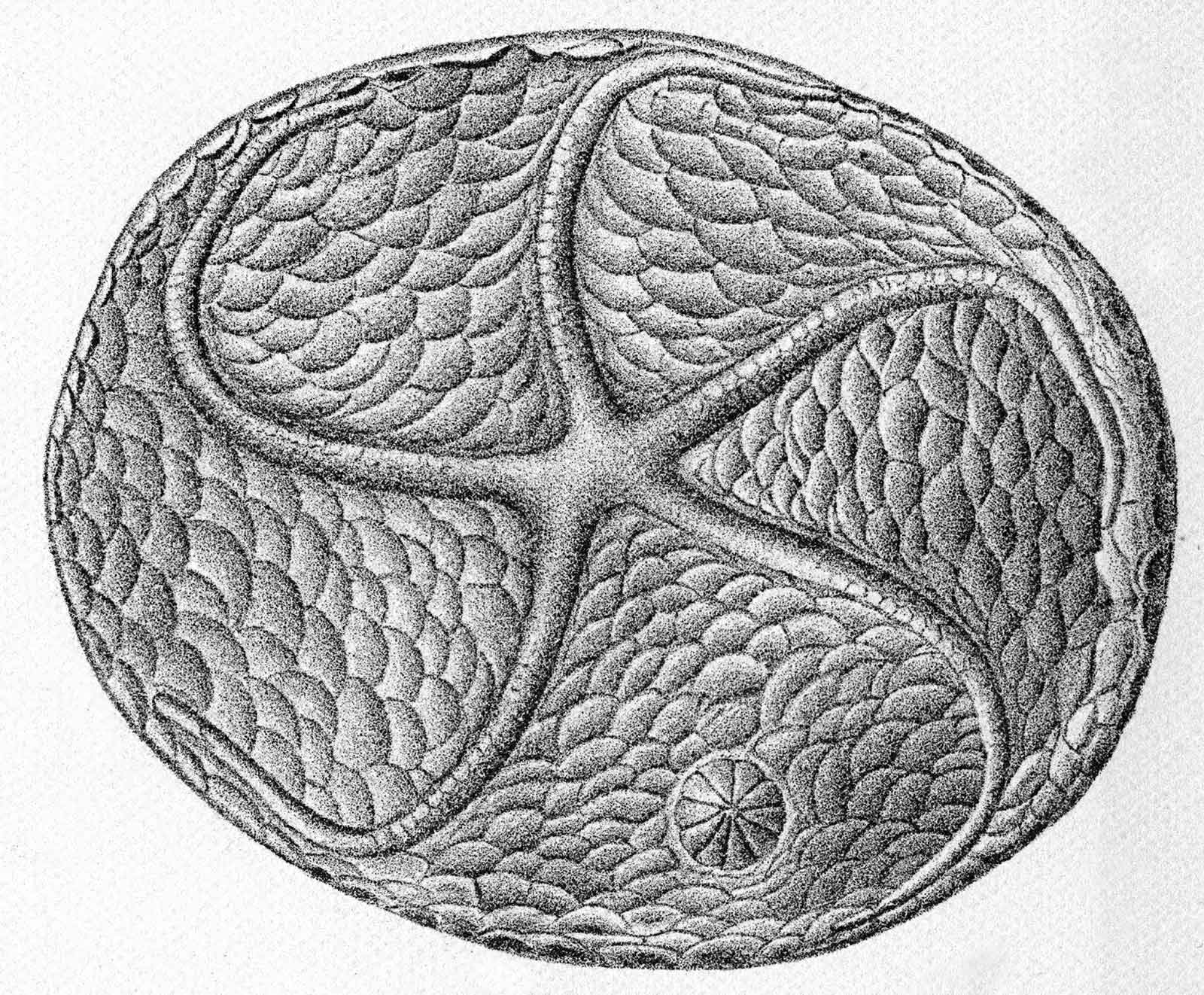
Lepidodiscus alleganius Edrioasteroid Fossil
This scan is from the book is called New York State Museum Bulletin 49 December 1901 Paleontologic Papers 2. It contains a number of papers including one called New Agelacrinites by John Mason Clarke (1857-1925). He named this new species Lepidodiscus alleganius (Clarke, 1901). Fossil like this are found in the Chemung sandstones at and near Alfred, Belvidere and Wellsville New York, USA, and 2 miles south of Sabinville, Tioga County Pennsylvania, USA. This fossil dates to the Devonian Period.
The fossil was re-evaluated in the paper The Classification of the Edrioasteroidea by R.S. Bassler (1878-1961) and its genus changed to Cooperidiscus. This paper was published in Smithsonian Miscellaneous Collections Volume 93, Number 8 (April 4, 1935).
Monday, August 2, 2021
Amnigenia catkillensis Pelecypod Fossils
This post documents a scan of large insert found in New York State Museum Bulletin 49 published December 1901. The paper is listed as Value of Amnigenia as an Indicator of Fresh-Water Deposits of New York, Ireland, and the Rhineland by John M. Clarke (pages 199-203; plate 11).
These pelecypods are listed as Amnigenia catkillensis (Hall, 1885) which were originally described by Vanuxem in 1842 as Cypricardites catskillensis. Researchgate web site lists genus renamed by Weir in 1969 to Archanodon. Fossils date to the Devonian Period.
Image is from plate 11 described as "a slab of limestone bearing 33 individuals of this species all with closed valves and buried in the mud at various angles across the lines of sedimentation." It was found in the Oneonta sandstone of Clarke Quarry at Oxford, New York, USA. The specimen was presented to the New York State Museum by E.E. Davis, esq. of Norwich, New York. The plate is sized at approximately 14 by 10 inches (35.5 x 25.4 cm)
Tuesday, June 1, 2021
Conchologist Elizabeth Letson
![]() |
| Elizabeth Jane Letson (1874-1919) Firefly-Gemini AI enhanced |
While reviewing one of Amadeus Grabau publications about New York fossils, it contained a section written by Elizabeth J. Letson. Staying with my 2021 theme of researching 19th century women in science I had to investigate.
Outside of Buffalo, New York it appears this remarkable woman's achievements have slipped past the modern historian's view.
Early Life
Elizabeth Jane Letson was born April 9, 1874 at Griffins Mills, New York (Erie County). The only child of Augustus Franklin Letson (1841-1900) and Nellie Webb Letson (1850-1924). Her mother was a 8th descendant of original settler William Bradford from the Mayflower and was direct descendant of Governor Bradford, first governor of Massachusetts.
She attended schools in Buffalo, New York. At an early age, she became interested in natural history, in particular conchology. After graduating, she continued her education at the Academy of Natural Sciences of Philadelphia (ANSP) after receiving the Jessup fellowship. She spent two years working with Henry Augustus Pilsby (1862-1957). When she died at a relatively young age of 44, he wrote her obituary in The Nautilus (journal of malacology). Later, she studied at the United States National Museum in Washington, D.C.
At the age 18, she started working at the Buffalo Society of Natural Sciences in 1892 where she would remain for 17 years. At first she volunteered to clean the museum and arrange the library. She eventually rose to the position on Director of the Buffalo Museum in 1899.
Scientific Work
In 1898, she named Tethys pilsbryi after her mentor Henry Pilsbry at ANSP.
She formed the Conchological Club in 1899.
In 1901 she published in the New York State Museum bulletin about post-Pliocene fossils found Niagara river gravels and in 1905 a list of mollusca found in New York.
In 1904, she traveled from Veracruz, Mexico to New York October 20-28 via the S.S. Havana.
In 1906, Alfred University conferred upon her the honorary degree of Doctor of Science.
Dr. Bryan and Elizabeth took an extended trip in 1917-1918 to the United States. They departed Honolulu July 3, 1917 on the S.S. Wilhelmina which arrived in San Francisco on July 10, 1917. The couple spent several months as the Philadelphia Academy of Natural Sciences researching Hawaiian marine mollusks. They also spent time research Hawaiian shells at the Smithsonian and Harvard museums.
Dr. Letson was a member of the American Anthropological Society, the National Geographic Society, the American Association for the Advancement of Science, the Audubon Society of Pennsylvania, the New York State committee for the Women's Out-of-door Art League, the American Civic Association, the Conchological Society of Great Britain and Ireland, the Buffalo Society, and the Mayflower Society of New York State.
Death
Elizabeth Letson Bryan died at 11:20 PM, February 28, 1919 in Honolulu, Hawaii of heart disease. She was reported to having been ill for 8 months prior to her death. Her mentor Henry Pilsbry wrote of her "gracious personality and sunny outlook, no less than the genuine love of nature which determined the course of her life, made her many warm friends who mourn her untimely death."
Legacy
Donations
Academy of Natural Sciences Philadelphia (A.N.S.P.) 1917
"Prof. W. A. and E. L. Bryan. Eight species of shells, Hawaiian Islands"
Species Named by Her
Tethys pilsbryi (Letson, 1898)
Species Name for Her
Amnicola letsoni (Walker, 1901)
Tellina (Arcopagia) elizabethae (Pilsbry, 1917) type no 80253 at A.N.S.P.
"Its distinctness from that species was brought to my attention by Mrs. Bryan for whom it is named."
Turbonilla (Evaletta) elizabethae (Pilsbry, 1917) type no 117596 at A.N.S.P.
"This pretty, delicately colored shell is named for Mrs. W.A. Bryan."
Species Named for Her Mother
Odostomia letsonae (Pilsby, 1917) type no 117600 at A.N.S.P.
"It was picked from beach debris by Mrs. Letson, whose work on the minutes shells of this locality has brought many interesting species to light."
Sources:
Dr. Elizabeth Letson Bryan, Former Buffalonian, Noted for Scientific Work, Dies in Hawaii, The Buffalo Evening Times, Saturday, March 22, 1919. page 9.
Pilsbry, Henry Augustus, Obituary for Elizabeth Letson Byran, Sc. D. The Nautilus, 1919 page 142.
E. J. Letson. “Description of a New Tethys (Aplysia).” Proceedings of the Academy of Natural Sciences of Philadelphia, vol. 50, 1898, pp. 193–193. JSTOR, www.jstor.org/stable/4062402. Accessed 30 May 2021.
https://www.findagrave.com/memorial/43807680/elizabeth-jane-bryan
Wikipedia page:
https://en.wikipedia.org/wiki/Elizabeth_Jane_Letson_Bryan