Showing posts with label elvira wood. Show all posts

Saturday, May 11, 2024

Amadeus Grabau's Paleontology of Niagara Falls Book


On September 12, 2022 I posted about acquiring Amadeus Grabau's (1870-1946) book Geology and Palaeontology of Eighteen Mile Creek and the Lake Shore Sections of Erie County, New York from 1899. While looking at my bookshelf for a book to read, I came across another book I had acquired in 2023. It is the 1901 Amadeus Grabau's Guide to the Geology and Paleontology of Niagara Falls and Vicinity. Normally I would not get a book about fossils from New York or a place I have not collected from before but I have a special interest in this author.

I bought the book for a number of reasons: it is signed by Dr. Grabau, it includes a chapter from Elizabeth J. Letson (1874-1919) [who I profiled in a blog posting June 1, 2021], it contains a number images by paleontologist Elvira Wood (1865-1928), and it has fossil images I can scan and post (particularly Silurian Period fossils). The book is an ex-Cap May City Public Library (New Jersey) copy and was bought from Princeton Antiques Bookfinders (Atlantic City).

It is inscribed: "To my good Friend Rev. August Steinle with the warm regards of the author Amadeus W Grabau May 8, 1906". Below is a scan of what he wrote, note the insect holes where they have eaten part of the page. I am not sure I have the spelling of the reverend's last name correct.


Chapter 5 in the book is written by Ms. Letson (title listed as Director of museum, Buffalo society of natural sciences) and it is entitled "Post-Pliocene Fossils of Niagara". On page 241, she included the figure and description for Amnicola letsoni (Walker, 1901) which is a gastropod species named after her. At the beginning of the chapter she lists a footnote "I wish to acknowledge here my obligations to Prof. Henry A. Pilsbry, Mr Bryant Walker and Dr. V. Sterki, for valuable assistance and advice given in the preparation of this chapter."


Sunday, March 19, 2023

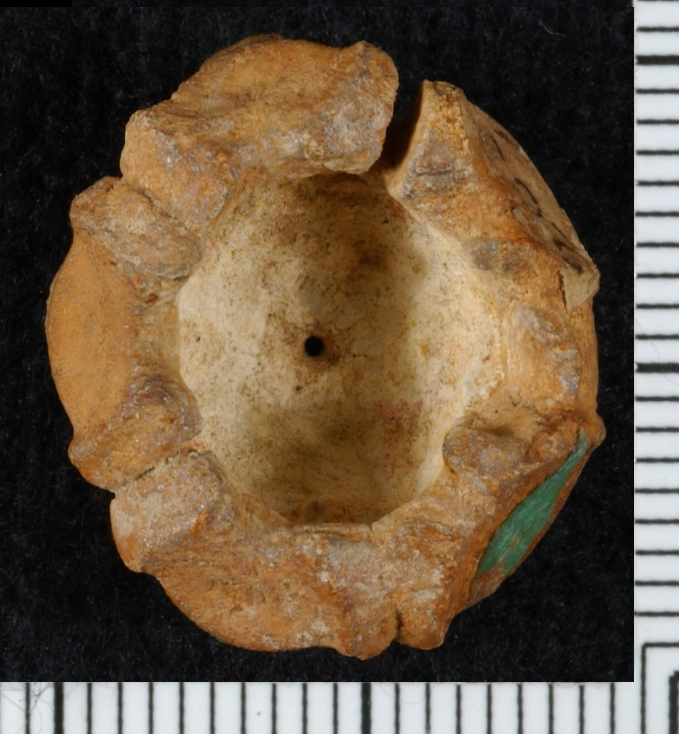
Echinocrinites fenestratus Cystoid Fossil

Image courtesy of the Smithsonian Institution Specimen Catalog Number:  USNM PAL 35091 Specimen 2 GUID:     http://n2t.net/ark:/65665/m3c65a4dfe-ad99-45cc-8f4a-0217d73e8a45 Photographer Suzanne McIntire. Specimen housed in the collections of the Department of Paleobiology, National Museum of Natural History, Smithsonian Institution

Echinocrinites fenestratus
(Troost, 1850) cystoid fossil described in A Critical Summary of Troost's Unpublished Manuscript on the Crinoids of Tennessee by Elvira Wood 1909. This cystoid was found in Brownsport limestone of Decatur County Tennessee USA (Silurian Period). It was assigned U.S. National Museum number 35091 and identified as a holotype.While fossil is described on pages 8-9, no explanation as to why no illustration was provided. It was later renamed by Professor Charles Schuchert (1858-1942) as Tetracystis fenestratus (1904). He published about this same specimen in On Siluric and Devonic Cystidea and Camarocrinus and included three photographs at Plate XXXIV figures 6-8.

Image courtesy of the Smithsonian Institution Specimen Catalog Number:  USNM PAL 35091 Specimen 2 GUID:        http://n2t.net/ark:/65665/m36381a8a3-ba40-4d94-aea8-3a9ab5a5c632 Photographer Suzanne McIntire. Specimen housed in the collections of the Department of Paleobiology, National Museum of Natural History, Smithsonian Institution

Image courtesy of the Smithsonian Institution Specimen Catalog Number:  USNM PAL 35091 Specimen 2 GUID:      http://n2t.net/ark:/65665/m3168ad43c-793c-4122-bdcc-1d6c566bba8a Photographer Suzanne McIntire. Specimen housed in the collections of the Department of Paleobiology, National Museum of Natural History, Smithsonian Institution
Photos are from the Smithsonian collection, first three shown from specimen 2. The record for USNM PAL 35091 lists only 1 specimen but there are six pictures and appear to be two distinct cystoid fossils. Three pictures shown below appear to be from specimen 1.

Image courtesy of the Smithsonian Institution Specimen Catalog Number:  USNM PAL 35091 Specimen 1 GUID:      http://n2t.net/ark:/65665/m360b0775e-4ca2-48cb-92e2-ca1ab25b8a70 Photographer Suzanne McIntire. Specimen housed in the collections of the Department of Paleobiology, National Museum of Natural History, Smithsonian Institution

Image courtesy of the Smithsonian Institution Specimen Catalog Number:  USNM PAL 35091 Specimen 1 GUID:       http://n2t.net/ark:/65665/m3a74e0aa5-fa6a-4fb5-8624-e6f4ce09d08c Photographer Suzanne McIntire. Specimen housed in the collections of the Department of Paleobiology, National Museum of Natural History, Smithsonian Institution

Image courtesy of the Smithsonian Institution Specimen Catalog Number:  USNM PAL 35091 Specimen 1 GUID:          http://n2t.net/ark:/65665/m3d01e00e9-334e-4fdf-a0e5-654056b7b4c0 Photographer Suzanne McIntire. Specimen housed in the collections of the Department of Paleobiology, National Museum of Natural History, Smithsonian Institution


Saturday, March 18, 2023

Barycrinus stellatus Crinoid Calyx Fossil


Image courtesy of the Smithsonian Institution Specimen Catalog Number:  USNM PAL 39942 Specimen GUID:             http://n2t.net/ark:/65665/m3d84e97de-ad18-4d93-b196-63b98eb801e1 Specimen housed in the collections of the Department of Paleobiology, National Museum of Natural History, Smithsonian Institution


Barycrinus stellatus (Troost, 1850) crinoid calyx fossil described in A Critical Summary of Troost's Unpublished Manuscript on the Crinoids of Tennessee by Elvira Wood 1909. Drawings in this post are from  Plate 8 figures 6-8 drawn by Major Adolphus Heiman (1809-1862). This crinoid was found in Keokuk horizon of the Tullahoma formation Stewart County Tennessee USA (Mississippian Period). It was assigned U.S. National Museum number 39942 and identified as a holotype. Originally it was called Cyathocrinites steallatus.

Photos are from the Smithsonian collection. The calyx is identified as being 19.5 mm in width. 

Image courtesy of the Smithsonian Institution Specimen Catalog Number:  USNM PAL 39942 Specimen GUID:                 http://n2t.net/ark:/65665/m3b87b9092-b56d-4328-a50b-6d88dbb88830 Specimen housed in the collections of the Department of Paleobiology, National Museum of Natural History, Smithsonian Institution


Image courtesy of the Smithsonian Institution Specimen Catalog Number:  USNM PAL 39942 Specimen GUID:                 http://n2t.net/ark:/65665/m3f3fd6c75-c59b-41d2-bf35-1580a382510c Specimen housed in the collections of the Department of Paleobiology, National Museum of Natural History, Smithsonian Institution

Image courtesy of the Smithsonian Institution Specimen Catalog Number:  USNM PAL 39942 Specimen GUID:                     http://n2t.net/ark:/65665/m362f5b1a6-526f-44bf-ad50-e774a9aabf28 Specimen housed in the collections of the Department of Paleobiology, National Museum of Natural History, Smithsonian Institution

Saturday, March 11, 2023

Melonite granulatus Crinoid Calyx Fossil

Image courtesy of the Smithsonian Institution Specimen Catalog Number:  USNM PAL 39909 Specimen GUID:     http://n2t.net/ark:/65665/36ce242a9-26bb-4138-8ab4-fccdd1ce4954 Photographer Suzanne McIntire. Specimen housed in the collections of the Department of Paleobiology, National Museum of Natural History, Smithsonian Institution

Melonite granulatus
(Troost, 1850) crinoid calyx fossil described in A Critical Summary of Troost's Unpublished Manuscript on the Crinoids of Tennessee by Elvira Wood 1909. This crinoid was found in Cumberland Gap Claiborne County Tennessee USA (Mississippian Period). It was assigned U.S. National Museum number 39909 and identified as a holotype.While fossil is described on pages 107-108, no explanation as to why no illustration was provided. 

Image courtesy of the Smithsonian Institution Specimen Catalog Number:  USNM PAL 39909 Specimen GUID:     http://n2t.net/ark:/65665/36ce242a9-26bb-4138-8ab4-fccdd1ce4954 Photographer Suzanne McIntire. Specimen housed in the collections of the Department of Paleobiology, National Museum of Natural History, Smithsonian Institution


Thursday, March 9, 2023

Cleiocrinus tessellatus Crinoid Calyx Fossil


Cleiocrinus tessellatus
(Troost, 1850) crinoid calyx fossil Plate 7 figures 11 drawn by Major Adolphus Heiman (1809-1862) from A Critical Summary of Troost's Unpublished Manuscript on the Crinoids of Tennessee by Elvira Wood 1909. This crinoid was found in the Lebanon limestone (Silurian Period) division of the Stones River Formation of Duck River, near Columbia, Maury County Tennessee USA. It was assigned U.S. National Museum number 39910 and identified as a holotype.

Pictures of the actual Troost fossil at the Smithsonian shown below. 

Image courtesy of the Smithsonian Institution Specimen Catalog Number:  USNM PAL 39910 Specimen GUID:         http://n2t.net/ark:/65665/33b065c2b-0ba1-423d-bcbc-2f7ec78c0007 Specimen housed in the collections of the Department of Paleobiology, National Museum of Natural History, Smithsonian Institution


Wednesday, March 8, 2023

Cyathocrinites tiaraeformis Crinoid Fossil


Cyathocrinites tiaraeformis (Troost, 1850) crinoid calyx fossil Plate 7 figures 15-17 drawn by Major Adolphus Heiman (1809-1862) from A Critical Summary of Troost's Unpublished Manuscript on the Crinoids of Tennessee by Elvira Wood 1909. This crinoid was found in the Carboniferous Period Keokuk horizon of the Tullahoma Formation of White's Creek Springs, Davidson County Tennessee USA. It was assigned U.S. National Museum number 54236 and identified as a holotype. Elvira Wood lists it as Ichthyocrinus tiaraeformis (Troost) Hall.

Pictures of the actual Troost fossil at the Smithsonian shown below.

Image courtesy of the Smithsonian Institution Specimen Catalog Number:  USNM PAL 54236 Specimen GUID:         http://n2t.net/ark:/65665/390e41ca3-405f-4e83-91c9-5e494bfd3e5b Specimen housed in the collections of the Department of Paleobiology, National Museum of Natural History, Smithsonian Institution 
 
 
Image courtesy of the Smithsonian Institution Specimen Catalog Number:  USNM PAL 54236 Specimen GUID:         http://n2t.net/ark:/65665/390e41ca3-405f-4e83-91c9-5e494bfd3e5b Specimen housed in the collections of the Department of Paleobiology, National Museum of Natural History, Smithsonian Institution
 

Image courtesy of the Smithsonian Institution Specimen Catalog Number:  USNM PAL 54236 Specimen GUID:         http://n2t.net/ark:/65665/390e41ca3-405f-4e83-91c9-5e494bfd3e5b Specimen housed in the collections of the Department of Paleobiology, National Museum of Natural History, Smithsonian Institution


Tuesday, March 7, 2023

Cyathocrinites roemerii Crinoid Fossil


Cyathocrinites roemerii (Troost, 1850) crinoid calyx fossil Plate 6 figure 11 drawn by Major Adolphus Heiman (1809-1862) from A Critical Summary of Troost's Unpublished Manuscript on the Crinoids of Tennessee by Elvira Wood 1909. This crinoid was found in the Carboniferous Period aged in the St. Louis Limestone of  Duck River, Maury County Tennessee USA. It was assigned U.S. National Museum number 39944 and identified as a holotype. Elvira Wood refers to as Scaphiocrinus huntsvillae  (Worthen).

Gerard Troost (1776-1850) does not list who the species is named after but it appears was one of two geologist brothers Friedrich Adolph Roemer (1809-1869) or Carl Ferdinand von Roemer (1818-1891).

UPDATE [December 2024]: The fossil was named after the younger Ferdinand Roemer. I found his 1860 book Die silurische Fauna des westlichen Tennessee / Eine palaeontologische Monographie in which he visited Troost in 1847 in Nashville. He writes (translated from German to English): "When I returned from Texas in the summer of 1847 to Nashville, the capital of the state of Tennessee, and found a very friendly welcome and valuable instruction on the geological conditions of the country from Dr. G. Troost, who has made a great contribution to the natural history of the western states, my attention was particularly drawn to the beautifully preserved Silurian fossils in the excellent man's rich paleontological collection..."

Picture of the real fossil is below which is stored at the Smithsonian. Their database shows it is a holotype called Dinotocrinus roemeri (Troost in Wood, 1909).

Image courtesy of the Smithsonian Institution Specimen Catalog Number:  USNM PAL 39944 Specimen GUID:         http://n2t.net/ark:/65665/39ac4d2dd-9845-4878-8d40-90204c177ae3 Specimen housed in the collections of the Department of Paleobiology, National Museum of Natural History, Smithsonian Institution


Monday, March 6, 2023

Granatocrinites globosus Blastoid Fossil


Granatocrinites globosus (Troost, 1835) blastoid fossil Plate 4 figures 12-14 drawn by Major Adolphus Heiman (1809-1862) from A Critical Summary of Troost's Unpublished Manuscript on the Crinoids of Tennessee by Elvira Wood 1909. This very distinct blastoid was found in the Devonian Period aged at Bedford County Tennessee USA. It was assigned U.S. National Museum number 33077 and identified as a holotype. Elvira Wood refers to as Orbitremites granulatus (Roemer).

Picture of the real fossil is below:

Image courtesy of the Smithsonian Institution Specimen Catalog Number:  USNM PAL 33077 Specimen GUID:     http://n2t.net/ark:/65665/m3fa639a8e-6c3a-459b-acd8-8d23c8e76bed Photographer Suzanne McIntire. Specimen housed in the collections of the Department of Paleobiology, National Museum of Natural History, Smithsonian Institution


Sunday, March 5, 2023

Troosticrinus reinwardtii Blastoid Fossil


Troostocrinus reinwardtii (Troost, 1835) blastoid fossil Plate 3 figures 2-4 drawn by Major Adolphus Heiman (1809-1862) from A Critical Summary of Troost's Unpublished Manuscript on the Crinoids of Tennessee by Elvira Wood 1909. This very distinct blastoid was found in the Silurian Period aged Brownsport limestone of Tennessee. It was assigned U.S. National Museum number 33071.

Troost's Original drawings of Pentremites reinwardtii from 1835 work

Gerard Troost (1776-1850) originally called this fossil Pentremites reinwardtii (Troost, 1835) in On The Pentremites reinwardtii, A New Fossil; With Remarks on the Genus Pentremites (Say), and Its Geognostic Position in the States of Tennessee, Alabama, and Kentucky in Geological Society of Pennsylvania (1835). It appears he named the species after a Dutch botanist Caspar Georg Carl Reinwardt (1773-1854). The genus Troost used was named by his friend from Philadelphia and New Harmony, Indiana Thomas Say (1787-1834).

 The holotype fossil Troost found back in the 1830s now resides at the National Museum of Natural History, Smithsonian Institution. See photographs of it below that were taken sometime in 2010.


Image courtesy of the Smithsonian Institution Specimen Catalog Number:  USNM PAL 33071 Specimen GUID:     http://n2t.net/ark:/65665/3fda37982-30dd-4c41-aa35-c48973890252 Photographer Suzanne McIntire. Specimen housed in the collections of the Department of Paleobiology, National Museum of Natural History, Smithsonian Institution

Image courtesy of the Smithsonian Institution Specimen Catalog Number:  USNM PAL 33071 Specimen GUID:     http://n2t.net/ark:/65665/3fda37982-30dd-4c41-aa35-c48973890252 Photographer Suzanne McIntire. Specimen housed in the collections of the Department of Paleobiology, National Museum of Natural History, Smithsonian Institution


Saturday, March 4, 2023

Macroporaster nylanderi Starfish Fossil

Macroporaster nylanderi drawing by Dr. Elvira Wood 1921

A Silurian Period fossil called Macroporaster nylanderi (Raymond, 1921). It was found in sandstone at New Sweden, Aroostook County, Maine, USA by Olof O. Nylander who the species is named after. Outer radius is 19 mm and inner radius is 7 mm, depth 2-2.5 mm. It was described in No.4 - A New Fossil Starfish From New England by Percy E. Raymond published Proceedings Boston Society of Natural History Volume 36 (August 1921). When fossil was published it was shown to be specimen number 14,966 in collection of Boston Society of Natural History.

Above is figure 7 in article drawn by Dr. Elvira Wood. This image was one of many illustrations she did for Dr. Raymond's publications between 1920-1924. Dr. Wood published one of the first American drawings of a starfish in 1909 of Troost's Palaeaster antiqua (Troost, 1835). Charles Schuchert renamed that fossil Mesopalaeaster antiquus (Troost, 1835) in 1915.

The current fossil is stored at the National Museum of Natural History at the Smithsonian Institution in Washington, D.C. and is listed as a holotype USNM PAL 166743. Another picture of this specimen shows its label (maybe from Boston) showing it was purchased from Nylander. Olof O. Nylander (1864-1943) was born in Oremella, Sweden where he became interested in natural history. He migrated to the United States in 1883 and worked in various states as a painter. He later was contracted out as a geologist for the U.S. Geological Survey, the Canadian government, and various universities/colleges. In 1939, the WPA built the Nylander Museum of Natural History in which he was the first curator-director. It housed his collections which were transferred to them in 1943 at his death. As of this writing, the museum in closed to the public.

Judging from the Smithsonian picture compared to the drawing, someone tried to prep this fossil and destroyed part of it. The paper described it as not having any other fossils on the matrix but it looks like the area around the fossil was removed and a small brachiopod fossil (reminds me of a Rhynchotreta) was revealed.

Image courtesy of the Smithsonian Institution Specimen Catalog Number:  USNM PAL 166743 Specimen GUID: https://collections.nmnh.si.edu/search/paleo/?ark=ark:/65665/3b69b1962935c41b69ed004c723c45745 Photographer Suzanne McIntire. Specimen housed in the collections of the Department of Paleobiology, National Museum of Natural History, Smithsonian Institution


Sunday, October 2, 2022

Triarthrus becki Trilobite Fossil


Triarthrus becki Trilobite Fossil illustration done in 1920 by Elvira Wood
Yesterday's posting was of the trilobite Triarthrus eatoni (Hall, 1838) specimens on display at the Harvard Museum of Natural History. Today's post will cover another species of this trilobite highlighted in The Appendages, Anatomy, and Relationships of Trilobites by Percy E Raymond. It was published in December of 1920 by Connecticut Academy of Arts and Sciences. Dr. Raymond was associate professor of palaeontology and curator of invertebrate palaeontology in the Museum of Comparative Zoology at Harvard University. It covers Charles Emerson Beecher (1856-1904) unpublished work on trilobites including the Triarthrus becki (Green, 1839?) found in the Utica Shale. Paleo-illustrator and MIT/Columbia University educated paleontologist Elvira Wood (1865-1928) did a lot of illustrating on this book.

On page 40 a historical description was provided, "Specimens of Triarthrus retaining appendages were first obtained by Mr. W. S. Valiant from the dark carbonaceous Utica shale near Rome, New York, in 1884, but no considerable amount of material was found until 1892. The first specimens were sent to Columbia University, and were described by Doctor W. D. Matthew (1893). This article was
accompanied by a plate of sketches, showing for the first time the presence of antennules in trilobites and indicating something of the endopodites and exopodites of the appendages of the cephalon, thorax,
and pygidium. Specimens had not yet been cleaned from the lower side, so that no great amount could then be learned of the detailed structure. Matthew concluded that 'The homology with Limulus seems
not to be as close in Triarthrus as in the forms studied by Mr. Walcott; but the characters seem to be of a more comprehensive type, approaching the general structure of the other Crustacea rather than any special form.'"

The following are from plate I in the book. Described as "Photographs of Triarthrus becki, made by C. E. Beecher."

Fig. 1. Specimen 213. The dorsal test has been removed from the glabella, revealing the outline of the posterior end of the hypostoma, the proximal ends of the antennules, the gnathites, and incomplete
endopodites of some appendages, × 5.43

Fig. 2. Specimen 214. The head of a complete large specimen. Part of the thorax is shown on pl. 3, fig. 6. Note especially the form of the segments of the endopodites and of the anterior coxopodite on the
right side, × 7.33.
Fig. 3. Specimen 217. This specimen shows better than any other the form of the gnathites of the cephalon. Note also the setæ of the exopodites under the cheek at the right. The appearance of a hook on the posterior gnathite on the right may be accidental, but it does not show broken edges, × 6.85.
Fig. 4. Specimen 215. The ventral side of the cephalon of a small entire specimen. Shows well the form of some of the gnathites and a few of the endopodites. Note the unusual position of the antennules. × 7.63.
Fig. 5. Specimen 226. This specimen did not photograph well, but is important as showing the exopodites and endopodites emerging from under the cephalon. × about 6.


Sunday, January 9, 2022

Cryptolithus tessellatus Trilobite Drawing


This image created by Doctor Elvira Wood and published in 1920 in The Appendages, Anatomy, and Relationships of Trilobites by Percy E. Raymond. It is of a Cryptolithus tessellatus (Green, 1832) trilobite. The creature lived in the Ordovician Period. This image was a restoration and not a direct drawing of an actual specimen. Trilobites like this are found in Carroll County, Kentucky.

I am not sure if an intact one has been found in Kentucky. The Cincinnati Dry Dredger's web site has a page for this trilobite showing an intact fossil. http://www.drydredgers.org/fragcrp1.htm

Thursday, December 9, 2021

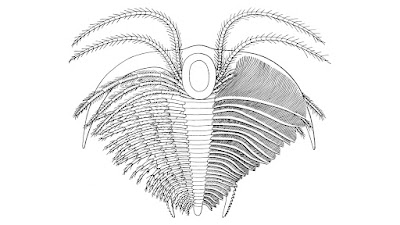
Marrella splendens Arthropod Image


This image created by Doctor Elvira Wood and published in 1920 in The Appendages, Anatomy, and Relationships of Trilobites by Percy E. Raymond. It is of a Marrella splendens (Walcott, 1912) arthropod. Charles Doolittle Walcott collected it from the Burgess Shale of British Columbia, Canada in 1909. He described it as a "lace crab". It turns out it is not a trilobite or a crab. The creature lived in the Cambrian Period.

This image is not correct as you will see if go to the Wikipedia entry below to see more modern interpretations of what this animal looked like. Dr. Raymond was directing Dr. Wood how to illustrate this fossil. He writes on page 116, "The accompanying restoration of the ventral surface of Marrella is a tentative one, based on Doctor Walcott's description and figures. ... The restoration is therefore subject to revision as the species becomes better known."

Learn more at: https://en.wikipedia.org/wiki/Marrella

Sunday, May 2, 2021

Leptodesma marcellense Pelecypod Fossil


Here are a series of images drawn by Elvira Wood in 1901 which she used to show fossil pelecypod called Leptodesma marcellense (Hall). She described and illustrated it in the 1901 paper Marcellus (Stafford) Limestones of Lancaster, Erie Co. N.Y. on pages 190. Illustrations on plate 9 figures 16 and 17.

Saturday, May 1, 2021

Onychochilus nitidulus Gastropod Fossil


Here is an image drawn by Elvira Wood in 1901 which she used to show fossil gastropod called Onychochilus (?) nitidulus (Clarke, 1894). She described and illustrated it in the 1901 paper Marcellus (Stafford) Limestones of Lancaster, Erie Co. N.Y. on pages 190. Illustration on plate 9 figure 20. Described as "A small exfoliated specimen."

On page 170, listed as "In bed III is found a minute sinistrally coiled gastropod which corresponds with Clark's description and figures except that, instead of a faint carination of the whorls, there is a distinct spiral band. The concentric growth lines are interrupted in passing over this band, which is apparently partially filled by foreign matter. This feature is well shown on the body whorls of one specimen only, but, if the  discovery of other specimens confirm this observation, they should be referred to the genus Hesperiella of Holzapfel rather than Onychochilus, with which I have doubtfully placed my specimens."

Friday, April 30, 2021

Camarotoechia prolifica Brachiopod Fossil


Here are a series of images drawn by Elvira Wood in 1901 which she used to show fossil brachiopod called Camarotoechia prolifica (Hall). She described and illustrated it in the 1901 paper Marcellus (Stafford) Limestones of Lancaster, Erie Co. N.Y. on pages 162.


Monday, April 26, 2021

Camarotoechia pauciplicata Brachiopod Fossil

Plate 9 Figure 7 Camarotoechia pauciplicata sp. nov. dorsal view of a specimen from the Stafford limestone of Genesee county.
 

Here are a series of images drawn by Elvira Wood in 1901 which she used to name a new species of brachiopod called Camarotoechia pauciplicata. She described and illustrated it in the 1901 paper Marcellus (Stafford) Limestones of Lancaster, Erie Co. N.Y. on pages 162-163.

"Associated with Camarotoechia sappho and C. horsfordi are specimens which differ from both in important respects. The outline of these shells is subpentagonal, the greatest width being two thirds the distance from the beak to the anterior margin. Pedicle valve slightly convex in the posterior portion but becoming depressed in the sinus and extended in front to meet the margin of the brachial valve. Beak elevated and slightly incurved. Brachial valve gibbous, the greatest convexity being at about the middle of the shell. Surface marked by three subangular plications on the fold, two in the sinus, and three broad, low plications on the lateral slopes. These are crossed by well marked lines of growth. Plications absent near the beaks and becoming well defined at about one fourth the length of the shell from the beak. A well marked constriction of both valves is often present about half way between the beak and anterior margin. The interior could not be observed. The nearly straight cardinal slopes, elevated ventral beak, and few plications of the fold and sinus are the most characteristic features of the species.

This species resembles externally Pugnax utah of the upper Coal Measures, but the specimens are longer in proportion to the width, and the plications become visible nearer the beak than in the latter species. From Camarotoechia (?) duplicata, of the Chemung beds, it differs in the unequal convexity of the valves, straight cardinal slopes, and greater number of lateral plications. This species shell has been found by the writer in material from the Stafford limestone of the Livonia shaft (N. Y. state museum)."


Plate 9 Figure 8 Camarotoechia pauciplicata sp. nov. anterior view of a specimen from the Stafford limestone of Genesee county.

 
Plate 9 Figure 9 Camarotoechia pauciplicata sp. nov. ventral view of a specimen from the Stafford limestone of Genesee county.

Plate 9 Figure 10 Camarotoechia pauciplicata sp. nov. pedicle valve of a specimen from which the beak has been broken.

Plate 9 Figure 11 Camarotoechia pauciplicata sp. nov. lateral view of the same

Plate 9 Figure 12 Camarotoechia pauciplicata sp. nov. dorsal valve