Showing posts with label arthropoda. Show all posts

Friday, June 23, 2023

Opabinia regalis Fossil


This fossil is an Opabinia regalis (Walcott, 1912) which is an extinct arthropod. It was found by Charles Walcott (1850-1927) in 1912 in Burgess Shale of British Columbia Canada. It dates to the Middle Cambrian Period (505 million years ago).

The picture was taken in June 2023 on the first floor of the Smithsonian Museum of Natural History in Washington D.C. USA.

Learn more about this genus on Wikipedia:

https://en.wikipedia.org/wiki/Opabinia

Thursday, December 9, 2021

Marrella splendens Arthropod Image


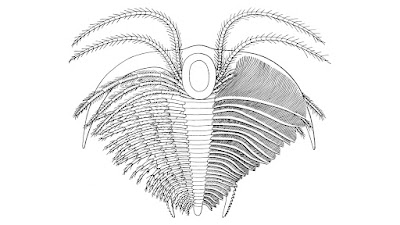
This image created by Doctor Elvira Wood and published in 1920 in The Appendages, Anatomy, and Relationships of Trilobites by Percy E. Raymond. It is of a Marrella splendens (Walcott, 1912) arthropod. Charles Doolittle Walcott collected it from the Burgess Shale of British Columbia, Canada in 1909. He described it as a "lace crab". It turns out it is not a trilobite or a crab. The creature lived in the Cambrian Period.

This image is not correct as you will see if go to the Wikipedia entry below to see more modern interpretations of what this animal looked like. Dr. Raymond was directing Dr. Wood how to illustrate this fossil. He writes on page 116, "The accompanying restoration of the ventral surface of Marrella is a tentative one, based on Doctor Walcott's description and figures. ... The restoration is therefore subject to revision as the species becomes better known."

Learn more at: https://en.wikipedia.org/wiki/Marrella

Sunday, November 11, 2018

Sculda pennata Arthropod Fossil


This picture is of a Sculda pennata arthropod fossil. It was found in Solnhofen Limestone of Germany. The fossil dates to Late Jurassic Period.  Fossil  displayed at Muséum National D'Historie Naturelle Jardin Des Plantes Paléontologie et Anatomie Comparée, Paris, France.  Image taken August 2016.

Learn more at their website: https://www.mnhn.fr/en/visit/lieux/galerie-paleontologie-anatomie-comparee-paleontology-and-comparative-anatomy-gallery

Wednesday, August 7, 2013

Marrella Arthropod Fossil


This image is of two Marrella sp. fossils found in the Burgess Shale of British Columbia, Canada. It is one of the common soft body fossil creatures found there. These fossils date to the Cambrian Period of the Paleozoic Era (about 530 million years ago).

Discovered by Charles D. Walcott who later was in charge of the Smithsonian in the United States. This fossil layer is quite famous. The Smithsonian later sent out specimens to natural history museums across the United States in the 1940s. More than likely this is one of that was sent to the Museum of Natural History and Science in Cincinnati, Ohio. It can be found in the invertebrate fossil display past the Ice Age exhibit in the museum as of August 2013.

Here is an illustration that was on display with these fossils of an artist interpretation of what these creature might have looked like.
Learn more at Wikipedia.org.

Saturday, December 3, 2011

Pemphix sueri Arthropod Fossil

 
This arthropod fossil has been identified as a Pemphix sueri.  This animal lived in the Middle Triassic seas and living life similar to today's lobsters. This creature still has crustacean relatives alive today in the Pacific Ocean.

Fossil displayed at the Carnegie Museum of Natural History in Pittsburgh, Pennsylvania (July 2011) and has the accession numbers is CM 2526 and CM 2537.

Visit the Carnegie museum web site:  http://www.carnegiemnh.org/

Wednesday, September 9, 2009

English Carboniferous Arthropods

Here are some interesting fossils on display at the 2nd floor of Muséum National D'Historie Naturelle Jardin Des Plantes Paléontologie et Anatomie Comparée in Paris, France. They are some sort of arthropod fossil that looks to be related to the modern horseshoe crab. They are all from the Carboniferous Period (U.S. Pennsylvanian Period).

This first one is from Coal Brook Dale, England and is called Prestwichia anthrax. The species was apparently discovered by Professor Joseph Prestwich in 1834-1836 (as Limulus anthrax). For any science fiction fans out there, it reminds me of a shadow ship on the TV series Babylon 5.


This next fossil is also from England and is named Prestwichia sp.


This last fossil is from Coal Brook Dale, England and is called Belinurus belulus. It is described in the Transactions of the Manchester Geological and Mining Society (May 1905) along with the previously shown Prestwichia anthrax on pages 124-127. The article is entitled "Prestwichia anthrax and Belinurus belulus from Sparth Bottoms, Rochdale" by Walter Baldwin. A scanned version of the article can be found at Google Books on the Internet.

Saturday, April 4, 2009

Blue Crayfish Pincers

Here are some more pictures of blue crayfish pincers.

UPDATE: Thanks to the nice people at www.bluecrayfish.com for identification of these pieces. They are Cambarus diogenes which is not a blue crayfish but has been bleached blue by the sun.

Click on images to see more detail.


Friday, April 3, 2009

Indiana Blue Crayfish

Okay, this pictures are of creatures that are not fossils... yet. They could be distantly related to trilobites.

While pruning the Concord grape plants the other day I came across the remains of blue crayfish. Some animal maybe a raptor or raccoon tends to leave remains near the grape arbor (usually a pile of feathers). I guess it could be a cat killing the crayfish and then a bird bringing the remains to the grapes to finish eating it. The tail, internal organs, and legs were missing from these crayfish. I think there were at least three crayfish and the remains were within a meter radius of each other. I estimate the crayfish could have been 6 inches (15-18 cm) long.

What really caught my attention was the blue color of the pincers and parts of the shell. I will have more detailed pincer images tomorrow. Doing a little research I found this nice website on blue crayfish. I also found this website on Indiana crayfish. Maybe this species is a Procambarus alleni, P. clarkii or Orconectes rusticus. I wonder if these crayfish are naturally blue or something in the environment is turning them this color. Should the water be tested? These remains were found in Clark County, Indiana.

One last thing, these are burrowing crayfish. Their mounds are all over the yard where water runs through from an irrigation pond. They are probably nocturnal.

UPDATE: Thanks to the nice people from www.bluecrayfish.com for identifying these pieces. They identified it as a Cambarus diogenes and it is blue because the sun bleached it.

CLICK ON IMAGES TO SEE MORE DETAIL.