Showing posts with label burgess shale. Show all posts

Saturday, June 24, 2023

Wiwaxia Fossil


This fossil is an Wiwaxia sp. (Walcott, 1911) which might be an extinct mollusc. It was found by Charles Walcott (1850-1927) in 1911 in Burgess Shale of British Columbia Canada. It dates to the Middle Cambrian Period (505 million years ago).

The picture was taken in June 2023 on the first floor of the Smithsonian Museum of Natural History in Washington D.C. USA.

Learn more about this genus on Wikipedia:

https://en.wikipedia.org/wiki/Wiwaxia

Friday, June 23, 2023

Opabinia regalis Fossil


This fossil is an Opabinia regalis (Walcott, 1912) which is an extinct arthropod. It was found by Charles Walcott (1850-1927) in 1912 in Burgess Shale of British Columbia Canada. It dates to the Middle Cambrian Period (505 million years ago).

The picture was taken in June 2023 on the first floor of the Smithsonian Museum of Natural History in Washington D.C. USA.

Learn more about this genus on Wikipedia:

https://en.wikipedia.org/wiki/Opabinia

Thursday, December 9, 2021

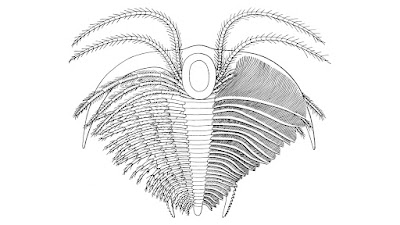
Marrella splendens Arthropod Image


This image created by Doctor Elvira Wood and published in 1920 in The Appendages, Anatomy, and Relationships of Trilobites by Percy E. Raymond. It is of a Marrella splendens (Walcott, 1912) arthropod. Charles Doolittle Walcott collected it from the Burgess Shale of British Columbia, Canada in 1909. He described it as a "lace crab". It turns out it is not a trilobite or a crab. The creature lived in the Cambrian Period.

This image is not correct as you will see if go to the Wikipedia entry below to see more modern interpretations of what this animal looked like. Dr. Raymond was directing Dr. Wood how to illustrate this fossil. He writes on page 116, "The accompanying restoration of the ventral surface of Marrella is a tentative one, based on Doctor Walcott's description and figures. ... The restoration is therefore subject to revision as the species becomes better known."

Learn more at: https://en.wikipedia.org/wiki/Marrella

Sunday, November 25, 2018

Olenoides serratus Trilobite Fossil


This trilobite fossil was on display at the American Museum of Natural History (AMNH) in New York city in July 2018. The trilobite fossil is named Olenoides serratus. It was found in the Burgess Shale of British Columbia, Canada and dates to the Cambrian Period. Accession number is Fl-22506.

Learn more about the museum at https://www.amnh.org/

Their trilobite exhibit was made possible by Dr. Martin Shugar, M.D. and Andy Secher who are also editors for the AMNH trilobite web site.

Thursday, August 8, 2013

Anomalocaris canadensis Cambrian Fossil


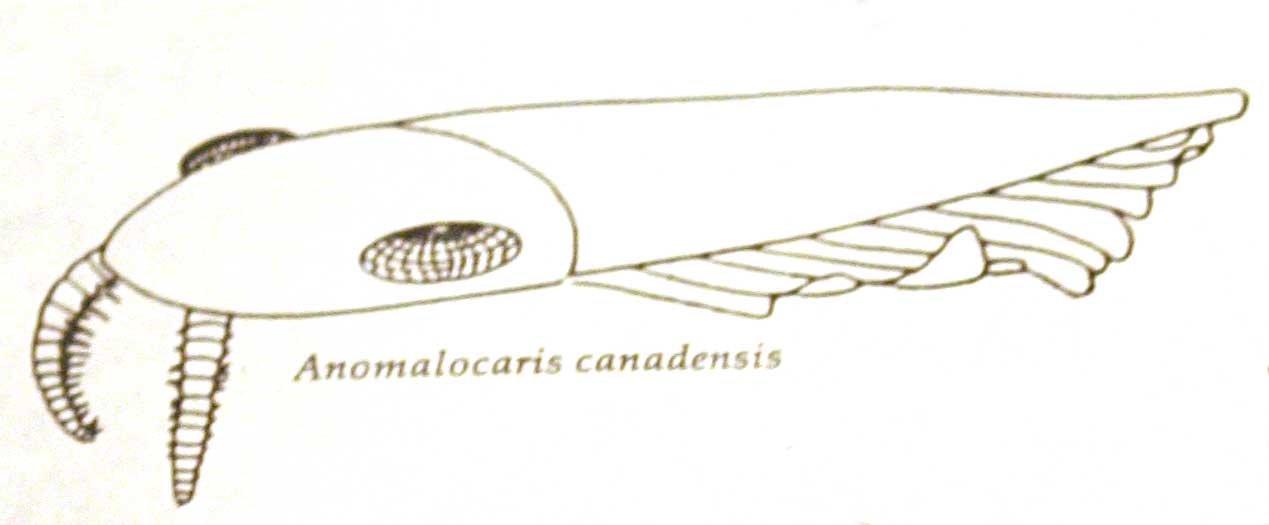
This image is of an Anomalocaris canadensis fossil found in the Burgess Shale of British Columbia, Canada. It is one of the larger fossil creatures found there. This fossil dates to the Cambrian Period of the Paleozoic Era (about 530 million years ago). Since only pieces of it were found it was mistaken for a worm or jellyfish like creature at first. Learn more at its wikipedia.org web page.

It was probably found by Charles D. Walcott (or someone in his group) who later was in charge of the Smithsonian in the United States. This fossil layer is quite famous. The Smithsonian later sent out specimens to natural history museums across the United States in the 1940s. More than likely this is one of that was sent to the Museum of Natural History and Science in Cincinnati, Ohio. It can be found in the invertebrate fossil display past the Ice Age exhibit in the museum as of August 2013.


Here is an illustration that was on display with these fossils of an artist interpretation of what these creature might have looked like.


Sunday, August 30, 2009

Burgess Shale Fossils

In celebration of the 100th anniversary of the Burgess Shale fossils being discovered, here are 3 images of some of those fossils on display at Muséum National D'Historie Naturelle Jardin Des Plantes Paléontologie et Anatomie Comparée in Paris, France. Looking at their labels they appeared to have been collected in 1937-1938. They are on display on the 2nd level of the museum in the invertebrate fossil section (maybe the crustaceans area next to the trilobites).

The famous American paleontologist Charles Walcott discovered this landmark on August 30, 1909 in British Columbia, Canada. Thanks to geology.com for bringing this date to my attention. You can learn more about the Burgess Shale and its fossils at the Smithsonian National Museum of Natural History in Washington, D.C. at their website.

Disclaimer: I had to take these images through a display case that did not provide the best of lighting conditions. Also since these fossils are black on a dark gray background in addition to being flatten thus making them 2-dimensional it is hard to get a good image.


The arthropod Waptia fieldensis that sort of looks like today's shrimp. Its genus name comes from Mount Wapta near the fossil bed in Canada while its species name reflects a town local to the site named Field. Learn more at this Smithsonian Institution web page.


Here is a Burgess Shale trilobite, though when first discovered by Charles Walcott he did not realize it. He classified it as a Crustacea instead and called it Naraoia compacta. It was later to be determined a trilobite by Professor Harry Whittington (Harvard University & Cambridge University till 1983). The genus name comes from Nareo lakes in British Columbia, Canada. See this Smithsonian web page for more information about this trilobite.

This last fossil is called Burgessia bella that is phylum Arthropoda and Class Trilobitoidea. See some better pictures at the Fossil Mall web page