Showing posts with label Muséum National D'Historie Paris. Show all posts

Thursday, January 5, 2023

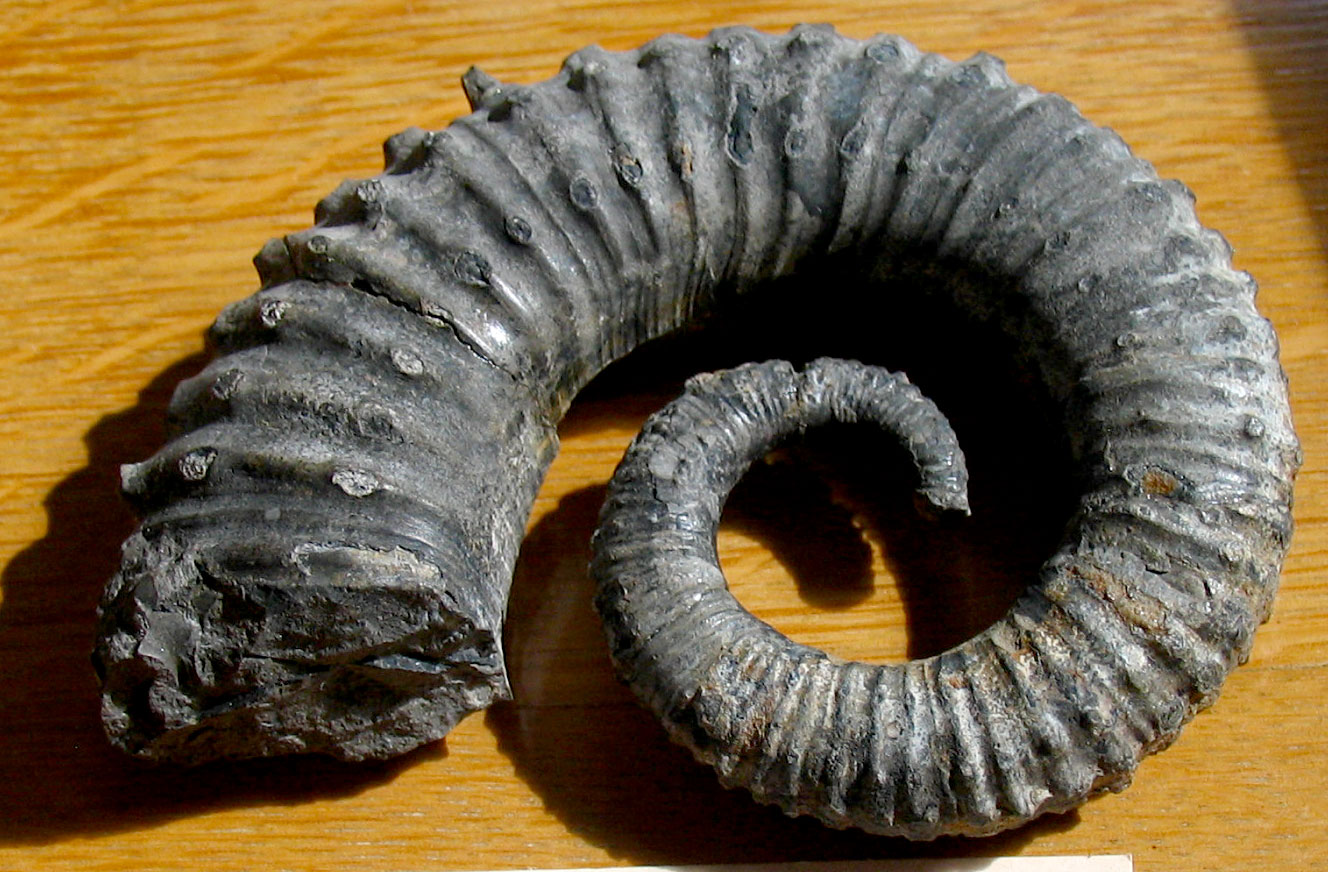
Spinocrioceras polyspinosum Ammonite Fossil


This picture is of a Spinocrioceras polyspinosum (Kemper, 1973) [Crioceratites sp.] fossil. It was found at Ville de Leyva (Leiva) Columbia. The fossil dates to the Barremian age of the Lower Cretaceous Period.

It was displayed at Muséum National D'Historie Naturelle Jardin Des Plantes Paléontologie et Anatomie Comparée, Paris, France. Image taken August 2009.

Wednesday, November 30, 2022

Halysites catenularia Chain Coral Fossil


This image shows a Halysites catenularia (Linnaeus, 1767) chain coral fossil. It dates to the Silurian Period and was found Kentucky USA. While I am guessing it was probably found at the Falls of the Ohio. It was displayed at Muséum National D'Historie Naturelle Jardin Des Plantes Paléontologie et Anatomie Comparée, Paris, France. Image taken August 2009.

The side view is has some green coloration maybe from moss from the Ohio River. It was from the Jules Marcou (1824-1898) collection. Marcou was born and educated in France and worked as a geologist for the Jardin des Plantes during the late 1840s. He traveled on expeditions in the United States during this time and in the early 1850s. So he could have acquired this fossil then. He later settled in Massachusetts USA, became a citizen and died there.


Tuesday, November 29, 2022

Favosites goldfussi Coral Fossil


This image shows a Favosites goldfussi (Larmarck, 1816) coral fossil. It dates to the Devonian Period and was found at Gerolstein Germany. It was displayed at Muséum National D'Historie Naturelle Jardin Des Plantes Paléontologie et Anatomie Comparée, Paris, France.  Image taken August 2009.

Monday, November 28, 2022

Stylocoenia emarciata Coral Fossil


This image shows a Stylocoenia emarciata (Larmarck, 1816) coral fossil. It dates to the Eocene Epoch, Paleogene Period (Bartonien) and was found at Lutétien-Grignon (Yvelines) France. It was displayed at Muséum National D'Historie Naturelle Jardin Des Plantes Paléontologie et Anatomie Comparée, Paris, France.  Image taken August 2009.

Sunday, November 27, 2022

Serpula quadristriata Worm Fossil


This image shows a number of Serpula quadristriata worm fossils. It dates to the Late Jurassic Period (Oxfordian Stage) and was found at Neuvisy (Ardennes) France. It was displayed at Muséum National D'Historie Naturelle Jardin Des Plantes Paléontologie et Anatomie Comparée, Paris, France.  Image taken August 2009.

Saturday, November 26, 2022

Porpoceras ventricosum Ammonite Fossil


This image shows a Porpoceras ventricosum (Buckman , 1914) ammonite fossil. It dates to the Jurassic Period (Toarcien) and was found at Anduze (Gard) France. It was displayed at Muséum National D'Historie Naturelle Jardin Des Plantes Paléontologie et Anatomie Comparée, Paris, France.  Image taken August 2009.

The species was named by British palaeontologist Sydney Savory Buckman (1860-1929). It was originally named by English naturalist James Sowerby (1757-1822) and it was called Ammonites "armatus" (Sowerby, 1815).

Friday, November 25, 2022

French Harpoceras serpentinum Ammonite Fossil

The image shown is a Harpoceras serpentinum (Schlotheim , 1820) ammonite fossil. It dates to the Jurassic Period (Toarcien) and was found at Cheville (Sarthe) France. It was displayed at Muséum National D'Historie Naturelle Jardin Des Plantes Paléontologie et Anatomie Comparée, Paris, France.  Image taken August 2009.

The species was named by German palaeontologist Ernst Friedrich, Baron von Schlotheim (1764-1832). He originally called it Ammonites serpentinus (Schlotheim , 1820). The name ammonite was derived from Egyptian deity Ammon who was represented by a symbol looking like a coiled ram horn.

Thursday, November 24, 2022

French Hildoceras bifrons Ammonite Fossil


Above is an image of an Hildoceras bifrons (Bruguière, 1789) ammonite fossil. It dates to the Jurassic Period (Toarcien) and was found at La Verpilliere (Isère), France. It was displayed at Muséum National D'Historie Naturelle Jardin Des Plantes Paléontologie et Anatomie Comparée, Paris, France.  Image taken August 2009.

The species was named by French zoologist Jean Guillaume Bruguière (1749-1798). While the name ammonite was derived from Egyptian deity Ammon who was represented by a symbol looking like a coiled ram horn.  In medieval England, the fossil was seen by some as a petrified coiled snake. The genus of this ammonite is associated with St. Hilda of Whitby, Yorkshire, England. Legend has it she turned a plague of snakes to stone. As such an American palaeontologist Alpheus Hyatt (1838-1902) named an ammonite genus Hildoceras (Hyatt, 1876) after her. 

Wednesday, June 29, 2022

Siphonophrentis gigantea Horn Coral on Display in Paris


I revisited pictures from my trip to Paris in 2016. This set of fossils are special in that they were found at the Falls of the Ohio, Clark County, Indiana USA. It was on display at the Muséum National D'Historie Naturelle Jardin Des Plantes Paléontologie et Anatomie Comparée in Paris France.The fossils were identified as Siphonophrentis gigantea (Lesueur, 1821). They are now known as Siphonophrentis elongata (Rafinesque and Clifford, 1820). Fossils date to the Middle Devonian Period.

You can see a picture of this fossil from 2009 in this posting:

https://louisvillefossils.blogspot.com/2009/09/visit-to-museum-of-natural-history-in.html

The genus was renamed from Zaphrentis to Siphonophrentis by Dr. Marjorie O'Connell in 1914. Click on her name to read about her interesting yet short career in paleontology I wrote about March 2021.


Sunday, June 26, 2022

Harpes naumanni Trilobite Fossil


This picture is of a Harpes naumanni (Barrande,1852) trilobite fossil. It was found in Lodenitz, Bohemia. The fossil dates to Silurian Period.  Fossil  displayed at Muséum National D'Historie Naturelle Jardin Des Plantes Paléontologie et Anatomie Comparée, Paris, France.  Image taken August 2016.

Saturday, June 25, 2022

Trinucleus concentricus Trilobite Fossil

This picture is of a Trinucleus concentricus (Eaton,1832) trilobite fossil. It was found in Caer Caradoc (Grande-B.). The fossil dates to Ordovician Period.  Fossil  displayed at Muséum National D'Historie Naturelle Jardin Des Plantes Paléontologie et Anatomie Comparée, Paris, France.  Image taken August 2016.

Sunday, February 7, 2021

The Fossil Woman Book


Recently, I acquired a new book entitled The Fossil Woman A Life of Mary Anning by Tom Sharpe (published by The Dovecote Press, 2020). The subject of this book is perhaps one of the best known fossil hunters known for finding Jurassic age marine fossils in the 19th century. It is somewhat rare that I buy a modern book about fossils but I was intrigued enough to purchase this book from Blackwells of Oxford, England and have it shipped to the USA. An added incentive was the author is donating part of the proceeds to a campaign in Lyme Regis to create and display a statue of Mary Anning.

Lyme Regis Museum building as it looked in August 2016. Site of where house where Mary Anning was born, lived and had her fossil shop till 1826. Original house demolished in 1889 so museum could be built.

Lyme Regis England Coastline at high tide August 2016
 
The Cobb at Lyme Regis England in August 2016

The book is a creation of a lot of thorough research and contains modern images and events pertaining to Miss Anning. It clears up some of the myths and misinformation about this most famous paleontologist. As the author notes in his introduction, there is much information not known about Mary Anning due to a lot of her correspondence and journals are lost to time. Mr. Sharpe does a fine job with the material he does have to weave a story about her life. I would highly recommend this book if you are interested in learning more about Mary Anning, British paleontology in the 1800s, and the Jurassic coast of southern England.

Public domain image of William Buckland that is misidentified as Mary Anning on Wikipedia at https://commons.wikimedia.org/wiki/File:Mary_Anning.jpg

One piece of misinformation I learned was an sketch of person walking along a landscape in a top hat and holding a rock hammer. It misidentified as being Mary and drawn by De la Beche. Mr. Sharpe marked as image 40 in his book as being a Thomas Sopwith sketch of William Buckland in Snowdonia (Wales) in 1841. The image is on Wikipedia's entry for Mary Anning (as of this writing) and it references the image on page 78 of a document entitled "Nomination of the Dorset and East Devon Coast for inclusion in the World Heritage List" by the Dorset County Council in the year 2000 [LINK]. I also wondered about this image how it was so different from the others of Mary. I assumed since she lived in poverty she would be very thin and the person in the image look almost overweight (so I assumed it was a lot of padding for the cold, windy environment of Dorset).

More things I learned that Mary Anning was a shrewd fossil dealer and an accomplished fossil preparer. Also that she was well known in the field with a number of newspaper and journal articles mentioning her while she was alive.

Plesiosaurus dolichodeirus fossil found in 1824 at Lyme Regis, Dorset, England by Mary Anning. It was the first articulated plesiosaur skeleton ever found and lived during the Lower Jurassic Period (203-194 million years ago). Named by W. D. Conybeare and bought by the Natural History Museum of London in 1848 from the estate of the Duke of Buckingham. It was on display at the museum in August 2016.

Termnodontosaurus platyodon (Conybeare, 1822) ichthyosaur fossil found by Mary Anning on display at Natural History Museum of London August 2016. Skylight reflection in display glass in image, apologies for image.

Dapedium politum fish fossil probably collected by Mary Anning displayed at the Lyme Regis Museum in Dorset England on August 2016.

Ichthyosaurus communis fossil found by Mary Anning in 1820 and sold to Georges Cuvier. Displayed at the Muséum National d'Histoire Naturelle in Paris France August 2016. 

One sad item the books documents is so many of the Mary Anning fossils found were destroyed in World War II bombing of England and museum fires. The book lists the Bristol City Museum fossil collection destroyed in air raids on November 24-25, 1940 (in 1987 they a partial ichthyosaur skull fossil from Anning 1814 that survived the bombing) and on May 10, 1941 a night bombing of Royal College of Surgeons in London fossil reptile collection was mostly destroyed (396 of 400).  In the United States, the New York Lyceum of Natural History had Anning specimens purchased in 1827 by G.W. Featherstonhaugh. This collection was destroyed in a fire on May 21, 1866. The author documents a number of other museums that have or had specimens but lost the labels so it difficult to know if Anning fossils still exist at those institutions.

When I was at the Natural History Museum of London in August 2016 and waiting in line for it open, I took some pictures of the Victoria and Albert Museum across the street which shows shrapnel damage made during World War II bombings of London.


Which just re-enforces the need for museums to digitize their collections. These vast store houses are not immune to loss. Which re-enforces that natural history collections need to be digitized and the data distributed across geographical distance servers so some record will exist if the original specimen is lost.

 Image (Tab. 42) of watercolor of Squaoraja fish fossil found by Mary Anning December 1829. Louis Agassiz had image created for his book Poissons Fossiles, Atlas Tome III 1833-1845. He called it Spinacorhynus polyspondylus and image painted by J Charles Weber.The original fossil was destroyed in World War II at the Bristol City Museum however the tail section still exists in the Philpot collection at Oxford University Museum of Natural History.

Again, I would encourage you to read this book if you are interested in the history of paleontology or if you plan on visiting Lyme Regis or the Natural Museum of History in London.



Friday, March 13, 2020

Syrian Propeamussium eocenicum Fossil


This image is of a Propeamussium eocenicum (Sacco) pelecypod fossil. It was found near Damascus Syria. The fossil dates to the Eocene Epoch. It was displayed at Muséum National D'Historie Naturelle Jardin Des Plantes Paléontologie et Anatomie Comparée, Paris, France.  Image taken August 2016.

Thursday, March 12, 2020

Inoceramus pictus Bivalve Fossil


This image is of an Inoceramus pictus (Sowerby) pelecypod fossil. It was found in St. Parres (Yonne), France. The fossil dates to the Late Creteous Period (Cenomanian). It was displayed at Muséum National D'Historie Naturelle Jardin Des Plantes Paléontologie et Anatomie Comparée, Paris, France.  Image taken August 2016.

Tuesday, March 10, 2020

Spiropora elegans Bryozoan Fossil


This image is of a Spiropora elegans (LAMOUROUX 1821) bryzoan fossil. It was found in Ranville, Calvados, France. The fossil dates to the Jurassic Period (Bathonien). It was displayed at Muséum National D'Historie Naturelle Jardin Des Plantes Paléontologie et Anatomie Comparée, Paris, France.  Image taken August 2009.

Monday, March 9, 2020

Fenestella subantiqua Bryozoan Fossil


This image is of a Fenestella subantiqua (d'ORBIGNY 1850) fossil. It was found in Konieprus, Bohemia, Czechoslovakia. The fossil dates to the Devonian Period. It was displayed at Muséum National D'Historie Naturelle Jardin Des Plantes Paléontologie et Anatomie Comparée, Paris, France.  Image taken August 2009.

Sunday, March 8, 2020

Constellaria constellata Bryozoan Fossil


This image is of a Constellaria constellata (VAN CLEVE 1846) fossil. It was found in Newport Kentucky. The fossil dates to the Ordovician Period. It was displayed at Muséum National D'Historie Naturelle Jardin Des Plantes Paléontologie et Anatomie Comparée, Paris, France.  Image taken August 2009.

Saturday, March 7, 2020

Dactylioceras tenuicostatum Ammonite Fossil


This image is of a Dactylioceras tenuicostatum (YOUNG et BIRD, 1822) fossil. When collected, the fossil was originally labeled Ammonites annulatus (J. SOWERBY, 1819). It was found in England. The fossil dates to the Jurassic Period. It was displayed at Muséum National D'Historie Naturelle Jardin Des Plantes Paléontologie et Anatomie Comparée, Paris, France.  Image taken August 2009.

Saturday, September 14, 2019

Hildoceras bifrons Ammonite Fossil


A few posts ago, I wrote about the snake stone ammonite. This ammonite is associated with St. Hilda of Whitby, Yorkshire, England. The American palaeontologist Alpheus Hyatt (1838-1902) named an ammonite genus Hildoceras (Hyatt, 1876) after her.

Above is an image of an Hildoceras bifrons (Bruguière, 1789) ammonite fossil. It dates to the Jurassic Period (Toarcien) and was found in Newcastle, England. Specimen was under glass in a room with a lot of natural light so there is glare on the upper part of the fossil.

Fossil displayed at Muséum National D'Historie Paris, France on August 2016.

Monday, November 12, 2018

Trinucleus godfussi Trilobite Fossil


This picture is of a Trinucleus godfussi (Barrande) trilobite fossil. It was found in Wesela Bohemia. The fossil dates to Ordovician Period.  Fossil  displayed at Muséum National D'Historie Naturelle Jardin Des Plantes Paléontologie et Anatomie Comparée, Paris, France.  Image taken August 2016.

Learn more at their website: https://www.mnhn.fr/en/visit/lieux/galerie-paleontologie-anatomie-comparee-paleontology-and-comparative-anatomy-gallery