Sea Rex 3D: Journey to a Prehistoric World opened at the
Louisville Science Center IMAX theater on June 12, 2010. The movie was not quite what I expected in that being more of a learning experience and less of an action movie. My only comparison would be a the Sea Monsters IMAX movie which was action oriented and told from the point of view of a sea creature. Going into Sea Rex, my big question was, "What actually is Sea Rex?" By the end of movie, I knew the answer.
The movie takes an interesting tact by using a modern aquarium or museum setting with a visitor named
Julie who takes a trip through time with a famous paleontologist
Georges Cuvier. Interspersed in the scenes of marine reptiles swimming in ancient seas, paleontologists give explanations of paleontological concepts. Scientists need to do more presentations like this to help the general public try to understand the scientific research. One should watch the credits as the scientists might be portrayed by actors [see this review at the
smithsonian.com site].
Georges Cuvier
The scientists highlighted the film are
Dr. Nathalie Bardet who shows a
Mary Anning discovery at the British Museum that becomes animated.
Dr. Olivier Rieppel of the Rowe Family Curator at Chicago's Field Museum,
Dr. Ryosuke Motani of the University of California Davis,
Dr. Zulma Gasparini from La Plata Museum in Argentina, and
Dr. Benjamin Kear of Australia's La Trobe University.
Dr. Kear's presentation in the film is definitely unique (he needs to eat more to put some meat on those bones).
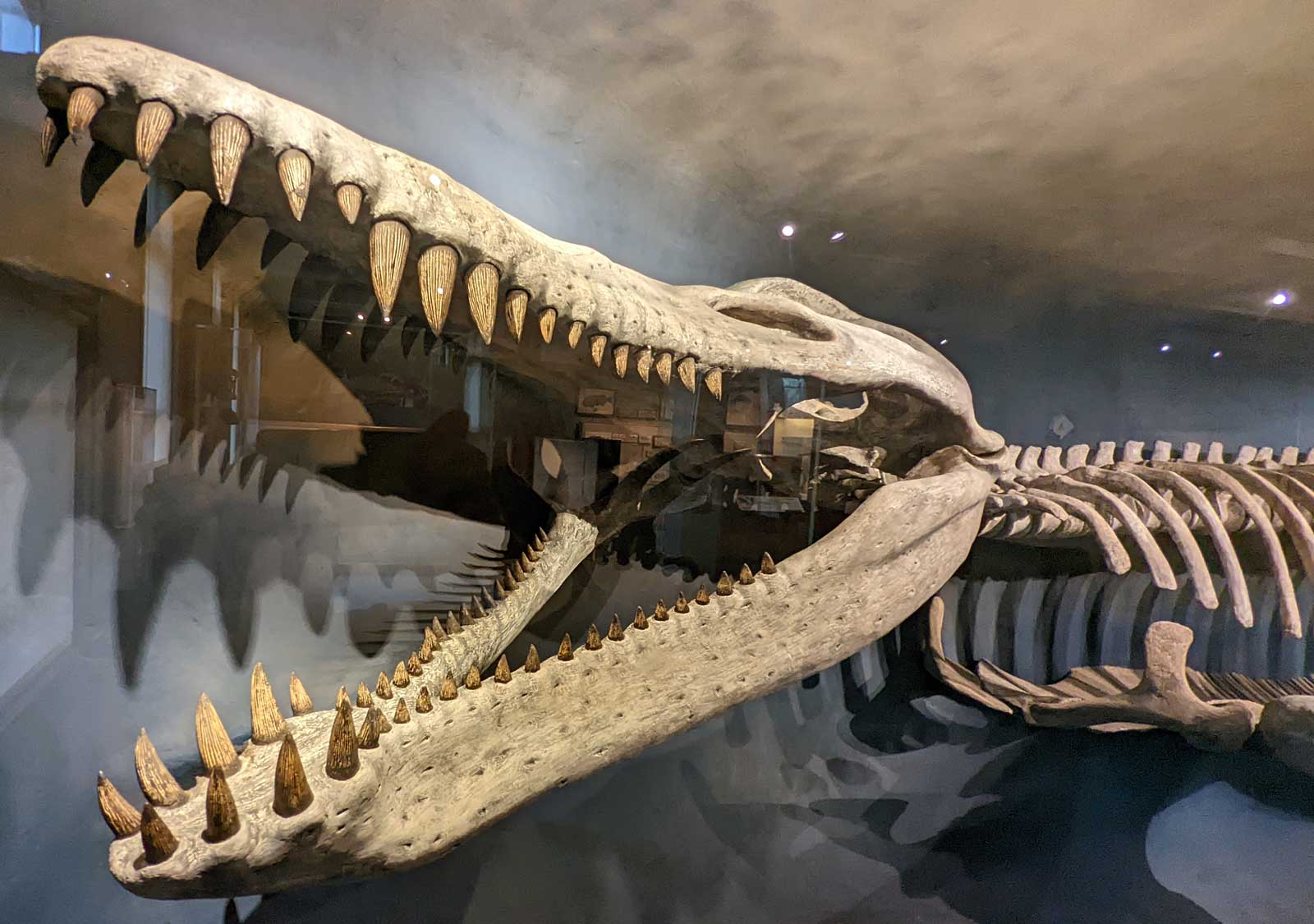
Prognathodon solvayi
Marine Reptile - Late Cretaceous Period
The film really utilizes computer graphics to help the viewer realize geologic time, continent formation, and marine reptile structure/anatomy. I did have to guess at some of the time periods in the graphics and I assume the major extinction events they refer to are Permian and the K-T. You also get to see a lot of creatures rendered like the
Shonisaurus,
Pterodactyl,
Prognathodon,
Mixosaurus,
Liopleurodon,
Ichthyosaur,
Parasaurolophus,
Mosasaur,
Rhomaleosaurus,
Kronosaurus, and
Tanystropheus.
Ichthyosaur Marine Reptile Fossil
Jurassic Period
Muséum National D'Historie Naturelle
Paris, France
Being a volunteer at the
Louisville Science Center, one will get questions about the movies being shown. Weekend visitors tend to be families with young children and one concern is will the movie scare young children. As for this movie, I would say not. It is rated for 4 year old children and up. Predator-prey relationships are explored in the movie but not in gory detail. Violent conflicts mostly take place off screen, leaving a good deal to the imagination. So it is a good film to show children, the marine reptiles are not too scary in my opinion.
If you like dinosaurs (and marine reptiles) or paleontology, the film is good to see. I enjoyed watching it and the educational topics and events they presented. I definitely plan on seeing it again!
It would be nice if they would put the names on the screen of the marine reptiles they were showing because it was hard to remember their names or keep track of them. The DVD with captions turned on should remedy this issue though. Another issue is they never tell the exact names of the sharks that appear, they are just referred to as sharks.
SLIGHT SPOILER: One last piece of advice for the movie character Julie, don't leave the museum with that item still in your purse. Security is not going to believe how you obtained it. :)