Showing posts with label australia. Show all posts

Wednesday, August 28, 2024

Fluorescent Opal Belemnite Fossil

This opal fossil is UV fluorescent. The original aragonite internal shell dissolved and was replaced by opal in this belemnite fossil. It existed in the Cretaceous Period. Fossil was probably found in Coober Pedy, Australia. Specimen was on display at the la Specola Museo Di Zoologia Ceropastica e Mineralogia (Florence, Italy) (August 2024).


Tuesday, August 27, 2024

Australian Opal Belemnite Fossil


The original aragonite internal shell dissolved and was replaced by opal in this belemnite fossil. It existed in the Cretaceous Period. Fossil was found in Coober Pedy, Australia. Specimen was on display at the Natural History Museum Vienna (Naturhistorisches Museum Wien) (August 2024).

Friday, July 7, 2023

Mawsonites spriggi Jellyfish? Fossil


This picture is of a Mawsonites spriggi (Glaessner & Wade, 1966) jellyfish? fossil cast. It was found in south Australia. It dates to the late Neoproterozoic Era.

The picture was taken in June 2023 on the first floor of the Smithsonian Museum of Natural History in Washington D.C. USA.

 

Saturday, August 20, 2022

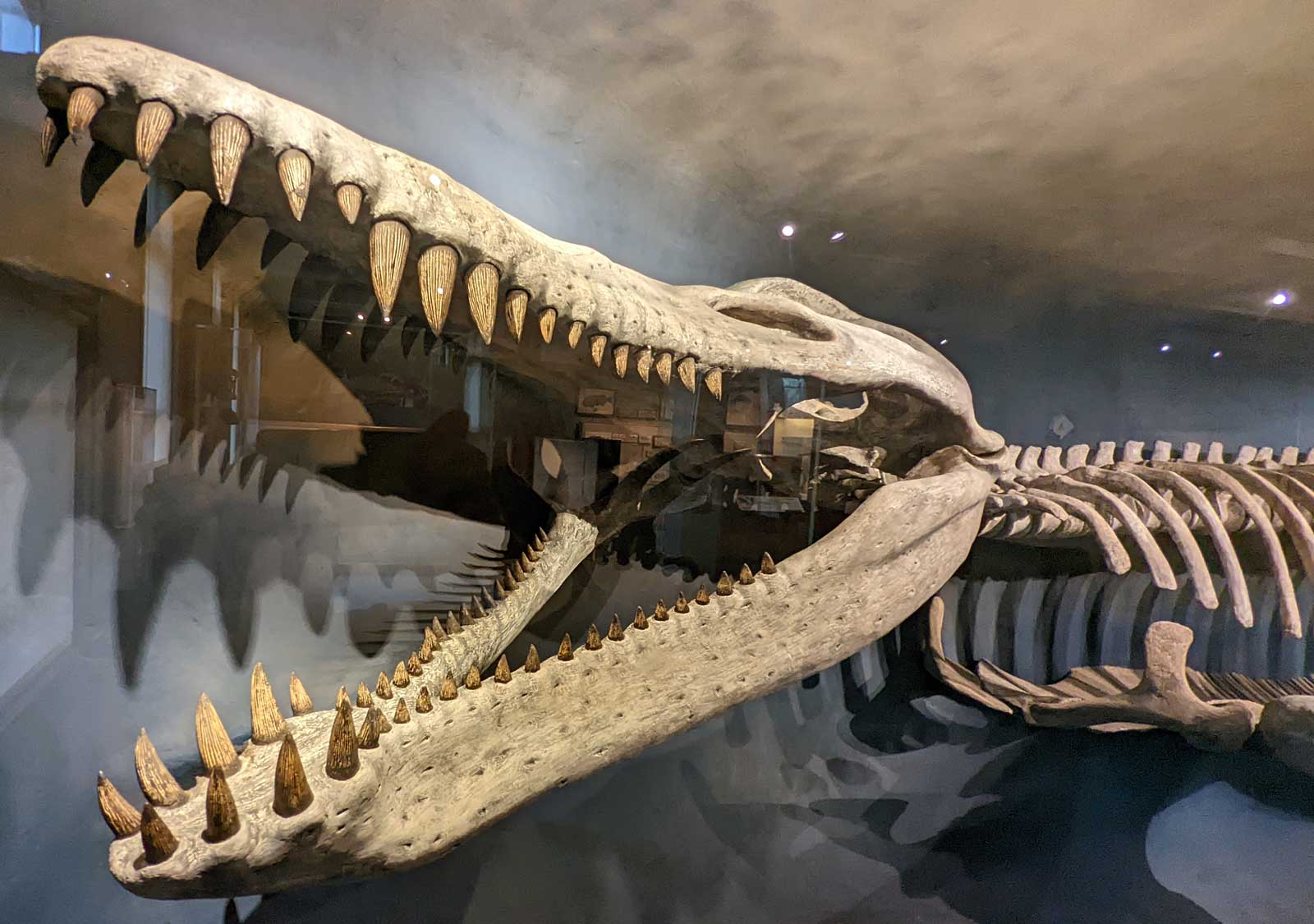
Kronosaurus Fossil at Harvard Museum


On display as of August 2022, at the Harvard Museum of Natural History in Cambridge, Massachusetts, USA is the fossil of a short neck pliosaur called Kronosaurus queenslandicus (Longman, 1924) [MCZ 1285]. The creature swam in the early Cretaceous Period seas (135 million years ago). It was found by an Australian rancher R.W.H. Thomas and shown to a member of the 1931-1932 Harvard Australian Expedition William E. Schevill (1906-1994). They were able to dynamite the limestone nodules out and then ship them back to Harvard. After Godfrey Lowell Cabot (1861-1962) provided the financing to prep the fossil, it was put on display in 1959.

Part of the skull, backbone, and paddles had weathered away but were able to be restored. About 30% of the fossil is plaster restoration and original bones are coated in plaster to protect the fossil. It appears the reconstruction has too many vertebrate so the 12.8 meter (42 ft) display should probably only be about 9-10.9 meters (30-36 ft). Also genus and species of this fossil should now be Electus longmani (Noe and Gomez-Perez, 2022).


Monday, August 24, 2020

Opal Plesiosaur Vertebra Fossil


In August 2020, I visited The Field Museum of Natural History. It is an amazing place for any one interested in natural history. My main interests were the fossil and mineral collections on display. One specimen that really impressed me was in the Grainger Hall of Gems. It was an opal plesiosaur vertebra fossil from Australia. The Grainger Hall of Gems started off as a Tiffany & Company gem collection exhibited at Chicago's 1893 World's Columbian Exposition. After the exposition was over, it was purchased and made part of the new museum when it opened in 1921.

Over hundreds and thousands of years silica-rich groundwater dissolve fossil remains and leave silica gel. Once the gel hardens it forms opal. Also included in the display are opal fossilized clam and snail fossils.


I have documented other Australian opal fossils at the Natural History Museum in London, England:
https://louisvillefossils.blogspot.com/2020/02/opal-gastropod-fossils.html

and Muséum National D'Histoire Naturelle Minéralogie et Géologie in Paris France
https://louisvillefossils.blogspot.com/2016/08/opal-belemnite-fossils.html

Tuesday, February 18, 2020

Opal Gastropod Fossils


Pictured are some nice fossils found in New South Wales, Australia (Lightning Ridge?). These snails date to the Cretaceous Period.

Fossils were on display August 2016 in Natural History Museum of London, England.

Wednesday, August 31, 2016

Opal Belemnite Fossils


The original aragonite internal shell dissolved and was replaced by opal in these belemnite fossils. They existed the Cretaceous Period. Fossils were found in Coober Pedy, Australia. Specimen was on display at the Muséum National D'Histoire Naturelle Minéralogie et Géologie in Paris France (August 2016).

Learn more here:
http://www.mnhn.fr/fr/visitez/lieux/galerie-mineralogie-geologie


Tuesday, July 1, 2014

Tetragraptus Graptolite Fossils from Australia


These pictures show a Tetragraptus fruticosus fossil specimen housed in a display case at the Geologia building located on the campus of Sapienza University of Rome. The case can be found on the second floor of the building. The fossil was found in Australia and lived during the Ordovician Period. The paleontology museum is on the 3rd floor of this building and has about 1000 fossils on display.


The university was founded in 1303 by Pope Boniface VIII. In 1870, it became a public university for the state of Italy.

Sources:
http://www.uniroma1.it/ateneo/chi-siamo/la-storia


Saturday, September 4, 2010

Mawsonites spriggi (Jellyfish fossil?)

Fossil cast of Mawsonites spriggi thought to be a jellyfish imprint.  Found in South Australia and creature existed in the Late Neoproterozoic.  Fossil on display at Smithsonian Museum of Natural History on August 2010.

Learn more about it at Wikipedia.

Wednesday, November 25, 2009

Pterotrigonia thoracica Pelecypod

The Pterotrigonia thoracica (Morton 1834) pelecypod is the official state fossil of Tennessee. It existed during the Cretaceous Period (about 70 million years ago - Maastrichtian). This fossil was found in McNairy County, Tennessee (Coon Creek Formation).

It became state fossil in 1998.

This creature might be related to the Myophorella ("Trigonia") of the Jurassic Period which has the modern relative of the Australian Broach Clam (Neotrigonia margaritacea). Learn more at this British website: Fossils of the Kimmeridge Clay (Southern England) by Ian West.

The genus was named by van Hoepen in 1929.

Thanks to Herb for allowing me to photograph it.


Update: August 2010, here is a picture of two Trigonia on display at the Smithsonian Museum of Natural History in Washington, D.C. The ones on the top are Trigonia thoracica (Late Cretaceous Period, Tennessee) and the bottom one is Trigonia moorei (Middle Jurassic Period, Australia).

Wednesday, September 23, 2009

Australian Plant Fossils

Here are some plant fossils that are on display at the Falls of the Ohio State Park in Clarksville, Indiana (right across the Ohio River from Louisville, Kentucky). The seed plant leaf Dicroidium acutifolium from the Middle Triassic Period. It was found in Dinmore, Queensland, Australia.


A seed plant leaf fossil called Dicroidium odontopteroides from the Late Triassic Period. It is from Dinmore, Queensland, Australia.


Seed plant leaves fossil call Glossopteris sp. found in the Illawarra Coal Measures. It is from the Late Permian Period. The fossil was found in Dunedoo, New South Wales, Australia.

Sunday, August 9, 2009

Australian Fossils

Here are some more pictures of fossils found in southeast Australia by Bill.

I am guessing these first two are of maybe some sort of plant. It reminds me of a Sphenophyllum from the Pennsylvanian Period in the United States.


I am not sure what kind of fossil this is. It does not look like anything I find in my area. [UPDATE: I have been reading a booklet called Fossil Beds of the Falls of the Ohio from the Kentucky Geological Survey, 1993. On page 18 figure c, they have an image of a coral head that is in a shape similar to this fossil. It is described as "Ham-hock-shaped Favosites in bedrock in the wash area". The ones in these pictures look pretty worn but the large area was probably a lot of small corallites fanning radially out.


Is this some sort of stem (crinoid or plant)?

This fossil looks like a worn brachiopod. It reminds me of a Silurian Period brachiopod called Stegerhynchus.

Saturday, August 8, 2009

Encrinuridae Encrinurus Trilobite

This is a really cool trilobite. Bill sent me this picture from some fossils he found in Australia.

What I find really interesting are the bumps on the cephalon and the protruding eyes. It appears to be an Encrinurus.


Sunday, July 26, 2009

Australian Coral Fossil Pictures

The following images appear to be fossilized corals from Australia. I think a few are some sort of horn corals and the first one reminds me of a Louisville, Kentucky Aulocystis or Romingeria from the Devonian Period. I think these fossils might be Silurian or Ordovician Period.

Thanks to Bill for sending them in.


Tuesday, July 21, 2009

More Fossils from Australia

Here are some more pictures of fossils from southeastern Australia. A visitor to this site named Bill sent them to me. If I had to guess, this first one is some sort of straight shelled cephalopod.


This second fossil looks like some sort of brachiopod.

This last fossil could be a cephalopod with is chamber segments but I am not sure.

Saturday, July 18, 2009

Australian Brachiopods & Clams

Here are some pictures sent to me by Bill in Australia. Here are some unidentified brachiopods and clams in mudstone or shale. They have a nice brownish-red color.

These fossils were found in southeastern Australia. They might be Ordovician Period.

It is always good to see fossils from different regions of the world.