Showing posts with label horn coral. Show all posts

Sunday, October 26, 2025

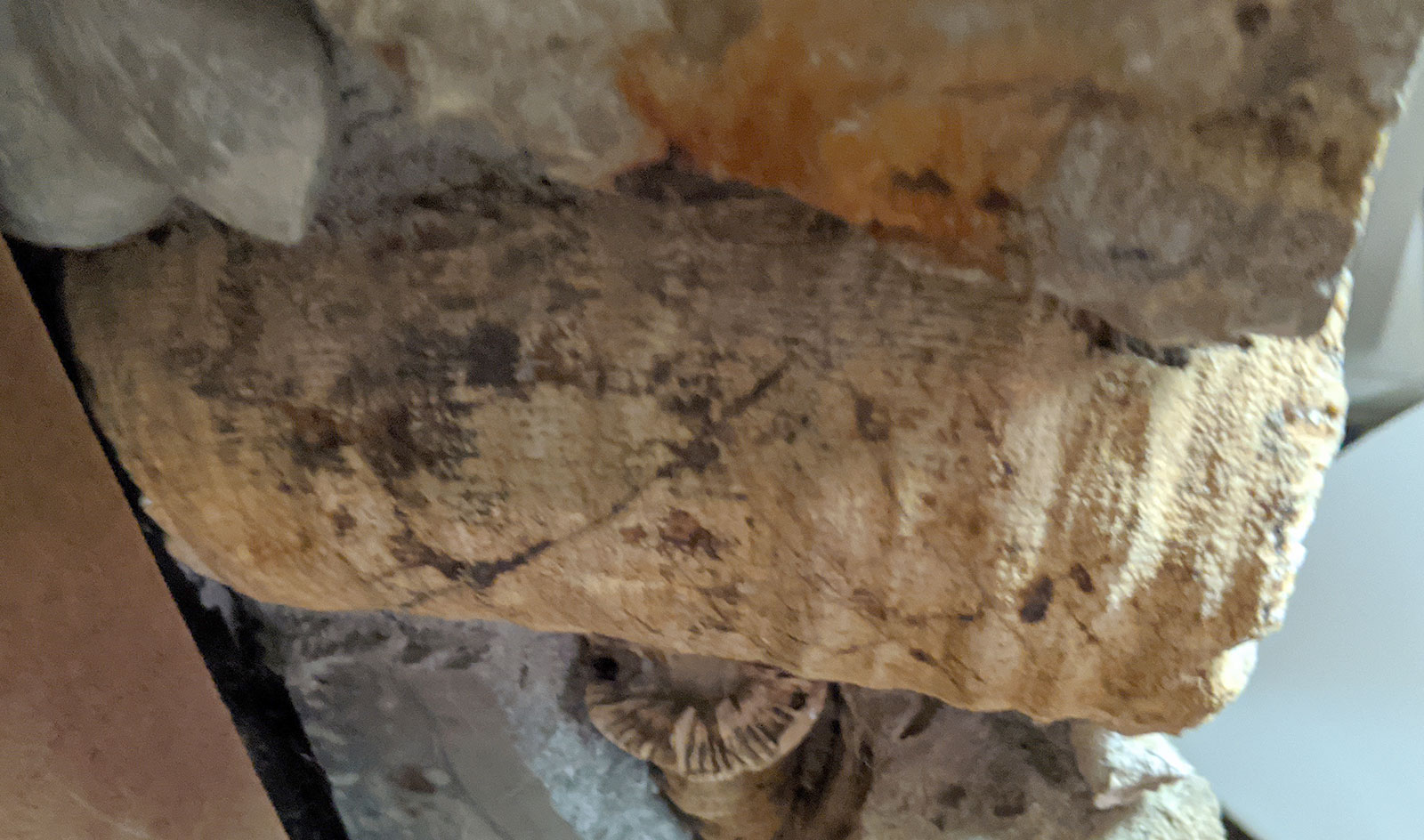
Grewingkia canadensis Horn Coral Fossils


This image is of a Grewingkia canadensis (Billings, 1862) horn coral fossil with some borings. It was found in the area of Cincinnati Ohio USA. The fossil dates to the Ordovician Period.


Picture taken at Museo di Geologia e Paleontologia Florence Italy (Università degli Studi di Firenze) in August 2024. The image below is of another horn coral fossil which might have a piece of a Cryptolithus cephalon trilobite.


Friday, October 24, 2025

Cyathophyllum heliantoides Coral Fossil


This image is of a Cyathophyllum heliantoides (Goldfuss, 1826) coral fossil. It was found in Eifel, Germany. The horn coral lived in the Devonian Period.

 
Picture taken at Museo di Geologia e Paleontologia Florence Italy (Università degli Studi di Firenze) in August 2024.

Thursday, November 28, 2024

Unidentified Horn Coral Fossils


This picture is of horn coral fossils. It existed during the Silurian period. The fossil was found in Gotland Sweden. Fossil was on display at the Natural History Museum Vienna (Naturhistorisches Museum Wien) on August 2024.


Wednesday, November 27, 2024

Dokophyllum Coral Fossil


This picture is of a Dokophyllum (Wedekind, 1927) horn coral fossil. It existed during the Silurian period. The fossil was found in Gotland Sweden. Fossil was on display at the Natural History Museum Vienna (Naturhistorisches Museum Wien) on August 2024.

Learn more: https://fossiilid.info/7897?mode=in_baltoscandia

Monday, November 25, 2024

Phaulactis Horn Coral Fossil


This picture is of a Phaulactis  (Ryder, 1926) horn coral fossil. It existed during the Silurian period. The fossil was found in Gotland Sweden. Fossil was on display at the Natural History Museum Vienna (Naturhistorisches Museum Wien) on August 2024.

Learn more: https://en.wikipedia.org/wiki/Phaulactis

Sunday, June 23, 2024

Breviphrentis nitida Horn Coral Fossil


These horn coral fossils pictured above were known as Breviphrentis nitida (Hall, 1876). They were found in the Jeffersonville Limestone of the Falls of the Ohio, Clark County, Indiana USA. The fossils date to the Devonian Period. Included in this picture is George Greene's original display label which refers to it as Zaphrentis nitida.

This coral fossil was once part of the collection of southern Indiana paleontologist George K. Greene (1835-1917). It appeared that all of Greene's fossil collection was sold to American Museum of Natural History in New York City after his death but as it turns out there was one cabinet not sold and was past down to his descendants. 

This fossil is now on display at the Falls of the Ohio State Park Interpretive Center till at least September 2024 after that it should be transferred to the Indiana State Museum. George Greene's great-great-grandson William "Bill" Bishop passed away on November 29, 2023 and his wish that fossils be donated.


Wednesday, September 20, 2023

Dr. John H. Lemon - New Albany Indiana Paleontologist


The 1910 U.S. Census lists John Herschel Lemon was born in September 1844 and his obituary lists at a farm near Harrodsburg, Indiana. His family moved to Bloomington, Indiana in 1856 when he was 12, where at age 13 he and his brothers became students at Indiana University (IU). The American Civil War interrupted his studies and in May 1862 he became a private in the 54th Indiana Infantry, Company A and later 82nd Indiana Infantry, Company F. They guarded 4000+ Confederate prisoners of war (POWs) at Camp Morton (Indianapolis) and later deployed to western Kentucky.

The Owen Connection

His interest in paleontology may have been inspired by geologist Richard D. Owen (1810-1890) who was boarder at his mother's house in Bloomington, Indiana. Owen was professor on Natural Science at IU for 15 years and served as colonel in the Union Army in the 15th and later 60th Indiana Infantry Regiment and was in charge of the POWs at Camp Morton. His permanent residence was in New Harmony, Indiana and where he is buried when he died.

After the war, John Lemon continued his studies at IU and later studied at University of Michigan. Once he became a doctor, he moved to New Albany in 1867 and practiced medicine till the 1930s. He died on July 10, 1935 which at that time he was considered Indiana's longest serving physician.

The Smithsonian Connection

In 1887, Dr. Lemon sent the Smithsonian some charophyte fossils found at the Falls of the Ohio. F. H. Knowlton (1860-1926) named the fossil after him in 1889 calling it Calcisphaera lemoni in a paper called Description of a problematic organism from the Devonian at the Falls of the Ohio. The holotype specimens are in the Smithsonian Museum of Natural History USNM P 3664.

The George Greene Connection

New Albany fossil collector and author George K. Greene named a number of fossils after Dr. Lemon in publications from 1904. Greene named the fossil horn coral Heliophyllum lemoni in which wrote "The specific name is in honor of Dr. John Lemon, of New Albany, Ind., an ardent collector and a good palaeontologist. Found in the lower Devonian (Corniferous group), at the Falls of the Ohio. Now in the collection of the author." Later in his publication, he named another fossil after Lemon, the Crania? lemoni. "The specific name in in honor of the discoverer, Dr. John Lemon, of New Albany, Ind."


The Colonel Lucien P. Beckner Connection

Beckner had two fossils of Dr. Lemon in his collection. The first was a Paraconularia newberryi (Winchell) fossil still partially embedded in a nodule.Another was labeled Pentremites pyriformis? blastoid both fossils listed as found in Indiana.


Sources

In preparing this entry about Dr. Lemon, an informative blog post entitled Dr. John Herschel Lemon Reminisces about Early Life in Bloomington by Randi Richardson on November 26, 2018 at the Monroe County History Center Research Library blog was found helpful.

George K. Greene's Contribution to Indiana Palaeontology Volume I Part I to XX published from February 1898 till September 1904.

Smithsonian National Musuem of Natural History Department of Paleobiology Collections database

Frank Hall Knowlton's 1889 paper Description of a problematic organism from the Devonian at the Falls of the Ohio


Thursday, August 24, 2023

Carl Brett Fossil Videos

Today's entry is to highlight a number of fossil YouTube videos featuring the University of Cincinnati geology professor Dr. Carlton Brett. These videos were created by Paleontological Research Institution (PRI) of Ithaca, New York, USA. This first video focuses on Devonian Period bivalves from central New York and in particular Actinopteria and Plethomytilus.


The 2nd video covers Devonian Period brachiopod fossils with a focus on Spinocyrtia and Tullypothyridina.


Dr. Brett continues his fossil exploration of a central New York site highlighting Devonian Period bryozoan fossils like the Leptotrypella.

 The fourth video covers Devonian Period trilobite fossils like the Phacops (Eldredgeops) rana.


The fifth video covers the rugose (horn) corals like the Heliophyllum halli.

 This last video shows tabulate coral finds like Favosites.


Thursday, June 15, 2023

Grewingkia canadensis? Horn Coral


These horn coral fossils appear to be Grewingkia canadensis (Billings, 1862). They were found in the Whitewater (aka Saluda) Formation of Napoleon Indiana USA. They date to the Hirnantian stage, Richmondian local stage of the Ordovician Period. The first fossil shown is just a cross section but shows a good view the septa. The second fossil does not have a visible septa but shows the more cornucopia shape of the horn coral.


Sunday, February 12, 2023

Duncanella borealis Horn Corals

This post is of a horn coral fossil called Duncanella borealis  (Nicholson, 1889). Fossil found in the Waldron Shale of Clark County Indiana USA. It dates to the Silurian Period.

Fossil on display at Falls of the Ohio Interpretative Center Clarksville Indiana USA as of December 2022.

Tuesday, October 4, 2022

Siphonophrentis and Heterophrentis Horn Coral Fossils

These horn coral fossils were seen at the New Harmony Indiana USA Working Men's Institute Museum & Library in June 2020. Accession numbers are WMI 50.46 and 50.013.

The one on the left is Siphonophrentis (O'Connell, 1914) and on the right Heterophrentis (Billings, 1875). They existed in the Devonian Period. I wonder if they were found at the Falls of the Ohio. The genus  was named by Dr. Marjorie O'Connell in 1914, click her name to read about her fascinating life.

Wednesday, June 29, 2022

Siphonophrentis gigantea Horn Coral on Display in Paris


I revisited pictures from my trip to Paris in 2016. This set of fossils are special in that they were found at the Falls of the Ohio, Clark County, Indiana USA. It was on display at the Muséum National D'Historie Naturelle Jardin Des Plantes Paléontologie et Anatomie Comparée in Paris France.The fossils were identified as Siphonophrentis gigantea (Lesueur, 1821). They are now known as Siphonophrentis elongata (Rafinesque and Clifford, 1820). Fossils date to the Middle Devonian Period.

You can see a picture of this fossil from 2009 in this posting:

https://louisvillefossils.blogspot.com/2009/09/visit-to-museum-of-natural-history-in.html

The genus was renamed from Zaphrentis to Siphonophrentis by Dr. Marjorie O'Connell in 1914. Click on her name to read about her interesting yet short career in paleontology I wrote about March 2021.


Wednesday, September 8, 2021

Dendrophillia america Coral Fossil

Here is a picture of a Dendrophillia america coral fossil at the Museo di Paleontologia at Sapienza University of Rome Italy. Fossil was found in Siena, Tuscany Italy.

Image taken in June 2014.

Tuesday, December 29, 2020

Streptelasma corniculum Horn Coral Fossil


Here is a horn coral fossil called Streptelasma corniculum (Hall, 1847). It existed in the Ordovician Period (490-443 million years ago). The fossil was found in the Richmond, Kentucky USA.

The fossil was on display in the Evolving Planet section of The Field Museum of Natural History in Chicago Illinois, USA as of August 2020. Accession number is P9537.

Learn more about this fossil here:

https://www.ordovicianatlas.org/atlas/cnidaria/anthozoa/rugosa/streptelasmatidae/streptelasma/

Saturday, September 12, 2020

Fossils on the Family Grave Marker


After attending a funeral for my aunt today, I visited the family marker that shows the section where my grandparents are buried. The marker is made of Bedford(?) limestone. Time and the elements has eroded part of the surface revealing small crinoid stems and a cross section of a horn coral. Fossils date from Mississippian Period. Marker is in Clark County, Indiana USA.


Sunday, March 22, 2020

Siphonophrentis elongata Horn Coral Fossil


This fossil is a horn coral called Siphonophrentis elongata (Rafenesque & Clifford, 1820). It was found in the Jeffersonville Limestone of Jefferson County Kentucky USA. The creature lived in the Middle Devonian Period. This species of horn coral was one of the largest that ever existed. Since it is, the fossil is pretty easy to identify when it is found. They are hard to find fully intact though. The maximum length can get to 60-80 cm and its largest diameter 8-10 cm.


This fossil was first described as Turbinolia buceros var. elongata by C.S. Rafinesque and J.D. Clifford in the 1820 article, Prodrome d' une monographie des Turbinolies fossils du Kentucky (dans l' Amerique Septentrionale) found in Annales Generales des Scinces Physiques [Bruxelles] Tome V, pages 231-235. The fossil was renamed by Erwin C. Stumm in the 1949 paper Revision of the families and genera of the Devonian tetracorals in Geological Society of America Memoir 40, 92 p., 25 Pls.

Below is a digitally altered image of Rafinesque taken from the book The Life and Writings of Rafinesque by Richard Ellsworth Call, Filson Club Publications No. 19, Louisville Kentucky printed by John P. Morton and Company 1895. The image was from a painting by Jouett in the Wisconsin Historical Society collection courtesy of Honorable R. G. Thwaites, the Secretary. The portrait painter Matthew Harris Jouett (1788-1827) was born and died in Kentucky.

This fossil has a special significance in relation to the Commonwealth of Kentucky. It was first described by one of Kentucky's first scientist/naturalist Constantine Samuel Rafinesque (1783-1840). He was born and self-educated in Europe. Between 1819-1826 he taught at Transylvania University in Lexington, Kentucky. While there, he published a number of works with a local merchant John D. Clifford (1778-1820). Using the book about Rafinesque mentioned above as source, Clifford was responsible for Rafinesque teaching in Kentucky and if he had not died suddenly would have more than likely continued to co-author more works on natural science.

Their 1820 article was the first to describe some of the coral fossils from the Falls of the Ohio in which they described over 34 species. The descriptions are incomplete and without illustrations though. None of their types were located by Erwin C. Stumm in the 1964 definitive work on Louisville area corals entitled Silurian and Devonian Corals of the Falls of the Ohio published in The Geological Society of American Memoir 93 page 5. He did note that the coral fossil now known as Siphonophrentis elongata was referred by them as "petrified Buffalo horns" and was also named by the French naturalist Charles-Alexandre Lesueur as Zaphrentis gigantea.

The genus Siphonophrentis was named by Majorie O'Connell in the Revision of the Genus Zaphrentis in Annuals of New York Academy Science Volume XXIII. pp. 177-192, February 25, 1914. [LINK]

Sunday, December 15, 2019

Large Horn Coral Embedded in a Fossil Fireplace


One of the largest horn coral fossils known to have existed was the Siphonophrentis elongata (Rafenesque & Clifford, 1820). When you find a piece of one these fossils you know it. It would be amazing to find one almost fully intact at this size. Fossil was probably found in the Jeffersonville Limestone of Clark County, Indiana, USA. This creature would have existed in the Devonian Period.

Second image is of the side view and is probably about 20 cm long and 8 cm in diameter.


This fossil is part of large collection of fossils that make up a large fireplace. The fossils are from a variety of places. Unfortunately, the creators of the fireplace have passed away making it difficult to determine the exact location of where this specimen is from.

Monday, December 31, 2018

Visit to the White River


At the end of the year, I visited Indianapolis to see relatives. They live near the White River. When visiting, I try to walk there to see the shells of fresh water creatures.


I have not seen fossils before there but this time I found 3 on the river bank. The first is a small pebble with part of a brachiopod fossil embedded in it.


The second was a nice plate of Fenestella like bryozoan fossils. I dropped it later and broke in half revealing layers of bryozoans.


The last was a section of a small horn coral fossil that reminded me of a Heliophyllum. Interesting the horn coral and bryozoan did not show signs of being in the water that long. Usually river rock with get very rounded from tumbling in the river bed and just having water running over it. So these must have been buried or dropped in off a bank somewhere upstream.


I also pick up trash to throw away but sometimes find items like this that can be re-used.


Monday, November 21, 2016

Dokophyllum intertrium Horn Coral Fossil


This horn coral fossil was discovered in the Waldron Shale of Clark County, Indiana USA. It appears to be a Dokophyllum intertrium (Hall). The fossil dates to the Middle Silurian Period (Wenlockian). Fossil is about 3 cm wide at top and 4 cm tall.

Thanks to Alan for letting me take a picture of it.

Thursday, December 24, 2015

Merry Christmas 2015


If you are viewing this blog I wish you a Merry Christmas. I hope 2016 brings you many good fossil finds.

This year's design features four fossils. They were all found in Grayson County Kentucky USA. Three different crinoid fossils were used for the tree trunk, ornaments and star. The tree body was a horn coral. I do not know their names but they are from the Mississippian Period (Carboniferous).