|
| Lucien Pearson Beckner (1872-1963) Firefly Gemini AI enhanced |
He was born in Winchester, Kentucky on December 29, 1872, the son of Judge W. M. Beckner (lawyer, ran Clark County Democrat newspaper, congressman) and Elizabeth Anne Taliaferro Beckner. Young Lucien attended the Louisville Military Academy. When he was 17 years old, he traveled to Naples Florida and collected a number of shells that are now in the possession of the author. Two of the shells have been blogged about before Oliva sayana and Fulguropsis pyruloides.

Later he went to Centre College, the University of Kentucky, Transylvania College and the University of Pennsylvania.
Lucien helped his father with publishing the newspaper. As a civil engineer he helped lay out the tracks in the City of Ashland and Lexington and eastern branch of the Louisville & Nashville Railroad. Later in 1903, he used this railroad expertise and went to Ecuador to help that country with its railroads.
He eloped with Marie Davis Warren (1875-1950) on August 14, 1894 in New Albany, Indiana at the residence of Reverand W. B. Ellis. The Kentucky Advocate newspaper in their notice reported that Lucien ("Choctaw") has job in Frankfort, Kentucky paying $1,200 a year. A first daughter was born Jean Warren Beckner on April 3, 1896 and tragically died of meningitis on September 17, 1898. Their second daughter was born Elizabeth Taliaferro Beckner (1897-1967) on November 17, 1897 and the third Marie Warren Beckner Kittrell (1904-2001) was born October 25, 1904.
Beckner practiced law in Winchester, Kentucky with father from 1904-1922 and published and edited newspapers The Winchester Sun and The Clark County Republican. He sold the papers and returned to being a geologist during the Kentucky oil boom of 1916.
During the 1917 Spanish flu outbreak, he helped administer medical treatments to residents of eastern Kentucky. His World War I draft registration showed that he was a consulting geologist as his occupation. He was an assistant at the Kentucky Geological Survey and consulting geologist for Louisville Gas & Electric (LG&E).
Beckner earned the title of colonel from multiple sources. 1) Kentucky Governor Edwin P. Morrow (1877-1935) commissioned him into the Kentucky Militia, he was give the honorary commission by Tennessee Governor Austin Peay (1876-1927) [a former classmate at Centre College], and in 1903 from the Government of Ecuador.
In 1933, Lucien was named curator of Louisville Museum of Natural History and Science and remained at that position till 1959. A major challenge during this time was dealing with the Ohio River flood in 1937. One of the highlights of the museum collection was Gerard Troost (1776-1850) mineral collection from 1811-1850. It was heavily damaged by the flood and a lot of mineral specimens lost their labels. With a Work Projects Administration (WPA) crew, they cleaned and re-identified the museum's 100,000 items. This work included baking the Egyptian mummy in a bread oven to dry it out. He oversaw the move of the museum from the main public library building (Fourth and York Streets) to the old Monsarrat school building (Sixth and York Streets).
The Filson Club
He published a number of articles in the The Filson Club Quarterly:
April 1927 - John Findley, The First Pathfinder of Kentucky
January 1928 - A Sketch of the Early Adventures of William Sudduth in Kentucky
October 1928 - Letter from George Washington to Charles Morgan, 1795
April 1931 - John D. Shane's Interview with Benjamin Allen, Clark County
October 1932 - Eskippakithiki, The Last Indian Town in Kentucky
July 1936 - Rev. John D. Shane's Notes on Interviews, in 1844, with Mrs. Hinds and Patrick Scott of Bourbon County
October 1937 - John D. Shane's Interview with Elijah Foley
July 1938 - John D. Shane's Notes on an Interview with Jeptha Kemper of Montgomery County
January 1946 - John D. Shane's Interview with Jesse Graddy of Woodford County
October 1946 - Groping for Health in the Mammoth Cave
April 1947 - Scientist (R.C. Ballard Thruston Issue)
October 1948 - John D. Shane's Copy of Needham Parry's Diary of Trip Westward in 1794
January 1952 - Kentucky's Glamorous Shorthorn Age
July 1955 - The Moundbuilders
April 1959 - Abraham Lincoln, Influences That Produced Him
Beckner was a director at the Kentucky Historical Society, elected president of the Kentucky Academy of Science, a representative of the American Geophysical Union, and a fellow of the American Association for the Advancement of Science.
Death
Aged 90, Colonel Beckner died on Wednesday August 28, 1963 at 5 p.m. at a Louisville, Kentucky nursing home. He had broken some bones the year before and never really recovered from that injury. At his funeral the Reverand Conrad G. Crow gave this tribute, "We in the city of Louisville possess a museum because of his devotion and labor... His range of interests was so wide, his conversations so gripping that those who heard him could not but be impressed by his scholarship. But he possessed something more: that intangible spark which fired the enthusiasm of his hearers and influenced many young people to take up their life work. " He was buried with other family members in the Winchester, Kentucky cemetery.

Memories of Colonel Beckner by Dr. James Conkin
James Conkin writes in his autobiography, "When I was a senior at Louisville Male High School in early 1940... I spent (after school) the remainder of most days studying fossils and rocks under Col. Lucien Pearson Beckner at the old Natural History Museum." He writes later in the endnotes, ""As Director of the Louisville Free Public Library Museum, Col. Beckner led me, from a junior high school student until his death (at 90) along with my geologic studies, it mattering not whether he was physically with me. I still sense his presence. I was able to nominate him for his Doctor of Science given him by the University of Louisville."
Dated October 28, 1948, James published his first paper in the Annals of Kentucky Natural History entitled On the Occurance of a New Species of Cyrtodonta from the Liberty Formation of Oldham County, Kentucky in which he named a pelecypod fossil after Lucien Beckner calling it Cyrtodonta beckneri.

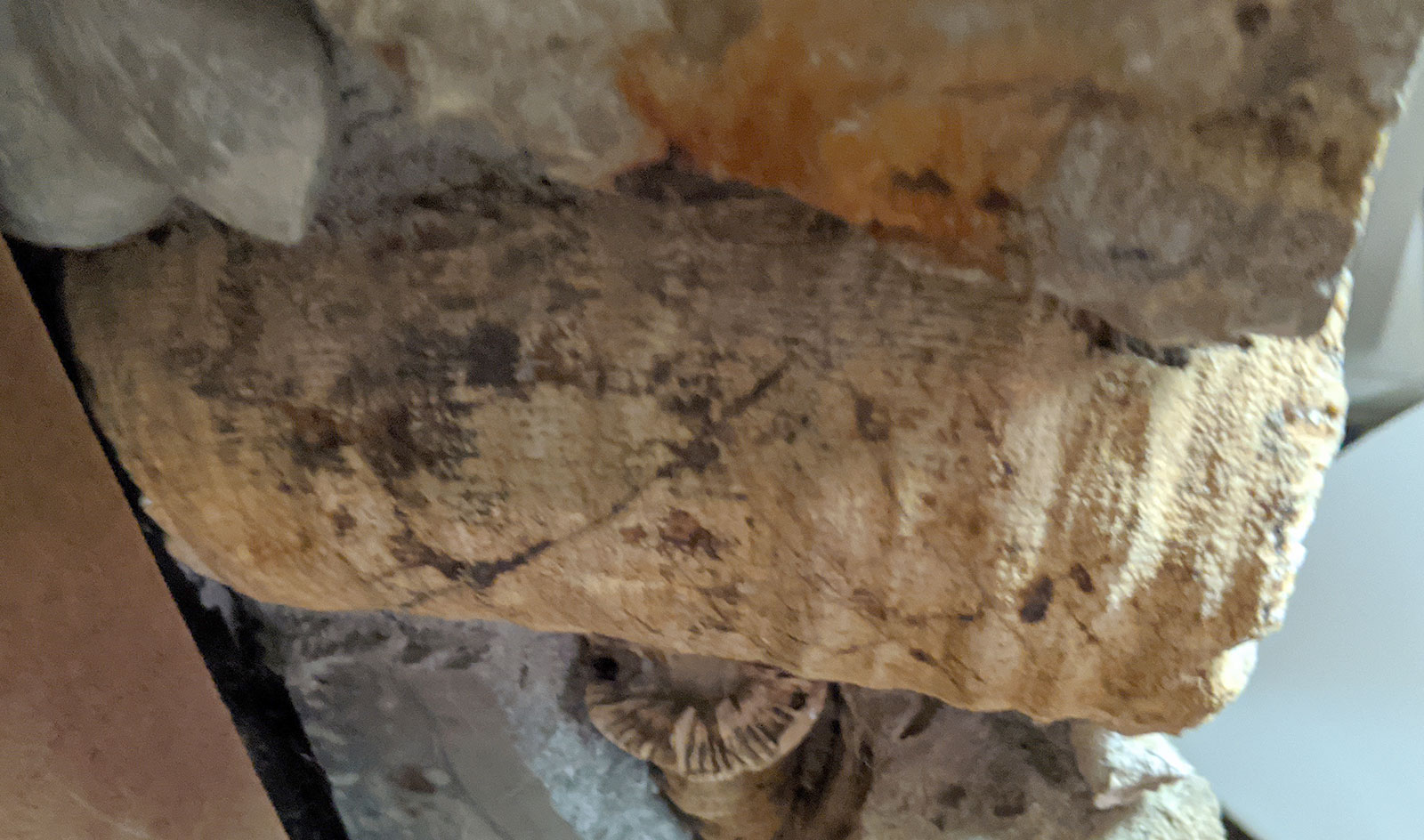
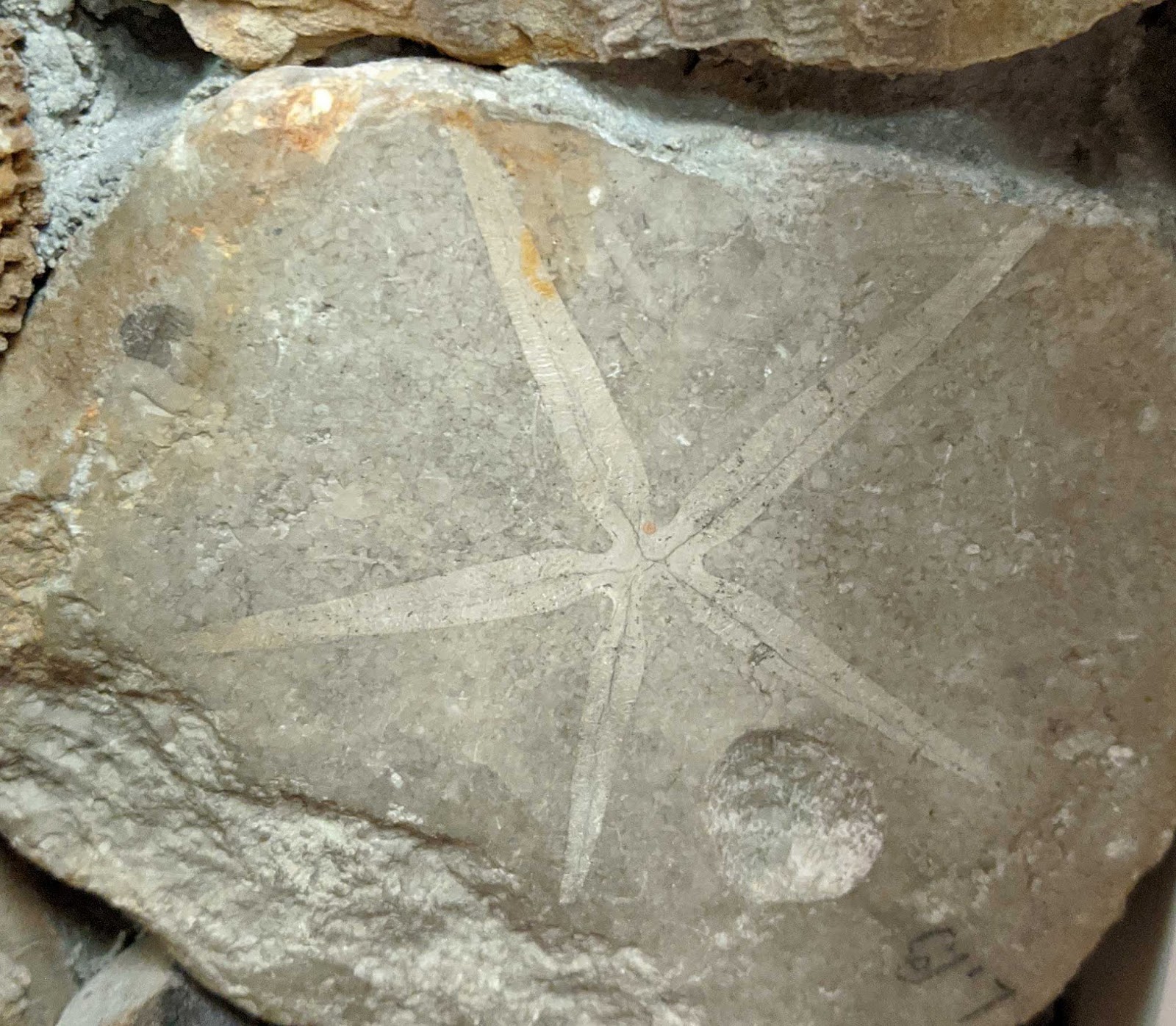
In Dr. Conkin's house in Louisville, he had a fireplace constructed consisting of a number of fossils. One of Lucien Beckner's fossils that was embedded there was what appears to be an Evactinopora quinqueradiata (Ulrich, 1890) byrozoan (its cross section looks like a starfish).

Musician Delcy Marcum
His daughter Elizabeth Anne Taliaferro Beckner (1897-1967) became a regional celebrity musician under the name Delcy Marcum. Like her father, she had quite a variety in her career who was a Kentucky State Board of Health medical technician, song writer, radio actress, ballad singer, dulcimer player, and writer of short stories, professional comedy skits, and newspaper features. Two of her father's poems "Spring Fever" and "Vine Leaves Serenade" she converted to songs. She wrote two more songs "One Kiss Devine" played by Wayne King and his orchestra and "Louisville Stomp" performed by Fletcher Henderson and his orchestra. She sang mountain ballads and played the dulcimer on Cincinnati and Chicago radio programs mostly in the 1930s and 1940s.