Showing posts with label gerard troost. Show all posts

Sunday, September 10, 2023

Colonel Lucien Beckner - Geologist & Museum Curator


Lucien Pearson Beckner (1872-1963) Firefly Gemini AI enhanced

Lucien Pearson Beckner was a figure that played a part in the formation of Louisville's knowledge of it's natural history. He lived a full life and his career spanned many directions: journalist, author, lawyer, geologist, engineer, writer, historian, and curator.

He was born in Winchester, Kentucky on December 29, 1872, the son of Judge W. M. Beckner (lawyer, ran Clark County Democrat newspaper, congressman) and Elizabeth Anne Taliaferro Beckner. Young Lucien attended the Louisville Military Academy. When he was 17 years old, he traveled to Naples Florida and collected a number of shells that are now in the possession of the author. Two of the shells have been blogged about before Oliva sayana and Fulguropsis pyruloides.

Later he went to Centre College, the University of Kentucky, Transylvania College and the University of Pennsylvania.

Lucien helped his father with publishing the newspaper. As a civil engineer he helped lay out the tracks in the City of Ashland and Lexington and eastern branch of the Louisville & Nashville Railroad. Later in 1903, he used this railroad expertise and went to Ecuador to help that country with its railroads.

He eloped with Marie Davis Warren (1875-1950) on August 14, 1894 in New Albany, Indiana at the residence of Reverand W. B. Ellis. The  Kentucky Advocate newspaper in their notice reported that Lucien ("Choctaw") has job in Frankfort, Kentucky paying $1,200 a year. A first daughter was born Jean Warren Beckner on April 3, 1896 and tragically died of meningitis on September 17, 1898. Their second daughter was born Elizabeth Taliaferro Beckner (1897-1967) on November 17, 1897 and the third Marie Warren Beckner Kittrell (1904-2001) was born October 25, 1904.

Beckner practiced law in Winchester, Kentucky with father from 1904-1922 and published and edited newspapers The Winchester Sun and The Clark County Republican. He sold the papers and returned to being a geologist during the Kentucky oil boom of 1916.

During the 1917 Spanish flu outbreak, he helped administer medical treatments to residents of eastern Kentucky. His World War I draft registration showed that he was a consulting geologist as his occupation. He was an assistant at the Kentucky Geological Survey and consulting geologist for Louisville Gas & Electric (LG&E).

Beckner earned the title of colonel from multiple sources. 1) Kentucky Governor Edwin P. Morrow (1877-1935) commissioned him into the Kentucky Militia, he was give the honorary commission by Tennessee Governor Austin Peay (1876-1927) [a former classmate at Centre College], and in 1903 from the Government of Ecuador.

In 1933, Lucien was named curator of Louisville Museum of Natural History and Science and remained at that position till 1959. A major challenge during this time was dealing with the Ohio River flood in 1937. One of the highlights of the museum collection was Gerard Troost (1776-1850) mineral collection from 1811-1850. It was heavily damaged by the flood and a lot of mineral specimens lost their labels. With a Work Projects Administration (WPA) crew, they cleaned and re-identified the museum's 100,000 items. This work included baking the Egyptian mummy in a bread oven to dry it out. He oversaw the move of the museum from the main public library building (Fourth and York Streets) to the old Monsarrat school building (Sixth and York Streets).

The Filson Club 

He published a number of articles in the The Filson Club Quarterly:

April 1927 - John Findley, The First Pathfinder of Kentucky

January 1928 - A Sketch of the Early Adventures of William Sudduth in Kentucky

October 1928 - Letter from George Washington to Charles Morgan, 1795

April 1931 - John D. Shane's Interview with Benjamin Allen, Clark County 

October 1932 - Eskippakithiki, The Last Indian Town in Kentucky

July 1936 - Rev. John D. Shane's Notes on Interviews, in 1844, with Mrs. Hinds and Patrick Scott of Bourbon County

October 1937 - John D. Shane's Interview with Elijah Foley

July 1938 - John D. Shane's Notes on an Interview with Jeptha Kemper of Montgomery County

January 1946 - John D. Shane's Interview with Jesse Graddy of Woodford County

October 1946 - Groping for Health in the Mammoth Cave

April 1947 - Scientist (R.C. Ballard Thruston Issue)

October 1948 - John D. Shane's Copy of Needham Parry's Diary of Trip Westward in 1794

January 1952 - Kentucky's Glamorous Shorthorn Age

July 1955 - The Moundbuilders

April 1959 - Abraham Lincoln, Influences That Produced Him

Beckner was a director at the Kentucky Historical Society, elected president of the Kentucky Academy of Science, a representative of the American Geophysical Union, and a fellow of the American Association for the Advancement of Science.

Death

Aged 90, Colonel Beckner died on Wednesday August 28, 1963 at 5 p.m. at a Louisville, Kentucky nursing home. He had broken some bones the year before and never really recovered from that injury. At his funeral the Reverand Conrad G. Crow gave this tribute, "We in the city of Louisville possess a museum because of his devotion and labor... His range of interests was so wide, his conversations so gripping that those who heard him could not but be impressed by his scholarship. But he possessed something more: that intangible spark which fired the enthusiasm of his hearers and influenced many young people to take up their life work. " He was buried with other family members in the Winchester, Kentucky cemetery.


Memories of Colonel Beckner by Dr. James Conkin

James Conkin writes in his autobiography, "When I was a senior at Louisville Male High School in early 1940... I spent (after school) the remainder of most days studying fossils and rocks under Col. Lucien Pearson Beckner at the old Natural History Museum."  He writes later in the endnotes, ""As Director of the Louisville Free Public Library Museum, Col. Beckner led me, from a junior high school student until his death (at 90) along with my geologic studies, it mattering not whether he was physically with me. I still sense his presence. I was able to nominate him for his Doctor of Science given him by the University of Louisville."

Dated October 28, 1948, James published his first paper in the Annals of Kentucky Natural History entitled On the Occurance of a New Species of Cyrtodonta from the Liberty Formation of Oldham County, Kentucky in which he named a pelecypod fossil after Lucien Beckner calling it Cyrtodonta beckneri.


In Dr. Conkin's house in Louisville, he had a fireplace constructed consisting of a number of fossils. One of Lucien Beckner's fossils that was embedded there was what appears to be an Evactinopora quinqueradiata (Ulrich, 1890) byrozoan (its cross section looks like a starfish).


Musician Delcy Marcum

His daughter Elizabeth Anne Taliaferro Beckner (1897-1967) became a regional celebrity musician under the name Delcy Marcum. Like her father, she had quite a variety in her career who was a Kentucky State Board of Health medical technician, song writer, radio actress, ballad singer, dulcimer player, and writer of short stories, professional comedy skits, and newspaper features. Two of her father's poems "Spring Fever" and "Vine Leaves Serenade" she converted to songs. She wrote two more songs "One Kiss Devine" played by Wayne King and his orchestra and "Louisville Stomp" performed by Fletcher Henderson and his orchestra. She sang mountain ballads and played the dulcimer on Cincinnati and Chicago radio programs mostly in the 1930s and 1940s.


Sunday, September 3, 2023

Earth Scientists Buried at Cave Hill Cemetery

A while back I was contacted by a researcher at the Cave Hill Cemetery here in Louisville Kentucky for more information about Dr. James Knapp. While he was medical doctor, he had a passion for paleontology and collected an impressive selection of local fossils. As it turns out, the cemetery in 1868 had geology document created and Dr. Knapp and Dr. Yandell are listed in it as donating a collection of fossils that were/are found at the burial grounds. This information request spawned an idea to create a posting of past Louisville area earth scientists that were interred at Cave Hill Cemetery. Here is the list:
 
Lunsford was born in on July 4, 1805 in Hartsville, Tennessee to a father who was a medical doctor. He followed his father into the profession studying at Transylvania University (Lexington, Kentucky) and graduating from the University of Maryland in 1825. Afterwards he setup a medical practice in Nashville and Murfreesboro, Tennessee. In 1831, he returned to Transylvania University and became a professor of chemistry. He helped found the Louisville Medical Institute in 1835 in Louisville, Kentucky and he taught physiology, chemistry and materia medica there. Dr. Yandell left Louisville in 1859 to join the faculty of Memphis Medical Institute (Tennessee) and when the American Civil War broke out in 1861 he was put in charge of the Confederate hospital in Memphis. When the Union Army took over Memphis in 1864, he and his wife moved to the family home in Daceyville, Tennessee and later returned to Louisville in 1867. In 1872, was elected president of the Louisville College of Physicians and Surgeons. He was also a member of the Boston Academy of Science as well as the Philadelphia Academy of Natural Sciences.
 
Dr. Yandell also was well known for his study of fossils. He published articles in 1855 in the Proceedings of the American Association for the Advancement of Science "Description of a new genus of Crinoidea", 1856 American Journal of Science and Arts "Notice of a new fossil genus belonging to the family Blastoidea (Eleutherocrinus)", and same journal 1851 "On the distribution of the Crinoidea in the Western States". He and Benjamin F. Schumard (1820-1869) published a book entitled Contributions to the Geology of Kentucky in 1847. A number of local fossil species where named in his honor and it appears some of the fossils specimens he found are in the Harvard Museum collection.
 
Two of his sons became doctors David Wendel Yandell (1826-1898) and Lunsford Pitts Yandell, Jr. (1837-1884) and his granddaughter Enid Yandell (1869-1934) was a noted sculptor. They are all buried at Cave Hill Cemetery with Dr. Yandell Sr. plot is located in Section O, Lot 257.


J. Lawrence Smith was born on December 16, 1818 in Charleston, South Carolina. He received his college education at the University of Virginia in Civil Engineering and later the Medical College of South Carolina. Smith graduated in 1840 with his medical degree. He continued his scientific studies in Paris, France and Giessen, Germany until 1843 when he moved to Charleston, South Carolina. Dr. Smith became an expert on agricultural chemistry. From 1846-1850 he helped the government of Turkey cultivate cotton and discover new mineral resources. While there, he discovered a uranium carbonate mineral he named liebigite. Once Smith was back in the United States, in 1852 he marries Sarah Julia Guthrie the daughter of Kentucky politician James Guthrie (1792-1869). 
 
James Guthrie was an important figure in Louisville's history. In 1847, he encouraged some of the medical faculty for Transylvania University to leave [among them Dr. Lunsford Pitt Yandell, Sr.] and form the Louisville Medical Institute which later became the University of Louisville (U of L). Guthrie became U of L's first president. He also got Louisville's first railroad bridge built across the Ohio River, the city to buy the land that became Cave Hill Cemetery and he was the president of the Louisville and Nashville Railroad.
 
Through his father-in-law, Dr. Smith got work at the Smithsonian Institution in Washington, D.C. in 1853. The next year, he and his wife moved to Kentucky where he became the chair and Professor of Medical Chemistry on Toxicology at the University of Louisville. After leaving the university in 1866, he spent time traveling Europe collecting and studying meteorites ("aerolites").
 
The newspaper the Republican Banner published an article on August 8, 1874 entitled "The Troost Collection". From the article, "The Trustees of the Public Library having purchased at a cost of twenty thousand dollars cash, the Troost cabinet recently of Nashville, it may be interesting to present to the public full information in regard to this celebrated and very valuable collection... The cabinet of Dr. Troost has been long recognized among the scientific men of Europe and America as one of the most extensive as well as valuable private collections in the world. It contains: 1. Minerals in number 13,582, 2. Fossil organic remains-paleontology-2,851; 3 . Geology-rocks, etc. from granites to lavas, between 2,000 and 3,000; 4. Shells- not numbered; 5. Indian relics from ancient mounds, with dresses, ornaments, war clubs and other weapons, arrow-heads, images, etc... In appropriation of the large sum of money necessary to secure for Louisville this vast treasure, the Board of Trustees have been influenced by the advice of our eminent scientists, Dr. J. Lawrence Smith, Drs. L. P.  Yandell, Sr., James Knapp, Thomas E. Jenkins, T. S. Bell, and others, who have interested themselves in a successful attempt to bring to Kentucky this result of the labor of one of the most busy and practical scholars of modern times;...The collection of meteoric stones of Dr. Smith is probably the best in this country, as be has made these "messengers from other worlds" the subject of his special study."
 
Somehow Dr. Smith was able to get the meteorites from the Gerard Troost (1776-1850) collection and incorporate them into his collection. Upon his death, his wife sold the meteorite collection to the Harvard Museum. The proceeds from the sale were used to create the J. Lawrence Smith Medal. Since 1888, it has usually been awarded every 3-5 years by the National Academy of Sciences for investigations of meteoric bodies.

J. Lawrence Smith is buried at Cave Hill Cemetery in Section B Lot 1 Grave 12 with his wife Sarah Julia Guthrie Smith (1827-1901) and her sister's family who are buried in a triangular pattern around their parents very large monument James Guthrie (1792-1869) and Eliza Churchill Prather Guthrie (1799-1836).


Dr. James Knapp (1821-1885)

James Knapp was born on January 29, 1821 in Groton, New York and grew up there. He moved to Floydsburg, Kentucky in 1821 and apprenticed as a saddler. He studied medicine at the Louisville Medical Institute and graduated from there in 1852. Once a doctor, his practice flourished and he became quite wealthy. In 1863, he enlisted in the Union Army as a physician.  In a 1868 document Cave Hill Cemetery had created it states,  "Dr. Knapp and Prof. L. P. Yandell have very kindly presented the Trustees of Cave Hill Cemetery a collection of the fossils belonging to the rocks of the Cemetery. They constitute a good record of a very early manifestation of life on this planet. The Trustees will provide for the preservation of these fossils as an instructive and interesting portion of the history of the Cemetery." It is uncertain what became of this fossil collection. As mentioned above, Dr. Knapp played a role is getting the Gerard Troost mineral collection transferred to the Louisville Public Library which was finished in 1882. The collection was later transferred to the Louisville Science Center who in 2019(?) transferred it to the Indiana State Museum. The picture of the fossil in the right corner is a Bordenia knappi (Hall, 1882) named after James Knapp by the famous paleontologist James Hall (1811-1898) of New York. Professor Hall named another after him (see grey shell drawing above) called Pentamerus knappi.
 
Dr. Knapp never married and his only heir was a brother in Pennsylvania. His estate was about $65,000 in 1885 which would be equivalent to about $2 million dollars today. After his death, Dr. Knapp's fossil collection was sold to William Borden (1823-1906), who at one time was one of the wealthiest people in the state of Indiana. The Borden fossil collection was sold to the Field Museum of Natural History in Chicago after Borden's death. James Knapp is buried at Cave Hill Cemetery in Section P, Lot 576 Part WP Grave 0 (the obelisk like stone is under a tree, the text is somewhat hard to read).


Henry Nettelroth (1835-1887) 

Henry Nettelroth was born on June 6, 1835 in the Kingdom of Hanover (Germany). He attended universities there and graduated as a civil engineer. After graduating he became an engineer in the Hanoverian army. After their defeat in 1866 to the Prussians, he emigrated to the United States and settled in the Louisville area. He collected fossils there from about 1872-1887 and created a book entitled Kentucky Fossil Shells: A Monograph of the Fossil Shells of the Silurian and Devonian Rocks of Kentucky. It was published after his death in 1889. Nettelroth wrote positively about Dr. James Knapp and Professor Lunsford Yandell in some of the fossil descriptions in the book and he listed that they are both dead at the time of its writing. He named fossil species after them and said they had some of the oldest fossil collections in Louisville.

His sons sold his fossil collection the Smithsonian Institution where it still resides as of this writing. The picture of the spiny snail fossil above is a Platyceras dumosum (Conrad, 1840). In 2023, that fossil was on display on the 1st floor of the Smithsonian Museum of National History. Henry Nettelroth is buried at Cave Hill Cemetery in Section A, Lot 502 N1/2 Grave 500 near his wife and another son and his family are in Section 29 Lot 41 NW1/2 Grave 3.


Ruth F. Gillespie was born on July 28, 1905 in Syracuse, New York. Her father was telecommunications engineer with Western Electric Corporation. He was sent to Sweden to install phone systems there and took his family. Ruth attended school in Europe as a result. After returning to the United States, she graduated from Cornell University in 1929 with a bachelor's and master's degrees in geology with emphasis on paleontology. She was married not long after graduating from college and raised a family in Virginia and they later moved to the Louisville for her husband's job.
She became involved in the Ohio Falls Chapter of Kentucky Society of Natural History as a geologist and director. Ruth also became involved in the formation of a natural history museum in Louisville and Falls of the Ohio State Park. Between 1958-1977 she published a number of papers on local area fossils particularly on Ordovician Period corals like the one shown above Foerstephyllum vacuum (Foerste, 1909). Ruth is buried at Cave Hill Cemetery in Section 35 Lot 23 Part B Grave 2 next to her husband.


James Elvin Conkin was born October 14, 1924, in Glasgow, Kentucky, USA. He graduated from Louisville's Male High School in 1943 and joined the U.S. Marine Corps during World War II where he served in the Pacific theater of operations. After the war, he graduated with a degree in geology from the University of Kentucky in 1950, a master's degree in geology from University of Kansas in 1953 and a doctorate from the University of Cincinnati in 1960. He was married to his wife Barbara in 1951 who was also a geologist and frequent research collaborator. He founded the Geology Department at the University of Louisville in 1964, served as its first chairman until 1968, and taught there from 1957 until 2001 before becoming professor emeritus. Dr. Conkin named numerous fossils especially in the Coral Ridge layer south of Louisville and had 100s of publications (like the one shown above written with is wife Barbara entitled Ancient Animals Locked in Louisville's Rocks.) He and Barbara are interred together at Cave Hill Cemetery in Section U, Crematory Garden Space 5.


Barbara was born on July 17, 1928, in Wilmette, Illinois, USA. She grew up there and graduated New Trier High School. Afterwards she graduated from Smith College and earned her Master's Degree in Geology from The University of Kansas. While at Kansas she met James Conkin (see above) and they were later married in 1951. She and her husband raised a family of 4 children. The family traveled though out the world for various geological studies.  She became the first geology teacher for Jefferson Community College, beginning there in 1969, retiring in 1995. She authored a number of books including the one shown above Why Are The Highlands High? The Geology Beneath the Landscapes of Jefferson County and co-authored a number of publications with her husband Jim. They are interred together at Cave Hill Cemetery in Section U, Crematory Garden Space 5.

Sunday, March 19, 2023

Echinocrinites fenestratus Cystoid Fossil

Image courtesy of the Smithsonian Institution Specimen Catalog Number:  USNM PAL 35091 Specimen 2 GUID:     http://n2t.net/ark:/65665/m3c65a4dfe-ad99-45cc-8f4a-0217d73e8a45 Photographer Suzanne McIntire. Specimen housed in the collections of the Department of Paleobiology, National Museum of Natural History, Smithsonian Institution

Echinocrinites fenestratus
(Troost, 1850) cystoid fossil described in A Critical Summary of Troost's Unpublished Manuscript on the Crinoids of Tennessee by Elvira Wood 1909. This cystoid was found in Brownsport limestone of Decatur County Tennessee USA (Silurian Period). It was assigned U.S. National Museum number 35091 and identified as a holotype.While fossil is described on pages 8-9, no explanation as to why no illustration was provided. It was later renamed by Professor Charles Schuchert (1858-1942) as Tetracystis fenestratus (1904). He published about this same specimen in On Siluric and Devonic Cystidea and Camarocrinus and included three photographs at Plate XXXIV figures 6-8.

Image courtesy of the Smithsonian Institution Specimen Catalog Number:  USNM PAL 35091 Specimen 2 GUID:        http://n2t.net/ark:/65665/m36381a8a3-ba40-4d94-aea8-3a9ab5a5c632 Photographer Suzanne McIntire. Specimen housed in the collections of the Department of Paleobiology, National Museum of Natural History, Smithsonian Institution

Image courtesy of the Smithsonian Institution Specimen Catalog Number:  USNM PAL 35091 Specimen 2 GUID:      http://n2t.net/ark:/65665/m3168ad43c-793c-4122-bdcc-1d6c566bba8a Photographer Suzanne McIntire. Specimen housed in the collections of the Department of Paleobiology, National Museum of Natural History, Smithsonian Institution
Photos are from the Smithsonian collection, first three shown from specimen 2. The record for USNM PAL 35091 lists only 1 specimen but there are six pictures and appear to be two distinct cystoid fossils. Three pictures shown below appear to be from specimen 1.

Image courtesy of the Smithsonian Institution Specimen Catalog Number:  USNM PAL 35091 Specimen 1 GUID:      http://n2t.net/ark:/65665/m360b0775e-4ca2-48cb-92e2-ca1ab25b8a70 Photographer Suzanne McIntire. Specimen housed in the collections of the Department of Paleobiology, National Museum of Natural History, Smithsonian Institution

Image courtesy of the Smithsonian Institution Specimen Catalog Number:  USNM PAL 35091 Specimen 1 GUID:       http://n2t.net/ark:/65665/m3a74e0aa5-fa6a-4fb5-8624-e6f4ce09d08c Photographer Suzanne McIntire. Specimen housed in the collections of the Department of Paleobiology, National Museum of Natural History, Smithsonian Institution

Image courtesy of the Smithsonian Institution Specimen Catalog Number:  USNM PAL 35091 Specimen 1 GUID:          http://n2t.net/ark:/65665/m3d01e00e9-334e-4fdf-a0e5-654056b7b4c0 Photographer Suzanne McIntire. Specimen housed in the collections of the Department of Paleobiology, National Museum of Natural History, Smithsonian Institution


Saturday, March 18, 2023

Barycrinus stellatus Crinoid Calyx Fossil


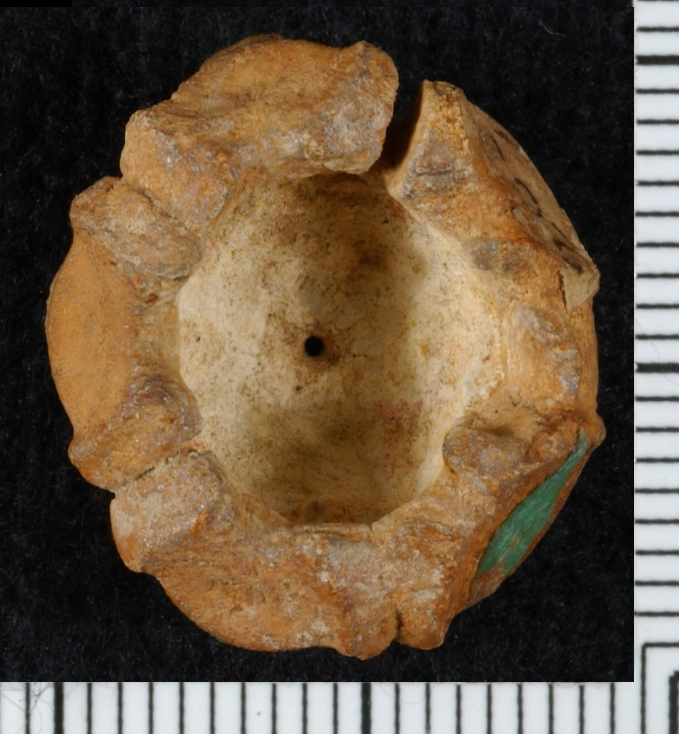
Image courtesy of the Smithsonian Institution Specimen Catalog Number:  USNM PAL 39942 Specimen GUID:             http://n2t.net/ark:/65665/m3d84e97de-ad18-4d93-b196-63b98eb801e1 Specimen housed in the collections of the Department of Paleobiology, National Museum of Natural History, Smithsonian Institution


Barycrinus stellatus (Troost, 1850) crinoid calyx fossil described in A Critical Summary of Troost's Unpublished Manuscript on the Crinoids of Tennessee by Elvira Wood 1909. Drawings in this post are from  Plate 8 figures 6-8 drawn by Major Adolphus Heiman (1809-1862). This crinoid was found in Keokuk horizon of the Tullahoma formation Stewart County Tennessee USA (Mississippian Period). It was assigned U.S. National Museum number 39942 and identified as a holotype. Originally it was called Cyathocrinites steallatus.

Photos are from the Smithsonian collection. The calyx is identified as being 19.5 mm in width. 

Image courtesy of the Smithsonian Institution Specimen Catalog Number:  USNM PAL 39942 Specimen GUID:                 http://n2t.net/ark:/65665/m3b87b9092-b56d-4328-a50b-6d88dbb88830 Specimen housed in the collections of the Department of Paleobiology, National Museum of Natural History, Smithsonian Institution


Image courtesy of the Smithsonian Institution Specimen Catalog Number:  USNM PAL 39942 Specimen GUID:                 http://n2t.net/ark:/65665/m3f3fd6c75-c59b-41d2-bf35-1580a382510c Specimen housed in the collections of the Department of Paleobiology, National Museum of Natural History, Smithsonian Institution

Image courtesy of the Smithsonian Institution Specimen Catalog Number:  USNM PAL 39942 Specimen GUID:                     http://n2t.net/ark:/65665/m362f5b1a6-526f-44bf-ad50-e774a9aabf28 Specimen housed in the collections of the Department of Paleobiology, National Museum of Natural History, Smithsonian Institution

Saturday, March 11, 2023

Melonite granulatus Crinoid Calyx Fossil

Image courtesy of the Smithsonian Institution Specimen Catalog Number:  USNM PAL 39909 Specimen GUID:     http://n2t.net/ark:/65665/36ce242a9-26bb-4138-8ab4-fccdd1ce4954 Photographer Suzanne McIntire. Specimen housed in the collections of the Department of Paleobiology, National Museum of Natural History, Smithsonian Institution

Melonite granulatus
(Troost, 1850) crinoid calyx fossil described in A Critical Summary of Troost's Unpublished Manuscript on the Crinoids of Tennessee by Elvira Wood 1909. This crinoid was found in Cumberland Gap Claiborne County Tennessee USA (Mississippian Period). It was assigned U.S. National Museum number 39909 and identified as a holotype.While fossil is described on pages 107-108, no explanation as to why no illustration was provided. 

Image courtesy of the Smithsonian Institution Specimen Catalog Number:  USNM PAL 39909 Specimen GUID:     http://n2t.net/ark:/65665/36ce242a9-26bb-4138-8ab4-fccdd1ce4954 Photographer Suzanne McIntire. Specimen housed in the collections of the Department of Paleobiology, National Museum of Natural History, Smithsonian Institution


Thursday, March 9, 2023

Cleiocrinus tessellatus Crinoid Calyx Fossil


Cleiocrinus tessellatus
(Troost, 1850) crinoid calyx fossil Plate 7 figures 11 drawn by Major Adolphus Heiman (1809-1862) from A Critical Summary of Troost's Unpublished Manuscript on the Crinoids of Tennessee by Elvira Wood 1909. This crinoid was found in the Lebanon limestone (Silurian Period) division of the Stones River Formation of Duck River, near Columbia, Maury County Tennessee USA. It was assigned U.S. National Museum number 39910 and identified as a holotype.

Pictures of the actual Troost fossil at the Smithsonian shown below. 

Image courtesy of the Smithsonian Institution Specimen Catalog Number:  USNM PAL 39910 Specimen GUID:         http://n2t.net/ark:/65665/33b065c2b-0ba1-423d-bcbc-2f7ec78c0007 Specimen housed in the collections of the Department of Paleobiology, National Museum of Natural History, Smithsonian Institution


Wednesday, March 8, 2023

Cyathocrinites tiaraeformis Crinoid Fossil


Cyathocrinites tiaraeformis (Troost, 1850) crinoid calyx fossil Plate 7 figures 15-17 drawn by Major Adolphus Heiman (1809-1862) from A Critical Summary of Troost's Unpublished Manuscript on the Crinoids of Tennessee by Elvira Wood 1909. This crinoid was found in the Carboniferous Period Keokuk horizon of the Tullahoma Formation of White's Creek Springs, Davidson County Tennessee USA. It was assigned U.S. National Museum number 54236 and identified as a holotype. Elvira Wood lists it as Ichthyocrinus tiaraeformis (Troost) Hall.

Pictures of the actual Troost fossil at the Smithsonian shown below.

Image courtesy of the Smithsonian Institution Specimen Catalog Number:  USNM PAL 54236 Specimen GUID:         http://n2t.net/ark:/65665/390e41ca3-405f-4e83-91c9-5e494bfd3e5b Specimen housed in the collections of the Department of Paleobiology, National Museum of Natural History, Smithsonian Institution 
 
 
Image courtesy of the Smithsonian Institution Specimen Catalog Number:  USNM PAL 54236 Specimen GUID:         http://n2t.net/ark:/65665/390e41ca3-405f-4e83-91c9-5e494bfd3e5b Specimen housed in the collections of the Department of Paleobiology, National Museum of Natural History, Smithsonian Institution
 

Image courtesy of the Smithsonian Institution Specimen Catalog Number:  USNM PAL 54236 Specimen GUID:         http://n2t.net/ark:/65665/390e41ca3-405f-4e83-91c9-5e494bfd3e5b Specimen housed in the collections of the Department of Paleobiology, National Museum of Natural History, Smithsonian Institution


Tuesday, March 7, 2023

Cyathocrinites roemerii Crinoid Fossil


Cyathocrinites roemerii (Troost, 1850) crinoid calyx fossil Plate 6 figure 11 drawn by Major Adolphus Heiman (1809-1862) from A Critical Summary of Troost's Unpublished Manuscript on the Crinoids of Tennessee by Elvira Wood 1909. This crinoid was found in the Carboniferous Period aged in the St. Louis Limestone of  Duck River, Maury County Tennessee USA. It was assigned U.S. National Museum number 39944 and identified as a holotype. Elvira Wood refers to as Scaphiocrinus huntsvillae  (Worthen).

Gerard Troost (1776-1850) does not list who the species is named after but it appears was one of two geologist brothers Friedrich Adolph Roemer (1809-1869) or Carl Ferdinand von Roemer (1818-1891).

UPDATE [December 2024]: The fossil was named after the younger Ferdinand Roemer. I found his 1860 book Die silurische Fauna des westlichen Tennessee / Eine palaeontologische Monographie in which he visited Troost in 1847 in Nashville. He writes (translated from German to English): "When I returned from Texas in the summer of 1847 to Nashville, the capital of the state of Tennessee, and found a very friendly welcome and valuable instruction on the geological conditions of the country from Dr. G. Troost, who has made a great contribution to the natural history of the western states, my attention was particularly drawn to the beautifully preserved Silurian fossils in the excellent man's rich paleontological collection..."

Picture of the real fossil is below which is stored at the Smithsonian. Their database shows it is a holotype called Dinotocrinus roemeri (Troost in Wood, 1909).

Image courtesy of the Smithsonian Institution Specimen Catalog Number:  USNM PAL 39944 Specimen GUID:         http://n2t.net/ark:/65665/39ac4d2dd-9845-4878-8d40-90204c177ae3 Specimen housed in the collections of the Department of Paleobiology, National Museum of Natural History, Smithsonian Institution


Monday, March 6, 2023

Granatocrinites globosus Blastoid Fossil


Granatocrinites globosus (Troost, 1835) blastoid fossil Plate 4 figures 12-14 drawn by Major Adolphus Heiman (1809-1862) from A Critical Summary of Troost's Unpublished Manuscript on the Crinoids of Tennessee by Elvira Wood 1909. This very distinct blastoid was found in the Devonian Period aged at Bedford County Tennessee USA. It was assigned U.S. National Museum number 33077 and identified as a holotype. Elvira Wood refers to as Orbitremites granulatus (Roemer).

Picture of the real fossil is below:

Image courtesy of the Smithsonian Institution Specimen Catalog Number:  USNM PAL 33077 Specimen GUID:     http://n2t.net/ark:/65665/m3fa639a8e-6c3a-459b-acd8-8d23c8e76bed Photographer Suzanne McIntire. Specimen housed in the collections of the Department of Paleobiology, National Museum of Natural History, Smithsonian Institution


Sunday, March 5, 2023

Troosticrinus reinwardtii Blastoid Fossil


Troostocrinus reinwardtii (Troost, 1835) blastoid fossil Plate 3 figures 2-4 drawn by Major Adolphus Heiman (1809-1862) from A Critical Summary of Troost's Unpublished Manuscript on the Crinoids of Tennessee by Elvira Wood 1909. This very distinct blastoid was found in the Silurian Period aged Brownsport limestone of Tennessee. It was assigned U.S. National Museum number 33071.

Troost's Original drawings of Pentremites reinwardtii from 1835 work

Gerard Troost (1776-1850) originally called this fossil Pentremites reinwardtii (Troost, 1835) in On The Pentremites reinwardtii, A New Fossil; With Remarks on the Genus Pentremites (Say), and Its Geognostic Position in the States of Tennessee, Alabama, and Kentucky in Geological Society of Pennsylvania (1835). It appears he named the species after a Dutch botanist Caspar Georg Carl Reinwardt (1773-1854). The genus Troost used was named by his friend from Philadelphia and New Harmony, Indiana Thomas Say (1787-1834).

 The holotype fossil Troost found back in the 1830s now resides at the National Museum of Natural History, Smithsonian Institution. See photographs of it below that were taken sometime in 2010.


Image courtesy of the Smithsonian Institution Specimen Catalog Number:  USNM PAL 33071 Specimen GUID:     http://n2t.net/ark:/65665/3fda37982-30dd-4c41-aa35-c48973890252 Photographer Suzanne McIntire. Specimen housed in the collections of the Department of Paleobiology, National Museum of Natural History, Smithsonian Institution

Image courtesy of the Smithsonian Institution Specimen Catalog Number:  USNM PAL 33071 Specimen GUID:     http://n2t.net/ark:/65665/3fda37982-30dd-4c41-aa35-c48973890252 Photographer Suzanne McIntire. Specimen housed in the collections of the Department of Paleobiology, National Museum of Natural History, Smithsonian Institution


Sunday, March 7, 2021

Digital Necromancy?


Gerard Troost
Picture of daguerreotype circa 1848
On Display at Tennessee State Museum - Nashville (2010)
Miss Margaret Lindsley Warden Collection
 Tennessee Division of Geology - Bulletin 84


Recently the website MyHertiage Deep Nostalgia™ became available that allows you to animate still pictures using artificial intelligence algorithms.  In a sense, it can allow one to digitally animate those that are dead.

As a test, I submitted two images of long dead paleontologists: Gerard Troost (1776-1850) and William Borden (1823-1906). I have documented their lives in earlier posts [Troost 12-13-2009 LINK & Borden 11-12-2009 LINK] and included still frame pictures used for this trial.

William Borden Picture from Baird's History of Clark County, Indiana (1909)