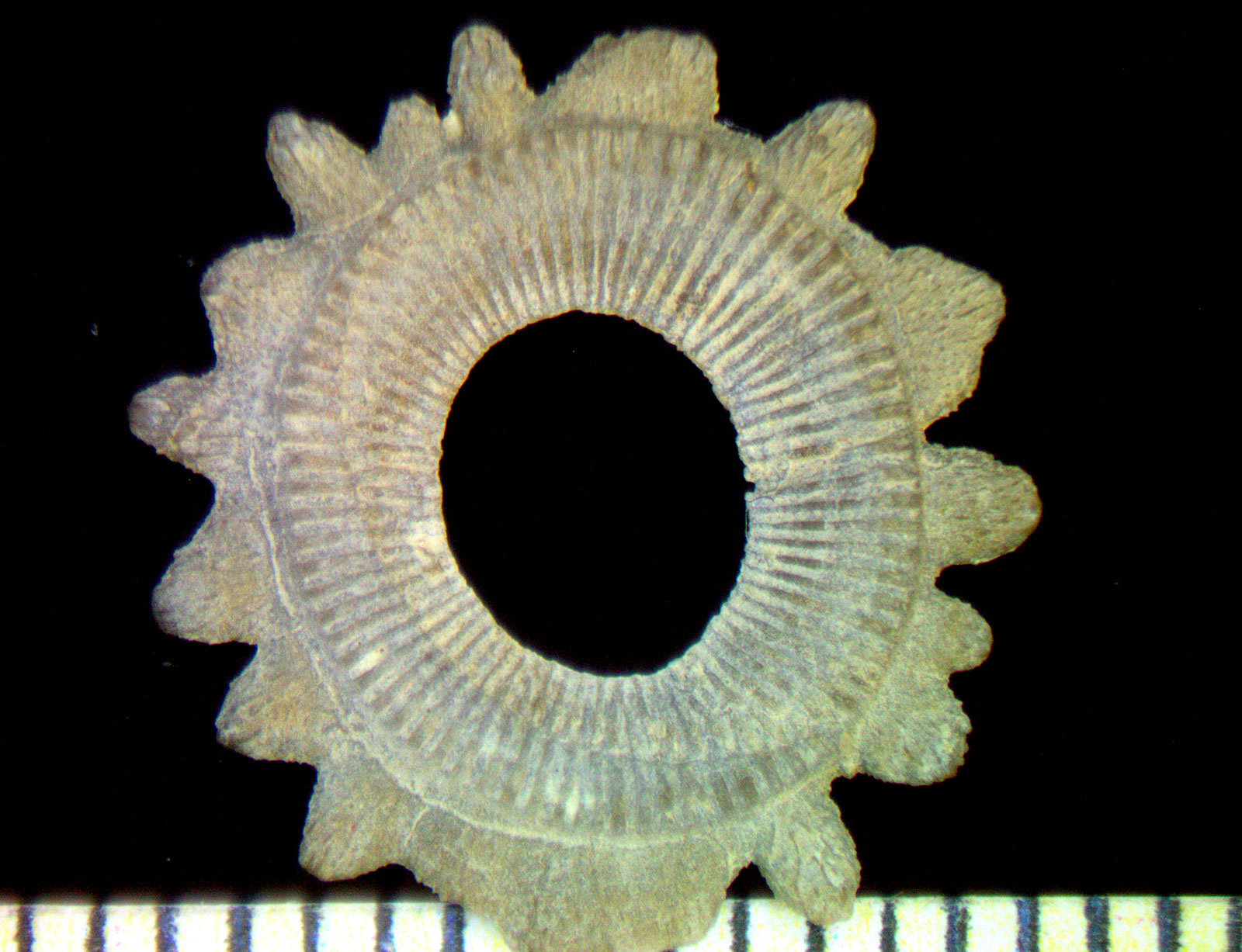
It is usually difficult to identify fossil crinoid stem pieces. So this fossil was recently found in the Jeffersonville Limestone Clark County Indiana USA. It dates to the Middle Devonian Period. The stem has some unique features so it seemed like a good candidate for trying to find its name. After some research, this fossil might be a Cactocrinus. A problem emerges in that that genus existed in the Mississippian Period and this fossil was found in much older rock.
Saturday, June 1, 2024
Cactocrinus? Crinoid Fossil Stem
It is usually difficult to identify fossil crinoid stem pieces. So this fossil was recently found in the Jeffersonville Limestone Clark County Indiana USA. It dates to the Middle Devonian Period. The stem has some unique features so it seemed like a good candidate for trying to find its name. After some research, this fossil might be a Cactocrinus. A problem emerges in that that genus existed in the Mississippian Period and this fossil was found in much older rock.
Tuesday, June 21, 2022
Eucalyptocrinites crassus Crinoid Stem Fossil
Eucalyptocrinites crassus (Hall, 1863) crinoid stem fossil found in the Waldron Shale of Clark County, Indiana USA. The crinoid existed in the Silurian Period.
Saturday, February 12, 2022
Louisville's First Female Geologist?
Recently, I ordered the two volume set Geology at Massachusetts Institute of Technology (MIT) 1865-1965 by Robert Rakes Shrock (1904-1993). The first volume was published in 1977 and the second 1982. Unfortunately, the research material I was looking for was absent in these books. Something did catch my interest in volume 2 was in chapter 13 Women in Geology at MIT pages 395-442.
The first female graduate profiled was Dixie Lee Bryant (1862-1949) born in Louisville, Kentucky on January 7, 1862. She has the distinction of being the first student to receive a Bachelor of Science degree in Geology from MIT in June 1891 with honors. Her theses was "A study of the most recent history of the tide water region of Charles River [Boston area]". The above picture is her 1891 school picture when she was at MIT. It has been colorized and visually adjusted with Photoshop Colorize and Smart Portrait neural filters.
While born in Louisville, her family moved in 1868 to Columbia, Tennessee while she was a young child. Dixie was student at Columbia Female Institution for 10 years. Afterwards she taught a year at a school in Culleska, Tennessee and another year as a 1st grade teacher at public school at Columbia, Tennessee. Next she moved to Lexington, Kentucky and taught at Hamilton College for several years.
In 1887, Joy Scholarship was awarded to Bryant so she could attend MIT in 1887. The Joy Scholarship came about "...by the gift of Nabby Joy and created pursuant to a decree of the Supreme Judicial Court of Massachusetts for the benefit of 'one or more women studying natural science at M.I.T.'"
After graduating she taught at the State Normal School at Plymouth, New Hampshire. In October 1892, the North Carolina Normal and Industrial School (later name Woman's College of the University of North Carolina [Greensboro]) was created and Dixie Bryant joined this new faculty where she created laboratories in biology, chemistry, and physics. After teaching from 1892-1901, she left to start graduate studies at Madison, Wisconsin with Charles R. Van Hise (petrography). From there she left to continue studies at University of Heidelberg with Rosenbush (microscopical petrography) and finished her studies at Erlangen University in Bavaria. On June 30, 1904 she was awarded the Doctor of Philosophy degree (Magna Cum Laude) in Mineralogy. Her thesis was "The Petrography of Spitzbergen".
After getting this advanced degree, Dr. Bryant moved to Chicago, Illinois and taught for 27 years in high schools there. She retired in 1931 and lived in Asheville, North Carolina until her death on November 18, 1949. She is buried in Riverside Cemetery.
After her death, American Association of University Women (AAUW) created the Dixie Lee Bryant Fellowship in 1950. Later University of North Carolina at Greensboro (previous name State Normal) established the Dixie Lee Bryant STAMPS (Science, Technology, and Math Preparation) scholarship. In 2021, MIT honored Dixie Bryant by naming a 400 seat auditorium the Dixie Lee Bryant Lecture Hall in the Cecil and Ida Green Building.
Learn more:
Dixie Lee Bryant scrapbook at UNC Greensboro (picture source)
http://libcdm1.uncg.edu/cdm/ref/collection/MSS/id/25303
https://www.ncpedia.org/biography/bryant-dixie-lee
https://eapsweb.mit.edu/news/2021/dixie-lee-bryant-trailblazer
Saturday, January 2, 2021
Crinoid Fossil Stem Cross Section
Let us start off the new year with a picture of a unique looking crinoid stem cross section. It was found in the New Providence Formation of the Borden Group of Scott County Indiana USA. The fossil dates to the Mississippian Period.
Thanks to Kenny for the image.
Saturday, November 21, 2020
Pentagon Shaped Crinoid Fossils
This picture is of a set of crinoid pentagon shaped fossils that once made up a column. They existed in the Mississippian Period. The fossils were found in Carwood Formation (part of the Borden Group) of Washington County, Indiana USA.
There are also a few impressions of brachiopods and near the bottom left corner a spiral shape that I am not sure what kind of creature it belonged to.
Thanks to Kenny for the picture.
Monday, February 17, 2020
Myelodactylus convulotus Crinoid from Waldron Shale
Staying with the same fossil as yesterday's posting, this one is from an older part of the Silurian Period. It was found in the Waldron Shale of Clark County, Indiana USA. The fossil is an enrolled Myelodactylus convulotus crinoid stem. My cousin Kenny found it in 2012.
Friday, December 29, 2017
Crinoid Holdfast on Dead Crinoid Stem
Monday, December 25, 2017
Merry Fossil Christmas 2017
The star (thin section of crinoid stem), trunk (eroded crinoid stem), circular ornament (button coral) and drop shaped ornament (anchor crinoid stem) were obtained from the Devonian Period Jeffersonville/Beechwood/Speed Limestone of Clark County, Indiana USA. The anchor crinoid is a Ancyrocrinus sp. found in the Beechwood Limestone and the button coral is a Hadrophyllum orbignyi from the Speed Limestone.
The tree portion is an Atlantic Auger gastropod shell (Terebra dislocata) and the small fragment ornament is a broken piece of a sea urchin. Both of these specimens were found at Folly Beach near Charleston South Carolina, USA.
To visitors of this blog, I wish you a Merry Christmas and hope the new year brings you new finds in search for fossils in the world around you.
Monday, May 8, 2017
Antholites Coral Fossil on Crinoid Stem
These images are of what appears to be an Antholites speciosus? coral growing on an unidentified crinoid stem. It was found in the Jeffersonville Limestone of Clark County Indiana USA. The fossils date to the Devonian Period. The specimen is about 3 cm long and 1 cm wide.
The book Silurian and Devonian Corals of the Falls of the Ohio (Stumm, 1964) was used to identify this specimen. Description on page 79 and plate 73, figures 1-5.
Wednesday, March 8, 2017
Onychocrinus pulaskiensis Crinoid Stem Fossils
Here is a picture of a collection of crinoid stem fossils recently collected in the Glen Dean Member of Grayson County Kentucky USA. They appear to be Onychocrinus pulaskiensis. These creatures existed in the Mississippian Period.
Thanks to Kenny for image.
Monday, January 23, 2017
Blastoid with Long Stem + Unidentified Crinoid?
This last picture is a close up of an unidentified crinoid calyx.
Thanks to Kenny for showing me these fossils.
Thursday, December 29, 2016
Fossilized Tree Stem Lenticels
This picture is of a fossil tree stem preserved in silica. This mineral preserved the air pores or lenticels.
It was on display at the British Natural History Museum in London on August 2016.
Tuesday, August 18, 2015
Crinoid Stem Segment Fossil - Flower Power!
These pictures show a crinoid stem segment fossil. It was found in the Glen Dean Member of Grayson County, Kentucky, USA. The fossil dates to the Mississippian Period. It looks like a little flower or maybe an asterisk. I will probably end up using one of the stem pieces on my fossil Christmas tree at the end of the year.
Photos taken with Moto G 2nd generation phone camera.
Monday, August 17, 2015
Crinoid Stem Fossil
These pictures show a crinoid stem fossil. It was found in the Glen Dean Member of Grayson County, Kentucky, USA. The fossil dates to the Mississippian Period.
Photos taken with Moto G 2nd generation phone camera.
Thursday, May 21, 2009
Fossils Found in Crawford County, Indiana - March 2008
Unknown trilobite pygidium found in the Indian Springs Shale of the Big Clifty Formation in Crawford County, Indiana.
UPDATE (2020/02/15): Maybe a Kaskia chesteriensis or Paladin chesteriensis.
Unknown horn corals from the Mississippian period.UPDATE (2020/02/15): Maybe a Zaphrentites spinulosa or Amplexi zaphrentis?