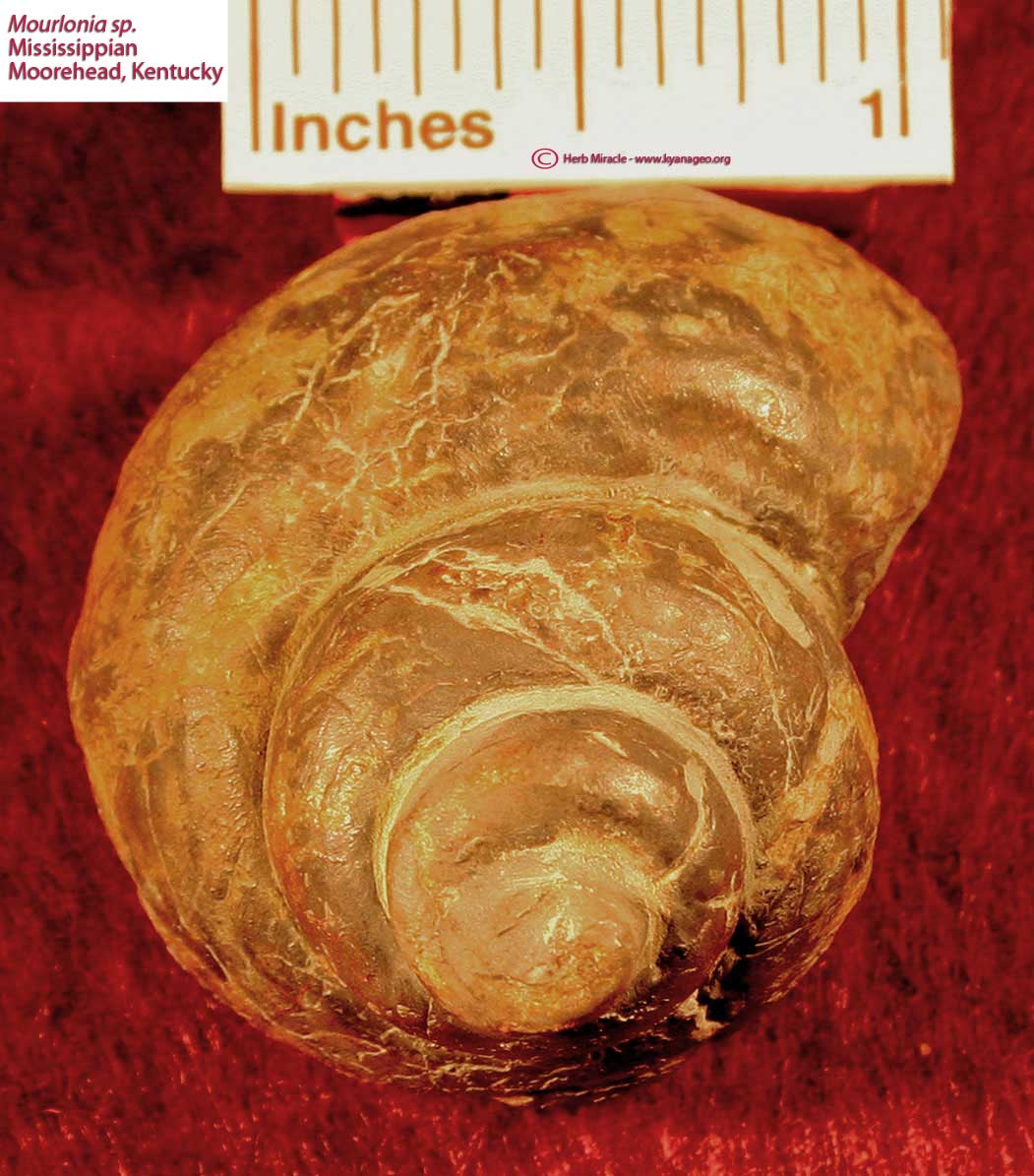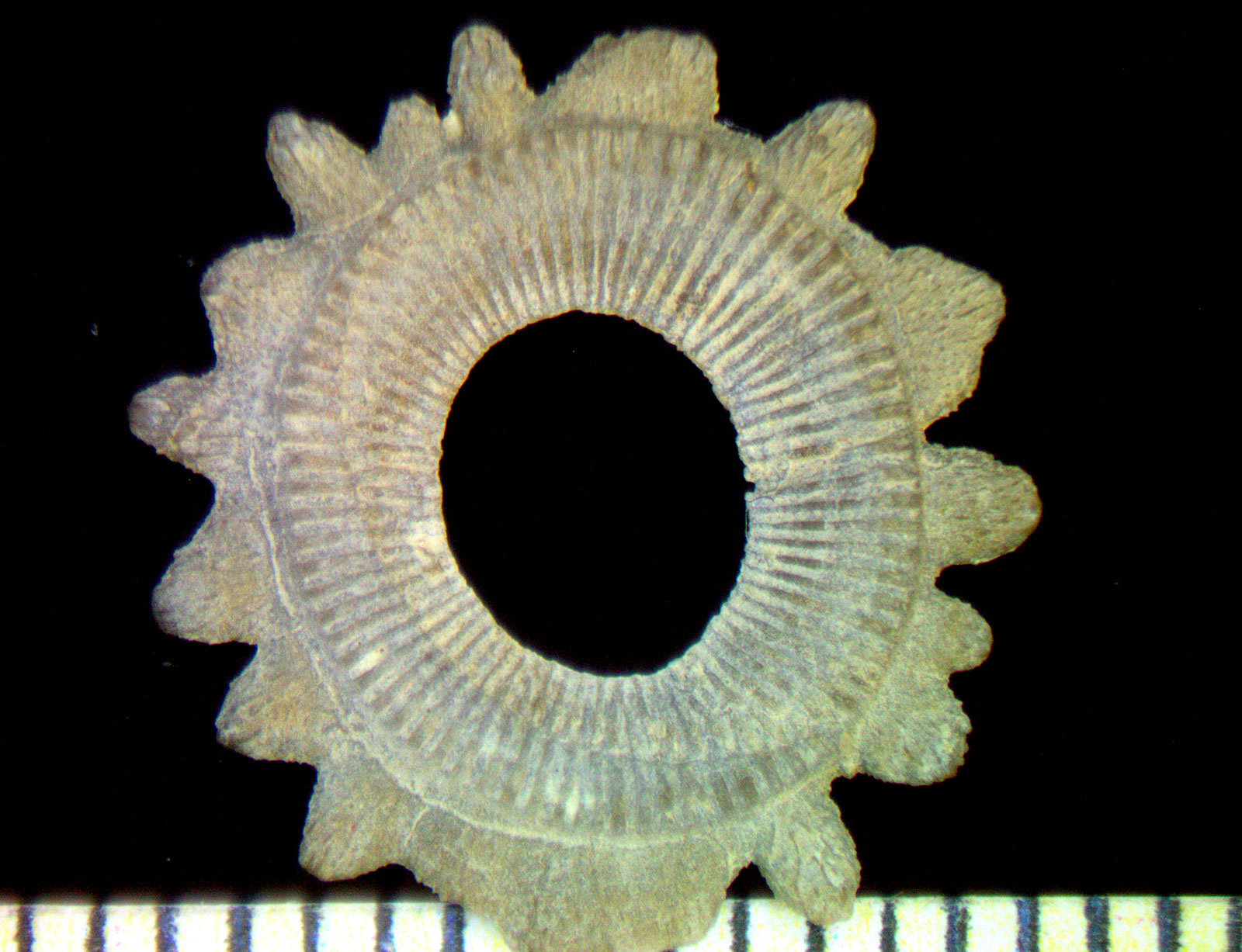
Thanks to Kenny for the image.

Thanks to Kenny for the image.

This picture is of a Productus wortheni (Hall, 1858) brachiopod fossil. It existed in the Mississippian Period. The fossil was found in Carwood Formation (part of the Borden Group) of Washington County, Indiana USA.
Thanks to Kenny for the picture.
The genus Productus was named by James Sowerby (1757-1822) in the work The Mineral Conchology of Great Britain or Coloured Figures and Descriptions of Those Remains of Testaceous Animals or Shells, Which Have Been Preserved at Various Times and Depths in the Earth, London: printed by Benjamin Meredith, Silver Street, Wood Street, Cheapside, MDCCCXII (1812). Book link here.
On page 153, he describes it as "GEN. CHAR. An equilateral unequal-valved bivalve with a reflexed, more or less cylindrical, margin; hinge transverse, linear: beak imperforate*; one valve convex, the other flat or concave externally. * This term is used because it was formerly paced among Anomiæ, which included perforate and imperforate.
No one not usually conversant with the subject, would conceive the shells I have collected for this Genus could be in any way related to the Genus Anemia of Linnæus, but as yet there seemed no other place for them in the system 5 nor do they agree with any of the Genera established by later Authors. Martin has pointed out several divisions of the Genus Anomia; one of them which he defines to be "imperforate, with one valve gibbous, the other flat or concave, hinge on a straight line," includes these shells and I expect several others, as he considers the reflected margin to be accidental. His Conch. Anomites productus is a good type of the Genus, therefore, as the name Anomites must be laid aside, I have adopted his specific name as the Generic one, the character it expresses being also peculiar. It is highly gratifying to me that I have the means of showing so many new Species of such a curious Genus as this from Scotland, by the help of the indefatigable, ingenious, and zealous Friend to science, the Rev. John Fleming of Flisk; every one must feel pleased at his generous desire to facilitate knowledge by trusting such delicate specimens so far, and further at his desire to commemorate the late Mr. Martin, by naming this Genus after him, for his superior talent in showing the divisions in the old Genus Anomia, but as the name Productus appeared so applicable, I was loth not to use it, so have been content to apply his name to the species I have robbed of the Generic one."
Below image is of Tab. LXVIII Figure 3 from book showing Productus spinulosus brachiopod fossil.


This picture is of a set of crinoid pentagon shaped fossils that once made up a column. They existed in the Mississippian Period. The fossils were found in Carwood Formation (part of the Borden Group) of Washington County, Indiana USA.
There are also a few impressions of brachiopods and near the bottom left corner a spiral shape that I am not sure what kind of creature it belonged to.
Thanks to Kenny for the picture.