Monday, January 6, 2025
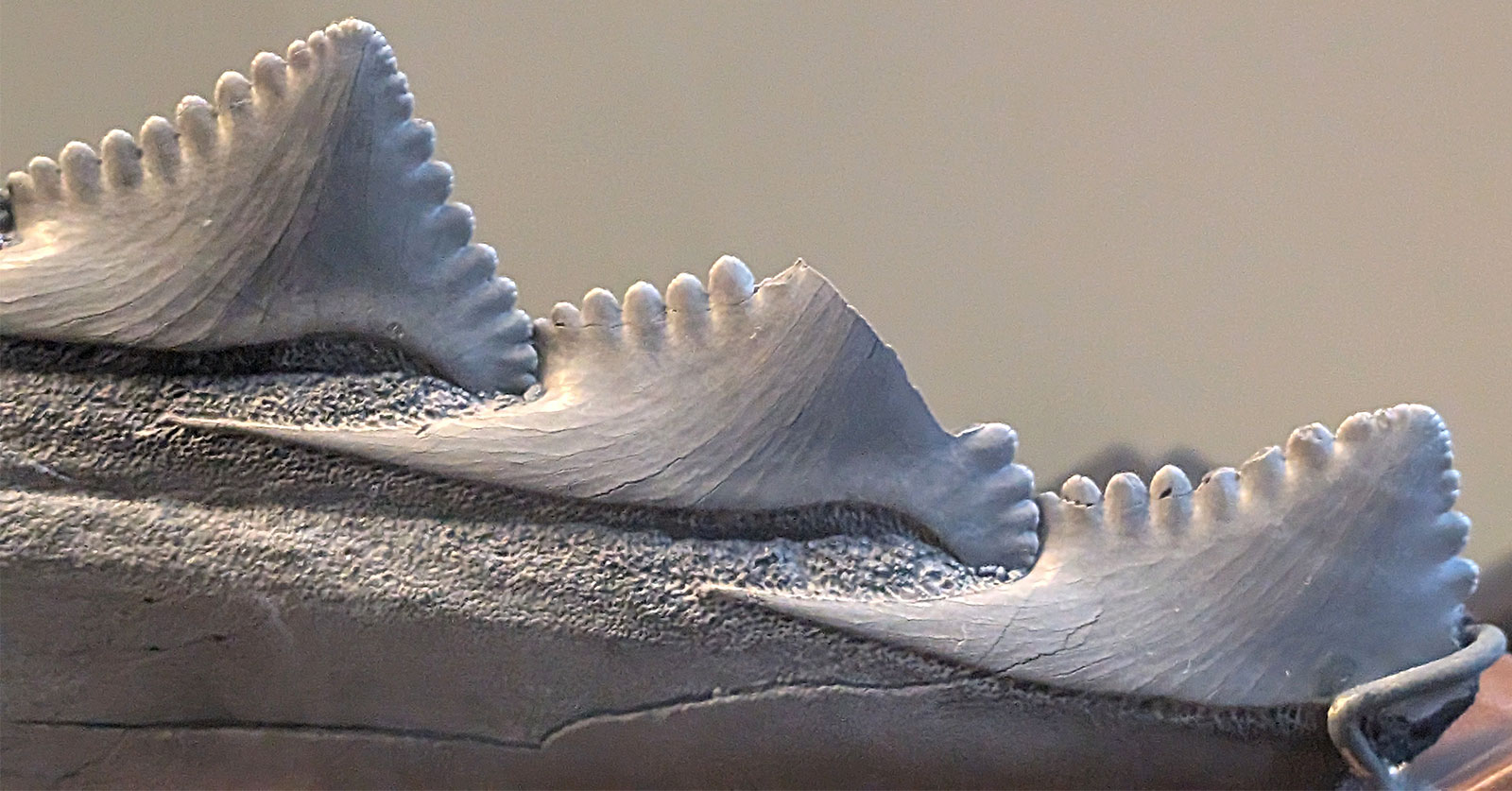
Edestus Shark Fossil
These images are of an Edestus (Leidy, 1856) shark fossil. The animal existed in the Carboniferous Period. Fossil was discovered in Marissa, Illinois, USA. Fossil was on display at the Natural History Museum Vienna (Naturhistorisches Museum Wien) on August 2024.
Saturday, October 26, 2024
Grabauphyllum johnstoni Coral Fossil
This picture is of a Grabauphyllum johnstoni (Foerste, 1917) coral fossil of the Silurian Period. This image is of the lost holotype published in 1917. It dates to the Silurian Period and was found outside of Chicago, Illinois, USA.
This fossil was first described and imaged in "Notes on Silurian Fossils From Ohio and Other Central States" by August F. Foerste (1862-1936) pages 187-204 in The Ohio Journal of Science Volume XVII No. 6 April 1917. The holotype fossil was lost. Fossil coral researcher Erwin C. Stumm (1908-1969) revisited this fossil in the November 15, 1968 publication Contributions from the Museum of Paleontology The University of Michigan, "A Redescription of the Middle Silurian Compound Rugose Coral Grabauphyllum johnstoni Foerste (Vol. 22, No. 6, pp. 71-73, 1 pl.).
Foerste wrote, "Found in the Niagaran dolomite near McCook, 5 miles west of Chicago, Illinois, by William Johnston. Genus named in honor of Prof. Amadeus Grabau, of Columbia University in recognition of his valuable contributions to our knowledge of corals." I have written about Dr. Amadeus Grabau (1870-1946) in an earlier blog posting.
Tuesday, July 4, 2023
Latzelia primordialis Centipede Fossil
This picture is of a Latzelia primordialis (Scudder, 1890) centipede fossil cast. It was found in Carbondale Formation of Grundy County, Illinois USA. It dates to the Pennsylvanian Period. Its U.S. National Museum catalog number is 38003. The specimen on display is the holotype.
The picture was taken in June 2023 on the first floor of the Smithsonian Museum of Natural History in Washington D.C. USA.
Fossil was named by Samuel Hubbard Scudder (1837-1911) in the Mazon Creek fossil beds of Illinois.
Monday, July 3, 2023
Euproops danae Horseshoe Crab Fossil
This picture is of an Euproops danae (Meek & Worthen, 1868) horseshoe crab fossil. It was found in Carbondale Formation of Grundy County, Illinois USA. It dates to the Pennsylvanian Period. Its U.S. National Museum catalog number is 38854.
The picture was taken in June 2023 on the first floor of the Smithsonian Museum of Natural History in Washington D.C. USA.
![]() |
| Image courtesy of the Smithsonian Institution Specimen Catalog Number: USNM PAL 38854 Specimen GUID: http://n2t.net/ark:/65665/m3f4bd1c88-6763-4b98-8641-93abc743175d Photographer Bruce Martin. Specimens housed in the collections of the Department of Paleobiology, National Museum of Natural History, Smithsonian Institution. |
Sunday, July 2, 2023
Eoscorpius carbonarius Scorpion Fossil
This picture is of an Eoscorpius carbonarius (Meek & Worthen, 1868) scorpion fossil cast. It was found in Carbondale Formation of Illinois USA. It dates to the Pennsylvanian Period. Its U.S. National Museum catalog number is 618348.
The picture was taken in June 2023 on the first floor of the Smithsonian Museum of Natural History in Washington D.C. USA.
Thursday, August 25, 2022
Archimedes reversus Bryozoa Fossil
This fossil was displayed on August 2022, at the Harvard Museum of Natural History in Cambridge, Massachusetts, USA. The bryozoa fossil called Archimedes reversus. This specimen was found in Illinois. It dates to the Mississippian/Carboniferous Period.
https://hmnh.harvard.edu/
Friday, November 6, 2020
Neuropteris inflata Fossil of Mazon Creek
Above is an image of part of a seed fern frond plant fossil called Neuropteris inflata (Lesquereux). This plant fossil dates to the age Moscovian/Desmoinesian of the Carboniferous (Pennsylvanian) Period between 354 and 290 million years ago. It was found Mazon Creek, Illinois, USA. Like most fossils found at this locality, it was inside a nodule. The layer to fossil was found is the Francis Creek Shale.
The fossil was on display in the Evolving Planet section of The Field Museum of Natural History in Chicago Illinois, USA as of August 2020. Accession number is P30763. They have quite an extensive collection of Mazon Creek fossils at the exhibit.
The Field Museum produced a visual PDF of some of the fossils found at Mazon Creek. It can be found at this link:
Tuesday, October 20, 2020
Crenulopteris acadica Tree Fern Fossil
Above is an image of a tree fern frond plant fossil called Crenulopteris acadica (Bell, 1962). This plant fossil dates to the Carboniferous (Pennsylvanian) Period between 354 and 290 million years ago. It was found Mazon Creek, Illinois, USA. Like most fossils found at this locality, it was inside a nodule. The layer to fossil was found is the Francis Creek Shale.
The fossil was on display in the Evolving Planet section of The Field Museum of Natural History in Chicago Illinois, USA as of August 2020. Accession number is PP46053. They have quite an extensive collection of Mazon Creek fossils at the exhibit.
The Field Museum produced a visual PDF of some of the fossils found at Mazon Creek. It can be found at this link:
Monday, October 19, 2020
Diplazites unita Fern Fossil
Above is an image of a tree fern frond plant fossil called Diplazites unita (Brongniart, 1822) Cleal, 2015. This plant fossil dates to the Carboniferous (Pennsylvanian) Period between 354 and 290 million years ago. It was found Mazon Creek, Illinois, USA. Like most fossils found at this locality, it was inside a nodule. The layer to fossil was found is the Francis Creek Shale.
The fossil was on display in the Evolving Planet section of The Field Museum of Natural History in Chicago Illinois, USA as of August 2020. Accession number is PP1015. They have quite an extensive collection of Mazon Creek fossils at the exhibit.
The Field Museum produced a visual PDF of some of the fossils found at Mazon Creek. It can be found at this link:
References:
Brongniart, A. (1822): Sur la classification et la distribution des végétaux fossiles ‒ Mémoires du Muséum d’Histoire Naturelle, 8
Cleal, C. J. (2015): The generic taxonomy of Pennsylvanian age marattialean fern frond adpressions. ‒ Palaeontographica, Abteilung B, 292: 1–21.
Sunday, October 18, 2020
Mazon Creek Calamites Plant Fossil
Above is an image of a horsetail trunk plant fossil called Calamites sp. This plant fossil dates to the Carboniferous (Pennsylvanian) Period (354-290 mya). It was found Mazon Creek, Illinois, USA. The layer fossils are found is in Francis Creek Shale.
The fossil was on display in the Evolving Planet section of The Field Museum of Natural History in Chicago Illinois, USA as of August 2020. Accession number is UP2561. They have quite an extensive collection of Mazon Creek fossils at the exhibit.
The Field Museum produced a visual PDF of some of the fossils found at Mazon Creek. It can be found at this link:
Mazon Creek Collections Database at Illinois State Museum
http://www.museum.state.il.us/databases/geology/mazoncreek/graphical/index.php
Monday, October 12, 2020
Odontopteris aequalis Mazon Creek Fern Fossil
Above is an image of a seed fern plant fossil called Odontopteris aequalis. This plant fossil dates to the Carboniferous (Pennsylvanian) Period. It was found Mazon Creek, Illinois, USA. Like most fossils found at this locality, it was inside a nodule.
The fossil was on display in the Evolving Planet section of The Field Museum of Natural History in Chicago Illinois, USA as of August 2020. Accession number is PP31097. They have quite an extensive collection of Mazon Creek fossils at the exhibit.
The Field Museum produced a visual PDF of some of the fossils found at Mazon Creek. It can be found at this link:
Sunday, October 11, 2020
Mariopteris nervosa Fern Fossil From Mazon Creek
Above is an image of a seed fern plant fossil called Mariopteris nervosa (Brongniart) Zeiller. This plant fossil dates to the Carboniferous (Pennsylvanian) Period. It was found Mazon Creek, Illinois, USA and appears to be made of chocolate (only kidding).
The fossil was on display in the Evolving Planet section of the Field Museum of Natural History in Chicago Illinois, USA as of August 2020. Accession number is PP46034. They have quite an extensive collection of Mazon Creek fossils at the exhibit.
Reference:
Saturday, September 19, 2020
Bumastus harrisi Trilobite
Above is an image of a prone trilobite fossil called Bumastus harrisi. A trilobite fossil dates to the Silurian Period. It was found Chicago, Illinois, USA and appears to be made of dolomite.
The fossil was on display in the Evolving Planet section of the Field Museum of Natural History in Chicago Illinois, USA as of August 2020. Accession number is P11447. Learn more at the Virtual Silurian Reef Project web site.
More about this type of trilobite can be seen here:
Saturday, August 22, 2020
Natural History Tiles at Roosevelt Station
While visiting Chicago, Illinois, USA, I traveled from Midway Airport to the Roosevelt station via the Orange "L" line. The "L" stands for elevated as in the tracks are high above the street. It is operated by the Chicago Transit Authority (CTA). The address of the station is 1167 South State Street, Chicago, Illinois 60605.
The Roosevelt Station is the closest to the Museum Campus where the Field Museum of Natural History can be found. Because of its locality, tile artwork in one of the passenger walk ways are decorated in a natural history theme.
The first image depicts a trilobite, if I had to guess it is a Silurian Period Calymene. Chicago is built on a 420 million year old Silurian Period seabed so this would be a good choice to show. The border tile in yelllow, black and gray show animals as well. The one on the left appears to show a Permian Period tetrapod Discosauriscus. While the one on the right shows a crinoid calyx with part of its stem.
On the opposite wall is tile shows what I think to be is a brachiopod.
The next image shows a Permian Period Dimetrodon (the fossil of one can be seen at the Field Museum of Natural History in the Evolving Planet exhibit). The smaller tiles from left to right show a straight conical shelled cephalopod, a Silurian Period sea scorpion Eurypterid, and maybe a crinoid column section.
At one end of the walkway is an image representing a human in a form similar to Leonardo da Vinci's Vitruvian Man artwork from 1490. The smaller tiles represent on the left a snail (reminds be of a Turritella or Loxoplocus fossil) and the right a standing bird (reminds me of a Dodo). The human figure seems to represent current time of where our natural world is at.
At the opposite end of the walkway, the tile shows the Big Bang or the beginning of our known natural world.
Thursday, August 24, 2017
Unknown Coiled Cephalopod Fossil
Recently, I was e-mailed these pictures of coiled cephalopod fossil. It was found by an 11 year old boy in rock from a quarry in northwest Illinois. The rock dates to the Silurian Period.
I think it might be a Lechritrochoceras. See the drawing of one at the Illinois State Geological Survey web site: http://www.isgs.illinois.edu/outreach/geology-resources/cephalopods
Monday, June 6, 2016
Crinoid Calyx Fossil Macrocrinus mundulus
This crinoid calyx fossil is called Macrocrinus mundulus (Hall). It dates to the Mississippian Period and was found Keokuk of Warsaw, Illinois, USA.
The fossil is part of the Indiana University Department of Geology collection.
Thanks to Kenny for image.
Sunday, October 19, 2014
Fibrous Calcite from Illinois
Back in 2010 I found a Devonian brachiopod fossil with a fibrous or needlelike mineral growth in it. I was trying to determine what this was. Last week while touring the Gallery of Natural History section of the Arizona Historical Society Museum at Papago Park (1300 N. College Ave, Tempe Arizona 85281) I saw a calcite specimen (AHS-NH#11396) from Cave in the Rock, Hardin County Illinois, USA. It appears to be composed of calcite fibers. This formation type seems similar to the one I saw in the brachiopod. So maybe this type of calcite is what formed in that Devonian brachiopod. Images of museum specimen taken October 2014.
Here is an image of the Devonian brachiopod I found in Clark County, Indiana, USA.
See the rest of the pictures and more discussion of this specimen at my blog post here:
http://louisvillefossils.blogspot.com/2010/12/fibrous-or-needlelike-mineral-growth-in.html
Saturday, August 24, 2013
Earth Discovery Day - August 2013
Today was Earth Discovery Day at the Falls of the Ohio State Park in Clarksville, Indiana. It is an event that focuses on educational activities for public. I have been volunteering over the last several years and it is a good feeling helping young students learn more about the mineral world around them while teaching about the fossil world of the past. Even though I have been really busy teaching, it is good to help out at an event like this.
The fossil pile was sparse in finds this year but the mineral pile while very dusty was a mountain of exploration for those willing to search for buried mineral treasure. The material is from a fluorite processing mill in southern Illinois that processed minerals from that area. Normally one sees four types of minerals: fluorite, barite, calcite, and sphalerite. The fluorite is usually purple, yellow or clear. Occasionally, green and blue fluorite will be found. A child found a nice fluorite cube corner shown in the first picture above. It has some nice purple phantom cubes that show through when held up to a light source.
Another child found a greenish-blue fluorite fragment while another found several aqua blue fluorite pieces. My challenge to visitors is to find pieces like this and usually about 4-6 specimens are found during my volunteer shift.
I was also told some material from China was processed there as well. So I am not sure what that might look like. A red or crimson colored rock was being found this year that was not seen in past years. It might be something from China. It is thought to be some type of reddish fluorite.
Fossils found were a number of brachiopods, corals, and snails from the Devonian fossil pile. The Silurian pile was being a bit more stingy. It did yield some nice brachiopods, a trilobite fragment, and a cephalopod fossil. Silurian Period Waldron Shale fossils are as shown: probably the tail (pygidium) of an Arctinurus sp. trilobite (I think it is upside down), next a fragment of a shell of a Dawsonoceras cephalopod, third is the index fossil of the Waldron Shale Eucalyptocrinus crassus crinoid calyx cup, and last an uncompressed Leptaena sp. brachiopod that has Cornulites sp. worm tubes on it.
Saturday, October 29, 2011
Silurian Reef Database Project
Silurian Reef Database from Field Museum on Vimeo.
Here is an interesting video from the Fossil Invertebrate Department of the Field Museum of Natural History in Chicago, Illinois. A summer 2011 intern named Alex Lang(?) is the narrator and describes his task of cataloging Silurian fossils into a computer database. He states in the video that only 278 invertebrate fossil specimens are on display of over the 2 million in the collection. The collection is cataloged on books that began with the 1893 Columbian World Exposition in Chicago. Hopefully, they have transcribed the handwritten volumes and keep a copy in a fireproof safe. Better would be to photograph the volumes and store them digitally in various places around the world.
Louisville, Kentucky and Chicago, Illinois both sit on top of the remains of ancient Silurian reefs. The Field Museum also has links to this area in its relationship between local mining tycoon and geologist/paleontologist William Borden. His approximately 30,000 piece fossil collection was transferred from New Providence (Borden), Indiana to the Field Museum in 1923. William Borden and Marshall Field were partners in mining interests in Leadville, Colorado as well. See my post about Mr. Borden for more info: http://louisvillefossils.blogspot.com/2009/11/borden-institute.html.
Learn more about the Field Museum at their web site: http://fieldmuseum.org/
Check out the Fossil Invertebrates Diversity picture gallery (147 images): http://fieldmuseum.org/explore/multimedia/fossil-invertebrates-diversity
Specimens they show of local interest:
Image 16 (UC 14016): Polypora (Fenestella) cultellata bryozoan Falls of the Ohio, Indiana
Image 17 (UC 17494): Constellaria florida bryozoa Covington, Kentucky
Image 21 (UC 28227): Archimedes symmetricus bryozoa Princeton, Kentucky
Image 23 (PE 16568): Hiscobeccus capax brachiopod Abington, Indiana
Image 27 (UC 12329): Kirkidium (Conchidium) laqueatum brachiopod Delphi, Indiana
Image 28 (UC 13212): Pentameus oblongus brachiopod Indiana
Image 29 (UC 13520): Anthracospirifer (Spirifer) bifurcatus brachiopod New Providence, Indiana (Borden collection?)
Image 41 (UC 16542): Onniella meeki brachiopods Brookfield, Indiana
Image 63 (PE 40269): Triangulotarbus terrehautensis spider? Terre Haute, Indiana
Image 72-74 (UC 12900-1): Carcinosoma (Eusarcus) newlini eurypterid Kokomo, Indiana
Image 90 (UC 2465): Petraster americanus starfish Cincinnati, Ohio
Image 91 (UC 6020): Triamara tumida (Holocystites adipatusas) cystoid Jefferson County, Indiana
Image 92 (UC 6028): Caryocrinites indianensis cystoid Jefferson County, Indiana
Image 94 (UC 6419): Agelacrinites pulaskensis endrioasteroid Pulaski County, Kentucky
Image 95 (UC 6623): Oligoporus sulcatus echinoid? Harding County, Kentucky
Image 96 (UC 8825): Carneyella pilea endrioasteroid Cincinnati, Ohio
Image 97 (UC 9956): Elaeacrinus verneuili blastoid Falls of the Ohio, Indiana
Image 98 (UC 18061): Holocystites alternatus cystoid Jefferson County, Indiana
Image 103 (UC 54070): Carneyella pilea endrioasteroid Cincinnati, Ohio
Image 104 (P 20623): Platystoma Shumardi gastropod Falls of the Ohio, Indiana
Thursday, April 21, 2011
Punctospirifer depressus
The Punctospirifer depressus brachiopod fossil found in the state of Illinois. This small animal existed in the Pennsylvanian Period.