Showing posts with label holotype. Show all posts

Saturday, October 26, 2024

Grabauphyllum johnstoni Coral Fossil


This picture is of a Grabauphyllum johnstoni (Foerste, 1917) coral fossil of the Silurian Period. This image is of the lost holotype published in 1917. It dates to the Silurian Period and was found outside of Chicago, Illinois, USA.

This fossil was first described and imaged in "Notes on Silurian Fossils From Ohio and Other Central States" by August F. Foerste (1862-1936) pages 187-204 in The Ohio Journal of Science Volume XVII No. 6 April 1917. The holotype fossil was lost. Fossil coral researcher Erwin C. Stumm (1908-1969) revisited this fossil in the November 15, 1968 publication Contributions from the Museum of Paleontology The University of Michigan, "A Redescription of the Middle Silurian Compound Rugose Coral Grabauphyllum johnstoni Foerste (Vol. 22, No. 6, pp. 71-73, 1 pl.).

Foerste wrote, "Found in the Niagaran dolomite near McCook, 5 miles west of Chicago, Illinois, by William Johnston. Genus named in honor of Prof. Amadeus Grabau, of Columbia University in recognition of his valuable contributions to our knowledge of corals." I have written about Dr. Amadeus Grabau (1870-1946) in an earlier blog posting.

Tuesday, July 4, 2023

Latzelia primordialis Centipede Fossil


This picture is of a Latzelia primordialis (Scudder, 1890) centipede fossil cast. It was found in Carbondale Formation of Grundy County, Illinois USA. It dates to the Pennsylvanian Period. Its U.S. National Museum catalog number is 38003. The specimen on display is the holotype.

The picture was taken in June 2023 on the first floor of the Smithsonian Museum of Natural History in Washington D.C. USA.

Fossil was named by Samuel Hubbard Scudder (1837-1911) in the Mazon Creek fossil beds of Illinois.

Tuesday, May 11, 2021

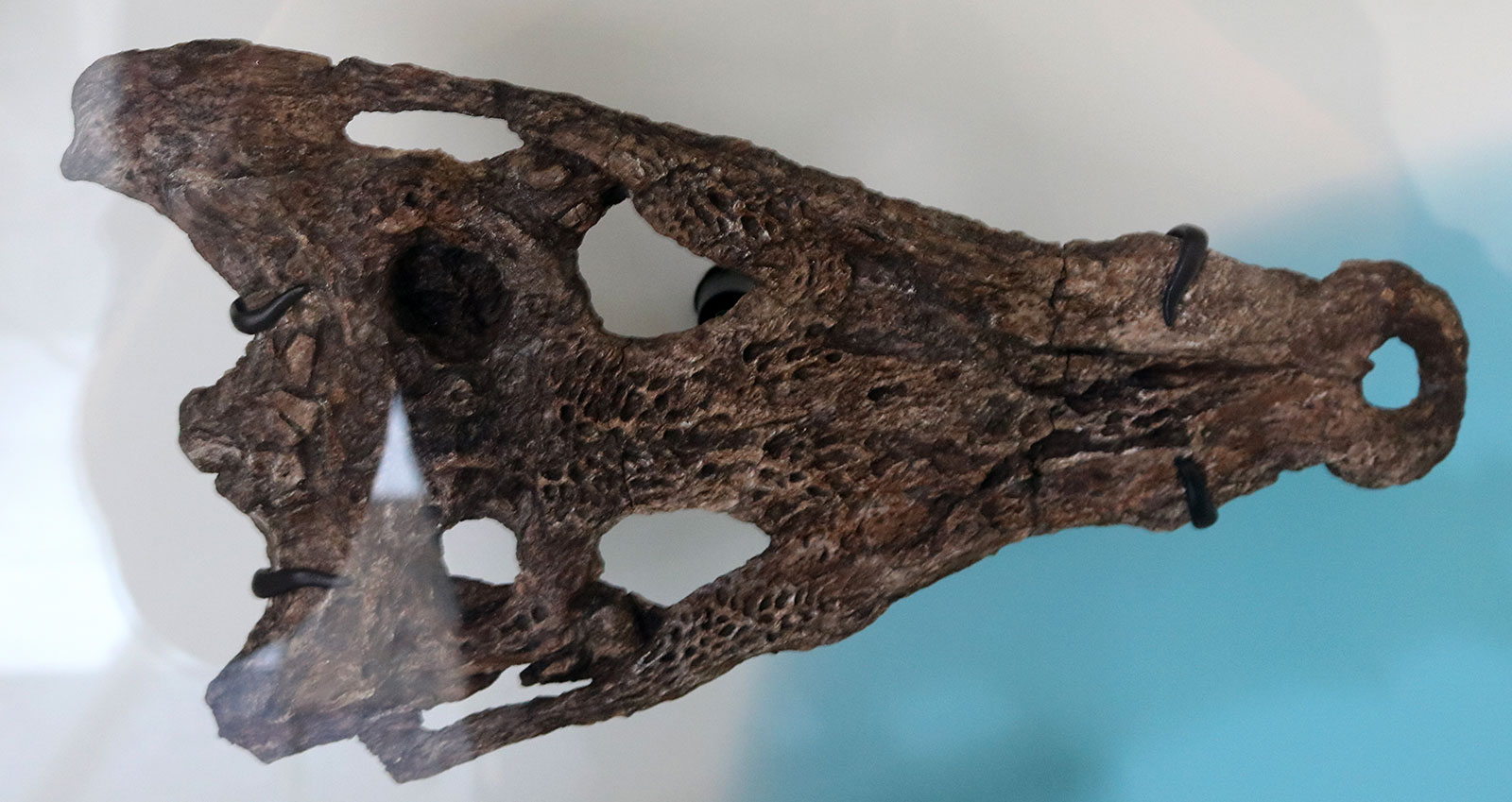
Leidyosuchus wilsoni Crocodile Skull Fossil


This crocodile skull fossil was on display at the American Museum of Natural History (AMNH) in New York City in July 2018. The fossil was named Leidyosuchus wilsoni (Mook, 1959). It was found in the Green River Formation at Wamsutter, Wyoming, USA and dates to the Middle Eocene Epoch. Accession number is AMNH 7637 and it is the type specimen. A gift from L. R. Wilson in 1956.

It was described in April 22, 1959 issue of American Museum Novitates in an paper entitled A New Species of Fossil Crocodile of the Genus Leidyosuchus from the Green River Beds by Charles C. Mook.

Learn more about the museum at https://www.amnh.org/

Tuesday, January 12, 2021

Gennaeocrinus carinatus Crinoid Fossil


These images are of the holotype fossil of Gennaeocrinus carinatus crinoid. It was named by Elvira Wood a paleontology instructor at the Massachusetts Institute of Technology (MIT) in 1901. The fossil found in the Hamilton Group of Charlestown, Indiana USA. The fossil dates to the Middle Devonian Period. I believe the Hamilton (New York) is compared to the Sellersburg Limestone (Silver Creek and Beechwood limestones).


The Miss Wood observes "This species is remarkable for its elaborate and delicate surface ornamentation, the thin carinae rising at right angles to the surface and sometimes a millimeter or more in height." The genus was named by Wachsmuth and Springer in 1881. The species name appears to be derived from the word "carina" (a keel-like part or ridge, Latin for keel). This holotype specimen now resides at the Museum of Comparative Zoology - Harvard University (Invertebrate Paleontology 108317).


This fossil is the first fossil species she named and would later leave MIT to work with Charles Walcott on Cambrian fossils at the U.S. Geological Survey. Afterwards, she would obtain her Masters and PhD at Columbia University and spend the rest of her career curating at natural history museums and creating paleoart for scientific papers (Columbia University, Museum of Comparative Zoology at Harvard University and American Museum of Natural History in New York).

Source:
A new Crinoid from the Hamilton of Charlestown, Indiana by Elvira Wood, American Journal of Science, Vol. XII, October 1901, pp. 1-14. Pl. V. [LINK]


Sunday, August 11, 2013

Nigersaurus taqueti Skull Fossil Cast


Here is the cast of a dinosaur skull fossil called Nigersaurus tauqueti. It is a cast of specimen MNN GAD512 at the Musée National du Niger, Niamey, Niger, Africa. This cast is from the holotype specimen found in "niveau des innocents" of the Gadoufaoua region of Republique du Niger. The species is named for French paleontologist Phillippe Taquet who explored the area from 1965-1972.

The head of this dinosaur with its neat rows of teeth reminds me of a wire crimping pliers tool.

Learn more about this type of dinosaur in this research article at PLOS One called Structural Extremes in a Cretaceous Dinosaur.

Dinosaur was named in the journal SCIENCE published 12 November 1999 in article entitled: Cretaceous Sauropods from the Sahara and the Uneven Rate of Skeletal Evolution Among Dinosaurs.

This cast was part of the Ultimate Dinosaurs: Giants from Gondwana exhibit at the Museum of Natural History and Science in Cincinnati, Ohio. It was photographed in August 2013. The dinosaur exhibit was created by the Royal Ontario Museum of Toronto Canada.

The exhibit was supported by Associate Exhibit Sponsor Frisch's restaurant and Promotional Partners Cincinnati Reds baseball, newspaper The Enquirer and TV channel Local 12 WKRO Cincinnati.