Tuesday, November 29, 2011

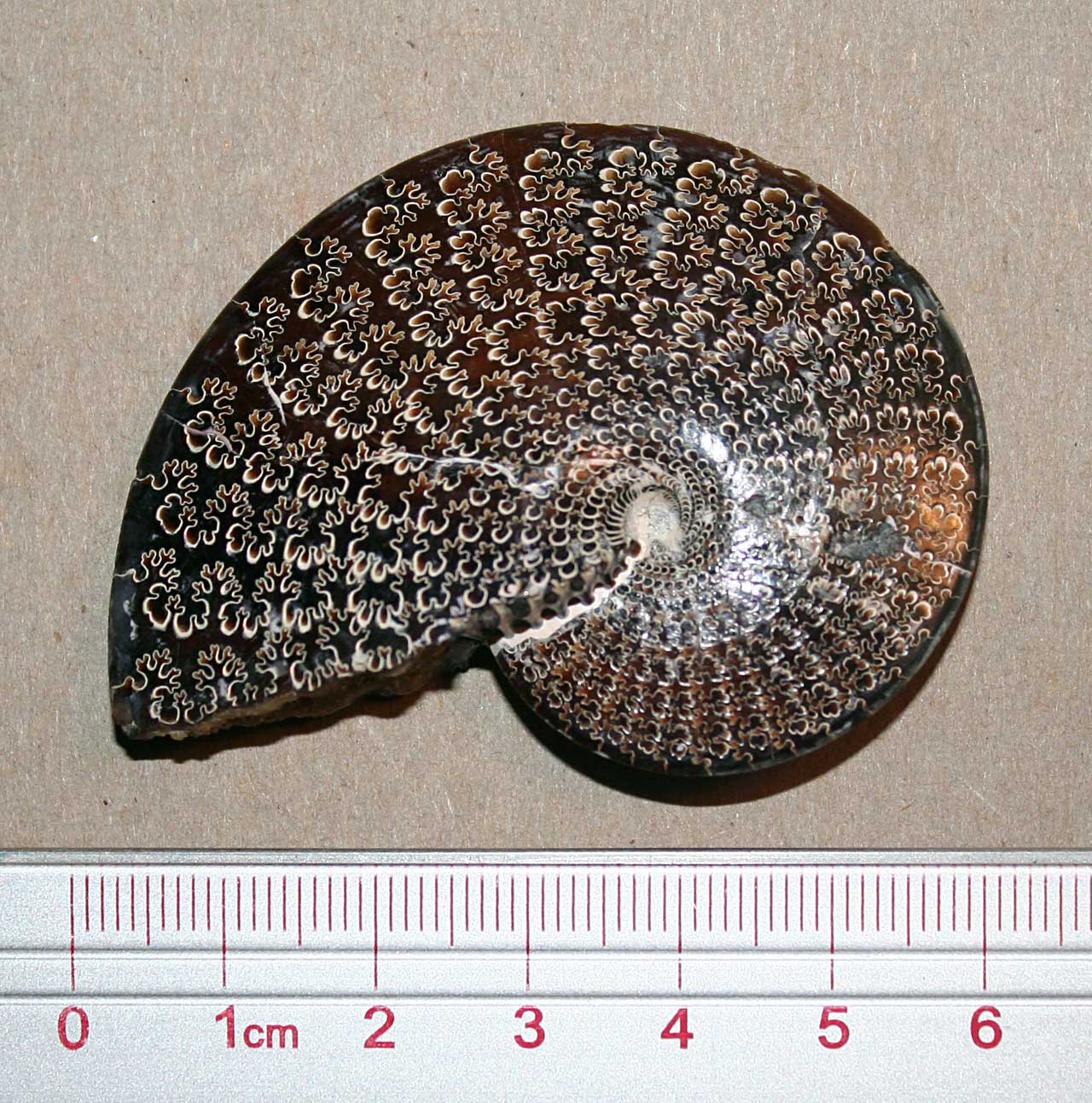
Sphenodiscus lenticularis Ammonite


The Sphenodiscus lenticularis ammonite found in the Fox Hills Formation of South Dakota, U.S.A. Originally named by Owen in 1852 the genus Ammonites. This creature swam the seas of the Upper Cretaceous. The suture pattern shown in the images was once covered by an iridescent shell.  See this link the University of Wisconsin for an example: http://pages.cs.wisc.edu/~ifischer/Collections/Fossils/Images/sphenodiscus2.jpg

Thanks to Mark Palatas for letting me photograph this specimen in his collection.

Learn more at Wikipedia: http://en.wikipedia.org/wiki/Sphenodiscus

Monday, November 28, 2011

Saivodus striatus Shark Tooth


This remarkable find of a Paleozoic shark tooth in central Kentucky is a Saivodus striatus.  This type of fossil was originally described by Agassiz in 1843 as the genus Cladodus being a member of the Ctenacanthiformes. Fossil was found in Hardin County (?) of Kentucky in the Mississippian Period Salem Limestone (Meramecian), member of Borden Formation.

The name was changed in a Journal of Vertebrate Paleontology (26(2):253-266. 2006) COMMENTS ON THE SELACHIAN GENUS CLADODUS AGASSIZ, 1843 by Christopher J. Duffin and Michal Ginter.

Here is a link to more pictures of Saivodus found in the Viséan, Mountain Limestone, vicinity of Armagh, Northern Ireland: CLICK HERE

Here is a link to another found in a cave in Tennessee: CLICK HERE

Here is a link to the shark fossils found at Mammoth Cave, Kentucky in 2020: CLICK HERE

Fossil was found and prepped by Mark Palatas of Louisville.


Sunday, November 27, 2011

Pararaucaria patagonica Cone Fossil


These plant fossils are very interesting showing conifer cones of the Pararaucaria patagonica.  These plants existed in the Middle Jurassic (Callovian - 160 million years ago). Fossils found in the Santa Cruz Province of Argentina.  One of the cones has been cut in two and its flat sides are polished.

Thanks to Mark Palatas for letting me photograph these specimens in his collection.