Showing posts with label salem limestone. Show all posts

Saturday, December 21, 2024

Unidentified Paleozoic Shark Tooth Fossil


These pictures show an unidentified shark tooth fossil. It was found in the Salem Limestone of Hardin County, Kentucky USA. The fossils date to the Mississippian Period. Thanks to Kenny for the image.

Wednesday, December 18, 2024

Petalodus Shark Tooth Fossil


These pictures show a Petalodus (Hall, 1858) shark tooth fossil. They were found in the Salem Limestone of Hardin County, Kentucky USA. The fossils date to the Mississippian Period. Thanks to Kenny for the images.


Tuesday, December 17, 2024

Globoendothyra baileyi Fossil


This picture shows some Globoendothyra baileyi (Hall, 1858) foraminifera fossils. They were found in the Salem Limestone of Hardin County, Kentucky USA. The fossils date to the Mississippian Period. Thanks to Kenny for the image.

Sunday, July 28, 2024

Deltodus Shark Tooth Fossil


Picture of what appears to be a Deltodus shark tooth fossil found in the Salem Formation of Hardin County Kentucky USA. It dates to the Mississippian Period. 


Thanks to Kenny for the picture.

Tuesday, July 9, 2024

Batocrinus icosidactylus Crinoid Fossil


These crinoid calyx fossils pictured above are known as Batocrinus icosidactylus (Casseday, 1854). They were found in the Salem Limestone of Lanesville, Harrison County, Indiana USA. The fossils date to the Middle Mississippian Period. 

The crinoid fossil genus and species was named by Samuel Addison Casseday (1831-1860), a Louisville area paleontologist.

These crinoid fossils were once part of the collection of southern Indiana paleontologist George K. Greene (1835-1917). It appeared that all of Greene's fossil collection was sold to American Museum of Natural History in New York City after his death but as it turns out there was one cabinet remained with the family and was past down to his descendants. 

The fossil collection is now on display at the Falls of the Ohio State Park Interpretive Center till September 2024 after that it will be transferred to the Indiana State Museum. George Greene's great-great-grandson William "Bill" Bishop passed away on November 29, 2023 and his wish that fossils be donated.

Monday, July 8, 2024

Batocrinus icosidactylus Crinoid Calyx


This crinoid calyx fossil pictured above is known as Batocrinus icosidactylus (Casseday, 1854). It was found in the Salem Limestone of Lanesville, Harrison County, Indiana USA. The fossil dates to the Middle Mississippian Period. 

The fossil was named by Samuel Addison Casseday (1831-1860), a Louisville area paleontologist.

This crinoid fossil was once part of the collection of southern Indiana paleontologist George K. Greene (1835-1917). It appeared that all of Greene's fossil collection was sold to American Museum of Natural History in New York City after his death but as it turns out there was one cabinet not sold and was past down to his descendants. 

This fossil is now on display at the Falls of the Ohio State Park Interpretive Center till September 2024 after that it will be transferred to the Indiana State Museum. George Greene's great-great-grandson William "Bill" Bishop passed away on November 29, 2023 and his wish that fossils be donated.

Sunday, February 24, 2019

Endothyra Foraminifera Fossils Revisited


In 2010, I posted some images of this type of microfossils found in Spergen Hill, Indiana, USA. This place is a type locality where this particular species was found and named in the literature first. Since my cousin Kenny recently acquired a new Amscope microscope I asked him to image some of these fossils for this posting.

These images are of foraminifera fossils from the Salem Limestone of Washington County, Indiana, USA. These creatures are called Globoendothyra "Endothyra" baileyi and existed 360-325 million years ago (Mississippian Period).

A very good write up on this particular fossil can be found on the Fossil Forum site written by user dshamilla. http://www.thefossilforum.com/index.php?/topic/54262-revisiting-spergen-hill-indiana-and-some-of-its-mississippian-micro-fossils/

Thanks to Kenny for the images.

Tuesday, November 22, 2016

Rhodophyte Algae Fossil


This fossil is Rhodophyte (red) algae. It was found in the siltstone facies of Salem Limestone of Hardin County Kentucky USA. The plant dates back to the Middle Mississippian Period.

Thanks to Alan for letting me photograph it.

Sunday, July 26, 2015

Unidentified Mississippian Period Shark Tooth Fossil


This picture shows an unidentified fossil shark tooth. It was found in the Somerset Shale of the Salem Limestone of Hardin County Kentucky, USA. The fossil dates back to the Mississippian Period.

Thanks to Kenny for the pictures.


Friday, November 28, 2014

Loxonema yandellana Gastropod Microfossil


The microfossil in this picture appears to be a Loxonema yandellana gastropod (snail). It was found in the Somerset Shale of the Salem Limestone of Meade County, Kentucky, USA. The creature existed in the Mississippian Period. Field of view in picture is about 2 mm.

Thanks to Kenny for the picture.

Monday, July 16, 2012

Pentremites conoidcus Blastoid Piece

This might be a segment of the ambulacral area of a Pentremites conoidcus blastoid has been magnified under a microscope. It is in a area about 4 mm wide. The fossil was found in the Salem Limestone of Spergen Hill Indiana. This area is known for its Mississippian Period fossils.
The identification appears to match Figure 32 found on Plate XXVI in the Indiana Department of Geology and Natural Resources Thirtieth Annual Report, W.S. Blatchely State Geologist, 1905.
Thanks to Kenny for the fossil image.
Pages 1436-1437 Plate XXVI Figure 32

Sunday, July 15, 2012

Dichocrinus striatus Crinoid Plate

This Mississippian Period fossil appears to be a Dichocrinus striatus crinoid calyx plate. Fossil in image about 4 mm wide. It was found at Spergen Hill, Indiana at a famous Salem Limestone microfossil locality. The identification matches Figure 5b found on Plate XIII in the Indiana Department of Geology and Natural Resources Thirtieth Annual Report, W.S. Blatchely State Geologist, 1905.
Thanks to Kenny for sharing this fossil image.
Plate XIII Figure 5b

Plate XIII Figures 5 and 5a


Sunday, March 21, 2010

Stories in Stone: Travels Through Urban Geology


Author David B. Williams carves and shapes words into a thought provoking book on stone and its role in history, science and art. The book, Stories in Stone: Travels Through Urban Geology was published in 2009. It contains a wide variety of stories that revolve around the theme of building materials and our human history.

Paradoxides Trilobite 
Photo by © Sam Gon III
My perspective reading it was more from a paleontological view and I was not disappointed by Mr. Williams discussions of fossils and their ties to building materials.  The first chapter on brownstone relates to a story of finding dinosaur tracks which in 1800s America were interpreted as ancient bird prints.  When writing of the Boston granite, a discussion of the Paradoxides harlani trilobite appears and tying together the North American continent with Africa.


His discussion of fossils continues in a chapter on coquina clam (Donax variabilis) of Florida and its role in helping maintain a Spanish presence in North America.  Another chapter discusses the petrified wood in Colorado and its unique use in building a gas station.  The chapter entitled America's Building Stone - Indiana Limestone highlighted a stone whose fossils I most familiar.  The Salem/Bedford/Indiana Limestone contains the remains of many, many fossils.  The author gives a great description of Mississippian Period sea environment.  Here is an excerpt from page 117:
The microscope would have revealed a world population of protozoans inhabiting one-twentieth-of-an-inch-wide-shells, each made of a half dozen chambers coiled like a poorly made cinnamon roll.
Known as foraminiferas, they lived for a few months, died in the lagoon, and settled amid the billions of shells of their cohorts. Forams are an abundant fossil in some parts of the Salem, but because of their wee size they are rarely visible in the stone. When you see a Salem wall you are looking at a cemetery of epic proportions.
Endothyra baileyi Foraminifera
Salem Limestone
Washington County, Indiana 
 
Of course the author is referring to the Endothyra (aka Globoendothyra) baileyi foraminifera which can be found at Spergen Hill, Washington County, Indiana.  The chapter also reveals that Spergen limestone is found in eastern Colorado but that same layer is known as Salem in Kansas and Illinois.  So I guess that might be why that hill was given that name.


Progressive Carvings of a Block of Indiana Limestone
Indiana State Museum
Indianapolis, Indiana

David Williams mixes poetry into his text and its relation to stone whether citing a Oliver Windell Holmes poem or a chapter describing the poet Robinson Jeffers ties to Carmel granite.  Mr. Jeffers built a house and tower in Carmel, California from the granite he harvested there.  The process produced works of poetry and some impressive hand-built structures.

Tribute to Indiana Limestone Quarries
Indiana State Museum
Indianapolis, Indiana

Quarries play a big role in the book and there are many descriptions of them.  The fascinating story of the building of the Bunker Hill Monument from Quincy, Massachusetts granite is unveiled.  The author ties in the use of the "plug and feather method" of stone cutting and early railroad building to move slabs to launch the Boston granite quarries.

The chapter about Michelangelo's marble and all the problems Standard Oil had after using it for their Chicago office building was a lesson in using the right materials.  It was informative about where in Italy Carrara marble is quarried and how much of it is used today.


At the end of the book there is a glossary of geological terms, research notes/sources sectioned by chapter, and an index.  Inside the back of the jacket lists the book Web site www.storiesinstone.info plus color photos and back stories on the author blog at stories-in-stone.blogspot.com.

Once finished reading, one will have a new perspective on the stone structures seen in everyday life. It inspired me to seek out buildings around Louisville, Kentucky whether it be the modern Humana building with its polished pink granite or Bedford Limestone trim on TARC's Union Station or the Gene Synder U.S. Courthouse.

Highly recommended and available at amazon.com or the check worldcat.org for copy in a library near you.

Tuesday, February 16, 2010

Blastoid Microfossil?

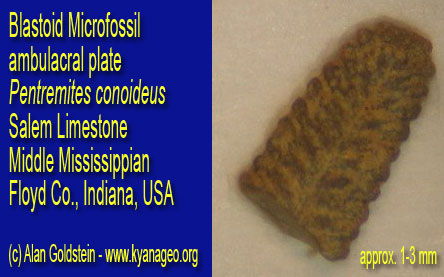
I am basing this identification off a picture on the KYANA Geological Society website (http://www.kyanageo.org/Fossils/mississippian/echinodermata/pentremites-conoideus.jpg). It is of a Pentremites conoideus blastoid in the Salem Limestone of Floyd County, Indiana. It is from the Middle Mississippian Period. The two pictures shown here are of a fossil from the Salem Limestone of Washington County, Indiana. 


Friday, January 22, 2010

Fossils in Indiana Limestone

Microfossils of the Salem Limestone (aka Indiana Limestone) that existed in the Middle Mississippian Period (340-335 million years ago). Sections of this limestone quarried near Bloomington and Bedford Indiana were used as material for famous buildings around the United States. Buildings such as New York City's Empire State Building & Rockefeller Center and Washington's Pentagon & National Cathedral.  One can learn more about the role of Salem Limestone in the building of the United States in Chapter 6 of the book Stories in Stone: Travels Through Urban Geology by David B. Williams.


This fossil is some sort of bryozoan.  Using its picture it might be a Fenestella or Hemitrypa.


Fossils found in Washington County, Indiana.

 
Thanks to Herb for the Salem Limestone sand material to study.

Thursday, January 21, 2010

Endothyra baileyi Foraminifera

Foraminifera fossils from the Salem Limestone of Washington County, Indiana. These creatures are called Endothyra baileyi and existed 360-325 million years ago (Mississippian Period).  Microfossils were studied quite a bit by the oil exploration industry so they could determine the rock layers drills had reached to help find fossil fuels.  I am not sure if they have the same importance today with the proliferation of advanced sensing technology.


Endothyra baileyi foraminifera (Webster's dictionary: "marine protozoans with calcareous shells full of tiny holes through which slender filaments project") described by James Hall in Transactions Albany Institute, volume IV, page 34 published in 1856.  The description is "Shell depressed, orbicular, sub-equally convex above and below, smooth, margin rounded, indented by the septa; spire depressed, involved; last volution slightly oblique, consisting of eight loculi; aperture contracted. The general form of this fossil is depressed, globular, with the involutions deviating slightly from the same plane. Not infrequently, however, the spire ascends in greater or less degree, and one of more loculi become visible beyond the single volution. Sometimes seven loculi only are visible in the volutions. The surface is smooth under the ordinary magnifier, and the outline is indented at the septa."


Listing found in Fauna of the Salem Limestone of Indiana section written by E.R. Cumings, J.W. Beede, E.B. Branson, and Essie A. Smith in the Indiana Department of Geology and Natural Resources Thirtieth Annual Report from 1905 on pages 1201-1202.


Thanks to Herb for the Salem Limestone sand.

Tuesday, January 19, 2010

Salem Limestone Microfossils


Images for this post are microfossils from Washington County, Indiana that exist in the Salem Limestone.  This first fossil is worm called Spirorbis annulatus.  The drawing below is of one from Indiana Department of Geology and Natural Resources 13th Annual Report by W.S. Blatchley, 1905.  Can be found on Google Books HERE.


Images were taken with an Intel QX3 microscope which has three settings 10x, 60x and 200x.  This device is somewhat old so its resolution is 512 pixels wide and there is quite a bit of noise at 200x magnification.  It also has plastic lens so not the greatest but I got it for $50 years ago so not a bad deal.


This next fossil is what Salem Limestone is famous for... the foraminifera.  This one is called Endothyra baileyi (at least in the 1905 Indiana Geology Report).  This first image is of a set of drawings from that report.


 This next picture is one I took at 60x magnification.  I have found maybe 30 so far after looking about a measuring cup worth of sand material.


These next set of 1905 drawings are the gastropod Solenospira vermicula, S. turritella, and S. attenuata


I am not sure which species this gastropod is so I will just call it Solenospira sp.

This last image is of an elliptical crinoid stem piece that reminds me of a Platycrinites.  I found 3 so far.


Thanks to Herb for the Salem Limestone sand to study.

Sunday, January 17, 2010

Mississippian Period Foraminifera


This fossil is a foraminifera from the Salem Limestone of Indiana.  It was found in Washington County, Indiana.  The little creature existed in the Mississippian Period.  I believe this is my first microfossil posted since I tend not to look for these animals.  After finding a binocular microscope to use, I searched through some cleaned sand that my friend Herb gave me.  With a vague idea of looking for a multi-segmented bubbly looking rolled up worm shape, I found about nine fossils in about 45 minutes.


Reading about this limestone layer ahead of time gave me the impression that it had a lot of micro fossils.  It lived up to its billing with fragments of bryozoans, small snail shells, spine looking shapes, and crinoid discs were among the fossils I visually encountered.  According to my research, the fossils pictured might be an Endothryra baileyi or Globoendothyra baileyi.


The pictures were taken through the microscope viewing lens using a 4 megapixel Kodak camera set to macro mode.  Forgive the picture quality.  I believe the microscope magnification was set between 20x-30x.


The last three pictures were taken at the Indiana State Museum in Indianapolis.  They are specifically from the Mississippian Period display which is describing fossils in the Salem Limestone.


A model of one of these micro-sized fossils.
 

Learn more about these tiny creatures at the German website www.foraminifera.eu run by Michael Hesemann.  If you can, help him out by sending fossil samples for him to photograph and document.