Showing posts with label indiana state museum. Show all posts

Sunday, February 20, 2022

Muensteroceras (Goniatites) indianensis Drawing from 1891


This image was scanned and Photoshop enhanced from Plate XIX figure 2 in Indiana Department of Geology and Natural Resources Seventeenth Annual Report 1891 by  Sylvester Scott Gorby (1848-1930). It is described on page 700 as a new species Goniatites indianensis (Miller, 1891). Fossil found in the lower Carboniferous Period.

"The species is founded upon two sandstone casts from the Knobstone or Waverly Group, of Clark County, Indiana, now in the State Museum of Indianapolis. The smaller specimen is only half the diameter of the one illustrated." The illustration measures about 30 mm across. Below is dorsal view shown in figure 3.


New name:Muensteroceras indianense

http://www.fossilworks.org/cgi-bin/bridge.pl?a=taxonInfo&taxon_no=278460

Saturday, March 2, 2013

Eurypterid and Mastodon Fossils at ISM

I am a big fan of museums which is why I have spent hundreds of hours volunteering at my local one. One of my favorite museums is the Indiana State Museum in Indianapolis, Indiana USA. They have a great number of exhibits showing off fossils found around the state of Indiana. In addition, they are publishing videos of fossils they have in their collection.

This first video is of a Silurian period Eurypterid found in a quarry in Kokomo, Indiana. If the display box is showing a different video, here is the direct link: http://www.youtube.com/watch?feature=player_embedded&list=UUg23t7QR8PYx5N3WX2M2eMg&v=ewev2B5-01I


The next video shows the assembly of the 13,000 year old Fred the mastodon fossil for an exhibit entitled Indiana's Ice Age Giants: The Mystery of Mammoths and Mastodons. It opens in November 2013. If the display box is showing a different video, here is the direct link: http://www.youtube.com/watch?list=UUg23t7QR8PYx5N3WX2M2eMg&v=ulUBrHPIPPM&feature=player_embedded


This video shows the Bothwell dig in 2005 that uncovered seven mastodonts, part of giant beaver, and vertebrate of stag moose. The dig was near Hebron, Indiana. See video at this link: http://www.youtube.com/watch?v=aKJ3CYRvF28
 
This video shows a 2008 fossil dig in an Indiana corn field.

Monday, June 11, 2012

Megalonyx Sloth Bone


This Megalonyx jeffersonii claw is on display at the Science on the Edge: Radical Innovation in New Harmony display at the Indiana State Museum in Indianapolis. This specimen once belonged to Indiana State Geologist David Dale Owen. It was found around 1850 by Walter Alves near Henderson, Kentucky on the Ohio River shore line. If I understand correctly part of the specimen was destroyed in a fire later at a museum. The specimen shown in the picture belongs to the Indiana State Museum and is known as the Henderson Sloth. Learn more about its history on Professor Clark Kimberling's web page at the University of Evansville.

Learn more about this exhibit at my earlier post from April 2012.


Saturday, June 9, 2012

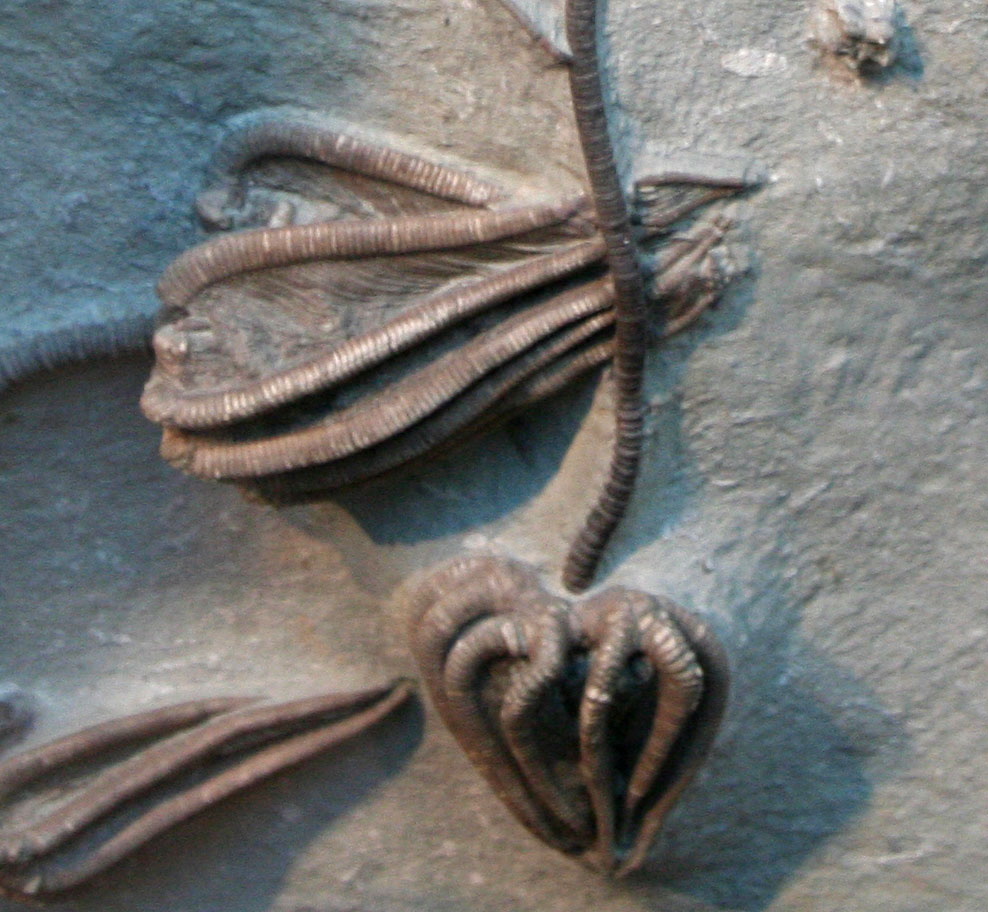
Abatocrinus grandis Crinoid

Abatocrinus grandis crinoid lived on the seafloor in the Mississippian Period. This fossil is on display on the first floor of the Indiana State Museum as of May 2012. This fossil is from Crawfordsville, Indiana. That is a some beautiful 3-D prep work!

Learn more about the Indiana State Museum at their web site.

Friday, June 8, 2012

Cyathocrinites multbrachiatus Crinoid Calyx

Cyathocrinites multbrachiatus crinoid lived on the seafloor in the Mississippian Period. This fossil is on display on the first floor of the Indiana State Museum as of May 2012. More than likely this fossil is from Crawfordsville, Indiana. That is a some beautiful 3-D prep work!

Learn more about the Indiana State Museum at their web site.

Thursday, June 7, 2012

Unidentified Sea Urchin Fossil


This unidentified sea urchin fossil moved along the seafloor in the Mississippian Period. This fossil is on display on the first floor of the Indiana State Museum as of May 2012. More than likely it was found around Crawfordsville, Indiana. That is a some beautiful 3-D prep work!

Maybe it is a Lepidesthes colletti named by White in 1878. See this specimen at the The Natural History Museum web site.

Learn more about the Indiana State Museum at their web site.

Wednesday, June 6, 2012

Eretmocrinus granuliferus Crinoid


This Eretmocrinus granuliferus crinoid lived on the seafloor in the Mississippian Period. This fossil is on display on the first floor of the Indiana State Museum as of May 2012. More than likely this fossil is from Crawfordsville, Indiana. That is a some beautiful 3-D prep work!

Learn more about the Indiana State Museum at their web site.


Tuesday, June 5, 2012

Onychaster Starfish Fossil

Onychaster sp. starfish fossil that crawled the seafloor in the Mississippian Period. This fossil is on display on the first floor of the Indiana State Museum as of May 2012. More than likely this fossil is from Crawfordsville, Indiana. That is a some beautiful 3-D prep work!

Learn more about the Indiana State Museum at their web site.

Sunday, June 3, 2012

Silurian Green Fossil - Bickmorites?


Sometimes when one is searching for fossils in the field, color is important as opposed to just trying to visually match shapes and patterns. In the case of today's posting, the color green is important. The Silurian Period Louisville Limestone found in Jefferson County, Kentucky at times has green blotches that show through. I assume this is a sign of some sort of copper being present. (UPDATE: see comment section as the green material might be glauconite.) My cousin told me this could be a sign of a cephalopod fossil which tend to be difficult to find in this rock layer. Mostly one finds corals (chain or colonial types) and some brachiopods with rare trilobite or graptolite fragments. Years ago, I saw cephalopod fossils found by others but recently I came across the remains shown in these first three pictures. After visiting the Indiana State Museum and seeing some of their Silurian cephalopod specimens, a green color was present in some of those specimens. Their material was from the Wabash Formation if I remember correctly. This formation might not quite match up with the Louisville Limestone.


These next two Bickmorites sp. specimens can be found on the first floor of the Indiana State Museum as of May 2012. They are in the fossil area in the Silurian case.


See a Bickmorites sp. specimen at the Indiana State Museum on-line database.

Last two images are magnified areas of the green fossil I found in the Louisville Limestone. Learn more about these creatures at this web site.


UPDATE:
A reader of this blog, avid fossil collector, and chemist Jack Kesling of Pennsylvania sent me a nice fossil find that relates to this posting. He found this unidentified Silurian cephalopod fossil with a lot of greenish material on it. The fossil was found in the Bertie Formation of Herkimer County, New York.

Photo by Jack Kesling

Saturday, June 2, 2012

Carcinosoma newlini Arthropod Fossil

This large Silurian fossil is of a Carcinosoma newlini eurypterid. Fossil was found in the Kokomo Limestone of Indiana and is housed at the Indiana State Museum (Indianapolis). Creature swam the seas that covered the state in the Late Silurian Period.

Note: there is a shadow across the fossil causing one side to be darker than the other.

Learn more about this type creature on Wikipedia.

Learn more about the Indiana State Museum at their web site.

Friday, June 1, 2012

Dorycrinus gouldi Crinoid Calyx

Dorycrinus gouldi crinoid calyx and stem on display at the Indiana State Museum (Indianapolis - May 2012). This fossil is part of a larger and quite impressive Mississippian period crinoid display on the first floor of the museum. If Indiana had a state fossil, it would probably be a crinoid from Crawsfordsville, Indiana. Learn more about the museum at their web site.

Thursday, April 19, 2012

Science on the Edge: Radical Innovation in New Harmony


The Indiana State Museum (Indianapolis) is hosting a temporary exhibit entitled Science on the Edge: Radical Innovation in New Harmony from March 24 through October 28, 2012. The exhibit will highlight the scientists who participated in the grand Utopian experiment at New Harmony, Indiana in the mid-1820s till the 1830s. Learn more at their web site.
My interest in this exhibit is of a more direct nature, as I was the one who prepared the mineral specimen loan to the Indiana State Museum from the Louisville Science Center from the historic Gerard Troost mineral collection (1811-1850). Dr. Troost was a scientist who with his family lived in New Harmony, Indiana in 1825-1826. He and the French naturalist Charles-Alexandre Lesueur left from New Harmony in 1826 and explored parts of southern Illinois and eastern Missouri. This trip provided a number of mineral specimens like fluorite from Illinois and galena (lead) from Missouri.

New Harmony attracted scientists like William Maclure, Thomas Say, and Robert Owen whose sons later became well known geologists. The mineral pictures in this posting are a yellow fluorite from Europe, troostite (var. Willemite) from Franklin, New Jersey, and a malachite/azurite specimen.


Monday, October 17, 2011

GeoFest 2011


This upcoming weekend the Indiana State Museum hosts its annual GeoFest which has lots of fossil and mineral experts on hand to answer questions.  In addition, dealers will be selling minerals, fossils, jewelry, books, tools, and assorted geological items. Visitors get into the show with admission to the museum.  While in the museum, check out the world-class exhibits about all things INDIANA!

See my blog posts about GeoFest 2010: CLICK HERE and CLICK HERE

The event happens October 21-23, 2011 and the times are:

Friday and Saturday (Oct. 21-22): 9 A.M till 5 P.M. EST
Sunday (Oct. 23): 11 A.M. till 4 P.M. EST

Indiana State Museum
650 West Washington St.
Indianapolis, IN 46204

Visit the Indiana State Museum to learn more: CLICK HERE


Sunday, January 2, 2011

Mastodont Buy-A-Bone


A creative fund raiser is underway by the Indiana State Museum that will provide funds for a Spring 2013 exhibition called Monsters of the Muck: Indiana's Elephant Graveyards.  The plan is to raise $125,000 of $200,000 needed to real-bone mount (with some casts for missing pieces) a bull mastodont found in 1998 in an ancient lake bed near Fort Wayne, Indiana.  It was radiocarbon dated to about 11,280 years old.  According to their web site, the creature was maybe 33 years old, about 3 meters high, and weighed approximately 2700 kg.

The remains recovered consisted of 292 bones and the fundraiser involves symbolically selling each bone for a certain price to help raise the needed money.  For example, the tusk casts would cost $5000 while the smaller foot bone casts would cost $50.  All donors receive a "Bone Ownership" certificate signed by the curator of paleobiology at the museum, a presentation box with an actual fragment of a mastodont tusk or bone, an acknowledgment of your donation at the exhibit, and the donation is tax deductible for American taxpayers.

Learn more about this neat project and how to donate on-line at this Indiana State Museum web page.

Images shown in this blog posting are of an American mastodont cast with other animal skeletons from the Ice Age.  The mastodont was excavated in August 2000 at the Gunz Farm near La Porte, Indiana by a group from the Indiana State Museum.


Thursday, December 9, 2010

Crawfordsville Indiana Crinoids

Rock plates with various crinoids exposed found in Crawfordsville, Indiana.  These plates are on display at the Indiana State Museum.  Crinoids lived 359 to 318 million years ago (Mississippian Period).


Wednesday, December 8, 2010

Agaricocrinus americanus Crinoid


Agaricocrinus americanus crinoids on display at the Indiana State Museum in Indianapolis, Indiana.  Crinoids are from the famous Crawfordsville location found in the Edwardsville Formation.  Animals grew in the Mississippian Period.


Next picture shows an Agaricocrinus splendens on display at the Muséum National D'Historie Naturelle Jardin Des Plantes Paléontologie et Anatomie Comparée in Paris, France.  More than likely it is from Crawfordsville, Indiana.

Thursday, November 4, 2010

South Dakota Cephalopod

Some of the suture pattern on a cephalopod fossil fragment still visible.  Creature lived in the Cretaceous Period and was found in South Dakota.  Fossil obtained from the Indiana Society of Paleontology at GeoFest 2010 (Indiana State Museum).
Fossil about 5 cm in length.

Wednesday, October 27, 2010

Crawfordsville Crinoids at ISM


If Indiana is known for a particular fossil, it has got to be the crinoids of Crawfordsville.  These prepped plates are on display on the first floor of the Indiana State Museum (October 2010).  Animals existed in the Mississippian Period.


Tuesday, October 26, 2010

Waldron Shale Fossils Displayed at ISM

Waldron Shale fossils on display at the Indiana State Museum (ISM). First is the index fossil of the Waldron Shale, the Eucalyptocrinites crassus crinoid calyx. 

 The next crinoid cup fossil appears to be an Eucalyptocrinites elrodi.

This third image shows the fragment of the crinoid calyx with arms of Eucalyptocrinites crassus.

 The fourth image shows unidentified crinoid arm.

Last image of the holdfast of an Eucalyptocrinus crinoid.