Sunday, March 30, 2025
Worm Tube Fossil
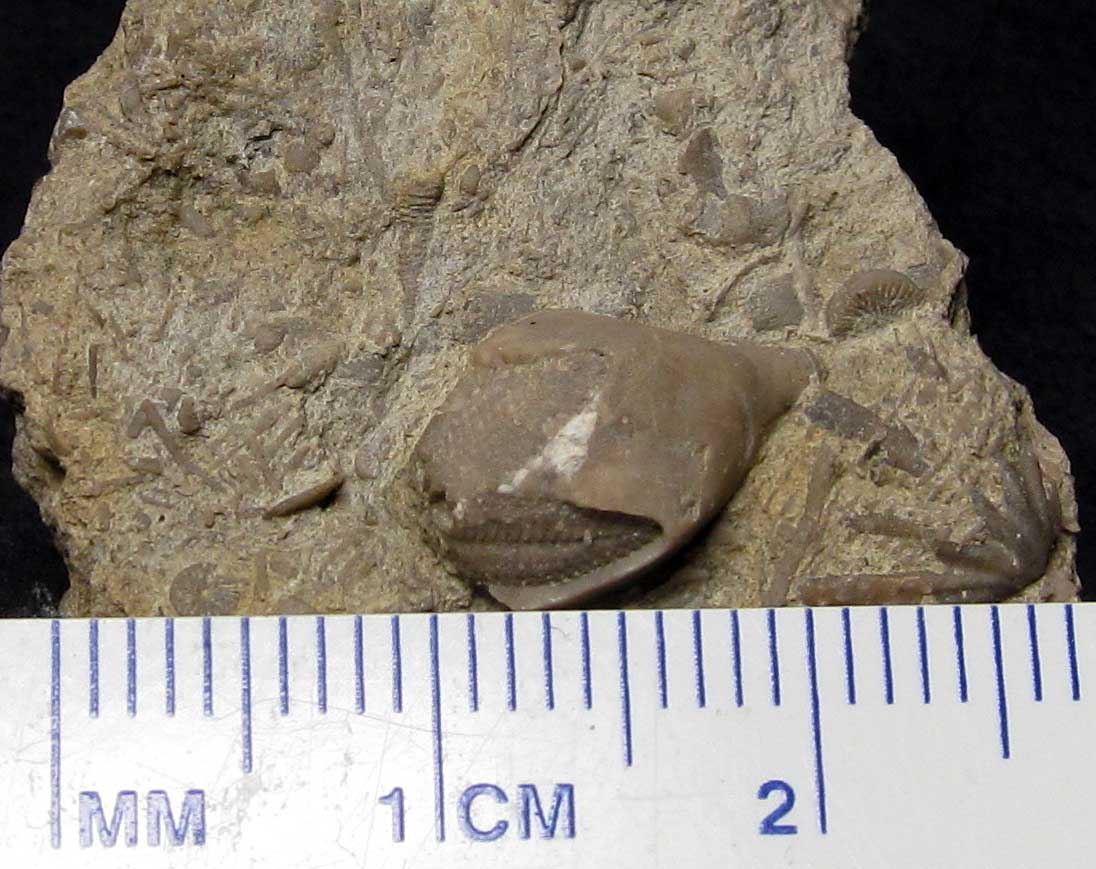
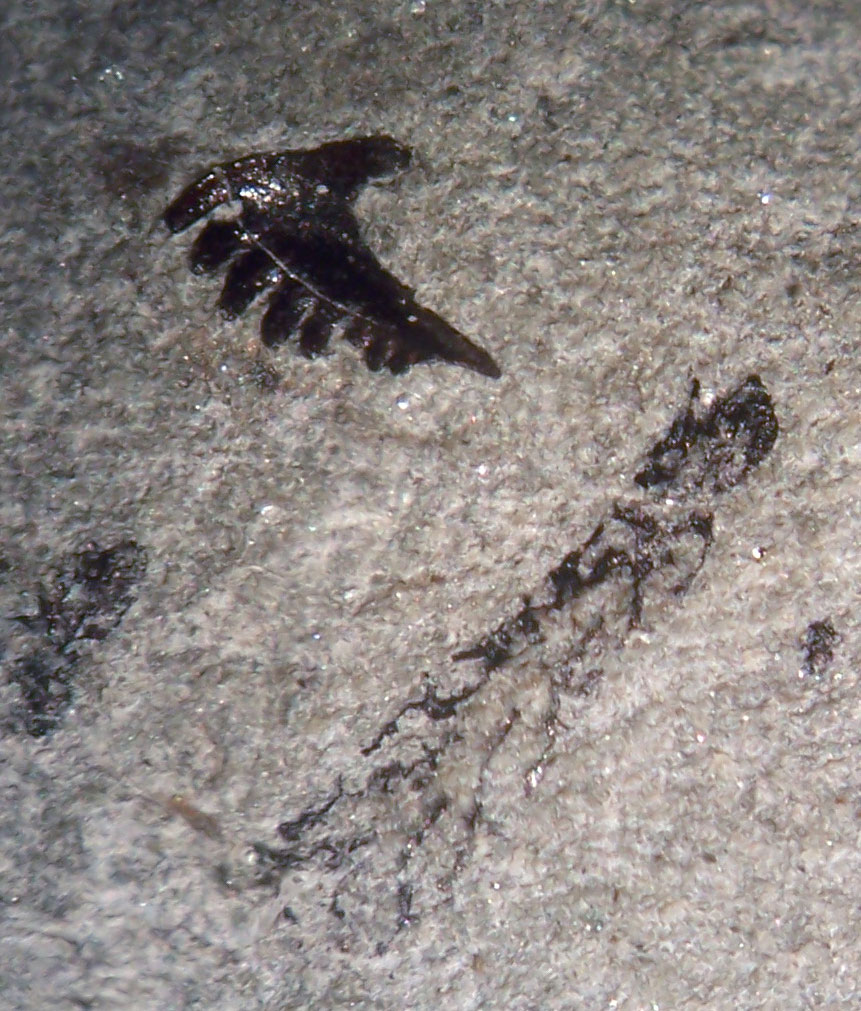
These pictures are of a worm tube fossil. Fossil found in the New Providence Formation of Clark County, Indiana USA. It dates to the Mississippian Period. Thanks to Kenny for the images.
Saturday, November 30, 2024
Alpena Michigan Microfossils
My cousin screened through a lot of micro material I brought back from Alpena Michigan USA in October 2021. It was found in the Potter Farm Formation and dates to Middle Devonian Period (Erian Age).
The brachiopod fossil in boxes 110 & 117, 76-77, and another in 109 appear to be a Strophondonta crassa (Imbrie,
1959).
Rectangles 107, 108, and 115 appear to be Aulopora coral fossils with some that had grown on a branching bryozoan.
Cornulites appear to be in boxes 60 and 61.
A blastoid in cells 62, 63 & 66 could be Heteroschisma subtruncatum.
Cell 22 is a fish tooth fossil.
Fossil in rectangle 69 is some sort of bone fossil.
Monday, September 21, 2020
Something New From The Waldron Shale
UPDATE (11-13-2020): I now think this fossil is a cluster of holdfasts for cystoids. See my post about this here.
Last Saturday (09-19-2020) I visited a Waldron Shale site and found a fossil I have not seen before. At first I thought it might be some sort of colonial coral. I showed it to my cousin Kenny and he thought it might be a parasite on a crinoid column. Similar to a fossil he found in 2015, on a Mississippian Period fossil. See this posting for more info. See image below of a Mississippian crinoid stem with what appear to be galls from parasitic marine worms.
One can see the similarities with the current Waldron Shale find.
He will need to prep this new find to see there is a crinoid column this fossils are attached to or part of. These shapes do look similar to galls of putative myzostomids (small marine worm) on crinoids as seen on a researchgate.net page showing an image from the book Fossil Crinoids by Hans Hess, William I. Ausich, Carlton E. Brett, and Michael J. Simms (Cambridge University Press, 1999).
Upon further Internet searching I came across the Time Scavengers blog with a 2017 post about The College of Wooster's paleontologist Mark A. Wilson. He posted an image Upper Ordovician cobble with encrusting crinoids (three volcano-like fossils). These shapes have some similarity to this fossil find has well. Could they be a cluster of small crinoid holdfasts?
http://webcentral.uc.edu/eprof/media/attachment/eprofmediafile_1303.pdf
Link to paper Phosphannulus on Paleozoic Crinoid Stems by James R. Welch 1976:
https://www.jstor.org/stable/1303489
https://www.researchgate.net/profile/David_Meyer16/publication/283756496_Biotic_Interactions_among_Recent_and_among_Fossil_Crinoids/links/568ad15008ae1975839db6d3/Biotic-Interactions-among-Recent-and-among-Fossil-Crinoids.pdf
https://deepblue.lib.umich.edu/bitstream/handle/2027.42/75404/j.1502-3931.1978.tb01229.x.pdf?sequence=1
https://bmcevolbiol.biomedcentral.com/articles/10.1186/s12862-014-0170-7
Friday, December 15, 2017
Sand Worms
I have always been intrigued by scolecodonts (fossil worm jaws/teeth) ever since finding one on a Ordovician road cut back in 2009. When visiting Dr. Conkin one day I saw a jar in his study with jaws similar to fossils I had been finding. As it turns out these were modern day Nereis sand worms. Here are some images of these creatures, there was no label showing where they were found.
While watching the Smithsonian channel I saw a video on Bobbit worms whose jaws seem very similar to the scoledonts found in the Ordovician rock. See this Wikipedia entry on Eunice aphroditois.
Wednesday, September 17, 2014
Mississippian Age Cornulites Fossil
The white fossil appears to be a Cornulites worm tube fossil next to an unidentified brown trilobite genial spine. It was found in the Glen Dean formation.of Grayson County, Kentucky USA. The fossil dates to the Mississippian Period. Image was taken with a microscope with an approximate 4 mm field of view (FOV).
Thanks to Kenny for the image.
Tuesday, September 16, 2014
Palaeoconchus Worm Fossil
The fossil the blue arrow is pointing to appears to be a Palaeoconchus (aka Spirobus) worm fossil. It was found in the Glen Dean formation.of Grayson County, Kentucky USA. The fossil dates to the Mississippian Period. The worm fossils is intermixed with bryozoans (maybe Fenestella). Image was taken with a microscope with an approximate 4 mm field of view (FOV).
http://www.fallsoftheohio.org/Fossil_Worms.html
Thanks to Kenny for the image for this blog posting.
Monday, December 2, 2013
Scalarituba missouriensis Worm Burrow Fossils
Thanks to Kenny for the picture.
Sunday, December 1, 2013
Trace Fossils from Carboniferous
Thanks to Kenny for the picture.
Sunday, August 25, 2013
Leptaena Brachiopod with Cornulites Worm Tubes
These images are of a Leptaena waldronensis? brachiopod that has two Cornulites sp. worm tubes attached. It somewhat rare to find the Cornulites worm tubes on fossils found in the Clark County, Indiana Waldron Shale. These fossils date to the Silurian Period (425-420 million years ago).
I encountered this fossil while volunteering at Earth Discovery Day at the Falls of the Ohio State Park in Clarksville, Indiana, USA. It is a good event to help the general public to learn about fossils and minerals found on our planet. The specimen shown was found by visitor on August 24, 2013.
Monday, May 27, 2013
Waldron Shale Scolecodont Fragment
It reminds me of a Silurian scolecodont found in Sweden called Kettnerites sp. Also one found in New York called Nereidavus invisibilis. I have not been able to find much research on the ones found in the American Waldron Shale though.
Thanks to Kenny for the picture.
Sunday, February 3, 2013
Mississippian Age Cornulites Fossil
Cornulites worm tube fossil found in the Indian Springs Formation of Crawford County, Indiana. The worm tube is located in the picture to the upper left of the blastoid. Fossil is dated to the Mississippian Period.
Thanks to Kenny for the picture.
Wednesday, August 15, 2012
Cornulites proprius on a Platystoma Fossil
Fossils have not been prepped yet so I am hoping for better detail once they are cleaned.
Wednesday, June 27, 2012
Cornulites proprius?
Described by James Hall in 1876 as "elongate-tubular, obconical or trumpet-shaped bodies, rapidly enlarging toward the aperture, which is campanulate with the margins always imperfect." The Cornulites propius worm tube fossil is found in the Waldron Shale of Bartholomew County, Indiana. These creatures lived in the Silurian Period.
![]() |
| Cornulites propius illustration from Indiana Department of Geology and Natural History 11th Annual Report 1881; Plate 32 Figure 4 |
Friday, October 14, 2011
Nereidavus invisibilis? Scolecodont
This fossil appears to be a Nereidavus invisibilis? scolecodont found in the Silurian Waldron Shale of Clark County, Indiana, USA. The fossil was found on top of another fossil as can be seen in the second picture. The second fossil is a crinoid holdfast.
Thanks to Kenny for the pictures and identification. See other possible scolecodonts found in the Waldron Shale: CLICK HERE and CLICK HERE.
Wikipedia has pictures of the modern sandworm Alitta virens (old genus name Nereis): CLICK HERE
Sunday, July 24, 2011
Plate Full of Scolecodonts
Recently, I found a plate with over 8 scolecodonts embedded on its surface. Though the specimens are quite small and a magnifier is needed to make out details, it is an amazing find. Fossil plate found in Trimble County, Kentucky in maybe the Drake Formation. These animals existed in the Ordovician Period. In addition to scolecodonts there are also a few graptolites and impressions of maybe brachiopods.
Wednesday, June 15, 2011
Return of the Serpula
Sometimes a fossil is so nice that it needs to be revisited photographically. This Inoceramus oyster shell fragment is covered with Serpula worm tubes. The fossils were found in the Eagleford Group, Kamp Ranch Formation in Dallas County, Texas. These marine creatures existed in the Cretaceous Period.
Last presented on the blog on December 4, 2009 (CLICK HERE). Thanks to Herb for loaning me the fossil to photograph.