Showing posts with label alpena. Show all posts

Saturday, November 30, 2024

Alpena Michigan Microfossils


My cousin screened through a lot of micro material I brought back from Alpena Michigan USA in October 2021. It was found in the Potter Farm Formation and dates to Middle Devonian Period (Erian Age). 

The brachiopod fossil in boxes 110 & 117, 76-77, and another in 109 appear to be a Strophondonta crassa (Imbrie, 1959).

Rectangles 107, 108, and 115 appear to be Aulopora coral fossils with some that had grown on a branching bryozoan.

Cornulites appear to be in boxes 60 and 61.

A blastoid in cells 62, 63 & 66 could be Heteroschisma subtruncatum.

Cell 22 is a fish tooth fossil.

Fossil in rectangle 69 is some sort of bone fossil.

Thanks to Kenny for image and preparing all those fossils. Very nice work!

Thursday, March 7, 2024

Alpena Michigan Coral Fossil


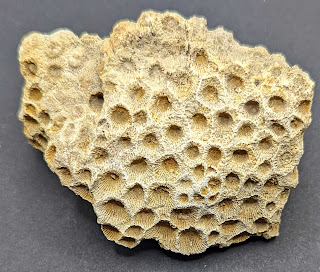
These pictures are of a Hexagonaria anna (Whitfield, 1973) coral fossil. It was found in the Bell Shale of the Traverse Group of Alpena County, Michigan, USA. The coral lived in the Devonian Period. Fossil was found October 2021.


Tuesday, July 11, 2023

Prismatophyllum Coral Fossil


This picture is of a Prismatophyllum (Simpson, 1900) coral fossil. It was found in Alpena County, Michigan, USA. It dates to the Middle Devonian Period.

The picture was taken in June 2023 on the first floor of the Smithsonian Museum of Natural History in Washington D.C. USA.

Sunday, January 16, 2022

Hexagonaria anna Coral Fossil

These pictures are of a Hexagonaria anna (Whitfield, 1973) coral fossil. It was found in the Bell Shale of the Traverse Group of Alpena, Michigan, USA. The coral lived in the Devonian Period. Fossil was found October 2021.


Tuesday, December 21, 2021

Trading Places in a Devonian Sea


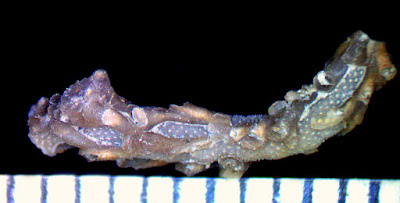
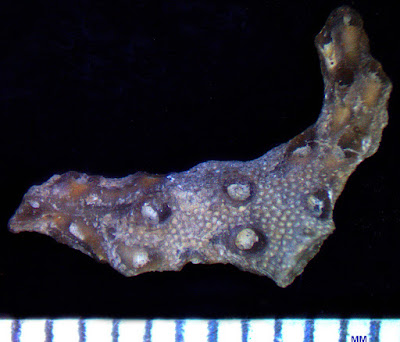
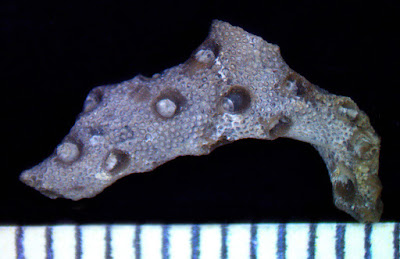
My cousin Kenny sent me some pictures of some fossils he screened from micro material I brought back from Alpena Michigan USA. What I found interesting was two specimens show the interactions between bryozoan and coral fossils. One specimen shows a coral growing on a bryozoan and another shows the reverse. First picture shows an Aulopora (Goldfuss, 1829) coral growing on what appears to be a Fistulipora (McCoy, 1849) bryozoan. The next image shows an Aulocystis ramosa with a matting Fistulipora bryozoan growing on top of it.

The next image shows the same type of coral fossil with a matting bryozoan. Field of view (FOV) in these images is about 12-15 mm.

It was found in the Potter Farm Formation and dates to Middle Devonian Period (Erian Age). Thanks to Kenny for image and screen material to find fossil.

Sunday, December 19, 2021

Strophondonta crassa Brachiopod Fossil

Screening through a lot of micro material brought back from Alpena Michigan USA. This brachiopod fossil appears to be a Strophondonta crassa (Imbrie, 1959). It was found in the Potter Farm Formation and dates to Middle Devonian Period (Erian Age). The length is about 13 mm. The fossil shows signs of having a worm tube or snail attached to it. Also maybe an Aulopora coral in the bottom left part of the shell.

Thanks to Kenny for image and screen material to find fossil.

Sunday, December 5, 2021

Hexagonaria Coral with Hederella Bryozoan Fossils

These pictures are of a Hexagonaria anna (Whitfield, 1973) coral fossil. It was found in the Bell Shale of the Traverse Group of Alpena, Michigan, USA. The coral lived in the Devonian Period. On the bottom of the coral is a small colony (3 cm long) of Hederella (Hall, 1883) bryozoans.


Thursday, October 14, 2021

Hexagonaria anna Coral Fossil

These pictures of a Hexagonaria anna (Whitfield, 1973) coral fossil. It was found in the Bell Shale of the Traverse Group of Alpena, Michigan, USA. The coral lived in the Devonian Period.

On the bottom of the fossil are a number Aulopora coral fossils that grew on the Hexagonaria. Also there are a number of bryozoan colonies. Plus there is a Aulopora coral fossil found on the top of the coral.


Saturday, October 9, 2021

Native American Bird Stone From Hexagonaria Fossil

In September 2021 I visited the Besser Museum at Alpena, Michigan, USA. They had a large exhibit on Native American artifacts found in Michigan. One that caught me attention was labeled "petoskey stone pop-eye", see picture above. It is a native American bird stone made shaped from a Hexagonaria coral fossil. They also have on display a copper bird stone identified as the only one known. The museum has an impressive collection of copper artifacts created by native American peoples of Michigan.

The Besser Museum for Northwest Michigan was named for Jesse Besser (1882-1970) who perfected and produced machines that create these famous concrete blocks. Out in the yard is a huge boulder sized Hexagonaria (Gürich, 1896) coral fossil (from Devonian Period). They also have areas where you can search for and keep fossils from material dumped there from local quarry.


Wednesday, October 6, 2021

Bryozoan Holdfast Fossil

In September 2021, I was collecting in Alpena Michigan USA. While there I found something that was not immediately apparent what it was. After consulting with Paleo Joe he told me it was a fan bryozoan holdfast fossil. It was found in the Potters Farm Formation of the Traverse Group. The fossil dates to the middle Devonian Period (Givetian Stage). Only found this one and was a little thrown off as I don't remember ever encountering a holdfast that looked like this.


Monday, October 4, 2021

Atrypa Brachiopod Fossil with Crystallized Lophophore


Check out this picture of an Atrypa (Hall, 1862) brachiopod fossil (note the two elliptical shapes which are feeding tubes or lophophore that have crystallized). The fossil was found in the Genshaw Formation at Alpena, Michigan USA. The creature lived Middle Devonian Period (Erian Stage).


Friday, September 24, 2021

Fossils at Mich-E-Ke-Wis Park

 Mich-E-Ke-Wis Park overlooks Lake Huron in Alpena, Michigan USA. Huge boulders line the waterline are a good place to explore to see so many fossils. So many death ensembles of a lot of brachiopod fossils as shown in first 2 pictures. My foot as reference shows how big an area the fossils are spread. Below shows Atrypa (Hall, 1862) brachiopods in close up.


This next picture shows a panoramic of coastline to explore.

The following picture shows the marks made by glacier movement thousands of years ago.

Last picture is of a large Hexagonaria (Whitefield, 1882) fossil.


Great place to visit. They have a nice playground and nice restaurants next to the park with great lake side views.

Wednesday, September 22, 2021

Predation on Atrypa Brachiopod Fossil


Here is a cool picture of an Atrypa (Hall, 1862) brachiopod fossil (note the circle in the top left corner probably made by a gastropod). The fossil was found in the Genshaw Formation at Carmeuse Quarry, Rogers City, Michigan USA. The creature lived Middle Devonian Period (Erian Stage).


Tuesday, September 21, 2021

Cyrtina alpenensis Brachiopod Fossil


Earlier this month, I found this brachiopod fossil in the Genshaw Formation of Alpena, Michigan, USA. It appears to be a Cyrtina alpenensis (Hall & Clarke, 1895). This creature lived in middle Devonian Period (Erian Stage).


Monday, September 20, 2021

Eunema speciosum Gastropod Fossil

While collecting in Alpena Michigan USA earlier this month, I found something that I could not immediately identify. It was gastropod fossil found in the Potters Farm Formation of the Traverse Group. The fossil dates to the middle Devonian Period (Givetian Stage). After consulting with Paleo Joe he told me it was a Longstaffia speciosa (Whiteaves, 1892) snail fossil as identified in Devonian Strata of Alpena and Presque Isle Counties, Michigan by G. M. Ehlers and R. V. Kesling (1970) [LINK]. For some reason the species name was altered in this document from its original name which ended in the letters "um" which were replaced with the letter "a". In Latin, words that end in "um" are genitive plural and plural words end in "a".

This species was named by Joseph Frederick Whiteaves (1835-1909) as Eunema speciosum in 1892's The Fossils of the Devonian Rocks of the Islands, Shores or Immediate Vicinity of Lakes Manitoba and Winnipegosis [LINK]. The genus Eunema was named by Salter in 1859 and then renamed in 1908 by Cossmann to Longstaffia.


According to Fossilworks the new name for this fossil is Kitikamispira speciosum (Wagner, 2020).