Showing posts with label indiana geological survey. Show all posts

Saturday, February 19, 2022

Prodromites (Goniatites) gorbyi Drawing


This image was scanned and Photoshop enhanced from Plate XV figure 1 in Indiana Department of Geology and Natural Resources Seventeenth Annual Report 1891 by  Sylvester Scott Gorby (1848-1930). It is described on page 700 as a new species Goniatites gorbyi (Miller, 1891). "Collected by R. A. Blair, in the lower part of the Choteau limestone or Waverly Group, at Pin Hook Bridge, in Pettis County, Missouri, and now in the collection of the author (Samuel Almond Miller [1836-1897]). The specific name is in honor of Prof. S. S. Gorby, State Geologist. The plate lists "FR BANK DEL" so that is who created the image.

This genus was renamed in 1901 in Prodromites, A New Ammonite Genus from the Lower Carboniferous by James Perrin Smith (1864-1931) and Stuart Weller (1870-1927) in The Journal of Geology April-May 1901 Volume 9, Number 3 pages 255-266. The write on page 259, "Neither the description nor the figure given by Miller of this type is accurate, the drawings of the septa being entirely too generalized." The specimen is now at the Paleontological Collection Walker Museum University of Chicago No. 6208. Diameter 114 mm, height of last whorl 64 mm, height of last whorl from the proceeding 35 mm. They put a picture on Plate VI, figure 1 shown below:

It does not appear the Walker Museum exists any more. The building is now used by the English department at the university. https://www.lib.uchicago.edu/collex/exhibits/building-long-future/george-c-walker/

Source:

Smith, James Perrin, and Stuart Weller. “Prodromites, a New Ammonite Genus from the Lower Carboniferous.” The Journal of Geology, vol. 9, no. 3, The University of Chicago Press, 1901, pp. 255–66, http://www.jstor.org/stable/30056692.


Saturday, April 13, 2013

New Albany Shale Fossil

Reading the Indiana Department Geology and Natural Resources Twenty-First Annual Report W.S. Blatchley State Geologist 1896, I came across a plate image and description of the Parenchymophycus asphalticum found in the New Albany Shale of Clark and Floyd Counties in Indiana, USA. The New Albany Shale was named by a local geologist in the 1800s named William Borden. The shale dates to the Late Devonian Period.

Below is an image of a New Albany Shale fossil that might be what is described in the 1896 Report.

On page 118, Parenchymophycus asphalticum is described as:
"Plant with band-like thallus 10 to 150 mm wide, the well preserved spongy parenchymatic cells always filled with asphaltum. The cell walls are rich in silica. Cross divisions (nodes) at regular distances divide the band into rectangular oblong pieces (internodes). The termination of the plant consists of an oval shaped bud similar to that of Fucus vesiculosus L. of the present age. The length of specimens found varied from a few centimeters to 183 cm. The cell walls of this most interesting sea plant have resisted so well the influence of decomposition that they served as a means of diffusion for fluid bitumen, which, after a long time, gave off the  volatile components and left only the hard aspaltum. All specimens show no ramification. (Pl. II, fig. 1)"


Monday, December 10, 2012

Goniasteroidocrinus and Death by Chloroform


Pretty much all of the time when researching fossils found in southern Indiana and northern Kentucky of the United States one finds text full of dry scientific descriptions and terms that are difficult to decipher in relation to the specimen being looked at. An exception was found while reading the Indiana Department of Geology and Natural History Seventeenth Annual Report S.S. Gorby State Geologist 1891 on pages 661-662 in the Palæontology section by S.A. Miller. In the area labeled Family Rhodocrinidæ, Goniasteroidocrinus tuberosus, Lyon & Casseday, Mr. Miller lists in the text that the entry about this particular fossil is:
 "for the purpose of correcting some erroneous observations that have been made about the arms and arm furrows, and for the purpose of showing that if the arms were turned up, they would be like the arms in other genera and species of crinoids, and that they differ only in the fact that they are directed downward with the arm furrows outward. The arm furrows are well illustrated in the figure, with the pinnules directed downward."

He then goes on to describe a plate placed in the Illinois Geological Survey Volume II on page 219 that shows this species but "is erroneous, because it should show a double series of plates below the bifurcations instead of a single series; and the arms are represented with the furrows against the calyx instead of being turned outward."

The mistake was compounded by a description based on that image by Wachsmuth & Springer in their article in the Proceedings of Academy of Natural Science of Philadelphia, 1878, page 262.
Mr. Miller goes on to state:

I can not understand how any one ever came to the conclusion that a crinoid arm could rotate on its axis. The first plates in an arm are never transverse, beside if they were, the plates were always held in position by ligaments and if the arms were, the plates were always held in position by ligaments and if the arms were made to rotate the ligaments would necessarily be broken and the arms twisted off. But the facts effectually get away with the erroneous supposition and philosophy. 
I take pleasure in correcting any mistake [Ed. REALLY?] I find in the palæontological part of the Geological survey of Illinois, because I was an assistant on the work on the 7th volume and was frequently consulted by the late State Geologist, Prof. A.H. Worthen, in regard to palæontological subjects and received numerous courtesies from him, during many years of friendly intercourse. I was also the personal friend of Prof. Meek, who adopted and published the first new variety of fossils I described nearly twenty years ago. There is no palæontological work with which I have more cause to be familiar than with that contained in the Geological Survey of Illinois. And yet, in a recent diatribe, by an English schoolmaster, named P. Herbert Carpenter, I am told that "It is not too much to expect" that I should make myself acquainted with the "Illinois Geological Reports." 

What caught my eye was the talk about a diatribe by an English schoolmaster. So I looked up the name on the Internet and found an entry for Philip Herbert Carpenter on Wikipedia. He was born in 1852 and educated at University College School, University College London, and Trinity College in Cambridge. He was a naturalist on several ocean expeditions in 1868, 1869-1870, and 1875. Dr. Carpenter was expert on  modern and fossil crinoid morphology.

As it turns out Dr. Carpenter probably never saw Mr. Miller's comments as the survey was not published till 1892 and Dr. Carpenter killed himself on October 21, 1891. The doctor died as described on Wikipedia as "by self-administration of chloroform during a bout of temporary insanity caused by chronic insomnia." Yikes! This sounds like something like what happened to super-star singer Michael Jackson. Trying to get some rest by the use of a potent drug that can kill if taken too much of.

Sadly, according to this article from March 1892 entitled "Sleeplessness and Suicide", he left a widow and 4 young children.

Sunday, December 9, 2012

Eucalyptocrinus elrodi Crinoid

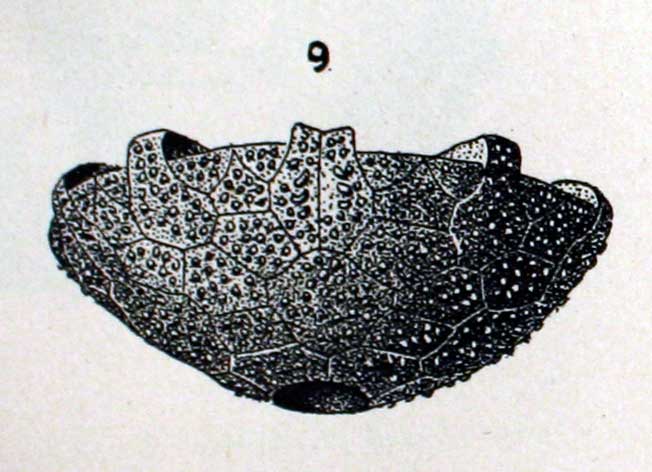
Eucalyptocrinus elrodi (Miller, 1891) crinoid calyx fossil found in Clark County Indiana USA. Not the best of specimens but you can see in the above picture the small raised dots that make up the distinct texture of this species. It is from the Middle Silurian Period. It is listed as a new species in the Indiana Department of Geology and Natural History Seventeenth Annual Report S.S. Gorby State Geologist 1891 on pages 650-651. It is listed as similar to the Eucalyptocrinus cælatus.

The illustrations listed below are from Plate VII Figures 9-10. They are described by S. A. Miller on page 651 as:
"Found in the Nigara Group, at Hartsville, Indiana, and now in the collection of Prof. S.S. Gorby. The specific name is in honor of Dr. Moses N. Elrod, a prominent physician, ardent collector and well known palæontologist of Hartsville, who was the first to discover this species and point out the fact that it is distinct from all others and undescribed. "


See a previous blog post for additional images of this species.

Saturday, December 8, 2012

Naming Fossils

While doing some research on Indiana crinoid fossils, I came across a section in the Indiana Department of Geology and Natural Resources Seventeenth Annual Report by S.S. Gorby State Geologist 1891 about naming fossils. At the beginning of the report, it lists the assistants to the state geologist including Geologist Moses N. Elrod and Palæontologist S.A. Miller. Pages 611-686 in the report is the section entitled Paleontology By S.A. Miller.
In his preliminary remarks, Mr. Miller ends with a discussion on how fossils are named. For my own reference, I am creating this posting which summarizes what he wrote about the naming process. Starting on page 613:

"Fossils are named in the same way that plants are named in botany and animals in zoology. Each one has a name consisting of two words - the first generic and the second specific. The generic name must always be a noun, a specific name when an adjective must be made to agree in gender with the generic name. The generic name should always be commenced with a capital letter, while the specific name never should be. For example, the generic name Orthoceras is derived from the Greek words, orthos (straight) and keras (horn); keras in Greek, is in the neuter gender, while orthis is feminine. Palæaster is from palaios (anient), aster (star); aster is masculine."


So if one was to name a fossil species after a person like the geologist mentioned above Moses Elrod, his name would be converted to the Latin genitive by placing the letter i at the end. Examples are the Silurian crinoid found in the Waldron Shale of Indiana Eucalyptocrinites elrodi (Miller, 1891) and cephalopod from the same area called Gyroceras elrodi.


If an fossil is named after a place, then the locality would have an ensis added to its end. Such as the chain coral fossil named for Louisville, Kentucky USA Halysites louisvillensis.


However, if the place's name ends in an a or e these letters are dropped. Such as the trilobite found in Niagara, New York called Bumastus niagarensis.


The book goes on to say (page 614):
"When a specific name is a common noun the ending is not changed; for example, cuneus, a wedge, would be written Orthoceras cuneus, Orthis cuneus, and Palæaster cuneus. It will be seen, the rules of nomenclature are not difficult or hard to learn, and they are the same in all branches of Natural History."
Example: Hippocardia cuneus (rostroconch fossil) found in the Devonian Jeffersonville Limestone of Louisville, Kentucky USA.

Tuesday, June 19, 2012

Indiana Department of Geology and Natural History 11th Annual Report


This post provides a link to the Indiana Department of Geology and Natural History 11th Annual Report of 1881 with John Collett State Geologist. It was published in 1882 at Indianapolis by Wm. B. Burford, State Printer. I am somewhat amazed they got the state legislature to pay for reports like this describing fossils and a shale layer that has no economic benefit to the state. Regardless, I am glad they did because it has been a big help to me.

I refer to this report quite a bit on this blog because it has extensive plates of the Waldron Shale fossils found in Indiana. While this scan is not the best copy it is an essential set of information for those collecting and studying fossils from this area.

One can find it at the Google Books site at this web link. Thanks Google Books for providing this great service!

Friday, December 9, 2011

Crania Silurian Brachiopod Holdfast


This Eucalyptocrinus crassus crinoid calyx bears the remnants of a Crania sp. brachiopod.  These brachopods existed in the Middle Silurian Period and their fossils can found in the Waldron Shale of Indiana. These brachiopods tended to attach to dead crinoids and brachiopods.

The next picture is an illustration of four holdfasts of the Crania siluriana brachiopod. The illustration shown was drawn by J.C. McConnell and can be found on Plate 21, Figure 6 of the Indiana Department of Geology and Natural History (Eleventh Annual Report) John Collett, State Geologist, 1881.


Last picture is of the first fossil shown but showing the attached matrix.


Thursday, December 8, 2011

Gyroceras elrodi Cephalopod


The illustration shown was drawn by J.C. McConnell and can be found on Plate 37 of the Indiana Department of Geology and Natural History (Eleventh Annual Report) John Collett, State Geologist, 1881. The fossil is identified as a Gyroceras elrodi found in the Silurian Waldron Shale of Indiana.

The next image is of Plate 38 Figure 4 showing a close up of the shell imprint. Described as "Portion of surface showing revolving and transverse lines."