Showing posts with label buildings. Show all posts

Monday, August 22, 2022

Red Ammonoid Fossils at Central Boston Public Library

The biggest surprise for me when I visited Boston last week was the Boston Public Library's McKim Building. It is an artistic and geological wonder. So many ammonite fossils embedded in the marble floor tiles. The complex is known as the Central Library in Copley Square of Boston, Massachusetts, USA. The City of Boston chartered their public library system in 1848. Decades later having outgrown previous locations they awarded a contract in 1887 to the firm of McKim, Mead, and White to build what is now known as the McKim Building. The cornerstone was placed in 1888 in which Oliver Wendell Holmes wrote in his dedication poem, "This palace is the people's own" (origin of it's later name "Palace of the People"). The building completed in 1895 at cost of 2.2 million dollars. Charles Follen McKim (1847-1909) was the chief architect for this building.


On the second floor of the McKim Building is the Abbey Room (originally the Book Delivery Room where books were picked up by patrons). The walls of the room have fifteen panels depicting Sir Galahad's Quest for the Holy Grail painted by Edwin Austin Abbey (1852-1911). He used Alfred, Lord  Tennyson's story Idylls of the King for the basis of these paintings. The checkerboard pattern of tiles on the floor are white Istrian limestone and red Verona marble (limestone aka Rosso Verona). Some of these reddish-pink tiles contain coiled ammonoids similar to what I found in Italy at Rome's St. Ignazio Church and Vatican City's St. Peter's Basilica.


Elwell, Newton W. "Delivery room." Photograph. Boston, Mass.: Geo. H. Polley & Co., 1896. Digital Commonwealth, https://ark.digitalcommonwealth.org/ark:/50959/6h440w43c (accessed August 21, 2022).  
 

It is amazing that these tiles have been in place for over 100 years. These ammonoids date to the Upper Jurassic Period of the Rosso Ammonitico Formation, Oxfordian Stage, Verona Province, Venetia Region of Italy.


Further reading:

https://quarriesandbeyond.org/states/ia/ia-structures.htm

https://www.digitalcommonwealth.org/search/commonwealth:ms35tx11f

https://slownomads.phoosh.net/fossil-hunting-in-verona/

 https://www.marmirossi.com/en/news/focus-materials/the-historical-bond-between-marble-and-verona

https://www.flickr.com/photos/jsjgeology/14802172801 

Saturday, January 15, 2022

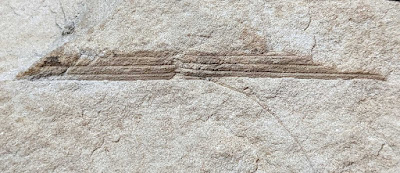
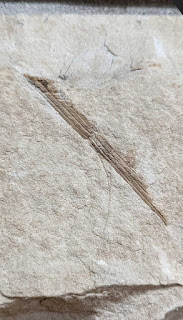
Tree Fossil in Sandstone?

While working in the lobby at work I noticed what appears to be a tree fossil imprint in a sandstone block. The building was built over 50 years ago and the lobby has its side walls surfaced with mortared sandstone blocks that are of varying sizes and are probably about 12 cm thick. The fossil is about 8 cm long and 1 cm wide.

The imprint reminds me of upper Carboniferous lycopodiophyte Sigillaria plant or could be part of a Calamites stem.

Learn more about fossil plants from this area at the Kentucky Geological Survey web site.

https://www.uky.edu/KGS/fossils/fossil-kinds-plants.php

 https://www.uky.edu/KGS/fossils/fossil-tree-stumps-types.php

Monday, October 21, 2013

Louisville in Motion Video


Louisville In Motion. A timelapse tour of Louisville Kentucky. from Eric Stemen on Vimeo.

If you were ever curious of places to visit around Louisville, this short video will give a quick Louisville geography lesson. This awesome timelapse series of images set to music was created by a local photographer Eric Stemen. He took tens of thousands of high definition images of landmarks around the Louisville area from February 2012 till September 2013.

Having taken pictures for years and dabbled a little with timelapse video, the imagery shown in this video is amazing and the product of 100s of hours of work. You can learn more about his work at the web site: http://oceanllama.com/

Oh yeah, how this ties to Louisville fossils is Eric's mom, Pam is a talented local fossil hunter. You can see some of her fossil finds in these posts: Hardin County Blastoid, Echinoid Spines, and Guam Micro Samples.

If you have trouble accessing Vimeo for the video, here is a YouTube link.