Showing posts with label rosso ammonitico formation. Show all posts

Wednesday, April 1, 2026

Red Ammonoid Fossil

I returned to St. Mary of the Annunciation Catholic Church located at East Eighth and Spring Streets, New Albany Indiana, USA. The fossil appears in the floor of the church alter area has strips of Red Verona or Rosso Verona marble in it. This rock dates to the Upper Jurassic Period of the Rosso Ammonitico Formation, Oxfordian Stage, Verona Province, Venetia Region of Italy.


In a previous post, I listed that the building was dedicated on December 12, 1858 primarily serving the German-speaking immigrants of the area. In the 1920s, renovations brought Carrara Italian marble to the alters, communion rail, sanctuary floor, baptismal font and wainscoting.  

 Sadly, my visit there was for the funeral of my Aunt Ruth Popp (1934-2026). May she rest in peace. 

Friday, June 13, 2025

Ammonite Fossil at St. Stephen's Cathedral


 St. Stephen's Cathedral is located in Vienna, Austria. In 1137 the first Romanesque church was built at the site. The second Romanesque church was built 1200-1225. In 1433 the South Tower was completed and the North Tower finished by 1578. 

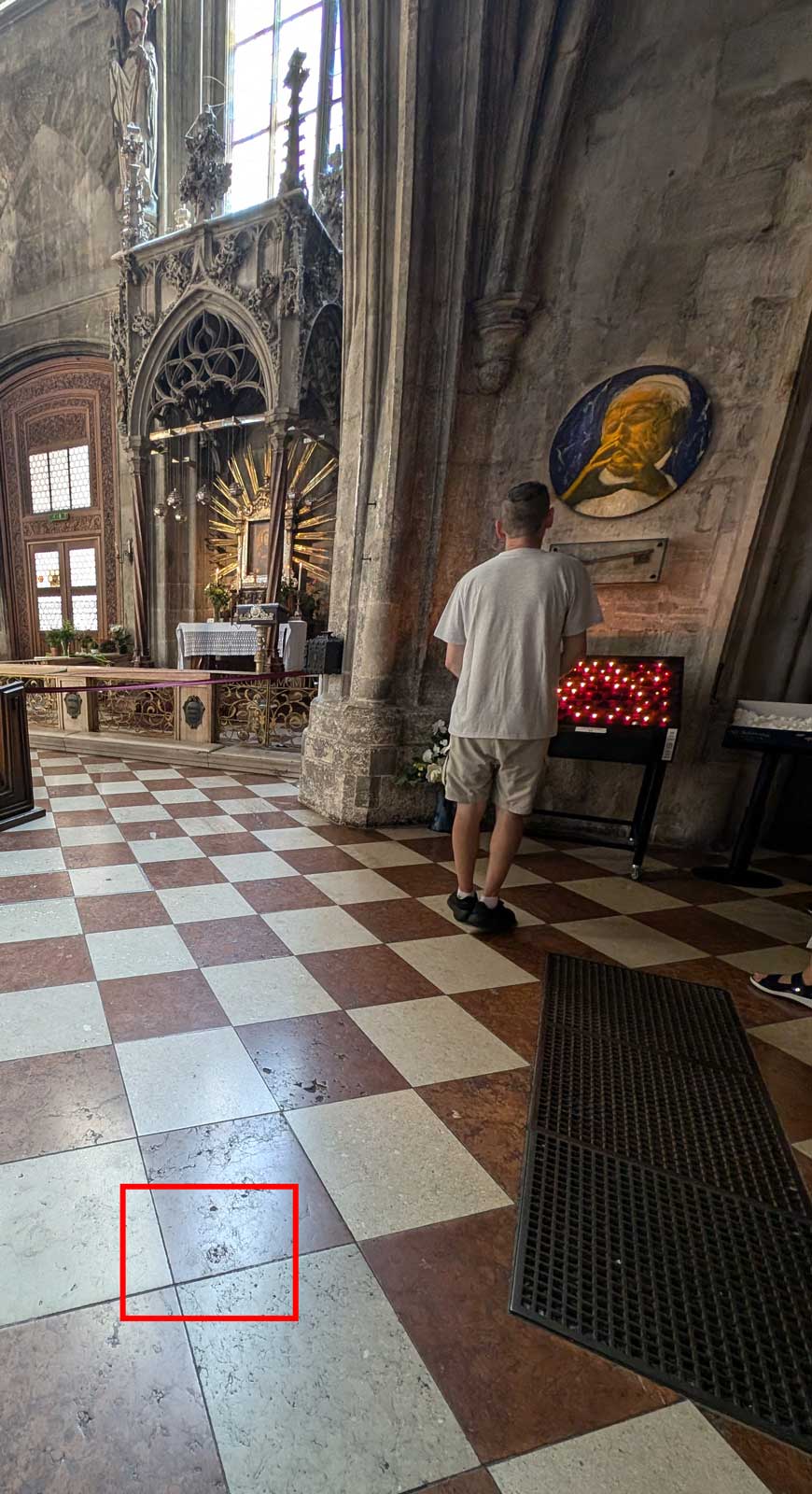
The floor has checkerboard pattern made up of red and white stone tiles. There is at least one red tile has an ammonite fossil in it. It appears to be about 7 cm wide. The images were taken in August 2024.

It appears in red floor tile of the church in back right corner. The limestone/marble tile could be Red Verona or Rosso Verona marble. This rock dates to the Upper Jurassic Period of the Rosso Ammonitico Formation, Oxfordian Stage, Verona Province, Venetia Region of Italy.


Sunday, September 15, 2024

Cephalopod Fossil at Basilica di Santa Croce

Here is a picture of a rare straight shelled cephalopod fossil found at Basilica di Santa Croce in Florence, Italy. I see a lot of coiled ammonoids in this material but not so many straight shelled cephalopods.

This building material is a iron enriched (red) limestone also known as Red Verona marble or Rosso Verona marble used in a lot of churches including this one. The material dates to the Upper Jurassic Period of the Rosso Ammonitico Formation, Oxfordian Stage, Verona Province, Venetia Region of Italy. Pictures taken August 2024.
 Look in the reddish square shapes in front of the tomb of Neri Corsini (1614-1678). Here is map.

Saturday, September 14, 2024

Ammonite Fossil at Basilica di Santa Croce


Here is a picture of an ammonoid fossil found at Basilica di Santa Croce in Florence, Italy. This building material is a iron enriched (red) limestone also known as Red Verona marble or Rosso Verona marble used in a lot of churches including this one. The material dates to the Upper Jurassic Period of the Rosso Ammonitico Formation, Oxfordian Stage, Verona Province, Venetia Region of Italy. Pictures taken August 2024.
 
Look in the reddish square shapes in front of the tomb of Neri Corsini (1614-1678). Here is map.


Sunday, September 1, 2024

Return To the Fossils of the Vatican


Last month, I returned to  St. Peter's Basilica in Vatican City near Rome, Italy. On September 3, 2019 I posted a blog entry about finding ammonite fossils in some of the floor slabs on a visit there. This building material is a iron enriched (red) limestone also known as Red Verona marble or Rosso Verona marble used in a lot of churches including this one. I now know to look for fossils when I see the reddish-pink stone in floors. The material dates to the Upper Jurassic Period of the Rosso Ammonitico Formation, Oxfordian Stage, Verona Province, Venetia Region of Italy.


On this visit, I investigated some of the slabs in more obscure locations like the corners along walls and found some very nicely preserved ammonoid fossils. It appears the stone mason might have intentional put some of these slabs with fossils there and they have held up well since people are not walking on that surface.


Saturday, August 24, 2024

Ammonite Fossils at Munich Residence Museum

When visiting old European cities, ammonites fossils can be found in certain types of limestone. I recently found a these red/white fossils in Germany at the Munich Residence (Residenz München). A number of the rooms contain a red polished limestone tile floors, studying this material one can find ammonoid fossils. This limestone reminds me of what I have seen in Italian churches that also have ammonoid fossils. These ammonoids could date to the Upper Jurassic Period of the Rosso Ammonitico Formation, Oxfordian Stage found in the Verona Province, Venetia Region of Italy. This iron enriched (red) limestone is also known as Red Verona Marble or Rosso Verona Marble. I am not sure if there is a source of this limestone in Austria or Germany or if it was imported from northern Italy. 

The limestone is used in floors in many of the rooms you are allowed to tour in the museum. I came across a lot of fossils and probably could have found more if not for a time constraint and the crowd of visitors touring the building.

The images on this post were found in the Octogon room which connects to the lavish 66 meter Antiquarium room commissioned by Duke Albrecht V from 1568 to 1571. This room seemed to have some of the best preserved and most fossils in its tiles. These pictures only represent some of the ammonites, I estimate I saw at least 10 in my short time looking. This building in bombed in 1944 during World War II and the original floors might have been destroyed. These images were taken in August 2024.


Friday, June 30, 2023

Fossil Ammonoids in New Albany Indiana


I was surprised to find Italian ammonoid fossils in New Albany Indiana USA. While visiting St. Mary of the Annunciation Catholic Church located at East Eighth and Spring Streets I spotted the red marble like limestone I had seen before in Italy and at the Boston Public library building. It appears that the floor of the church alter area has strips of Red Verona or Rosso Verona marble in it. This rock dates to the Upper Jurassic Period of the Rosso Ammonitico Formation, Oxfordian Stage, Verona Province, Venetia Region of Italy.

 
According to the church web site, the building was dedicated on December 12, 1858 primarily serving the German-speaking immigrants of the area. In the 1920s, renovations brought Carrara Italian marble to the alters, communion rail, sanctuary floor, baptismal font and wainscoting. 


As to why I was at the church, rest in peace Kenneth E. Popp (1932-2023).


You can read of my previous encounters with Red Verona marble at these postings:

https://louisvillefossils.blogspot.com/2019/09/ammonite-fossils-in-st-ignazio-church.html

https://louisvillefossils.blogspot.com/2019/09/fossils-at-st-peters-basilica-in-rome.html

https://louisvillefossils.blogspot.com/2022/08/red-ammonoid-fossils-at-central-boston.html

Tuesday, August 23, 2022

Red Belemnite Fossil at Boston Public Library's Abbey Room

 Yesterday I introduced the Boston's Central Public Library building (McKim) and the ammonoid fossils found there. Today I will introduce another type of fossil I have not seen in the red Verona marble before.

On the second floor of the McKim Building is the Abbey Room (originally the Book Delivery Room where books were picked up by patrons). The walls of the room have fifteen panels depicting Sir Galahad's Quest for the Holy Grail painted by Edwin Austin Abbey (1852-1911). He used Alfred, Lord  Tennyson's story Idylls of the King for the basis of these paintings. The checkerboard pattern of tiles on the floor are white Istrian limestone and red Verona marble (limestone aka Rosso Verona).

While looking at the flooring tiles I spotted the familiar shape of a belemnite (part of extinct squid-like cephalopod). This creature existed in the Upper Jurassic Period (Oxfordian Stage). Tile was probably quarried from the Rosso Ammonitico Formation of Verona Province of Venetia Region of Italy.


Monday, August 22, 2022

Red Ammonoid Fossils at Central Boston Public Library

The biggest surprise for me when I visited Boston last week was the Boston Public Library's McKim Building. It is an artistic and geological wonder. So many ammonite fossils embedded in the marble floor tiles. The complex is known as the Central Library in Copley Square of Boston, Massachusetts, USA. The City of Boston chartered their public library system in 1848. Decades later having outgrown previous locations they awarded a contract in 1887 to the firm of McKim, Mead, and White to build what is now known as the McKim Building. The cornerstone was placed in 1888 in which Oliver Wendell Holmes wrote in his dedication poem, "This palace is the people's own" (origin of it's later name "Palace of the People"). The building completed in 1895 at cost of 2.2 million dollars. Charles Follen McKim (1847-1909) was the chief architect for this building.


On the second floor of the McKim Building is the Abbey Room (originally the Book Delivery Room where books were picked up by patrons). The walls of the room have fifteen panels depicting Sir Galahad's Quest for the Holy Grail painted by Edwin Austin Abbey (1852-1911). He used Alfred, Lord  Tennyson's story Idylls of the King for the basis of these paintings. The checkerboard pattern of tiles on the floor are white Istrian limestone and red Verona marble (limestone aka Rosso Verona). Some of these reddish-pink tiles contain coiled ammonoids similar to what I found in Italy at Rome's St. Ignazio Church and Vatican City's St. Peter's Basilica.


Elwell, Newton W. "Delivery room." Photograph. Boston, Mass.: Geo. H. Polley & Co., 1896. Digital Commonwealth, https://ark.digitalcommonwealth.org/ark:/50959/6h440w43c (accessed August 21, 2022).  
 

It is amazing that these tiles have been in place for over 100 years. These ammonoids date to the Upper Jurassic Period of the Rosso Ammonitico Formation, Oxfordian Stage, Verona Province, Venetia Region of Italy.


Further reading:

https://quarriesandbeyond.org/states/ia/ia-structures.htm

https://www.digitalcommonwealth.org/search/commonwealth:ms35tx11f

https://slownomads.phoosh.net/fossil-hunting-in-verona/

 https://www.marmirossi.com/en/news/focus-materials/the-historical-bond-between-marble-and-verona

https://www.flickr.com/photos/jsjgeology/14802172801