Showing posts with label crab. Show all posts

Friday, December 29, 2023

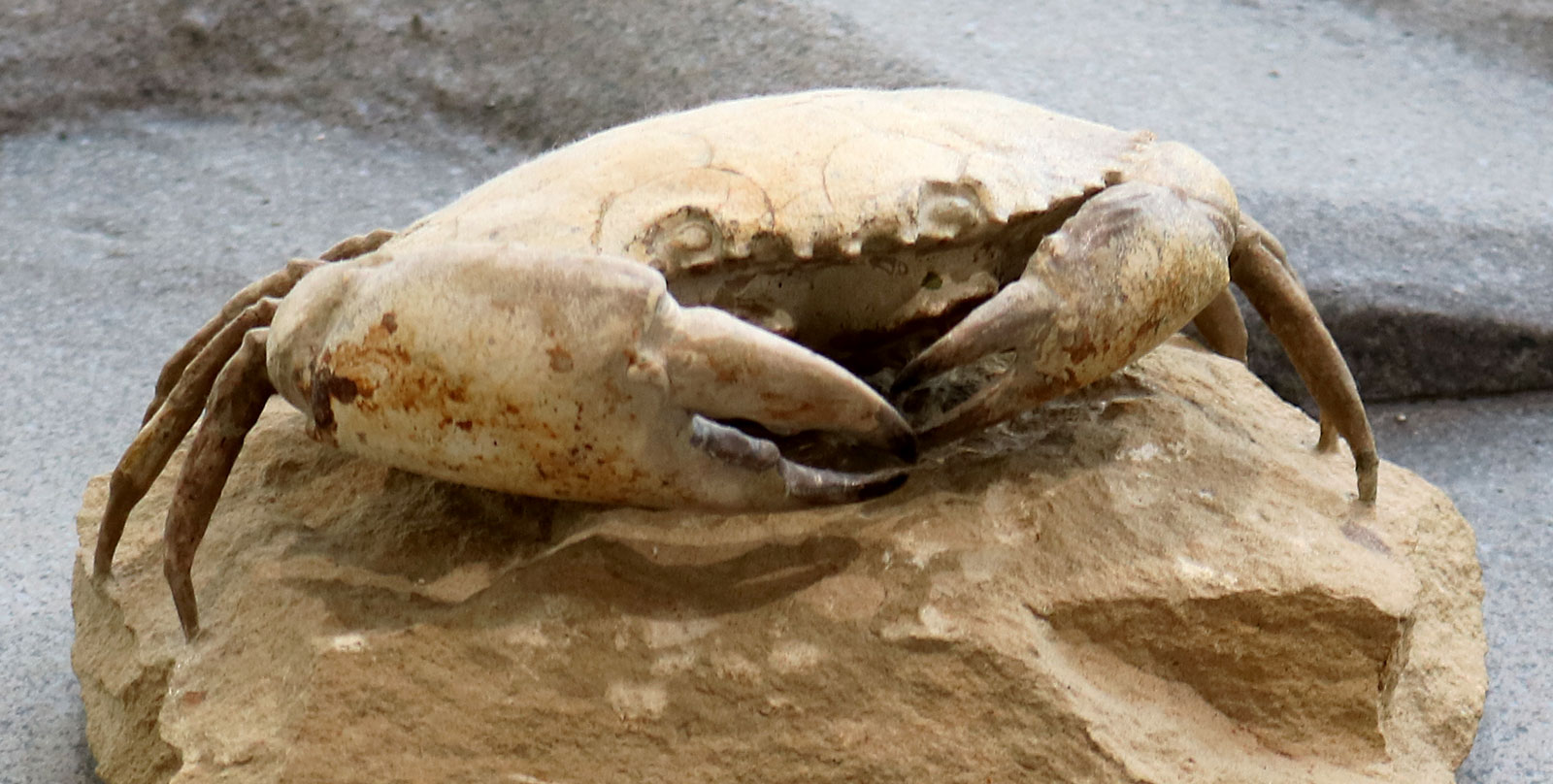
Avitelmessus grapsoideus Crab Fossil


This image is of a muffin crab fossil aka Avitelmessus grapsoideus (Rathbun, 1923) on display at Mace Brown Museum of Natural History (August 2017). It was found in North Carolina USA and dates to the Cretaceous Period (80 million years ago).

The Mace Brown Museum of Natural History is located at the College of Charleston, 202 Calhoun Street, 2nd Floor, Charleston, South Carolina 29424.

Learn more at their blog: http://blogs.cofc.edu/macebrownmuseum/

Friday, December 28, 2018

Zanthopsis dufouri coral crab fossil


This image is of a Zanthopsis dufouri crab fossil on display at Mace Brown Museum of Natural History (August 2017). It dates to the Eocene Epoch (about 50 million years ago), Paleogene Period. The fossil was found in Spain.

The Mace Brown Museum of Natural History is located at the College of Charleston, 202 Calhoun Street, 2nd Floor, Charleston, South Carolina 29424.

Learn more at their blog: http://blogs.cofc.edu/macebrownmuseum/

Thursday, December 27, 2018

Zanthopsis vulgarsis Coral Crab Fossil


This image is of a Zanthopsis vulgarsis coral crab fossil on display at Mace Brown Museum of Natural History (August 2017). It dates to the Eocene Epoch (about 50 million years ago), Paleogene Period. The fossil was found in Spain.

The Mace Brown Museum of Natural History is located at the College of Charleston, 202 Calhoun Street, 2nd Floor, Charleston, South Carolina 29424.

Learn more at their blog: http://blogs.cofc.edu/macebrownmuseum/

Wednesday, December 26, 2018

Harpactoxanthopsis quadrilobata Crab Fossil


This image is of a Harpactoxanthopsis quadrilobata crab fossil on display at Mace Brown Museum of Natural History (August 2017). It dates to the Eocene Epoch (about 50 million years ago), Paleogene Period. The fossil was found in Monte Baldo, Italy.

The Mace Brown Museum of Natural History is located at the College of Charleston, 202 Calhoun Street, 2nd Floor, Charleston, South Carolina 29424.

Learn more at their blog: http://blogs.cofc.edu/macebrownmuseum/

Monday, December 24, 2018

Lophoranina marestiana Coral Crab Fossil


This image is of a Lophoranina marestiana coral crab fossil on display at Mace Brown Museum of Natural History (August 2017). It dates to the Eocene Epoch (about 50 million years ago), Paleogene Period. The fossil was found in Vicenza, Italy.

The Mace Brown Museum of Natural History is located at the College of Charleston, 202 Calhoun Street, 2nd Floor, Charleston, South Carolina 29424.

Learn more at their blog: http://blogs.cofc.edu/macebrownmuseum/

Monday, July 30, 2018

Fossils at Obelisk in Central Park


If you visit New York City's famed Central Park, consider stopping by the Egyptian obelisk located behind the Metropolitan Museum of Art. The white limestone base the granite obelisk rests on contains a lot of visible fossils. The obelisk (known as Cleopatra's Needle) were created to celebrate the 30 year reign of pharaoh Thutmosis III (1479-1425 B.C).


Their original location was at the Temple of the Sun in Heliopolis, Egypt. They were constructed from pink granite at the quarries in Aswan. Roman Emperor Augustus had them moved to the temple Caesarium around 12 B.C.

The Khedive Ismail Pasha of Egypt exchanged this obelisk for economic aid from the City of New York, United States in 1881. Earlier, it's twin obelisk was transferred to London, England in 1878.


The Romans added an Egyptian limestone base and steps plus 4 bronze crabs to stabilize the obelisk on its new base. Only two of the crabs partially survived when the obelisk was being made ready for transfer to the United States. Once it arrived, Brooklyn Navy Yard workers forged four new 418 kg metal crabs in about 10 days. Molten lead was used to secure the crabs to the obelisk thus re-enforcing the broken corners. The claws are inscribed in English telling of who replaced them.


The remains of the two original Roman bronze crabs are on display at the Metropolitan Museum of Art in the Temple of Dendur exhibit. It looks like they were mostly plundered for their metal or as souvenirs by long ago visitors. The claw has a Greek inscription on the outside stating Roman prefect Barbarus and architect Pontius erected the obelisk in the 18th year of an emperor (Augustus?). The original metal crabs were donated by Lt. Commander Henry H. Gorringe who transferred the obelisk to New York in 1880-1881.


When I first encountered the base I was not sure what type of fossils it was covered with at first I thought they might be pelecypods or brachiopods. Now I am convinced they are foraminiferan Nummulites fossils.

The fossils are somewhat worn, but the picture on the right with two orange arrows showing two Nummulites with their tops or bottoms cross sectioned.

The base and steps appear to be composed of an Eocene limestone from Egypt. This type of limestone was used to construct ancient Egyptian structures so they contain these fossils as well. Learn more at Wikipedia.


Most of the fossils I saw appeared to be Nummulites stacked on top of one another but picture on the left looks like a gastropod or ammonite whorl.


The picture on the right has an orange arrow pointing to what appears to be a fossil with some sort of spines. It might be a spiny brachiopod or some sort of echinoid.


So if you get a chance to visit New York City's Central Park, allot some time and visit the oldest man-made object in the park.


Learn more about this obelisk and its connection to New York City at Google Books site for The New York Obelisk or How Cleopatra's Needle Came to New York and What Happened When It Got Here by Martina D'Alton from The Metropolitan Museum of Art Bulletin (Spring 1993).

Sunday, August 27, 2017

Coeloma Crab Fossil from Russia


This image is of Coeloma taunicum crab fossils on display at Mace Brown Museum of Natural History (August 2017). They date to the Oligocene Epoch (about 25 million years ago), Paleogene Period. The fossil was found in Kazakhstan, Russia.

The Mace Brown Museum of Natural History is located at the College of Charleston, 202 Calhoun Street, 2nd Floor, Charleston, South Carolina 29424.

Learn more at their blog: http://blogs.cofc.edu/macebrownmuseum/

Saturday, August 26, 2017

Macropipus Crab Fossil - Italy


This image is of a Macropipus tuberculatus swimming crab fossil on display at Mace Brown Museum of Natural History (August 2017). It dates to the Miocene Epoch (about 10 million years ago), Neogene Period. The fossil was found in Sardinia, Italy.

The Mace Brown Museum of Natural History is located at the College of Charleston, 202 Calhoun Street, 2nd Floor, Charleston, South Carolina 29424.

Learn more at their blog: http://blogs.cofc.edu/macebrownmuseum/

Wednesday, December 23, 2015

Cancer sp. Crab Fossil


Here is a picture of a Cancer sp. crab fossil at the Museo di Paleontologia at Sapienza University of Rome Italy. Creatures like this existed in the Pliocene Epoch of the Neogene Period.


Image taken in June 2014.

Tuesday, December 22, 2015

Palaeocarpillus Crab Fossil


Here is a picture of a Palaeocarpillus sp. crab fossil at the Museo di Paleontologia at Sapienza University of Rome Italy. Creatures like this existed in the Eocene Epoch of Paleogene Period.

Image taken in June 2014.

Wednesday, September 3, 2014

Granchio indeterminato Crab Fossil


Here is a picture of a Granchio indeterminato crab fossil at the Museo di Paleontologia at Sapienza University of Rome Italy. Creatures like this existed in the Miocene Epoch of Neogene Period. Fossil was found in Argentina.

Image taken in June 2014.


Monday, January 21, 2013

Dakoticancer Crab Fossils

This fossil appears to be a Dakoticancer crab fossil found in the Coon Creek Formation of Mississippi or Tennessee, USA. The animals lived in the Cretaceous Period along with mosasaurs and plesiosaurs. Thanks to Mary Ann for finding these fossils and to Kenny who is prepping the fossils. There are 3 different specimens shown in the following pictures.