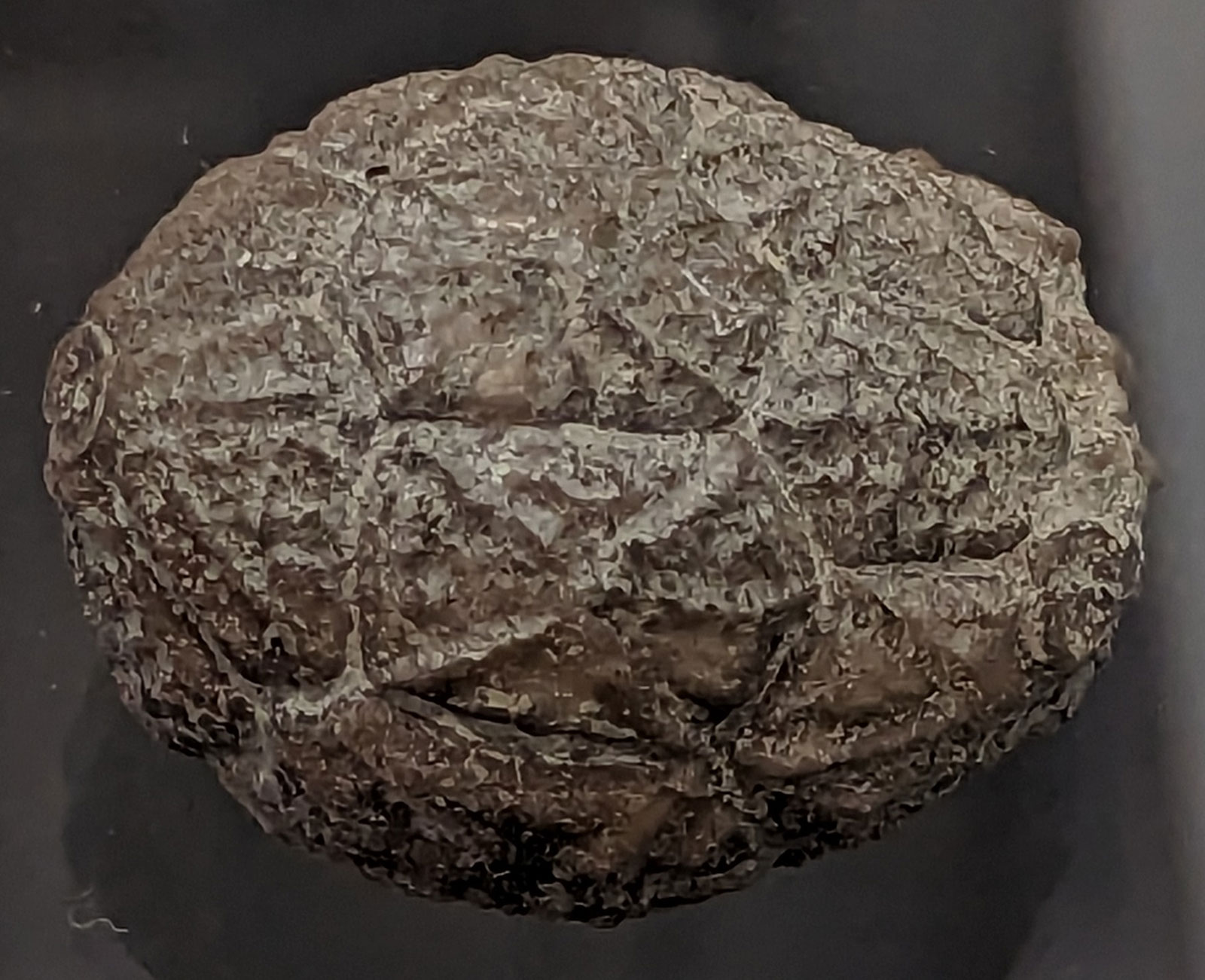
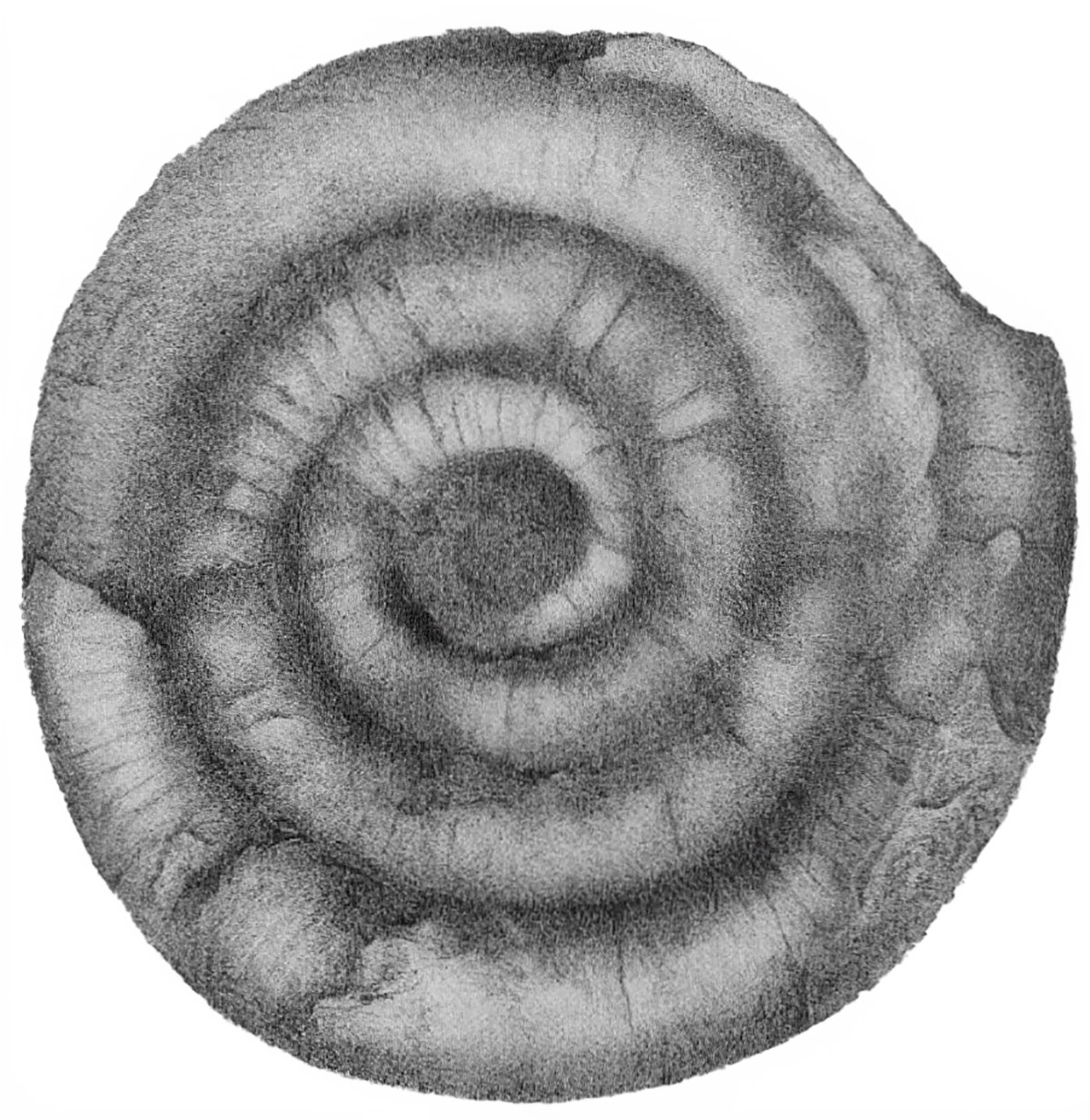
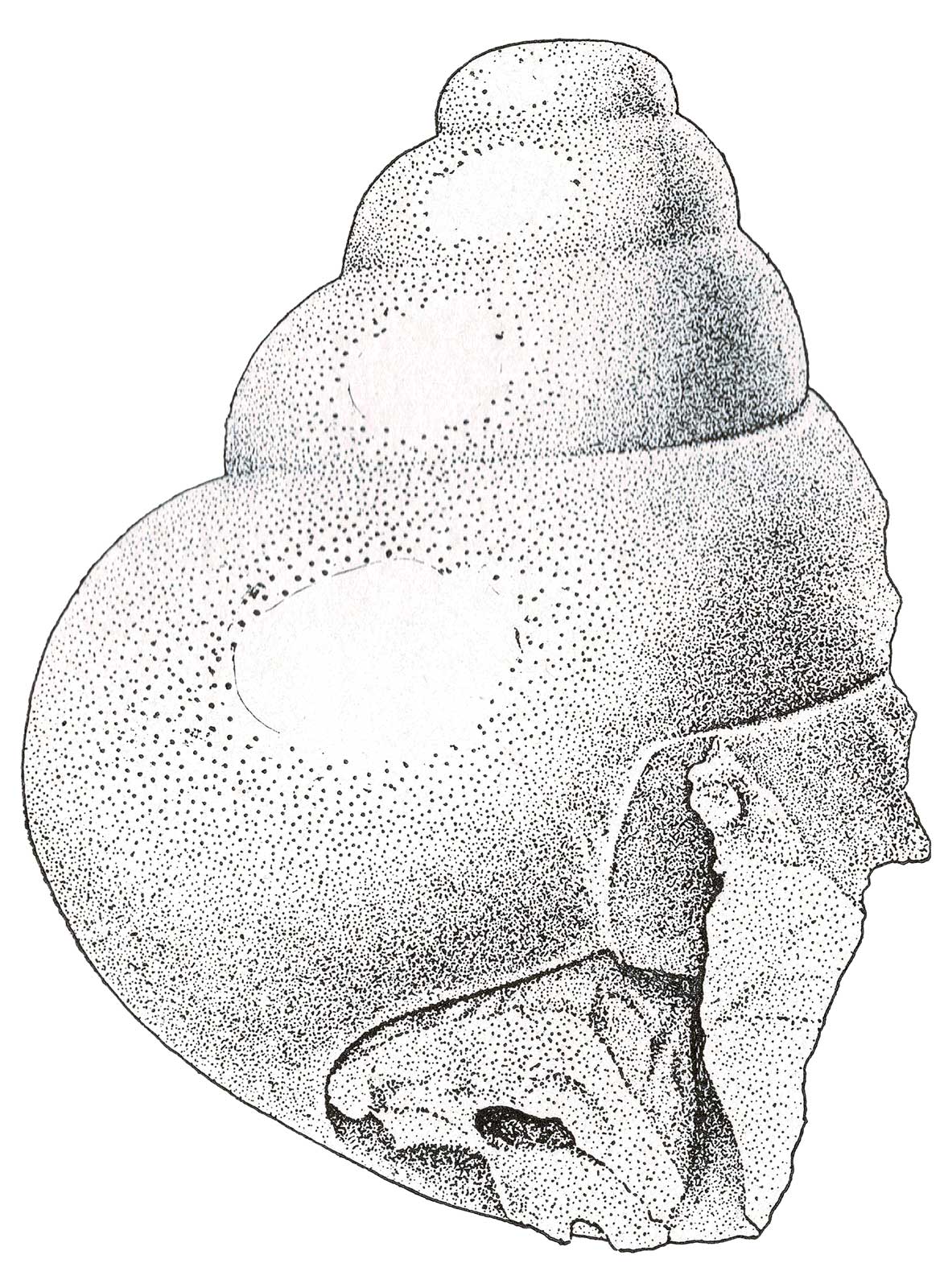
This fossil was drawn by Elvira Wood and was published in Guide to the Geology and Paleontology of Niagara Falls and Vicinity by Amadeus W. Grabau (1901) on page 217 figure 149. It was identified as Trochoceras gebhardi (Hall, 1852). It is described as being found in the Manlius limestone of North Buffalo and Williamsville in New York. The species was originally described from the Coralline limestone (Niagara) of Schoharie County, New York USA. Fossil dates to the Silurian Period.
I am curious as to why this is classified as a cephalopod and not a gastropod. It's shell look more like that of a snail.
A contemporary of Dr. Wood and Dr. Grabau named Ruth Raeder Mook published a paper A New Cephalopod from the Silurian of Pennsylvania in 1915. In it she wrote "The name proposed by Hall was printed in the second volume of the Paleontology of New York in 1850, although the volume was not issued until 1852.* Hall's genotype was Trochoceras gebhardi. His original description of the genus follows:
'' Turbinate or trochiform ; spire elevated, more or less ventricose, umbilicated; aperture rounded or round oval; volutions above the other one septate; siphuncle submarginal or dorsal.
"In the specimen from which the generic description is principally made, the septa are strongly arched from the inner basal angle of the volution to the outer one, advancing on the outer angle towards the aperture." In the above description owing to a confusion of terms the siphuncle is recorded as submarginal or dorsal, whereas in present day usage it would be recorded as submarginal or ventral.
In 1894 Hyatt pointed out that Hall's species are quite distinct from Barrande's, and that they do not belong to any genus yet described from Bohemia. Trochoceras Barrande is not generically identical with Trochoceras Hall. Hyatt suggested that the name Trochoceras Barrande be retained and for Hall's forms Trochoceras gebhardi and turbinatum he proposed the new name Mitroceras with Mitroceras (Troch.) gebhardi as the genotype. Mitroceras Hyatt differs from Trochoceras Barrande in the high turbinate spire, and in the deep and sharply angulate umbilicus."
Her paper written while she was at the paleontological laboratory of Columbia University. Dr. Grabau was a professor there and in the early 1900s Dr. Wood got her advanced degrees at that university.