Sunday, April 22, 2012
Red Hill Fossils
Here are some images of fossils found in material from Red Hill Pennsylvania. This Devonian (Famennian stage) matrix contains fish parts among other things. It might be part of the Catskill Formation.
Thanks to Dave for the material. See his blog for more info: viewsofthemahantango.blogspot.com/2012/04/hyneria-scale-from-red-hill.html
viewsofthemahantango.blogspot.com/2012/04/osteolepid-fish-scale-from-red-hill.html
Labels:
devonian,
pennsylvania
Saturday, April 21, 2012
Hederella Bryozoan
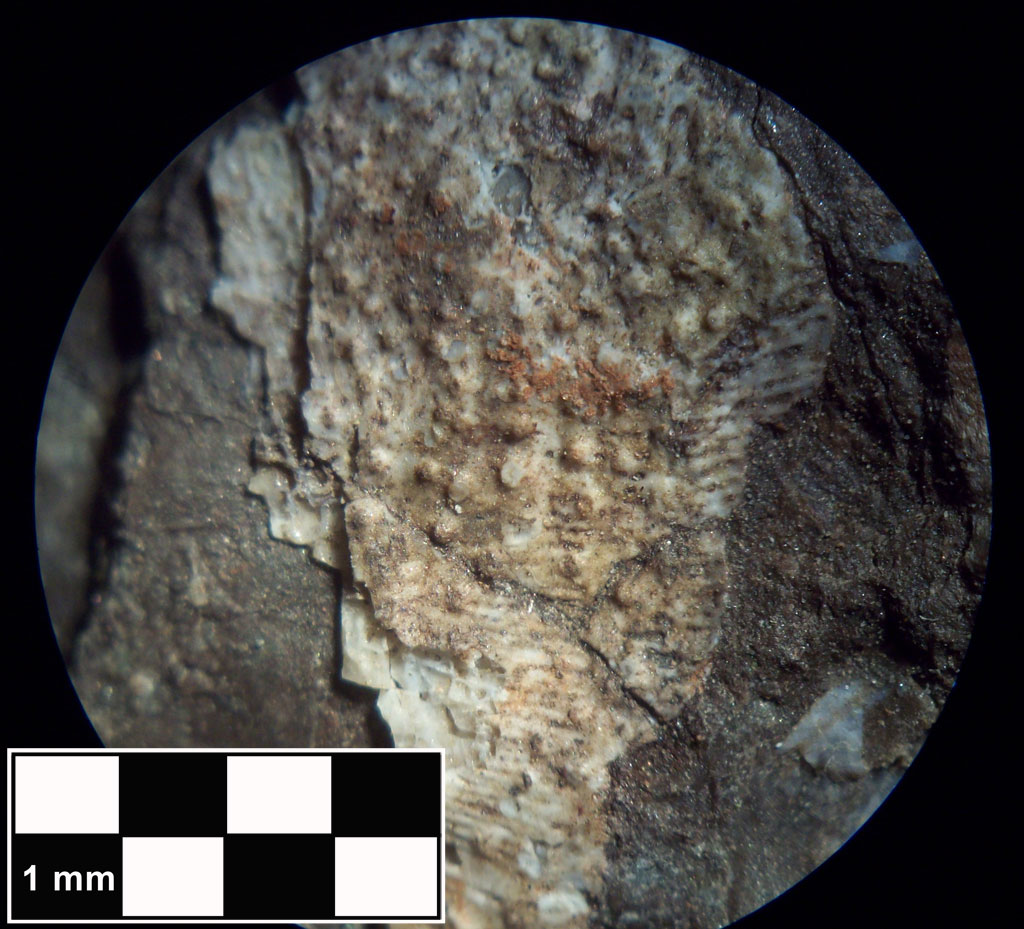
These pictures were taken using a microscope and are of bryozoan growing on crinoid stems. Fossils are from the Mississippian Period. They were found in the Glen Dean formation of Grayson County, Kentucky.
The byrozoan appears to be a Hederella sp. I believe these were named by Ray S. Bassler in a paper entitled The Hederelloidea a suborder of Paleozoic cyclostomatous Bryozoa (1939, Smithsonian Institution). He defined the genus as:
Zoarium attached to various foreign organic objects and rarely to pebbles or other inorganic substances, branching, consisting of a tubular axis composed of the earlier part of successive zooecia from which the zooecia bud laterally, alternately to right and left; tubes annulated transversely but finely striated longitudinally; apertures terminal, transversely-elliptical.
Labels:
bryozoan,
Kentucky,
mississippian
Thursday, April 19, 2012
Science on the Edge: Radical Innovation in New Harmony
The Indiana State Museum (Indianapolis) is hosting a temporary exhibit entitled Science on the Edge: Radical Innovation in New Harmony from March 24 through October 28, 2012. The exhibit will highlight the scientists who participated in the grand Utopian experiment at New Harmony, Indiana in the mid-1820s till the 1830s. Learn more at their web site.
My interest in this exhibit is of a more direct nature, as I was the one who prepared the mineral specimen loan to the Indiana State Museum from the Louisville Science Center from the historic Gerard Troost mineral collection (1811-1850). Dr. Troost was a scientist who with his family lived in New Harmony, Indiana in 1825-1826. He and the French naturalist Charles-Alexandre Lesueur left from New Harmony in 1826 and explored parts of southern Illinois and eastern Missouri. This trip provided a number of mineral specimens like fluorite from Illinois and galena (lead) from Missouri.
New Harmony attracted scientists like William Maclure, Thomas Say, and Robert Owen whose sons later became well known geologists. The mineral pictures in this posting are a yellow fluorite from Europe, troostite (var. Willemite) from Franklin, New Jersey, and a malachite/azurite specimen.
Labels:
gerard troost,
indiana state museum,
minerals
Subscribe to:
Posts (Atom)