

Showing posts with label lexington limestone. Show all posts
Showing posts with label lexington limestone. Show all posts
Thursday, December 28, 2023
Modiolopsis Pelecypod Fossil


Tuesday, December 26, 2023
Pseudolingula Brachiopod Fossil

Monday, December 25, 2023
Modiolodon Pelecypod Fossil

This pelecypod fossil appears to be a Modiolodon (Ulrich, 1894) from the Ordovician Period. It was found in the Logana Member of the Lexington Limestone for Franklin County, Kentucky, USA. Thanks to Kenny for the picture.
Saturday, July 8, 2017
Isotelus gigas Trilobite Fossil

Below is picture of what looked like before he started.


Wednesday, May 3, 2017
Tentaculites richmonensis Fossils

Here is an image of a nice plate of fossils found in the Lexington Limestone of Franklin County, Kentucky USA. There are at least 8 Tentaculites richmonensis shown in the image around that brown object which is an Isotelus trilobites hypostome (feeding scoop). Also in the images are brachiopods and bryozoans. Fossils date to the Ordovician Period.
Thanks to Kenny for image.
Tuesday, May 2, 2017
Unidentified Crinoid Pinnules Fossil

Thanks to Kenny for images.

Monday, September 10, 2012
Let Me Play Among the Constellaria...

The next image is of a magnified star shape. It is nice in you can see the individual pores (zooecia). The Cincinnati Fossils book edited by R.A. Davis (Cincinnati Museum Center,1998) lists two species of this bryozoan that are found: Constellaria florida and C. polystomella.

My blog title refers to the Frank Sinatra song Fly Me to the Moon "and let me play among the stars".


Sunday, August 12, 2012
Fluorite? in the Lexington Limestone

I make no claims as to being a mineral expert but I believe these specimens are fluorite mixed with calcite or some other mineral (dolomite?). They were found with Cyclonema sp. snail fossils in Franklin County, Kentucky. The layer should be the Lexington Limestone of the Ordovician Period.
The majority of the fluorite is yellow but one has a small section of purple. I find it unique as typically think of the fluorite areas of the state of Kentucky to the western part near southern Illinois.
Mindat.org lists fluorite, calcite, and dolomite as all being found in Franklin County, Kentucky.

Friday, August 10, 2012
Carbonaceous Filmed Pelecypod Fossil

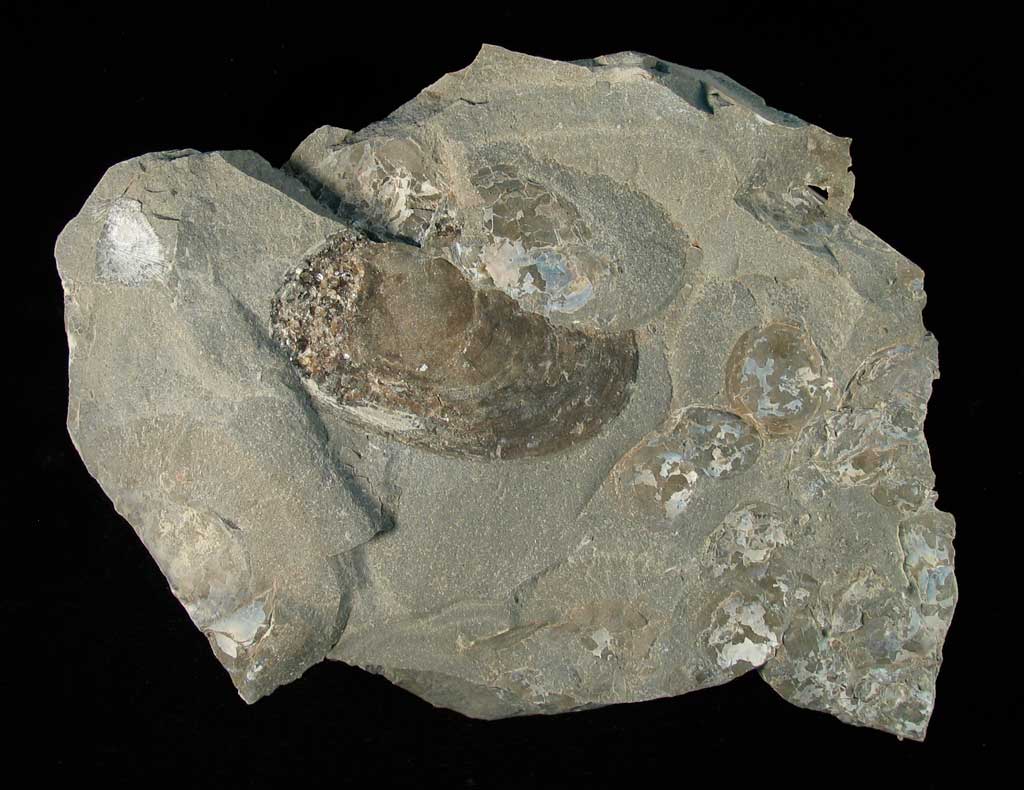
This interesting fossil is some sort of clam preserved by carbonaceous film. It was found in the Lexington Limestone of Franklin County, Kentucky. The name might be a Psiloconcha sp. If you look at the picture of the matrix plate, it was fossilized in place with a number of other sea creatures. In addition, a brachiopod imprint appears in the matrix as well. Also the clam might have some calcite crystals at one end of it.
Thanks to Lawrence for these fossils.


Thursday, October 7, 2010
Unidentified Ordovician Brachiopod (UOB)

Unidentified brachiopod found in the Lexington Limestone of Franklin County, Kentucky. Fossil is from the Ordovician Period. Maybe this is a flattened Glyptorthis? See a visual list of Ordovician Period brachiopods at the Dry Dredgers web site.


Wednesday, October 6, 2010
Zygospira Brachiopod

See more specimens on the Dry Dredgers web site.


Monday, March 22, 2010
Isotelus Trilobite Hypostoma
The Isotelus trilobite's feeding scoop (hypostoma) fossil found in the Lexington limestone of Franklin County, Kentucky. This trilobite existed in the Ordovician Period.
These fossils were part of a larger rock plates but using a diamond saw blade attached to a water cooler it downsized the pieces.


These fossils were part of a larger rock plates but using a diamond saw blade attached to a water cooler it downsized the pieces.


Thursday, March 11, 2010
Constellaria Bryozoan Kentucky

This bryozoan fossil has to be a favorite to find because of its star like patterns. It is called Constellaria and is found in the Lexington Limestone of Franklin County, Kentucky. Ordovician Period was the time in which this creature lived. This piece is about 5 cm long and is the largest I have found so far.


Tuesday, March 9, 2010
Stylophoran Enoploura (Carpoid) Fossil
Over the weekend the weather was very nice for March. So I visited a Lexington Limestone site with two friends and collected Ordovician Period fossils. Here is one of my rare finds of a fossil plate of a carpoid called Enoploura. Fossil found in Franklin County, Kentucky.

Also view this November 22, 2009 blog entry of a larger section of Enoploura found.

Also view this November 22, 2009 blog entry of a larger section of Enoploura found.
Tuesday, February 9, 2010
Lexington Limestone Microfossils
These microfossils were found in the Lexington Limestone of Franklin County, Kentucky. They existed in the Ordovician Period. This first fossil is a snail or gastropod. It appears to be composed of some sort of black material. All fossils are about 1 mm in length. A microscope was used to magnify 40x.

I tried something new to help produce an in focused image of these 3-D fossils when using a microscope. The idea was to take a series of images with the microscope of one part of the fossil in focus. After taking a series of 4-6 images, put them in a program like Registax to stack the in focus parts together. Well, the plan hit some snags due to my process. First, I was using a handheld camera so the fossil was in slightly different place in each file. The fossil was too big for target box to follow in Registax. The program was designed to be used with astronomy images taken with the telescope so a 16x16 or 64x64 pixel area can be tracked when it is planet or crater size in the image. Needless to say the stacked image was some what blurry.
I then tried using Photoshop to align and stack the images. The program was geared to work with larger images. The microfossils images were cropped to about 700x700 pixels and were aligned. I then realized that even though the microscope had been set to focus on a different area of the 3-D fossil the camera I was using seemed to being focusing on the same area of the fossil each time. So all my images pretty much look the same thus rendering the stacking ineffective! I will try this experiment again at a later date and with a fixed mounted microscope camera.
This fossil might be a crinoid stem fragment.


I tried something new to help produce an in focused image of these 3-D fossils when using a microscope. The idea was to take a series of images with the microscope of one part of the fossil in focus. After taking a series of 4-6 images, put them in a program like Registax to stack the in focus parts together. Well, the plan hit some snags due to my process. First, I was using a handheld camera so the fossil was in slightly different place in each file. The fossil was too big for target box to follow in Registax. The program was designed to be used with astronomy images taken with the telescope so a 16x16 or 64x64 pixel area can be tracked when it is planet or crater size in the image. Needless to say the stacked image was some what blurry.
I then tried using Photoshop to align and stack the images. The program was geared to work with larger images. The microfossils images were cropped to about 700x700 pixels and were aligned. I then realized that even though the microscope had been set to focus on a different area of the 3-D fossil the camera I was using seemed to being focusing on the same area of the fossil each time. So all my images pretty much look the same thus rendering the stacking ineffective! I will try this experiment again at a later date and with a fixed mounted microscope camera.
This fossil might be a crinoid stem fragment.

Thanks to an identification by blog visitor Solius. This is a "Hyolithos; an enigmatic creature that some propose are mollusks."

Monday, February 8, 2010
Microfossil Crinoid Spines?
These microfossils were found in the Lexington Limestone in Franklin County, Kentucky. They appear to be some sort of spines maybe belonging to a crinoid. Magnification was set to 40x. Fossils are from the Ordovician Period.


Subscribe to:
Posts (Atom)